


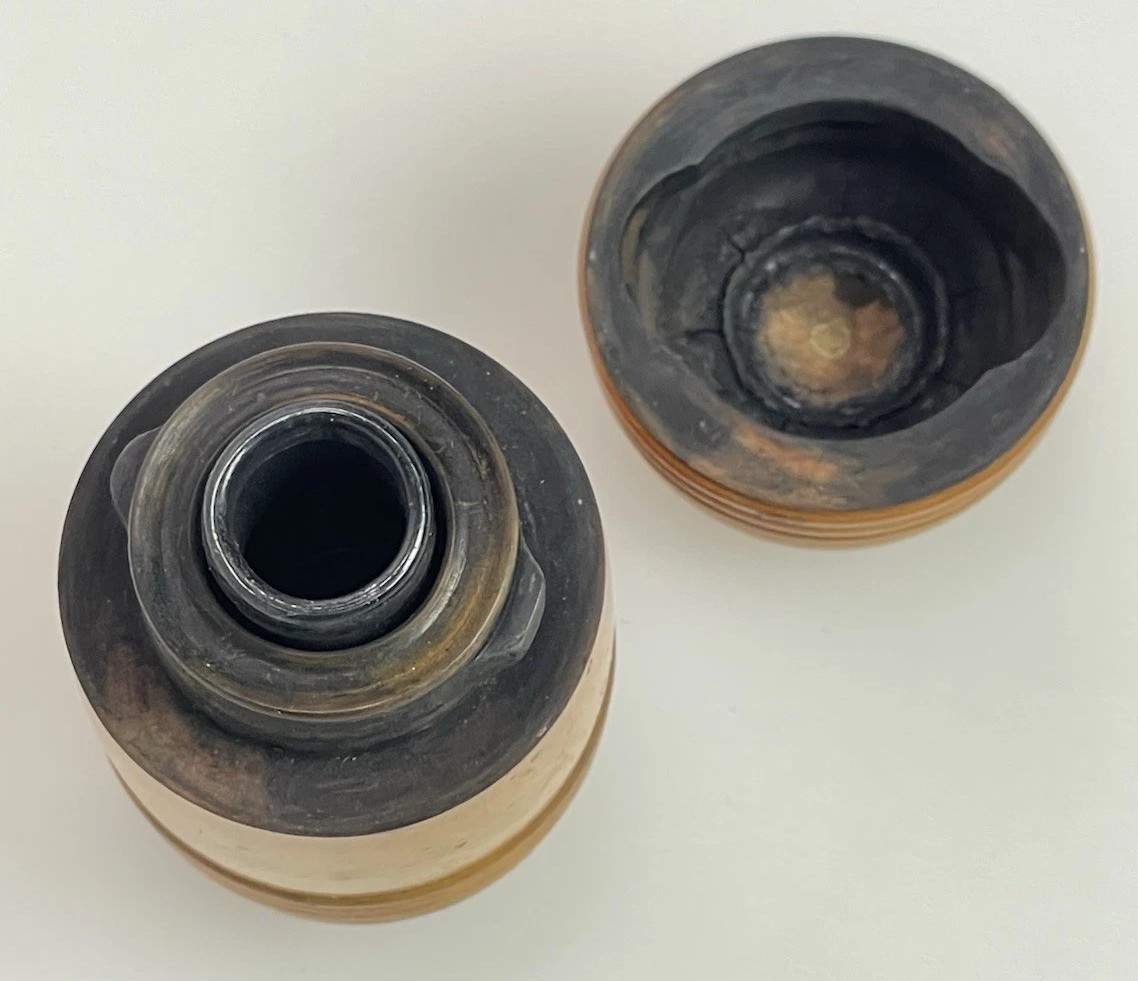


S. Silliman Barrel Traveling Inkwell
| Categories | Travel |
| Material | Wood |
| Markings | Unmarked |
| Manufacturer | Silliman & Co |
| Origin | United States |
| Date or Era | circa 1860 |
This is a nice example of mid-19th-century American “treen” (small domestic functional objects made of wood).
Description: The S. Silliman Barrel Inkwell
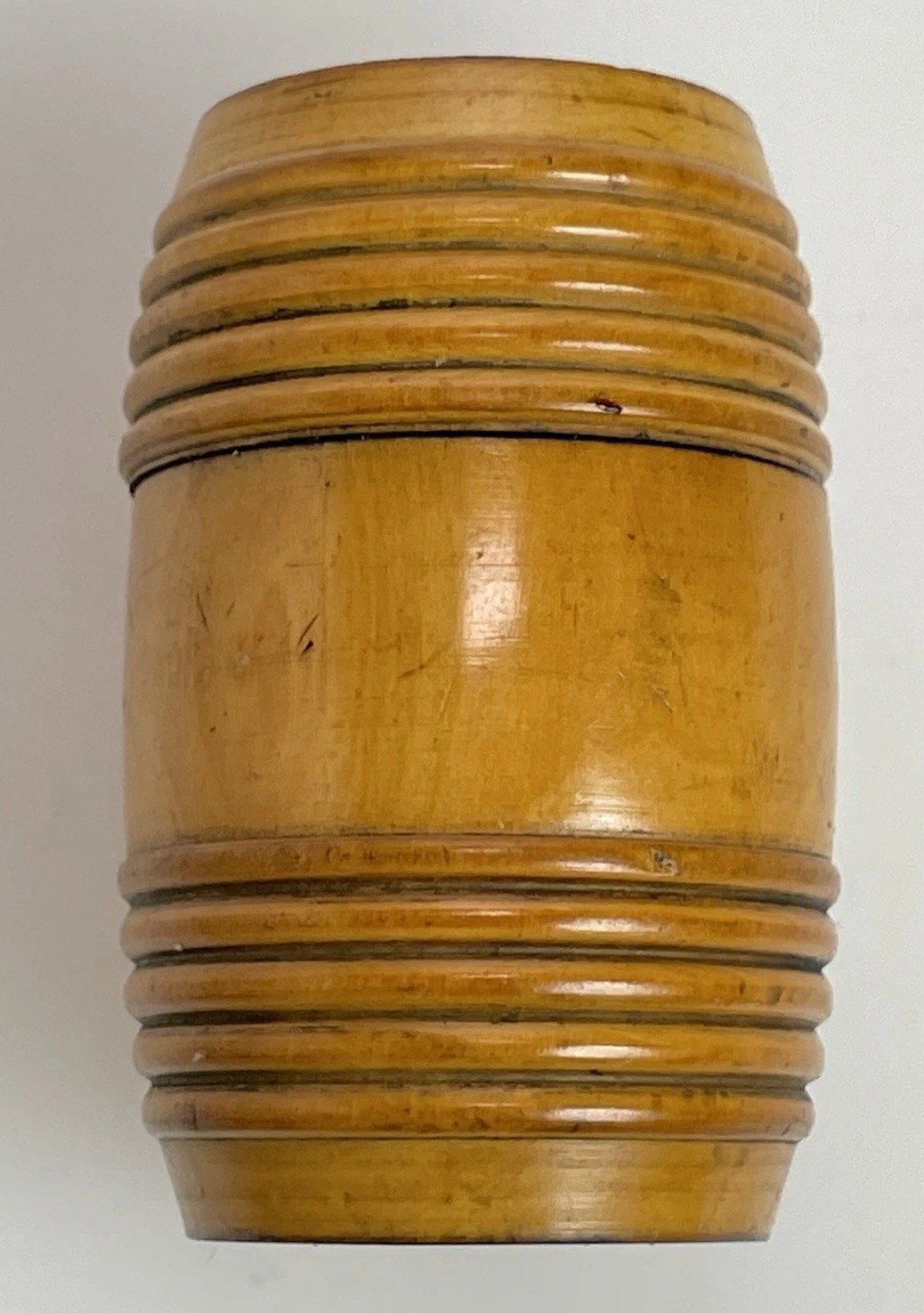
This traveling inkwell is designed to resemble a miniature wooden barrel, complete with “hoops” (the concentric ribbed lines) turned into the wood to provide both a realistic aesthetic and a tactile grip.
- Form: A two-part cylindrical barrel with a slightly tapered top and bottom.
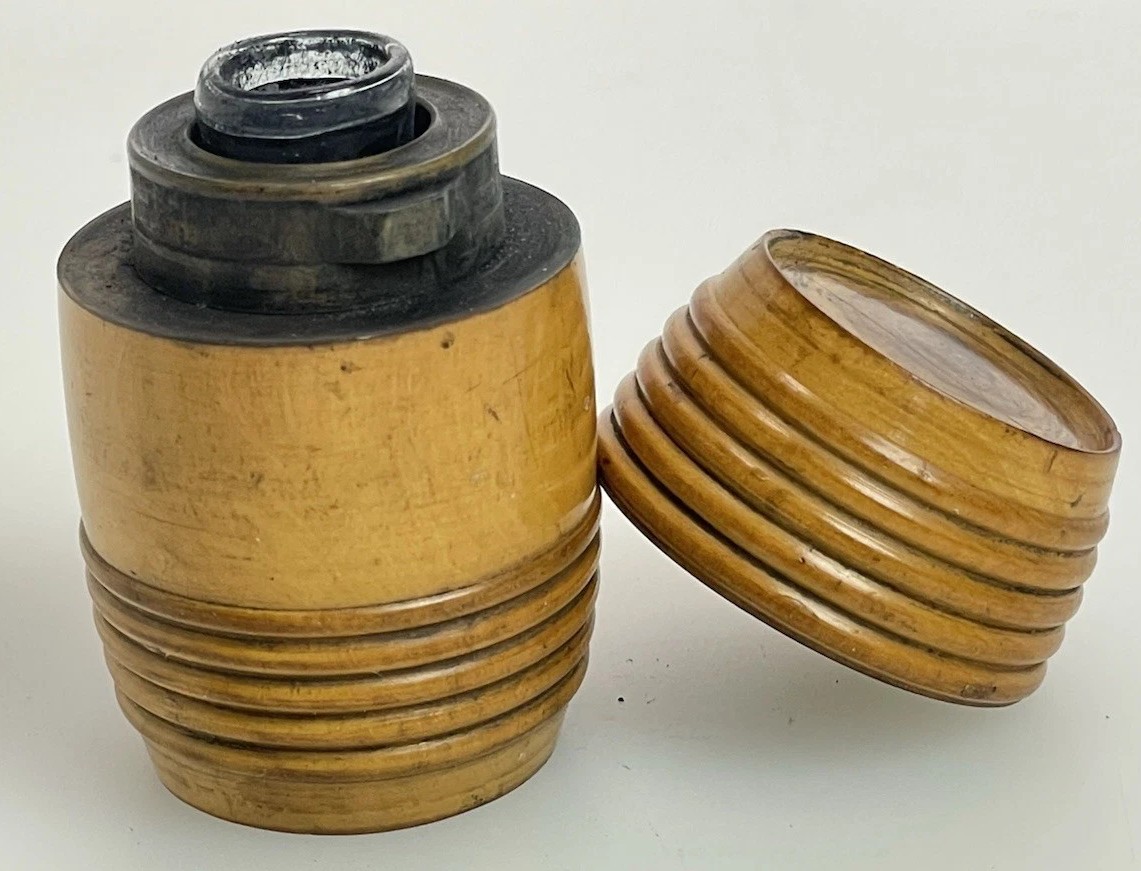
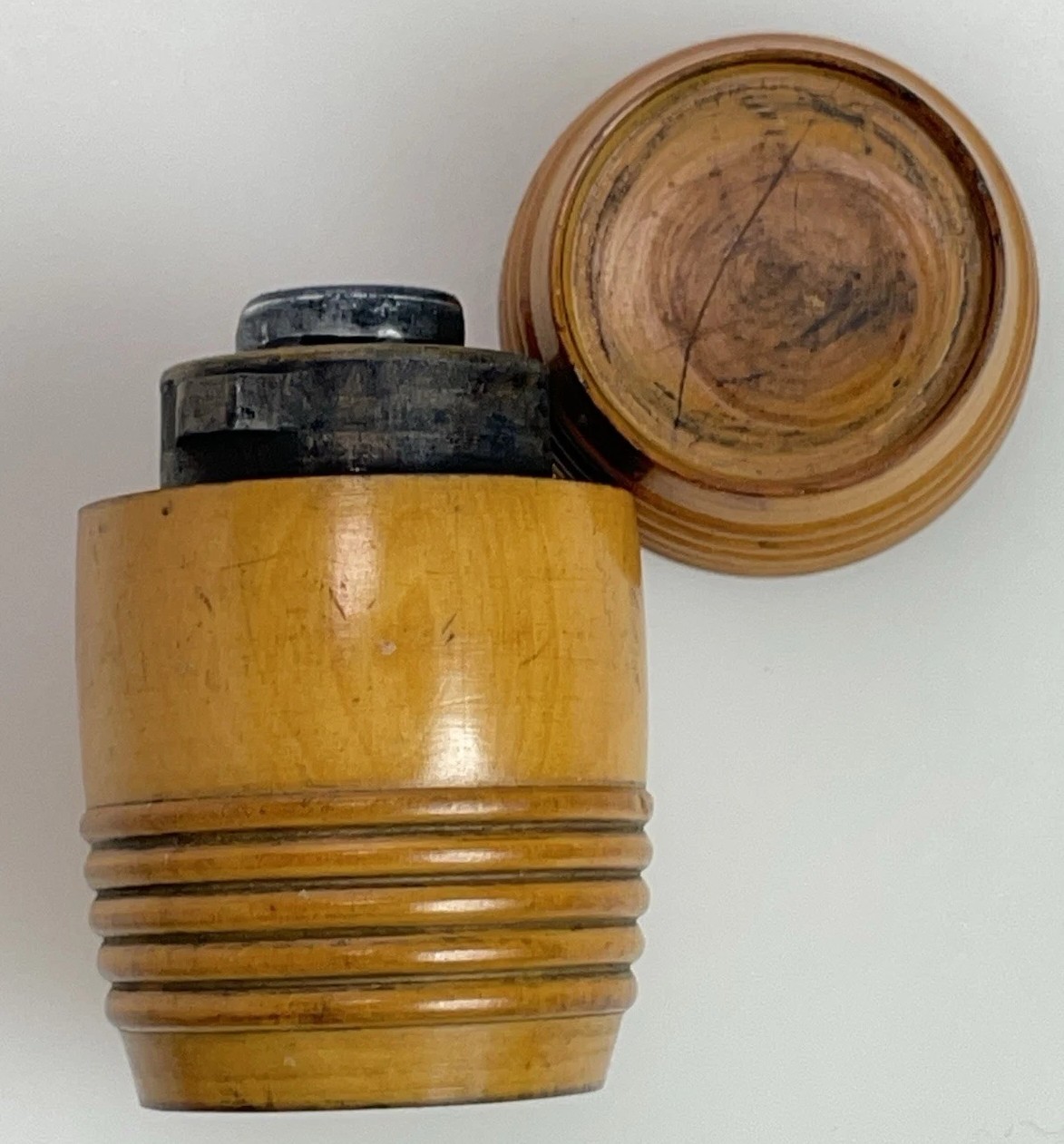
- Mechanism: It features a bayonet catch (explained below), allowing the top to be secured or removed with a simple quarter-turn rather than multiple rotations of a screw thread.
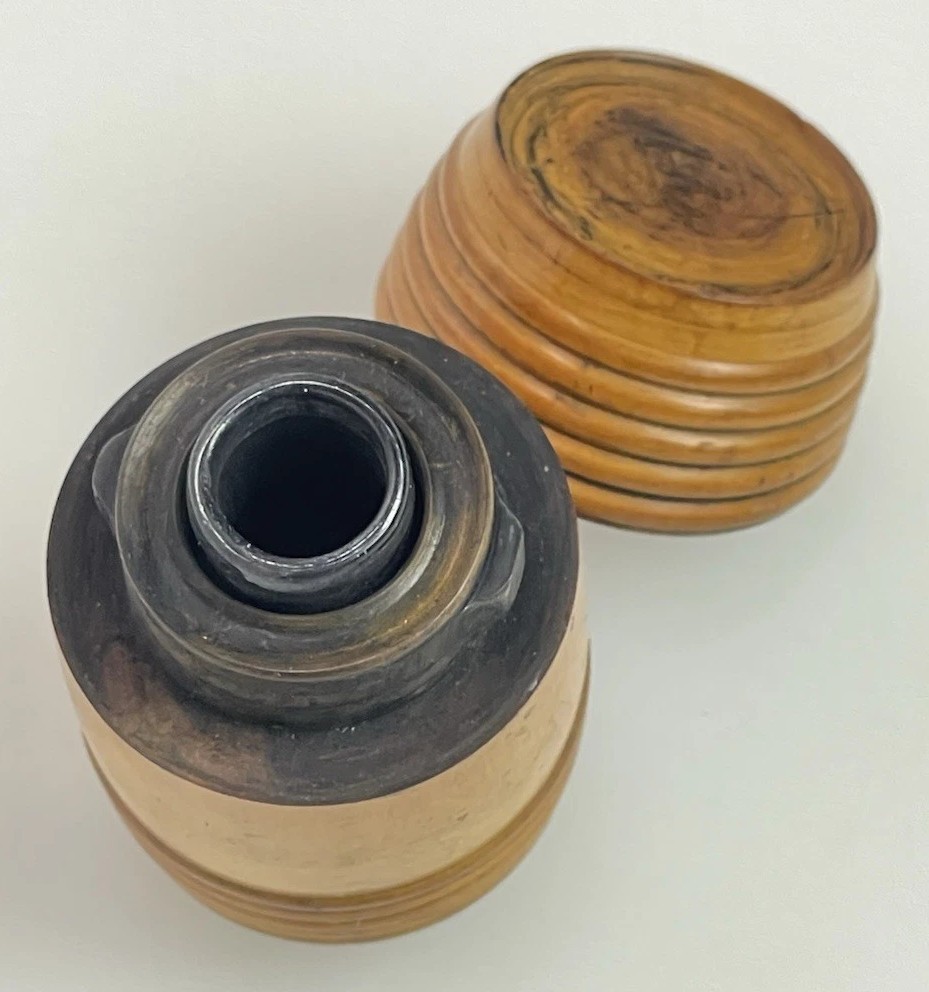
- Interior: When opened, it reveals a protective housing containing a small glass inkwell. The dark material surrounding the vial acts as both a shock absorber and a thermal insulator.
Materials and Construction
Exterior: Boxwood
An advertisement explicitly lists “Boxwood, Bayonet Catch” as an option.
- Why Boxwood? Boxwood is an incredibly dense, fine-grained hardwood. Unlike most woods, it has almost no visible grain “pores,” allowing it to be turned on a lathe to a very smooth, ivory-like finish. It was the gold standard for “treen” because it doesn’t warp easily and can hold the fine detail of the barrel ribs and the delicate bayonet lugs.
Interior: The “Air Chamber” and Protective Lining
The dark material inside is likely Gutta-percha or Hard Rubber (Ebonite).
- Gutta-percha: A natural latex material that was the precursor to modern plastics. It was waterproof and could be molded into the precise shapes needed for the bayonet slots.
- The “Air Chamber”: As noted in the bottom of the advertisement, these inkwells were designed with an air chamber. This was a sophisticated Victorian “thermos” concept. By suspending the glass vial in a non-conductive material (like the dark liner) and leaving a gap of air between the glass and the outer wood, the ink was protected from freezing during winter travel.
Understanding the “Bayonet Mount”
The term “bayonet mount” refers to the locking mechanism, similar to how a bayonet was historically attached to a rifle or how a modern camera lens attaches to a body.
Instead of a continuous screw thread, the base has two or more small protruding lugs. The cap has corresponding L-shaped slots carved into its inner rim.
- You push the cap down so the lugs enter the vertical part of the “L.”
- You give it a quick twist so the lugs slide into the horizontal part of the “L.”
- This creates a secure, leak-proof seal that won’t accidentally “unscrew” in a pocket or travel bag.
History of S. Silliman & Co. (Chester, CT)
The Rise of the Silliman Empire
Founded by Samuel Silliman in the mid-1830s in Chester, Connecticut, the company became one of the most prolific manufacturers of woodenware in the United States. Chester was a hub for “bit-and-brace” (drill) manufacturing and small wood-turning shops due to its proximity to water power.
Evolution of the Product
Silliman originally focused on pounce boxes (which held a fine powder used to dry ink before blotting paper was common) and sand boxes. As the mid-19th century progressed and pen technology improved, the company shifted its focus toward specialized inkstands.
By the 1860s (the era of this inkwell), they were famous for their “Patent Wood Inkstands.” They held several patents for the internal suspension systems that kept glass vials from breaking. Their “Barrel Traveling Inkstands” were marketed heavily to soldiers during the American Civil War, as they were lightweight, durable, and the bayonet catch prevented the ink from leaking onto a soldier’s uniform or correspondence.
Legacy
- Silliman & Co. represented the peak of the American wood-turning industry. While many competitors used cheaper woods and painted them to look expensive, Silliman maintained high standards using Rosewood, Boxwood, and Cocoawood. The company eventually transitioned into other wooden goods as the fountain pen (which carried its own ink) began to make portable inkwells obsolete toward the end of the 19th century.
Condition Note
The dark staining on the wood of this piece is “ink-burn.” Over decades of use, ink has likely spilled or been wiped onto the boxwood. Because boxwood is so dense, it doesn’t rot easily, but the tannins in old iron-gall ink react with the wood to create those deep, permanent dark patinas—a sign of an authentic, well-used 19th-century tool.
Sold for $125 in March 2026
Content disclaimer. The information posted is the owner’s best knowledge and may not have been vetted by the SOIC. We welcome comments, corrections, and additions, working to make our website information comprehensive and accurate.
Join the Society of Inkwell Collectors (SOIC) – it’s free!
Founded in 1981 as a non-profit organization,
we are documenting inkwells (and accessories).
We’re here to help and inform!