


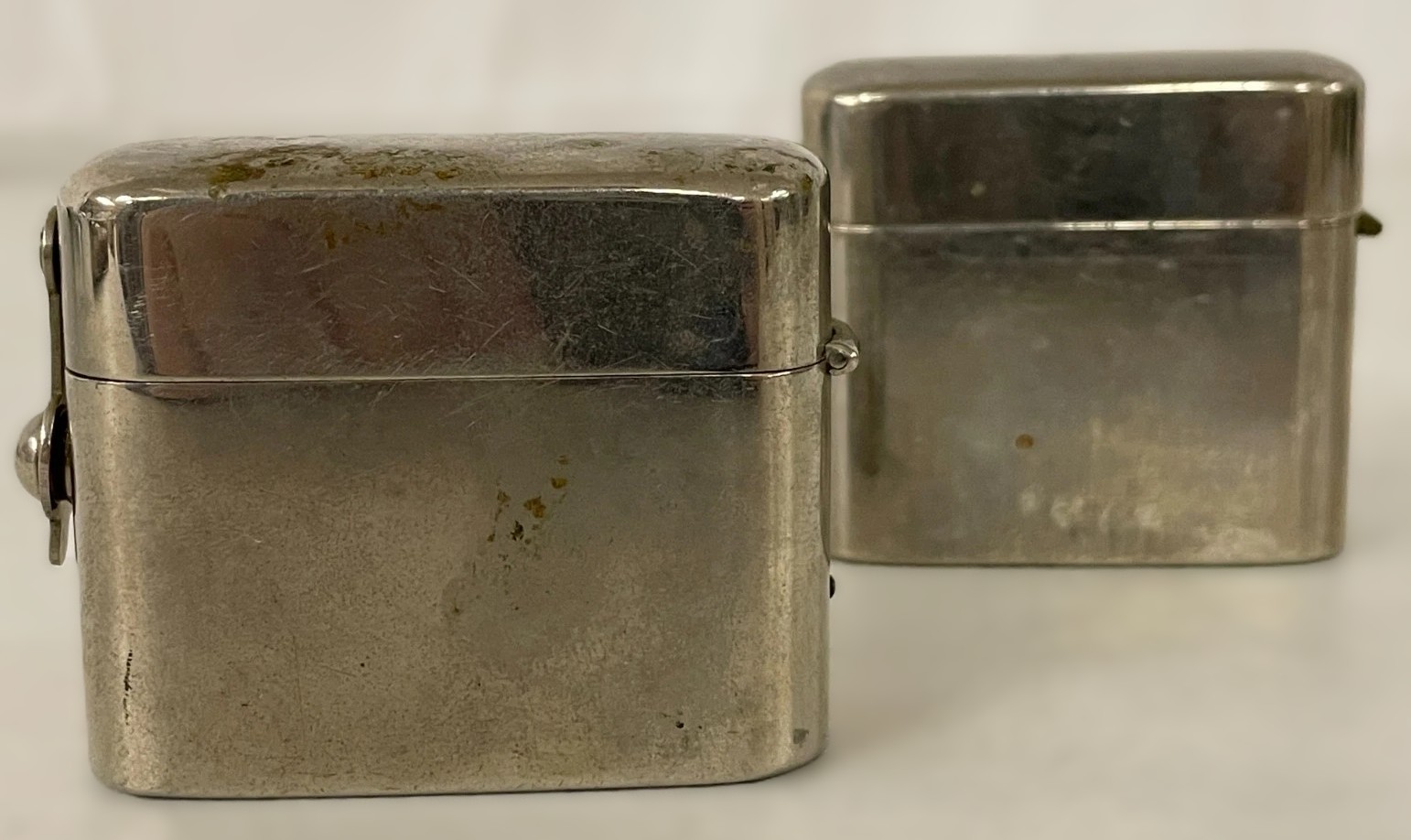
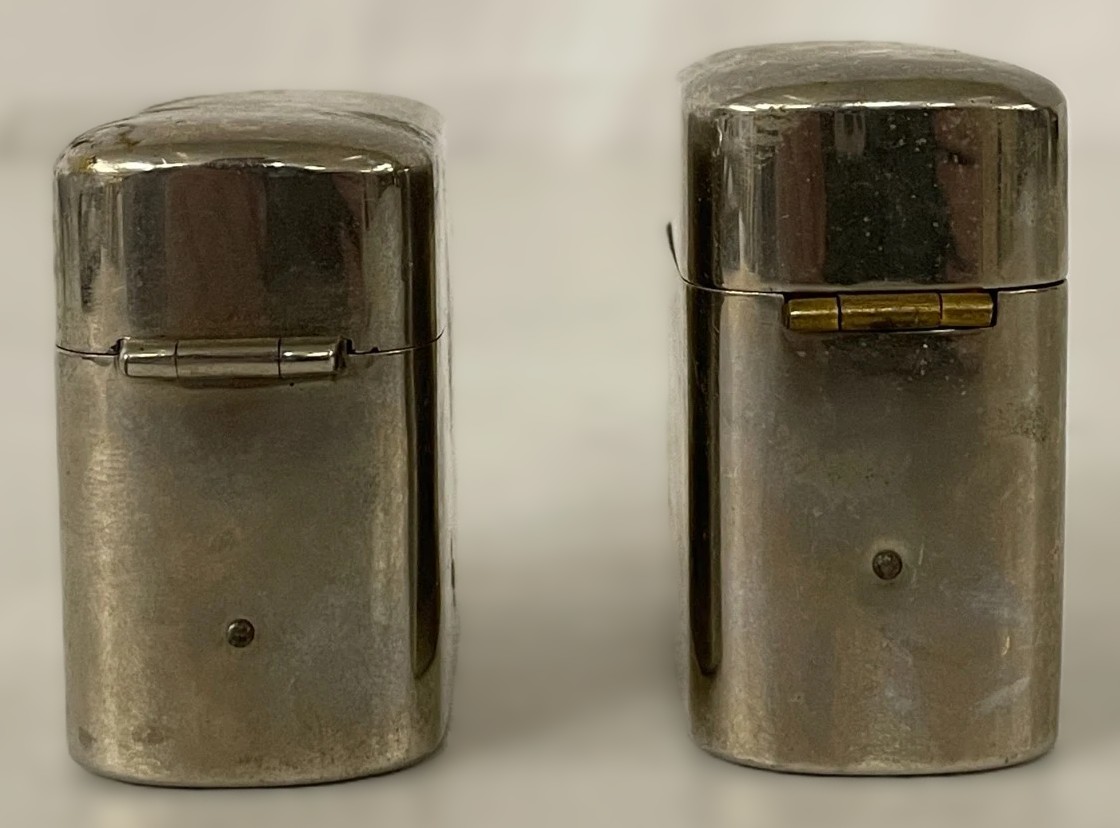


Traveling Inkwell & Match Vesta Set
| Categories | Travel |
| Material | Nickel Silver |
| Markings | Unmarked |
| Manufacturer | Undetermined |
| Origin | England |
| Date or Era | circa 1900 |
This is a traveling inkwell and match vesta set. These paired items were the “EDC” (everyday carry) essentials for a 19th-century traveler, providing the tools for both communication and light in a compact, durable form.
Materials and Construction
These pieces are made of nickel silver (often called “German Silver” or “Alpaca”).
- Nickel Silver: This is a sturdy alloy of copper, nickel, and zinc. Despite the name, it contains no actual silver, but it was favored for travel items because it is much harder and more durable than sterling silver, resisting the dents and scratches that come with being carried in a pocket or trunk.
- Patina: The slight yellowish tint visible in the wear areas suggests a high brass or nickel content, which was common for functional “campaign” or travel gear.
How They Work
The Traveling Inkwell (Left)
The primary challenge for a portable inkwell was preventing leaks.
- The Seal: Inside the lid, there is a circular compression pad made of leather, cork, or rubber.
- The Latch: To ensure the seal is airtight, these inkwells use a tension latch. When you swing the arm over and snap it down, it applies significant downward pressure, wedging the pad against the mouth of the glass or ceramic bottle. This allows the inkwell to be tossed into a bag or pocket without ruining one’s clothes.
- The Bottle: The interior houses a small, thick-walled bottle designed to hold a small amount of “traveling” ink.
The Match Vesta (Right)
The “vesta” was designed to keep matches dry and prevent them from accidentally igniting.
- Interior Flap: The vesta features an internal hinged flap. This served two purposes: it kept the matches from falling out when the main lid was opened and provided a flat surface to press against.
- The Striker: Most vestas, like this one, have a “striker” surface—a patch of serrated or ribbed metal on the internal flap.
The “Vesta” and Its Significance
Derivation: The word “Vesta” comes from the Roman goddess Vesta, the deity of the hearth, home, and fire. In the 1830s, a popular brand of friction matches was patented as “Wax Vestas.” The name became so synonymous with the product that pocket match-safes are still called “vesta cases” today.
Why a traveler carried matches: In an era before flashlights or lighters, a traveler was responsible for their own light. Matches were essential for:
- Lighting lamps or candles in dimly lit inns or train carriages.
- Sealing letters: To secure a private letter, a traveler would use a match to melt a stick of sealing wax.
- Tobacco: Lighting pipes or cigars was a standard part of social travel.
Why are they linked?
These two items were frequently sold as a “Traveler’s Companion” set. Writing a letter required a stable ink source (the inkwell) and often a flame to melt sealing wax to close the envelope (the vesta). Because they were both pocket-sized and made of the same durable metal, they were the perfect matched set for a writing desk on the move.
Where were they made?
These were most likely manufactured in Birmingham, England.
- England (The Likely Origin): Birmingham was the world’s center for “small work” metalware in the 19th century. British firms like Elkington & Co. or Sampson Mordan specialized in these types of travel sets.
How old are they?
This set dates to the late Victorian or early Edwardian era, roughly 1880–1910.
Several clues help narrow down this date:
- The Tension Latch (Inkwell): This specific “swing-arm” compression latch was perfected in the mid-to-late 19th century. Earlier versions used screw-tops, while later 20th-century versions moved toward cheaper, less reliable snap-caps.
- The Internal Flap (Vesta): The gold-toned (gilt) interior and the hinged internal flap on the vesta were features of higher-quality sets from the 1890s. This flap kept the matches from falling out while the traveler was on a bumpy train or carriage.
- The “Matched Set” Concept: Selling inkwells and vestas as a coordinated pair peaked in popularity between 1885 and 1905, just before the fountain pen (with its own internal ink) and the safety match (which didn’t require such heavy-duty cases) began to make these items obsolete.
Sold for $40 in April 2026
Content disclaimer. The information posted is the owner’s best knowledge and may not have been vetted by the SOIC. We welcome comments, corrections, and additions, working to make our website information comprehensive and accurate.
Join the Society of Inkwell Collectors (SOIC) – it’s free!
Founded in 1981 as a non-profit organization,
we are documenting inkwells (and accessories).
We’re here to help and inform!