










Tatum’s Postal Inkstand
| Categories | Cast Iron, Mechanical - Levered or Rotating Lids |
| Material | Cast iron |
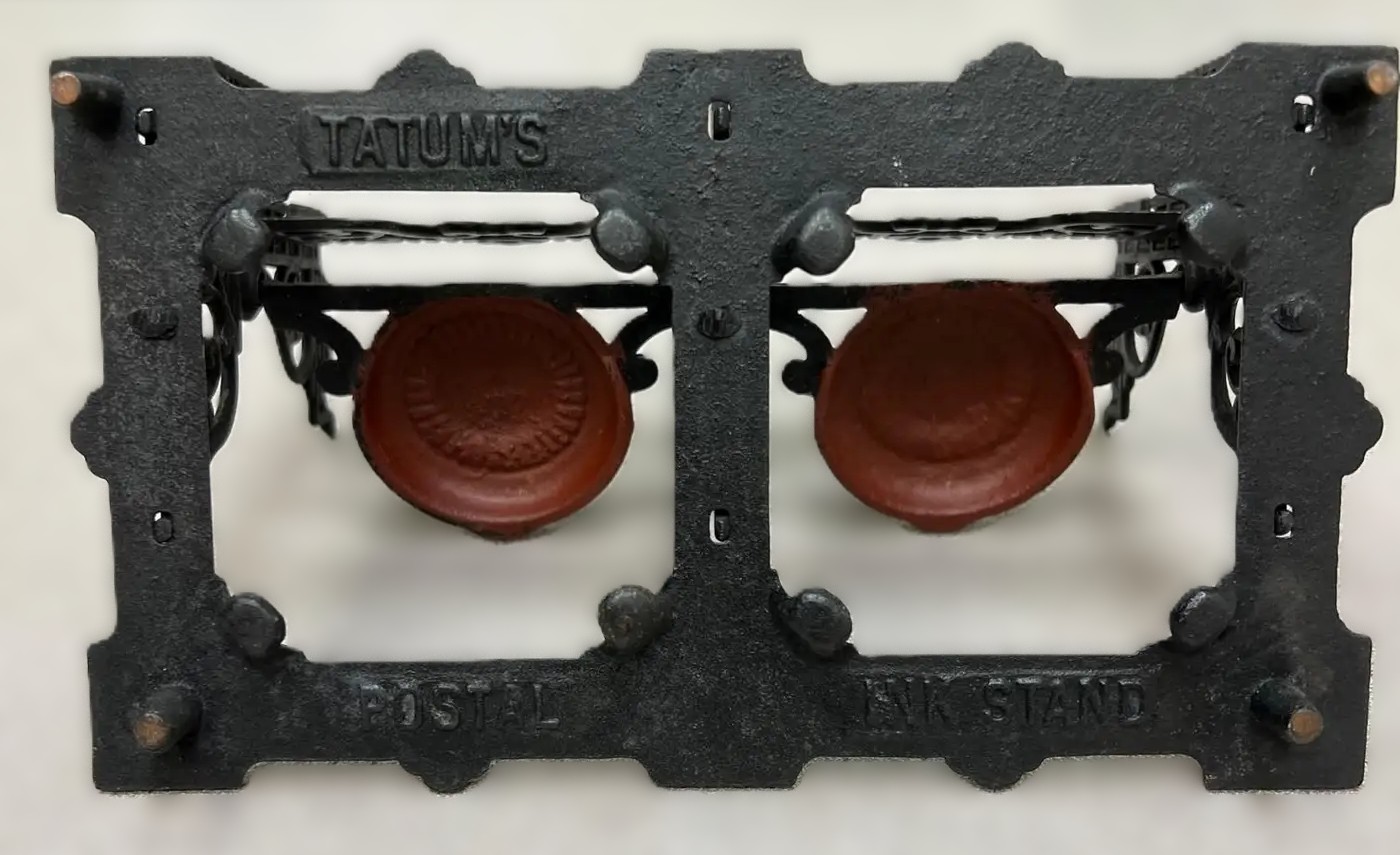
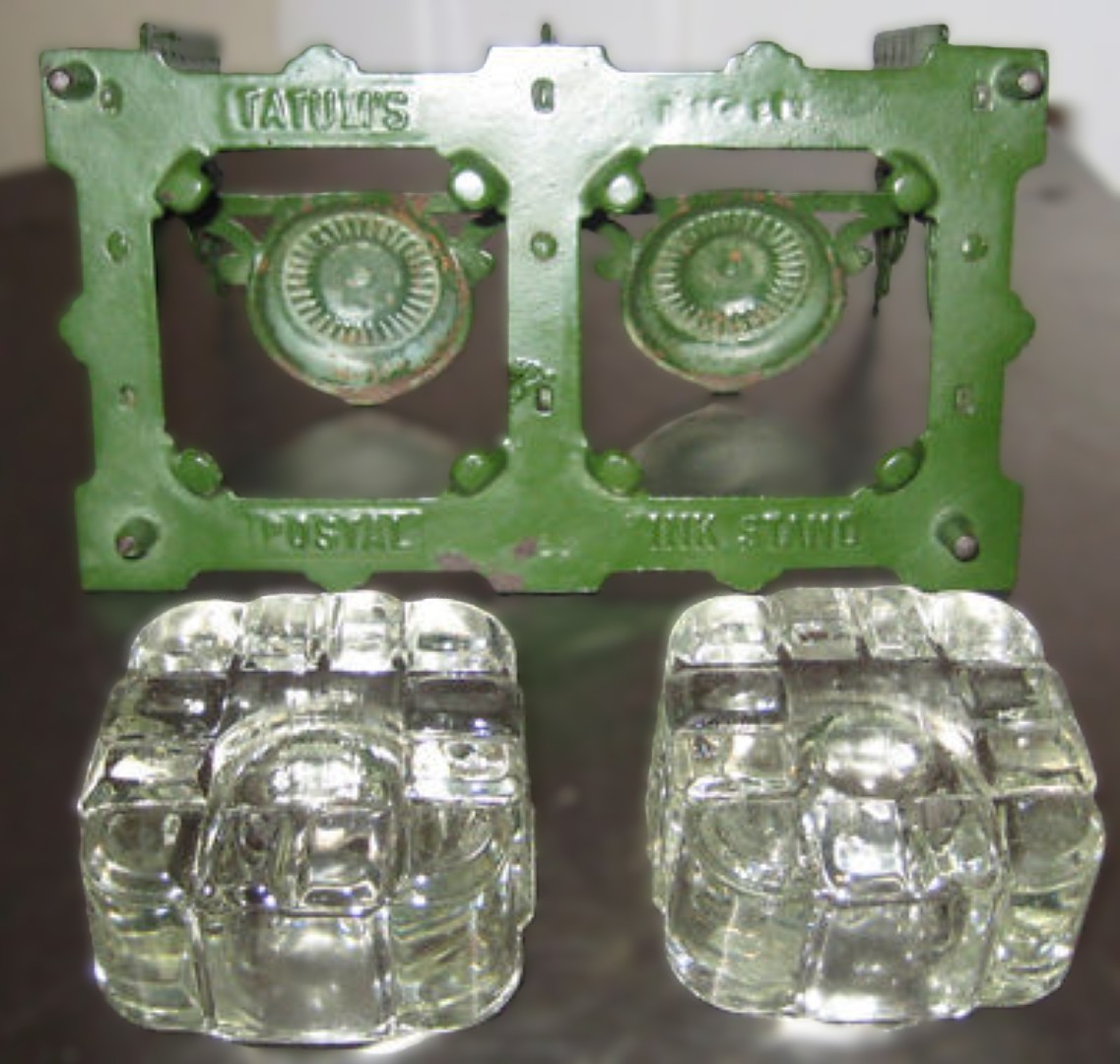
| Markings | Tatum's Postal Inkstand |
| Manufacturer | Tatum Manufacturing |
| Origin | United States |
| Date or Era | circa 1890 |
| Measuring | (Double): 8 ½” x 4 ¾” x 5 ¼” high |
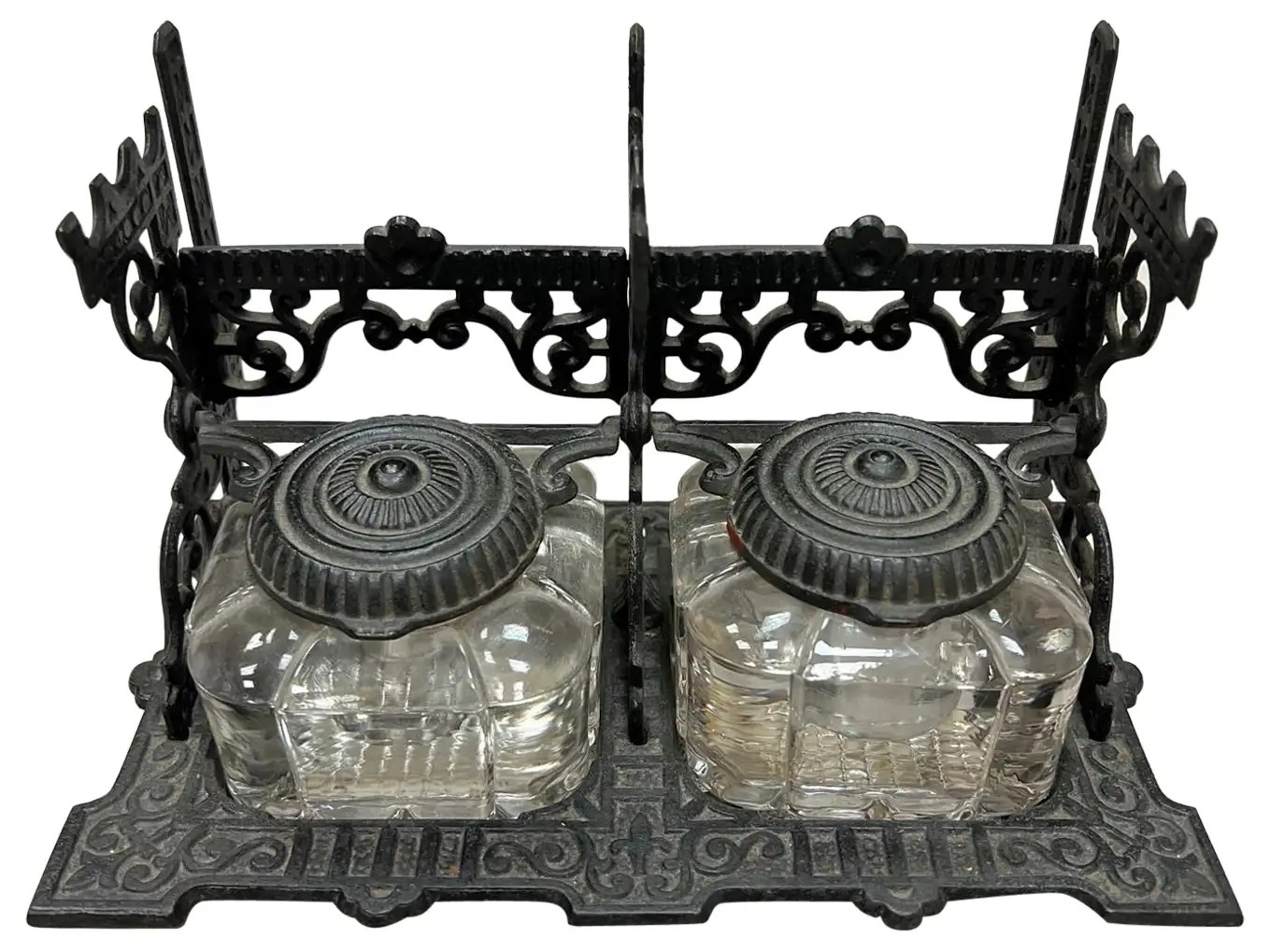
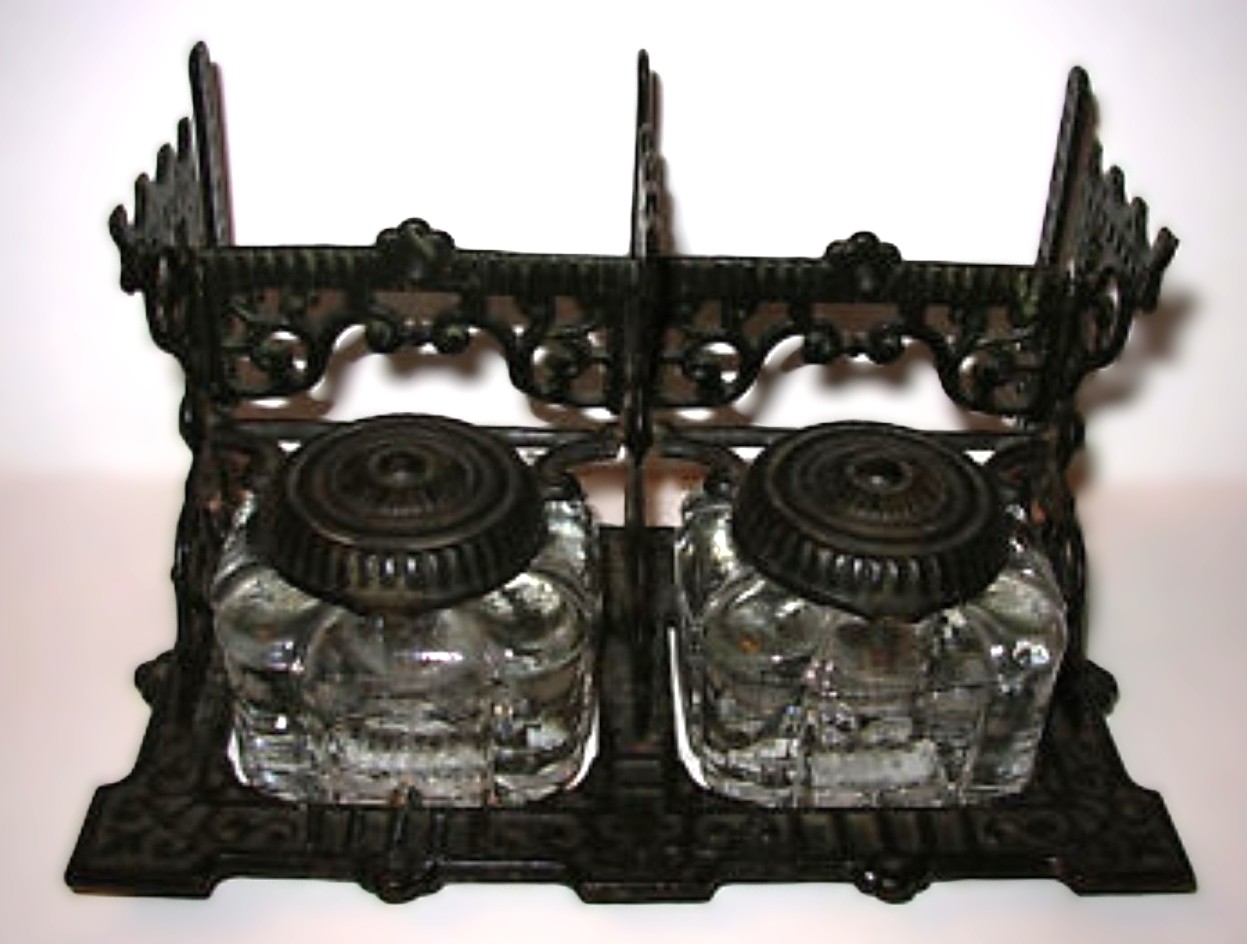
This Tatum’s Postal Inkstand is a piece of industrial-age Americana. Its heavy cast iron construction and “Gothic Revival” scrollwork are typical of the late 19th-century aesthetic, where even the most functional office equipment was expected to have decorative flair.
Detailed Description
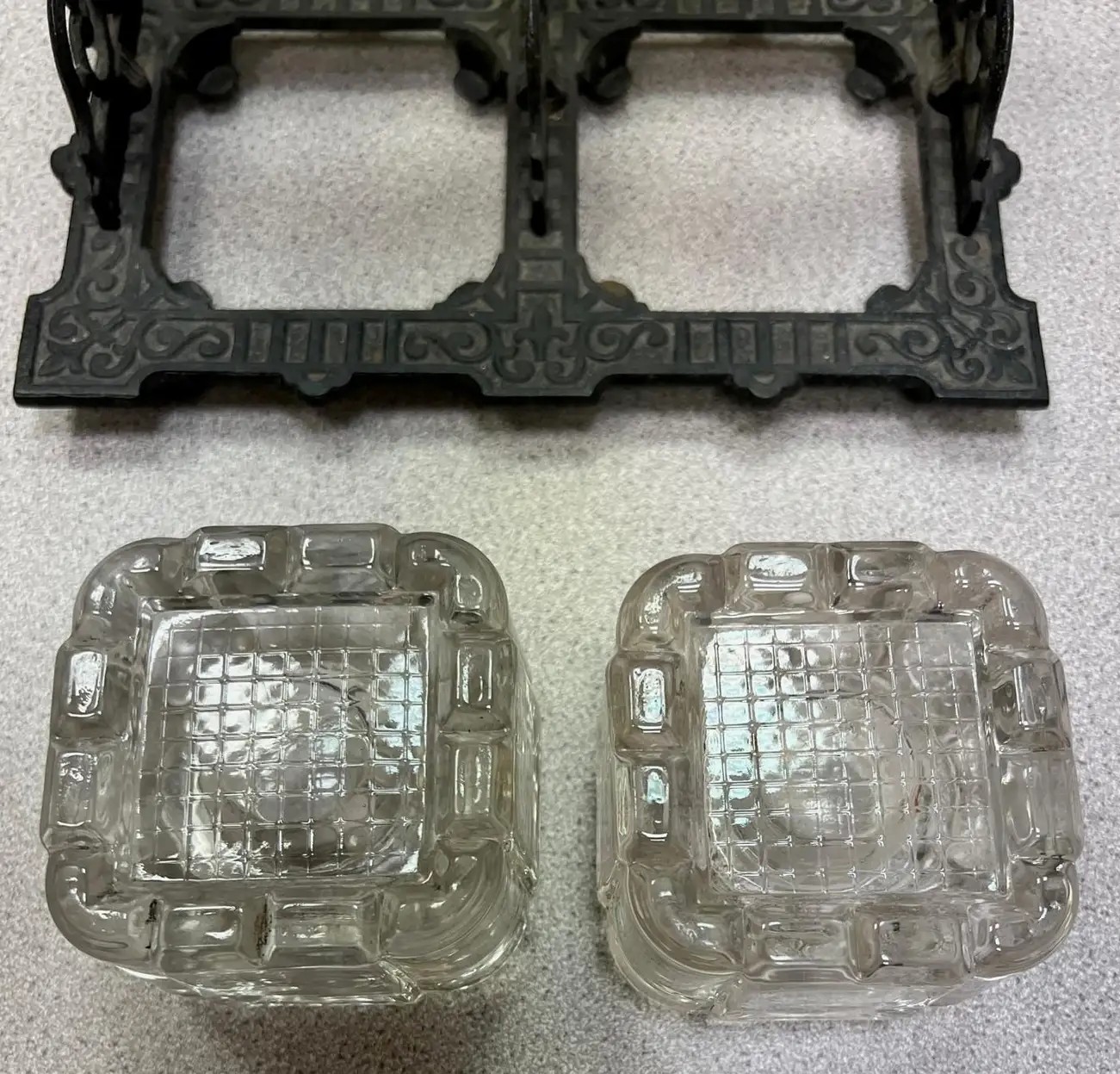
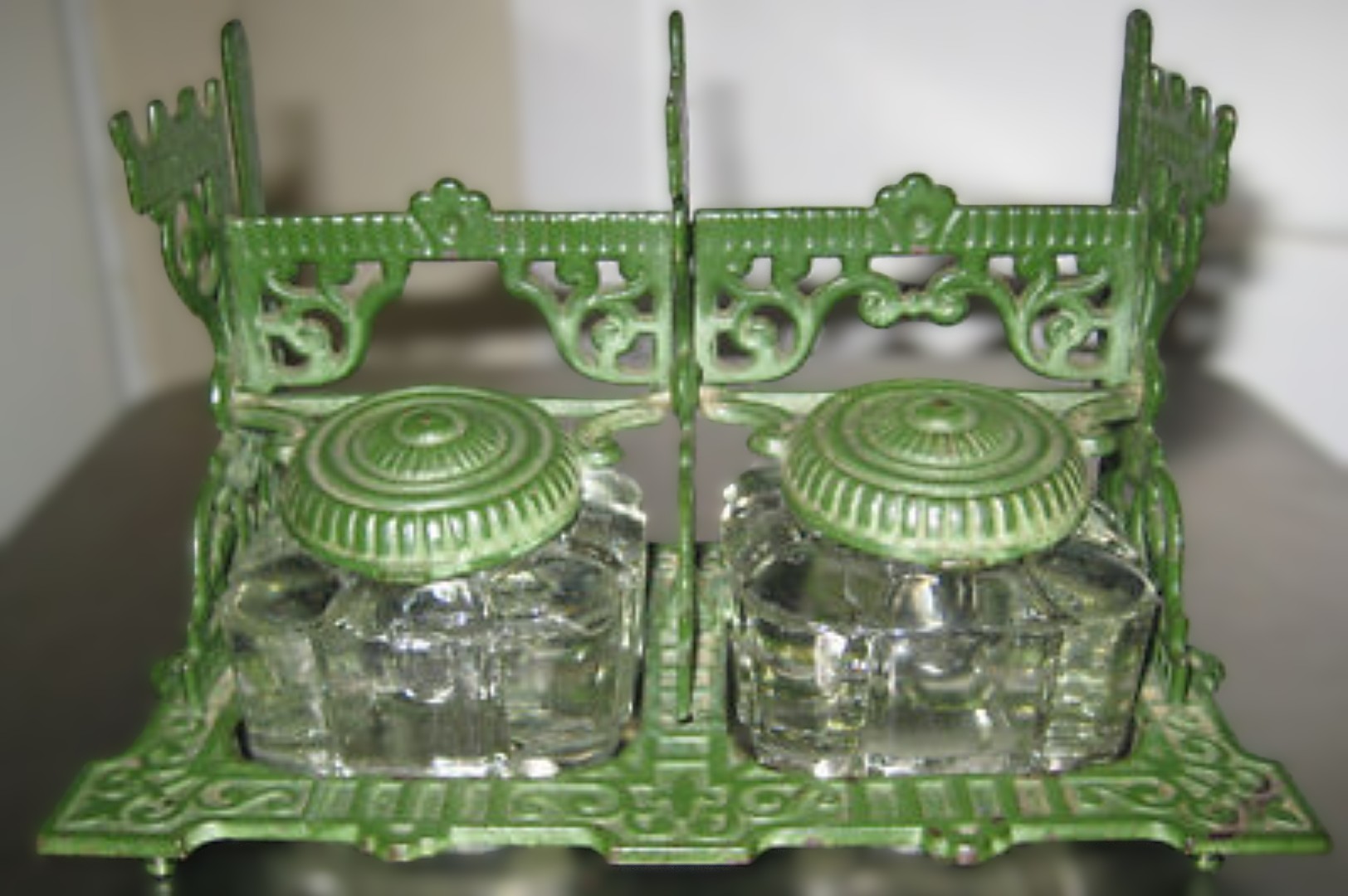
- The Framework: The stand is made of ornate, black-enameled cast iron. The base features heavy scrollwork and a fleur-de-lis motif in the center.
- The Inkwells: It features two clear, pressed-glass inkwells with a “lobed” or “quaterfoil” design. These are removable for cleaning and refilling.
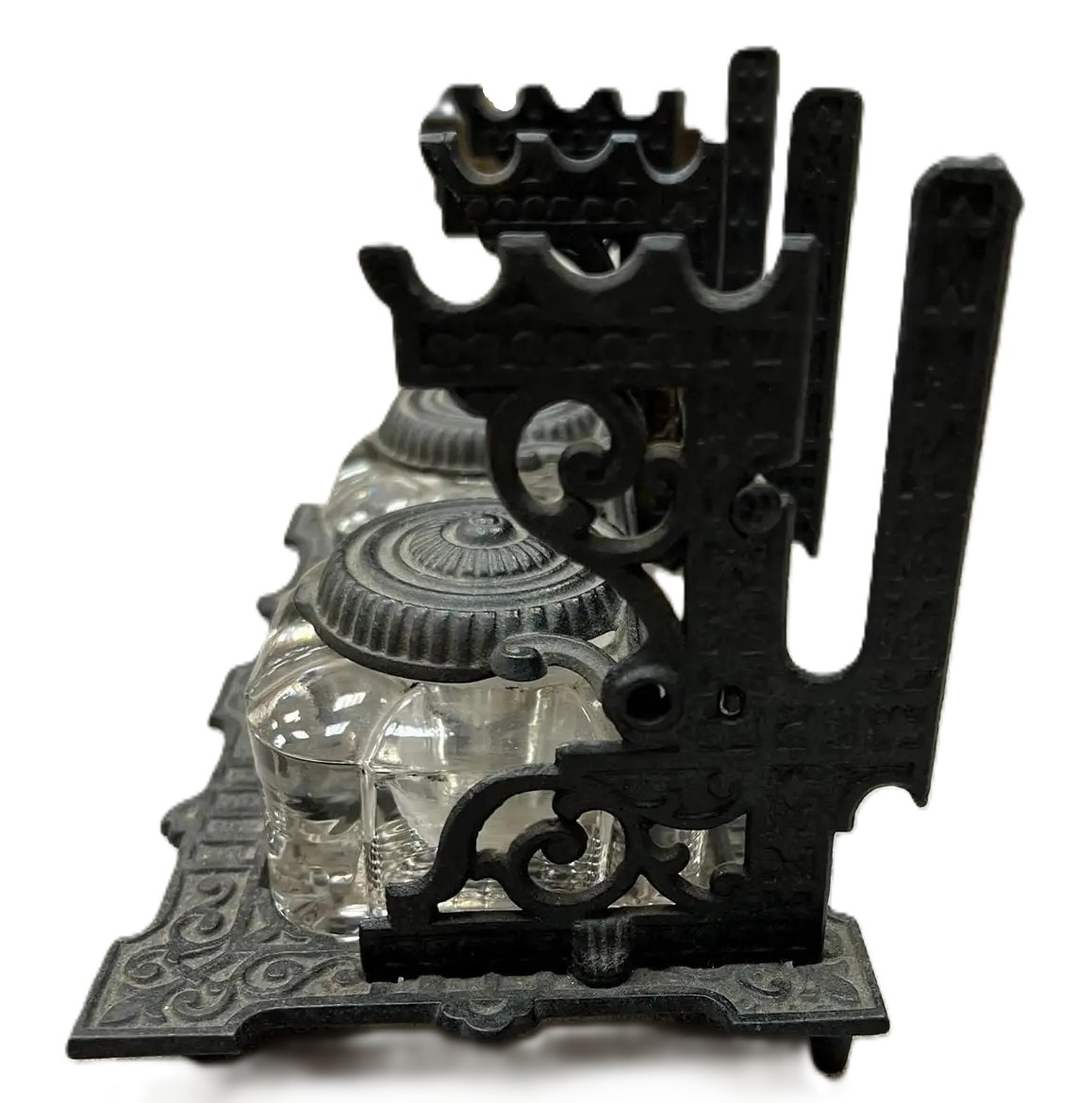
- The Lids: Uniquely, the circular cast iron lids are permanently attached to the frame. They are hinged at the back and flip upward.
- Writing Tools: Pen Rests: The vertical side supports and the central divider are notched to serve as a tiered rack, capable of holding up to three pens horizontally.
- Back Slot: Behind the inkwells, the frame forms a tall, narrow slot designed to hold a blotter or a small stack of stationery.
- Markings: The underside of the base is clearly embossed with:
“TATUM’S POSTAL INKSTAND”
The Samuel C. Tatum Company
The Samuel C. Tatum Company was based in Cincinnati, Ohio, and was a major player in the “office specialties” market from the late 1800s into the early 20th century. Samuel Tatum founded the company in 1859, initially as a foundry. By the 1880s and 90s, they became famous for high-quality cast iron goods, ranging from sewing machine parts to copy presses and, of course, inkstands.
The “Postal” Connection
Were these inkstands made specifically for the Post Office? The answer is both yes and no:
- Marketing & Utility: In the late 19th century, “Postal” was a widely used model name in the stationery industry. It signaled that the item was designed for high-volume mail and correspondence. A “Postal” stand almost always featured two wells: one for standard black ink and one for red ink (used for accounting, marking “paid,” or underlining).
- The “Survival of the Fittest”: Tatum marketed these as “Government Standard” equipment. Because they were heavy (so they wouldn’t slide) and the lids were permanently attached (so they couldn’t be lost), they were indeed favorites for busy post offices and government bureaus.
- The Back Slot: The slot in the back for paper or a blotter was specifically designed to handle the “outgoing” pile of letters or the blotter used to dry the ink on stamped envelopes—further reinforcing the “Postal” branding.
- A Professional Grade: Tatum marketed two main versions: the “Office” inkstand and the “Postal” inkstand. The “Postal” model was the heavy-duty, professional grade. In the 1890s, “Postal” was a brand keyword indicating that the item was “Government Standard”—meaning it was built to withstand the rigorous, 24/7 environment of a government bureau or a high-volume shipping room.
- Dual-Color Logic: The two inkwells were designed specifically for the “Black and Red” system. Postal workers and clerks used black (or blue) for standard correspondence and red ink for marking mail as “Paid,” “Registered,” or for correcting ledger entries.
- “Un-losable” Lids: In a busy post office, separate lids often went missing. By hinging the lids directly to the heavy cast iron frame, Tatum solved the problem of disappearing caps and ensured the ink stayed free of the coal dust common in 19th-century buildings.
Catalog Details & Original Price
In the 1890s, these sets were sold through major stationery wholesalers like the Tower Manufacturing Co. or the American News Company. These inkstands came with different finishes: black enamel; green enamel; brass plated. They were also sold as “double” and “single” inkstands.
Original Retail Price: According to period trade catalogs, a “Tatum’s Postal” double stand originally retailed for approximately $1.50 to $2.25 (depending on the specific glass style and finish). To put that in perspective, a $2.00 inkstand in 1895 would be roughly equivalent to spending $75 in 2026—a significant investment for a high-quality tool.
Period of Manufacture
Based on the casting style and the Samuel C. Tatum company history, this inkstand was most likely produced between 1885 and 1900. By the 1910s, office aesthetics shifted toward simpler, “sanitary” glass designs, and the elaborate Gothic cast iron look began to fade.
Black enamel finish sold for $183 in January 2026
Content disclaimer. The information posted is the owner’s best knowledge and may not have been vetted by the SOIC. We welcome comments, corrections, and additions, working to make our website information comprehensive and accurate.
Join the Society of Inkwell Collectors (SOIC) – it’s free!
Founded in 1981 as a non-profit organization,
we are documenting inkwells (and accessories).
We’re here to help and inform!