


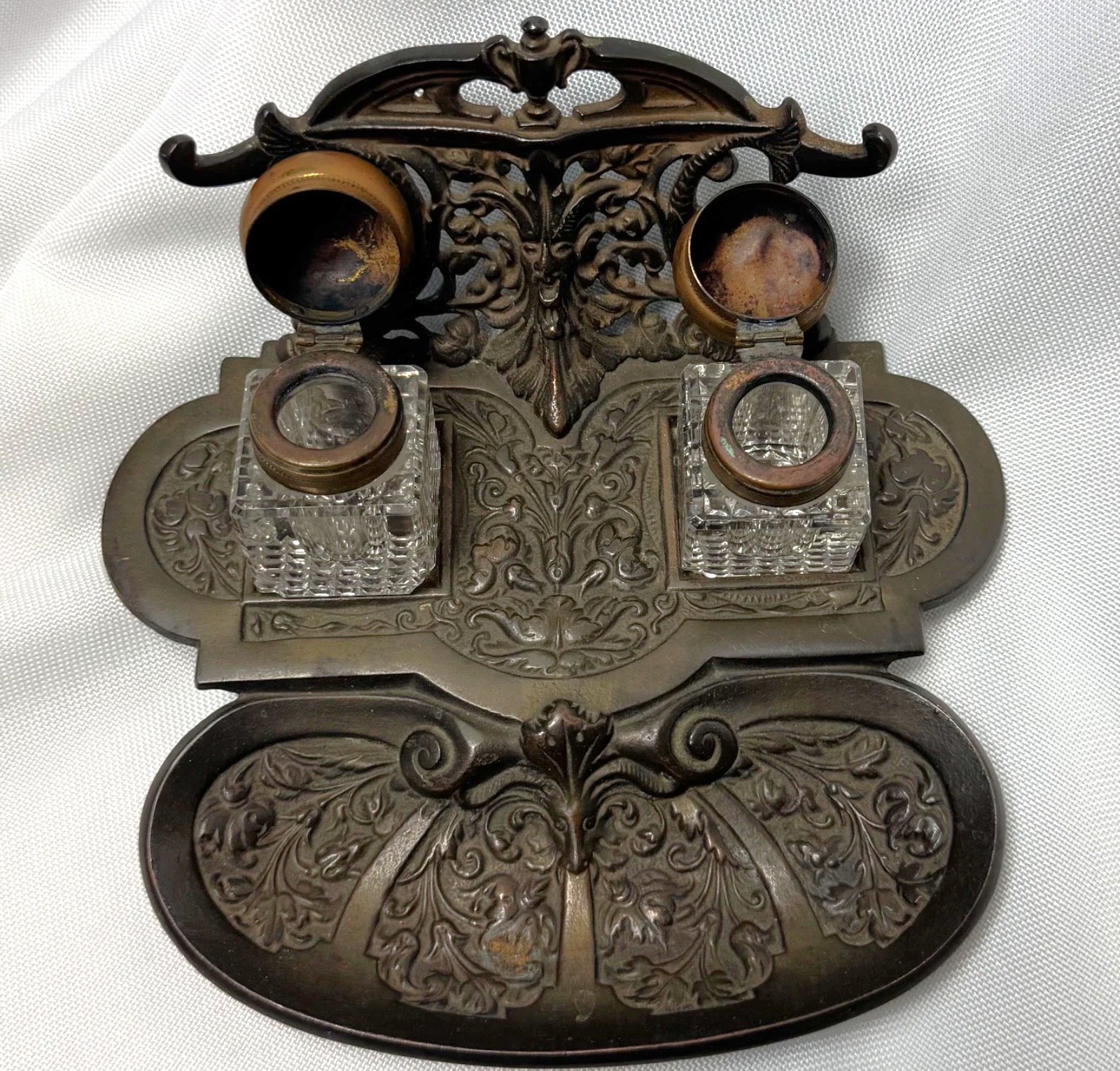

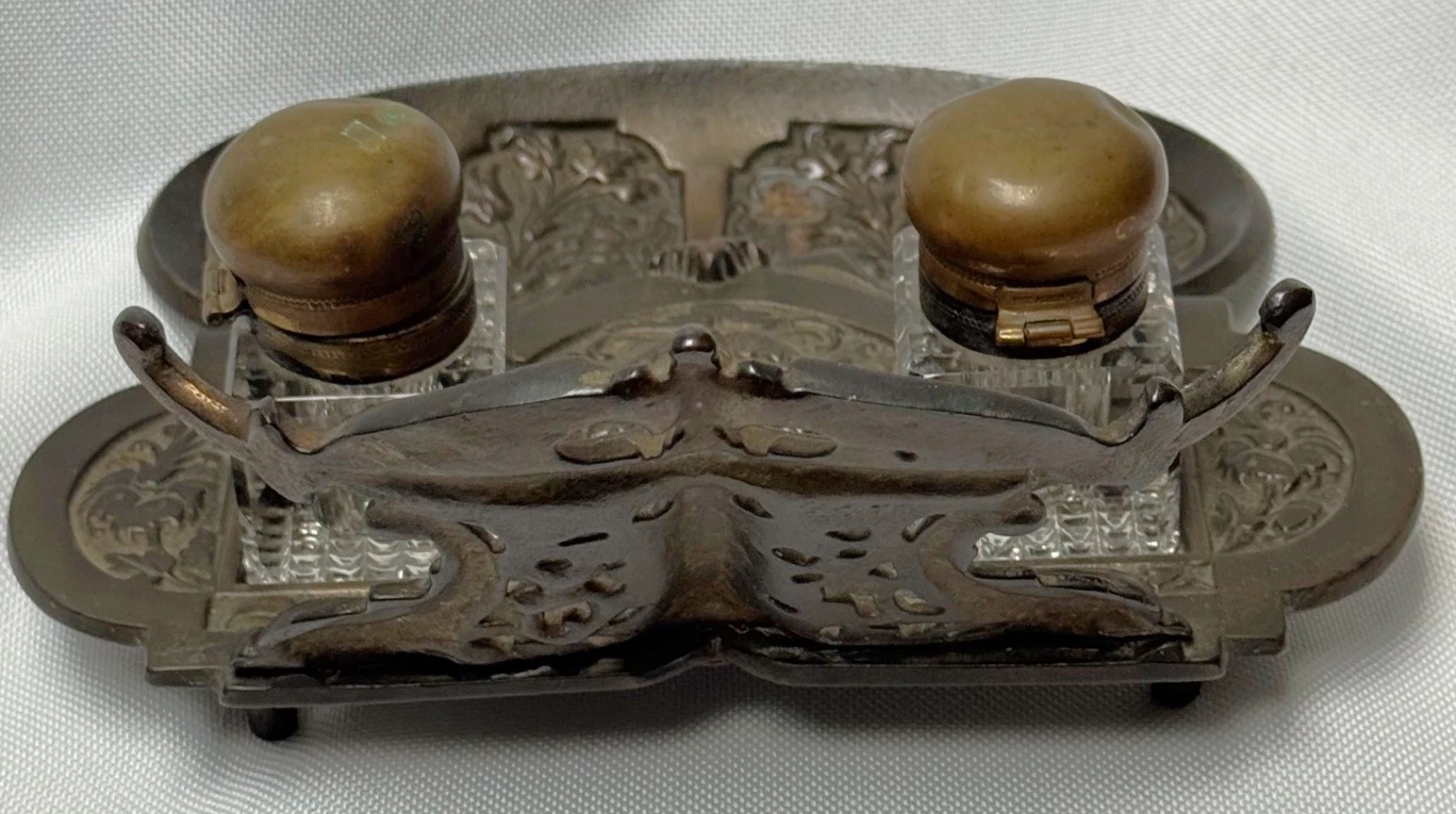

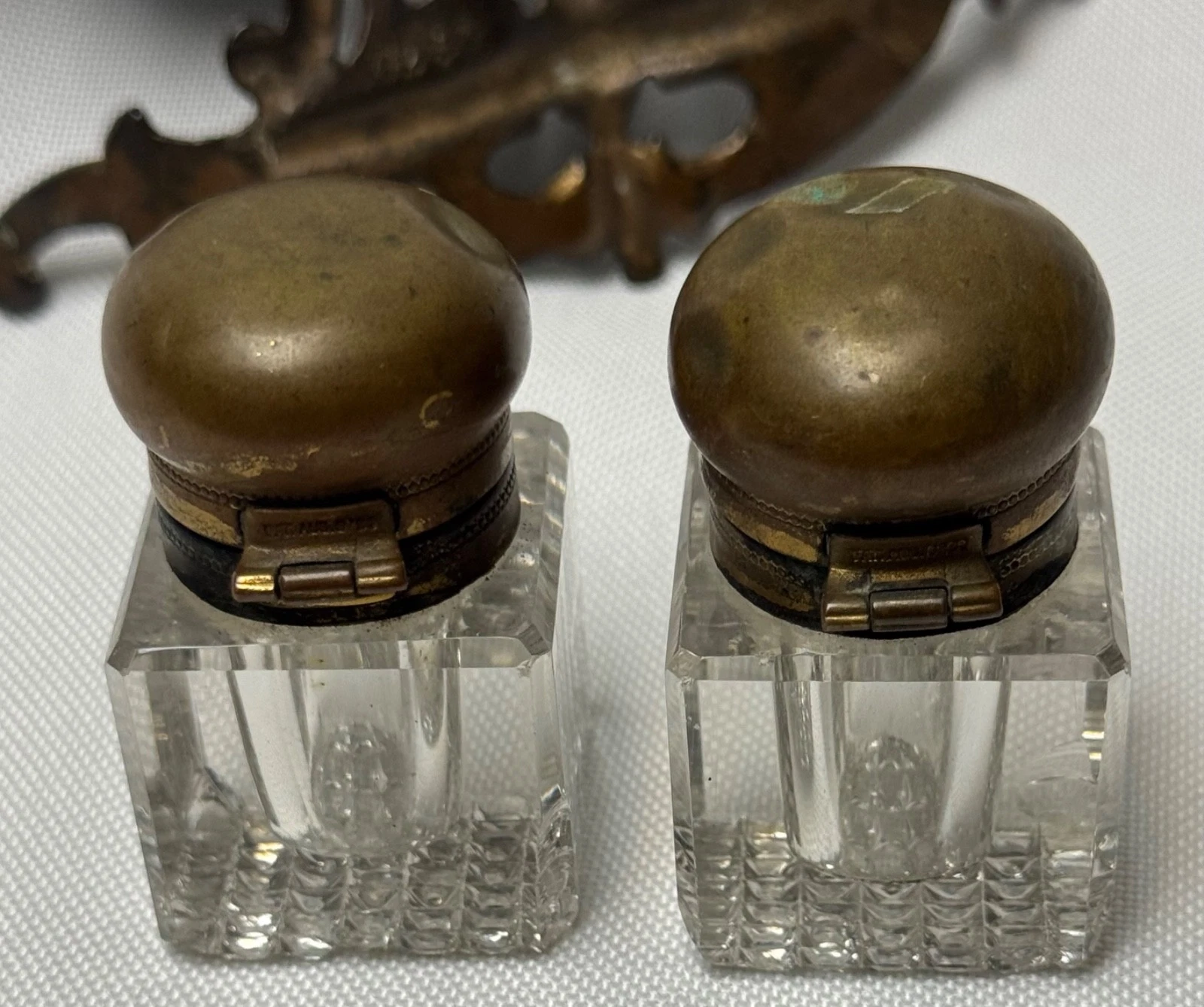
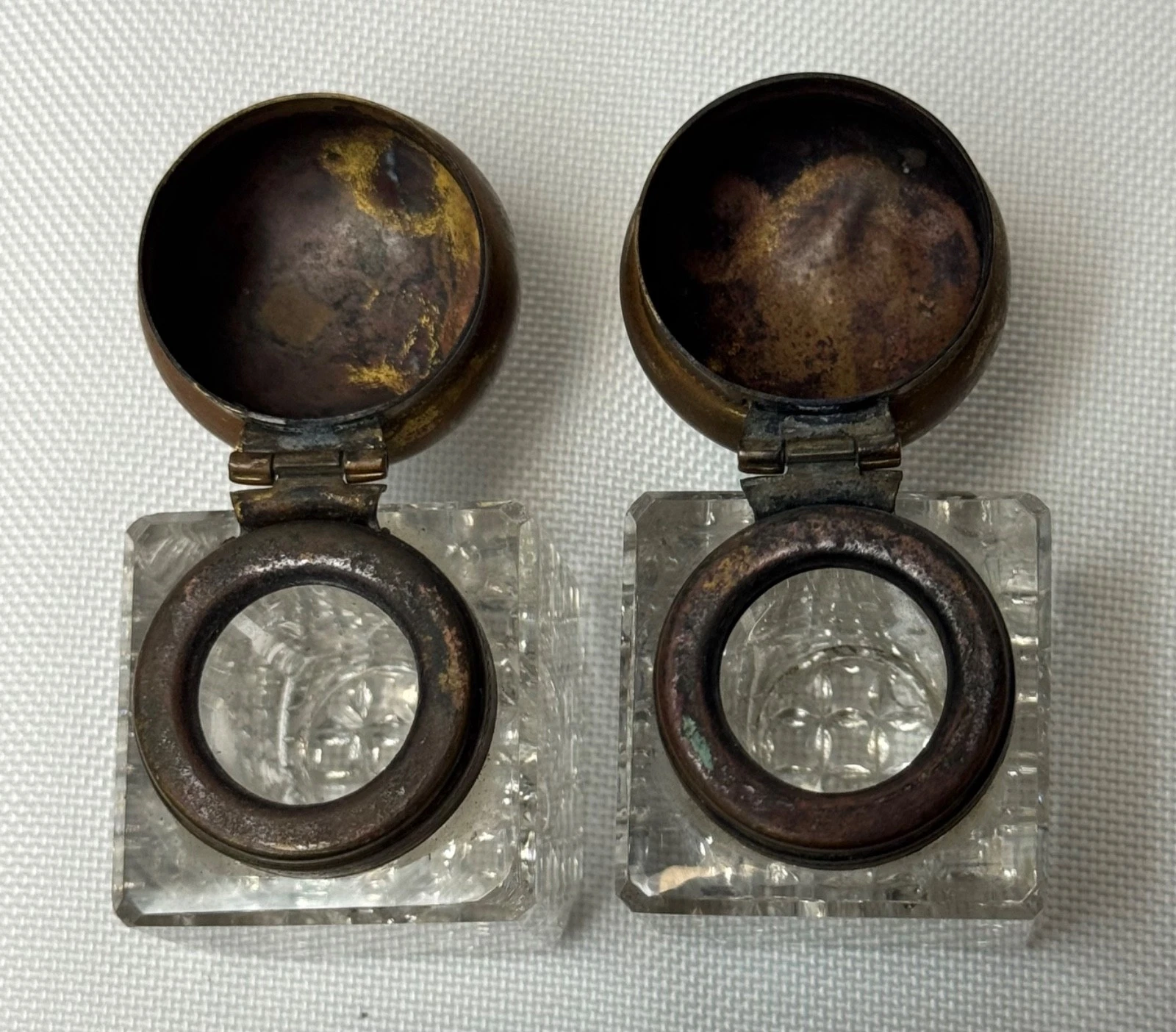


Cast Iron Double Inkstand
| Categories | Cast Iron |
| Material | Cast iron |
| Markings | "4470" |
| Manufacturer | H L Judd |
| Origin | United States |
| Date or Era | circa 1890 |
This double inkstand is characterized by its heavy casting and intricate Neoclassical and Rococo Revival motifs.
Materials and Construction
The stand is made of cast iron with a bronze or “japanned” finish. This was a common technique in the late 19th century to make durable iron pieces appear as though they were more expensive solid bronze.
- Inkwells: The two square inkwells are made of pressed glass with a “diamond-point” pattern on the base.
- Lids: The hinged, dome-shaped lids are made of a lighter brass alloy, which shows significant patina and some remains of a gilded or polished surface.
Design Features
- Central Ornamentation: The most striking feature is the “Green Man” or Mascaron face in the center of the backplate. This face is flanked by stylized dolphins or sea-serpents whose tails curve upward to form part of the pen rack.
- Pen Gallery: The backplate features two outstretched arms that serve as a rest for dip pens.
- Base and Tray: The base includes a wide, scalloped pen tray at the front, heavily decorated with acanthus leaf scrolls and floral filigree.
- Markings: The number “4470” is stamped into the underside. This is a pattern or catalog number used by the foundry for inventory and ordering purposes.
Manufacturer: H.L. Judd Manufacturing Co.
This inkstand was produced by the H.L. Judd Manufacturing Company, which was based in Wallingford, Connecticut.
Judd was a prominent American foundry during the late 19th century that specialized in small “fancy goods” and desk accessories. They were known for using a specific numerical cataloging system, and pattern 4470 is a documented number for this exact double-inkstand model.
Key Identification Points
- The Markings: Judd often used four-digit pattern numbers (like 4470) stamped directly into the cast iron, sometimes accompanied by their initials or a patent date.
- The Glass: The square, hobnail-patterned glass wells are original to the set. In many of Judd’s pieces, the glass inserts themselves were sometimes marked “Judd” on the bottom, though this is not always the case.
- The Style: This piece is a classic example of Victorian Neoclassical/Rococo Revival. The “Green Man” or Mascaron face and the dolphins are signature Judd motifs used to appeal to the high-Victorian taste for mythical and naturalistic imagery.
Production Era
The number 4470 places this piece in the late 1880s to early 1890s. During this period, H.L. Judd was competing directly with other famous Connecticut foundries like Bradley & Hubbard, often producing very similar high-quality “bronzed” ironware for home offices and parlors.
Summary of Origins
- Maker: H.L. Judd Manufacturing Co.
- Location: Wallingford, Connecticut, USA.
- Era: Circa 1890.
- Composition: Cast iron with a bronze wash/finish and brass-lidded glass wells.
Sold for $125 in February 2026
Content disclaimer. The information posted is the owner’s best knowledge and may not have been vetted by the SOIC. We welcome comments, corrections, and additions, working to make our website information comprehensive and accurate.
Join the Society of Inkwell Collectors (SOIC) – it’s free!
Founded in 1981 as a non-profit organization,
we are documenting inkwells (and accessories).
We’re here to help and inform!