


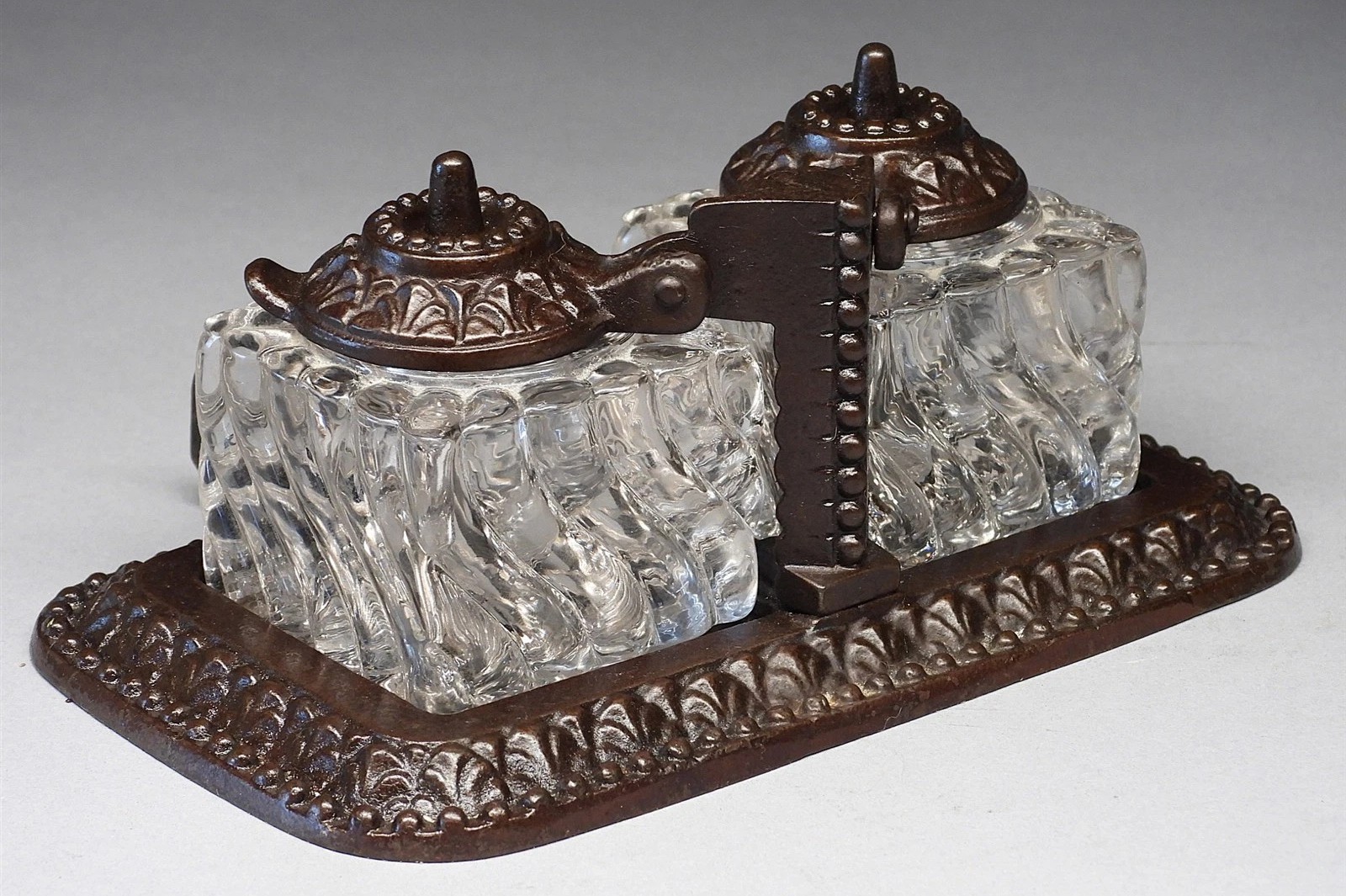


Tatum’s “Postal” Model Inkstand
| Categories | Cast Iron, Mechanical - Levered or Rotating Lids |
| Material | Cast iron, Glass |
| Markings | Unmarked |
| Manufacturer | Tatum Manufacturing |
| Origin | United States |
| Date or Era | circa 1880 |
| Measuring | 7 ½” x 5 ⅛” x 3” high |
This double inkstand is an example of late 19th-century American industrial art, specifically a Tatum’s “Postal” model manufactured by the Samuel C. Tatum Company of Cincinnati, Ohio, circa 1878–1900.
The Manufacturer: Samuel C. Tatum Co.
During the Gilded Age, the Tatum Company was a leader in the production of high-quality cast iron stationery and office goods. This specific design was marketed as the “Postal” inkstand because its rugged durability and non-removable lids made it the ideal “workhorse” for high-traffic public spaces like U.S. Post Offices, courthouses, and telegraph stations.
Mechanical Innovation: The “Attached Lid” System
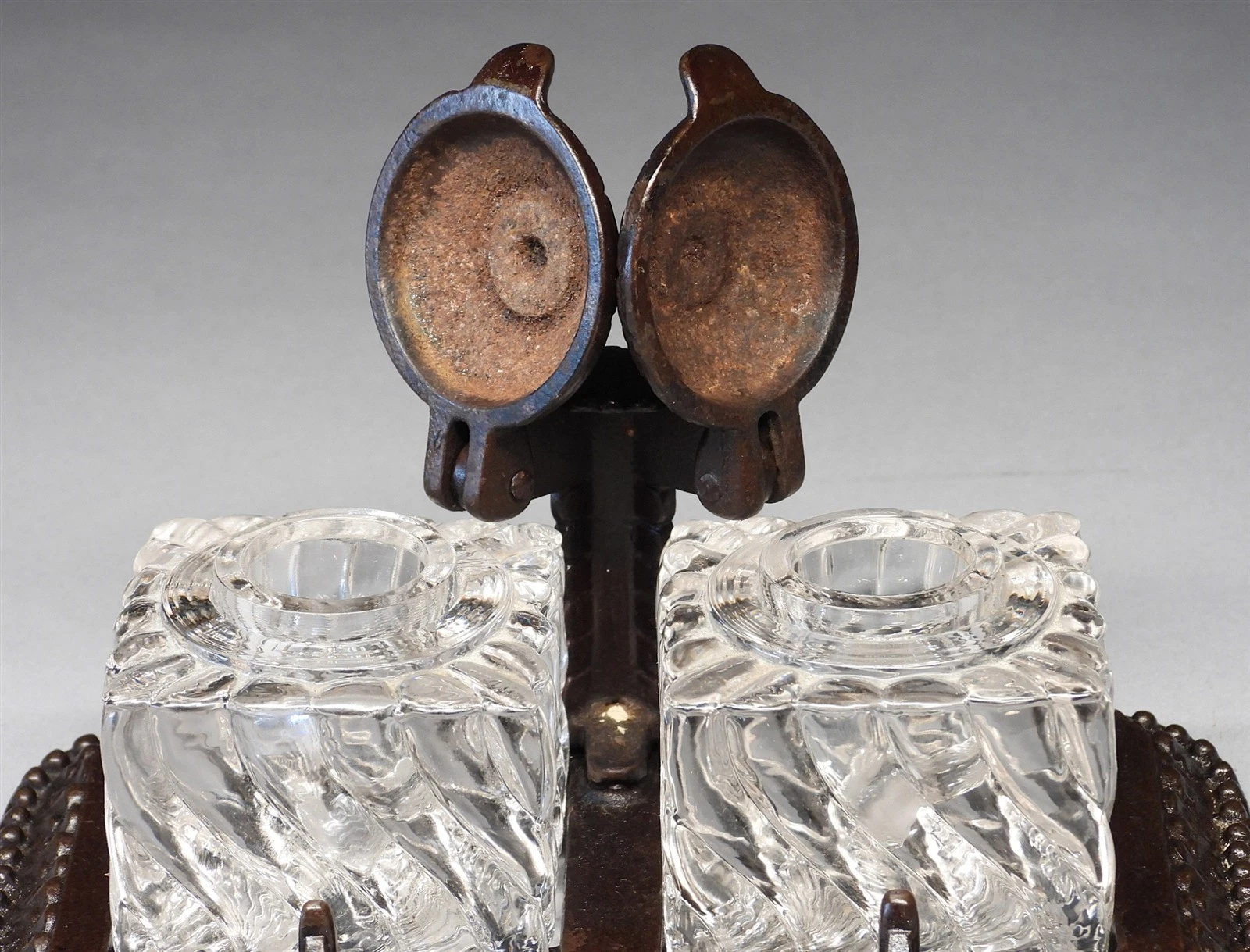
The most distinguishing feature of this set—and the primary reason for its commercial success—is the stationary hinged lid mechanism.
- No-Lost-Lids: Unlike standard inkwells with loose or removable caps, these lids are permanently hinged to the cast iron vertical standard (the frame).
- Gravity Seal: The lids are precisely weighted so that when dropped, they form a dust-proof gravity seal against the mouth of the glass reservoir, protecting the ink from drying out through evaporation.
- Removable Reservoirs: Despite the attached lids, the design allows the glass inkwells to be easily lifted out of the frame for cleaning or refilling without needing to disassemble the hinges.
The Cast Iron Base & Pen Rack
- Signature “Arms”: The two forward-facing, curved arms are the signature Tatum Pen Rack. They were specifically engineered to hold dip pens horizontally in front of the writer, ensuring they were immediately accessible and separate from the inkwells.
- Japanese Bronze Finish: The deep “bronzed” patina was achieved through a 19th-century process called “copper-washing”. The raw iron was electroplated with a thin layer of copper, chemically oxidized to a dark chocolate brown, and then hand-buffed on the raised decorative highlights to reveal the warm copper underneath.
The Glass Inkwells
The set contains two heavy, molded glass inserts featuring a distinctive “swirl” or fluted pattern.
- Origin: These wells were almost certainly manufactured by Whitall, Tatum & Company (a separate New Jersey glass firm often partnered with the Cincinnati metalworks).
- Form: They were standard “Size No. 1” or “No. 2” wells, characterized by their square profile and thick, fire-polished necks that fit perfectly into the metal collars of the Tatum frame.
Identification Summary
| Feature | Historical Detail |
| Manufacturer | Samuel C. Tatum Company, Cincinnati, Ohio |
| Model | “Postal” or “Standard Office” Double Inkstand |
| Estimated Age | 1880–1895 |
| Markings | Often unmarked on the base. Check for “PAT APR 9 1878” or “TATUM” cast into the underside of the iron lids or on the inner face of the hinge standard. |
Estimated value: $100
Content disclaimer. The information posted is the owner’s best knowledge and may not have been vetted by the SOIC. We welcome comments, corrections, and additions, working to make our website information comprehensive and accurate.
Join the Society of Inkwell Collectors (SOIC) – it’s free!
Founded in 1981 as a non-profit organization,
we are documenting inkwells (and accessories).
We’re here to help and inform!