







Sterling Silver Inkwell with Tortoiseshell Lid
| Categories | Silver |
| Material | Silver, Tortoiseshell |
| Markings | See Narrative |
| Manufacturer | Levi & Salaman |
| Origin | England |
| Date or Era | circa 1913 |
| Measuring | 4” diameter; 1 ⅜” high |
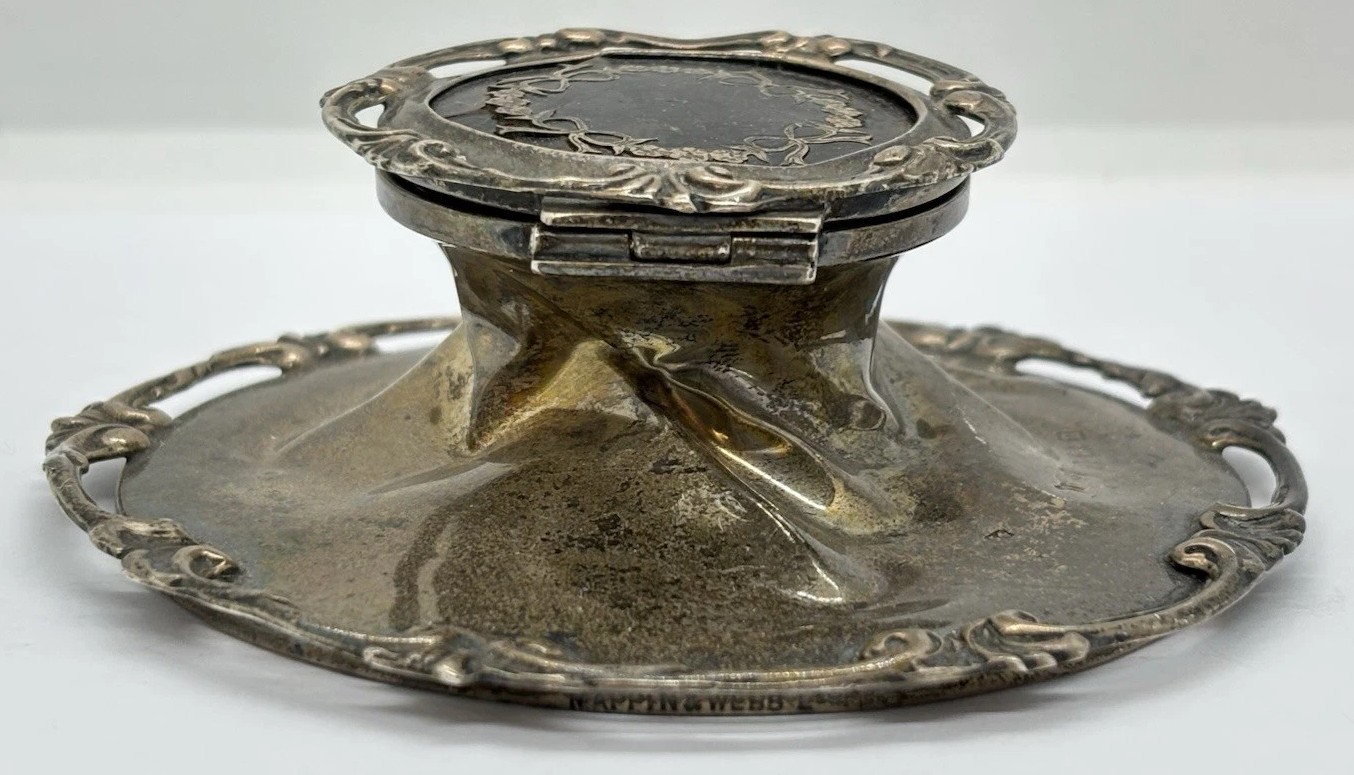
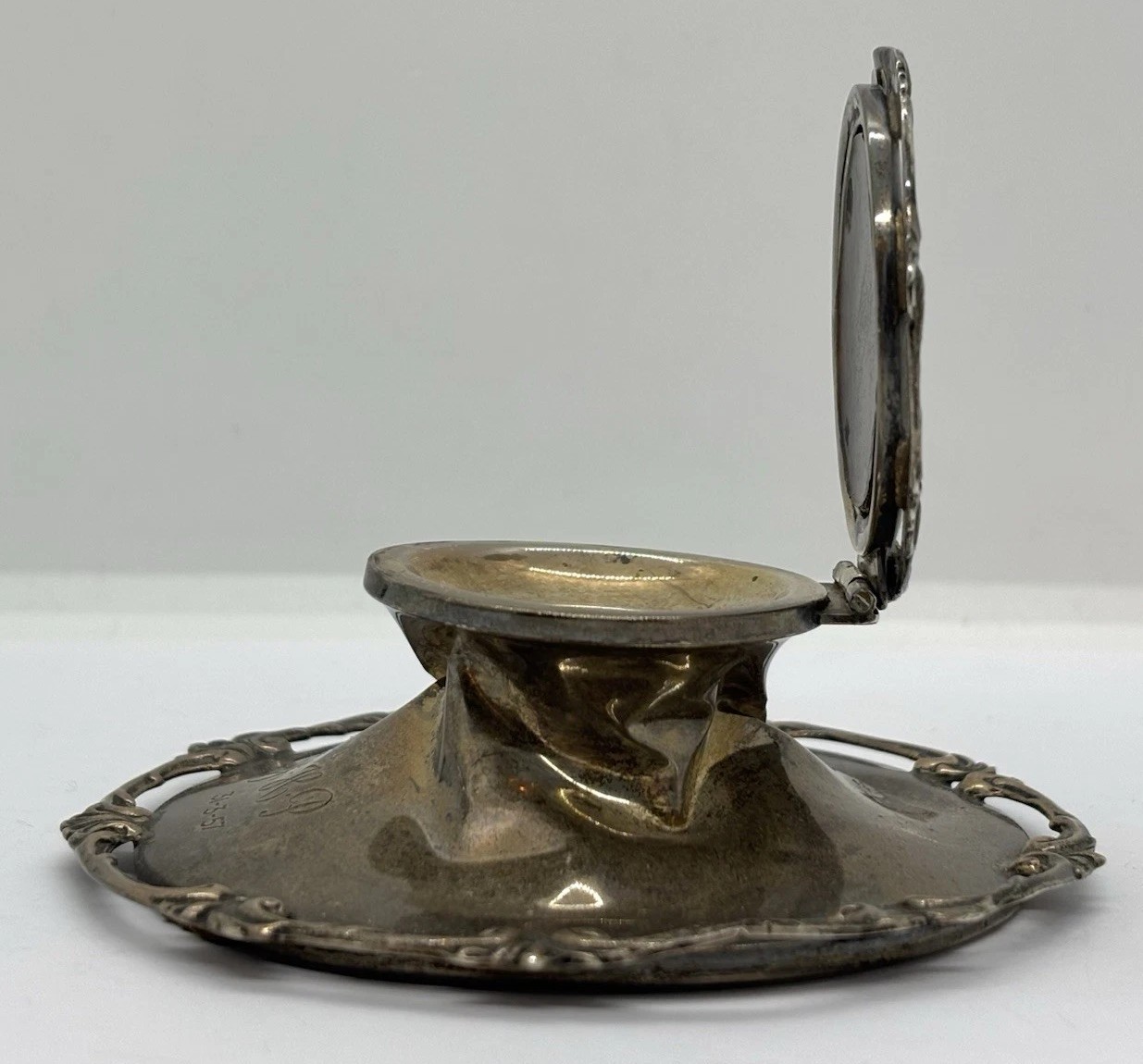
This is a refined sterling silver capstan inkwell, featuring a traditional nautical-inspired sloping base and a decorative piqué-work lid.
Hallmark Analysis
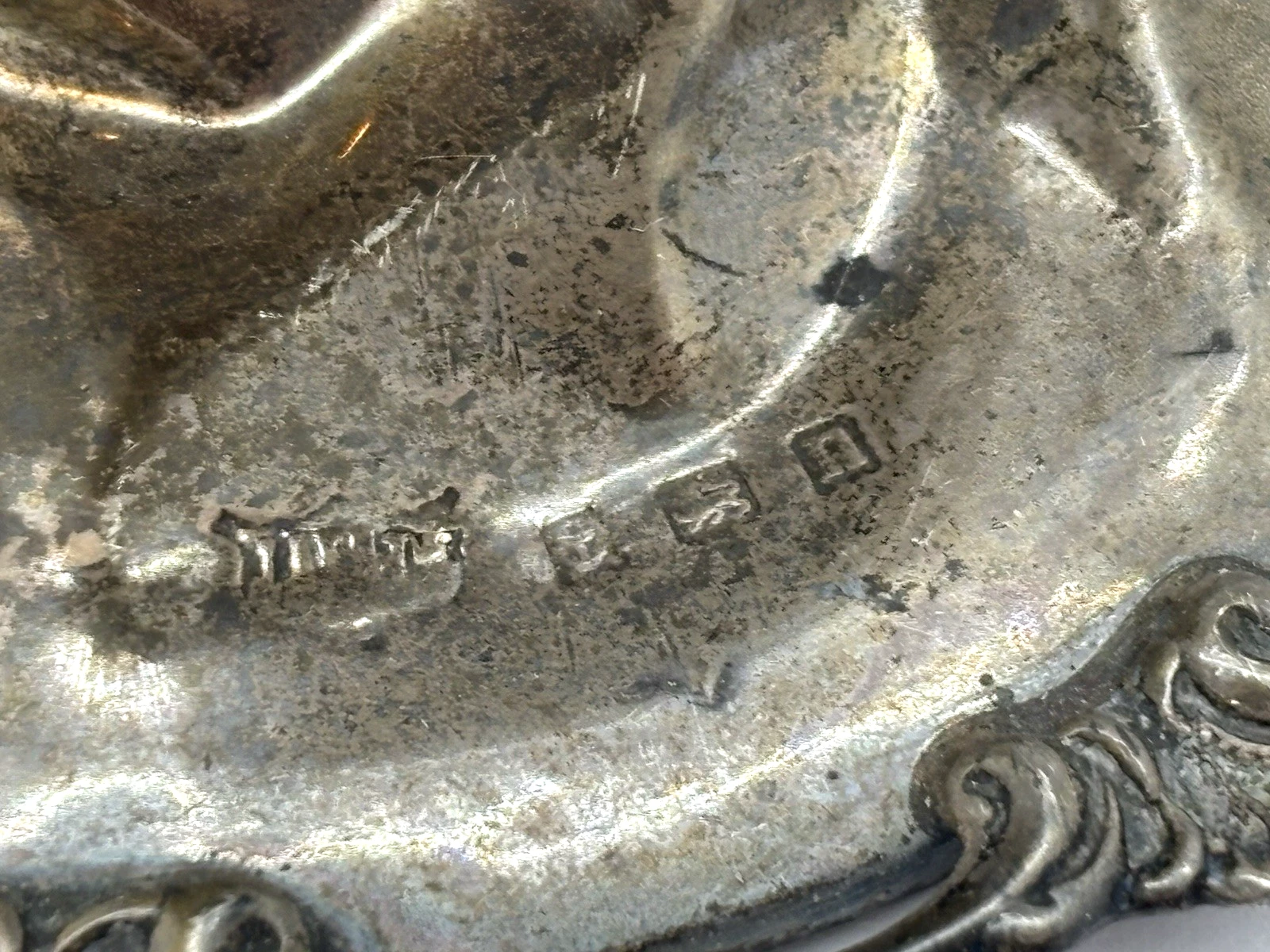
The hallmarks on the side of the base confirm its British origin and date of manufacture:
- Maker’s Mark (“L&S”): This represents the well-known firm Levi & Salaman, a prolific Birmingham silversmithing company active during this period.
- The Anchor: The assay office mark for Birmingham, England.
- The Lion Passant: The certification of Sterling Silver (.925 purity).
- Date Letter (“n”): This specific lowercase “n” in a shield represents the year 1913.
The Silver Piqué Process
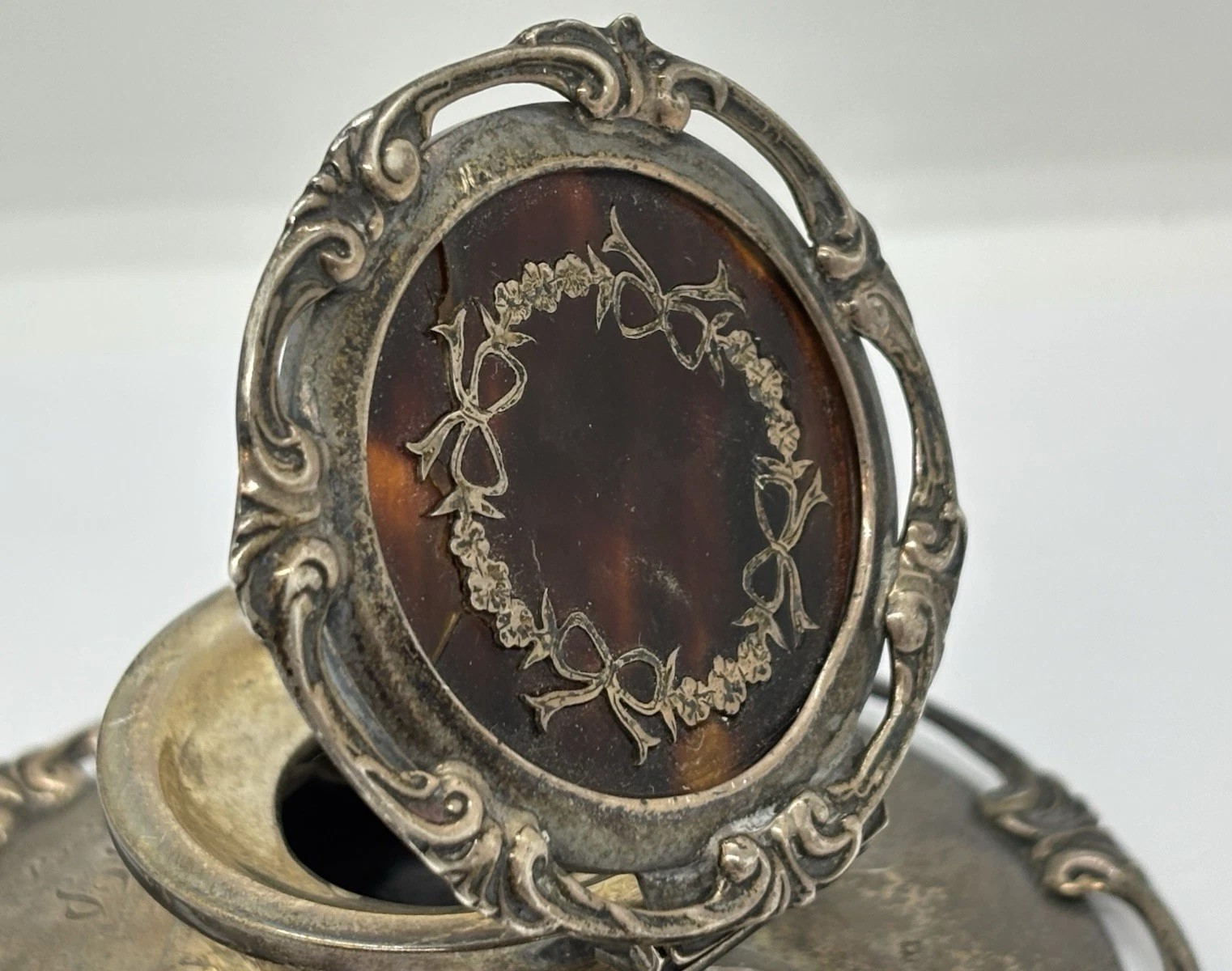
The lid features a genuine tortoiseshell medallion decorated with piqué work. The design depicts a neoclassical floral wreath tied with four distinct ribbon bows.
The process of piqué involved several meticulous steps:
- Softening: The organic tortoiseshell was heated in boiling water or oil until it became soft and pliable.
- Inlaying: While the shell was soft, an artisan would press pre-cut pieces of silver sheet or wire into the surface.
- Locking: As the tortoiseshell cooled, it naturally contracted and hardened, permanently “locking” the silver design into the material without the use of glue or fasteners.
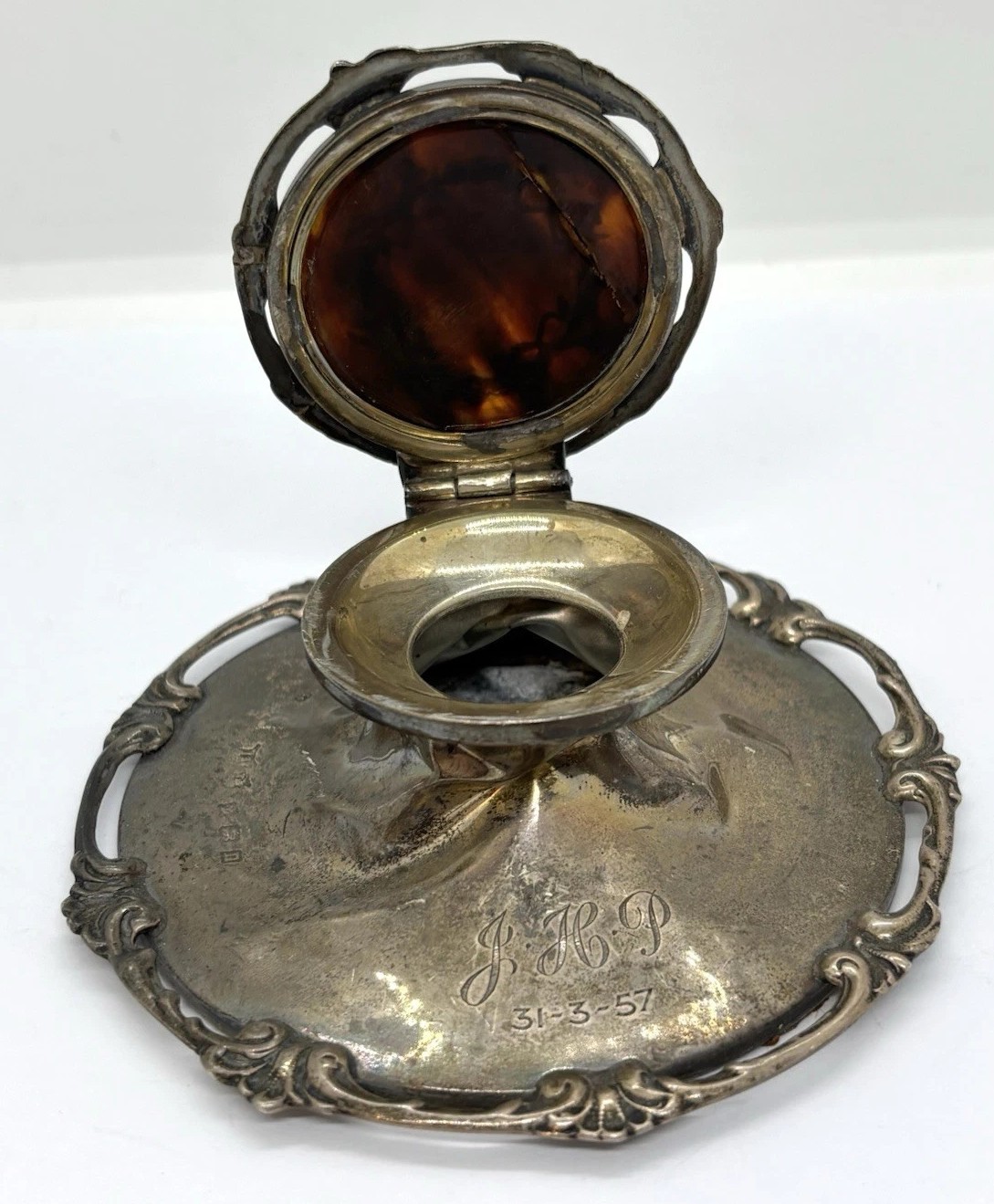
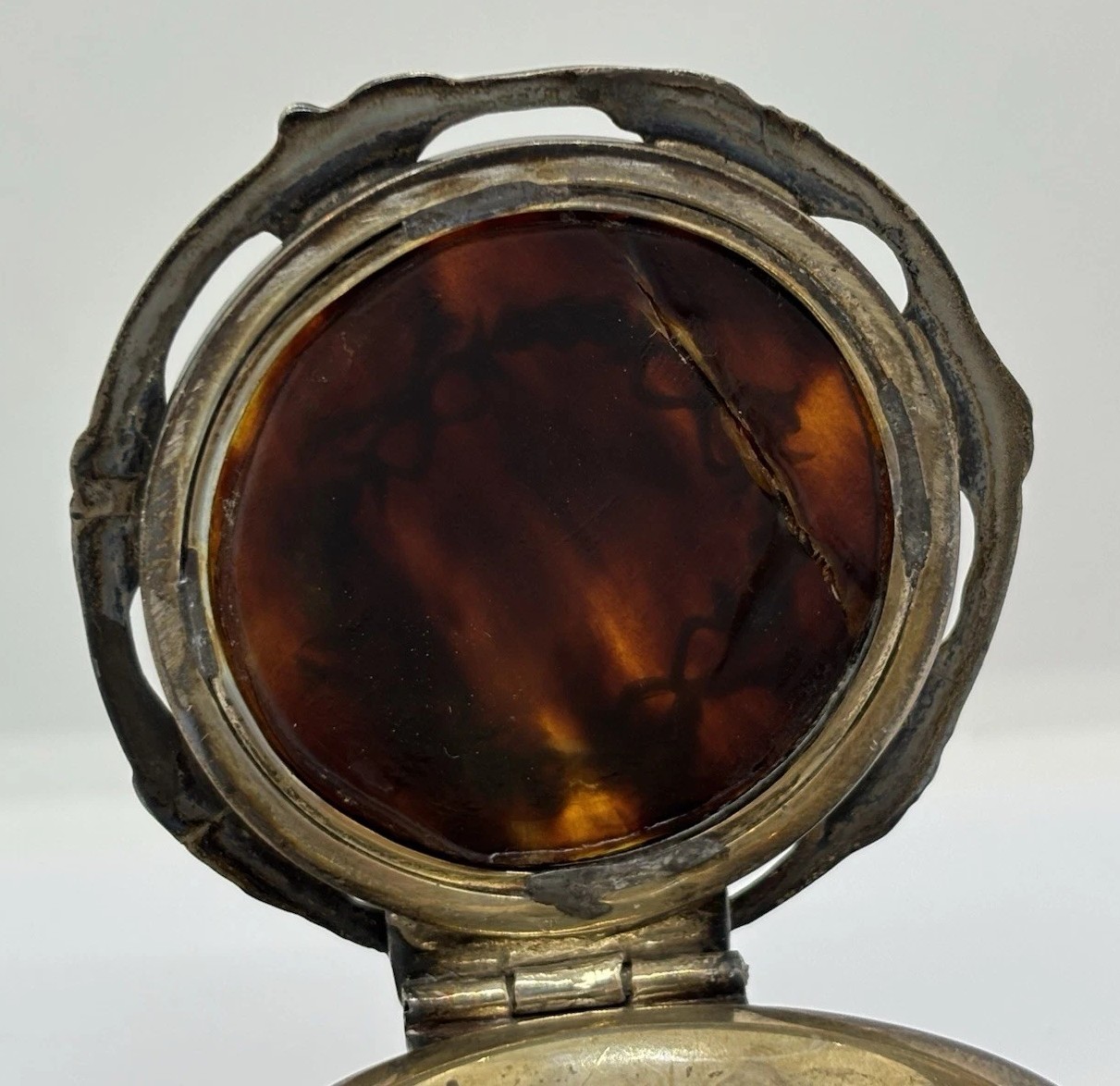
- Condition Note: You can see the authenticity of the material in the characteristic reddish-brown mottling and a natural stress crack visible on the underside of the lid.
Additional Physical Features
- The Base: The sloping circular base is finished with a pierced scroll and foliate border.
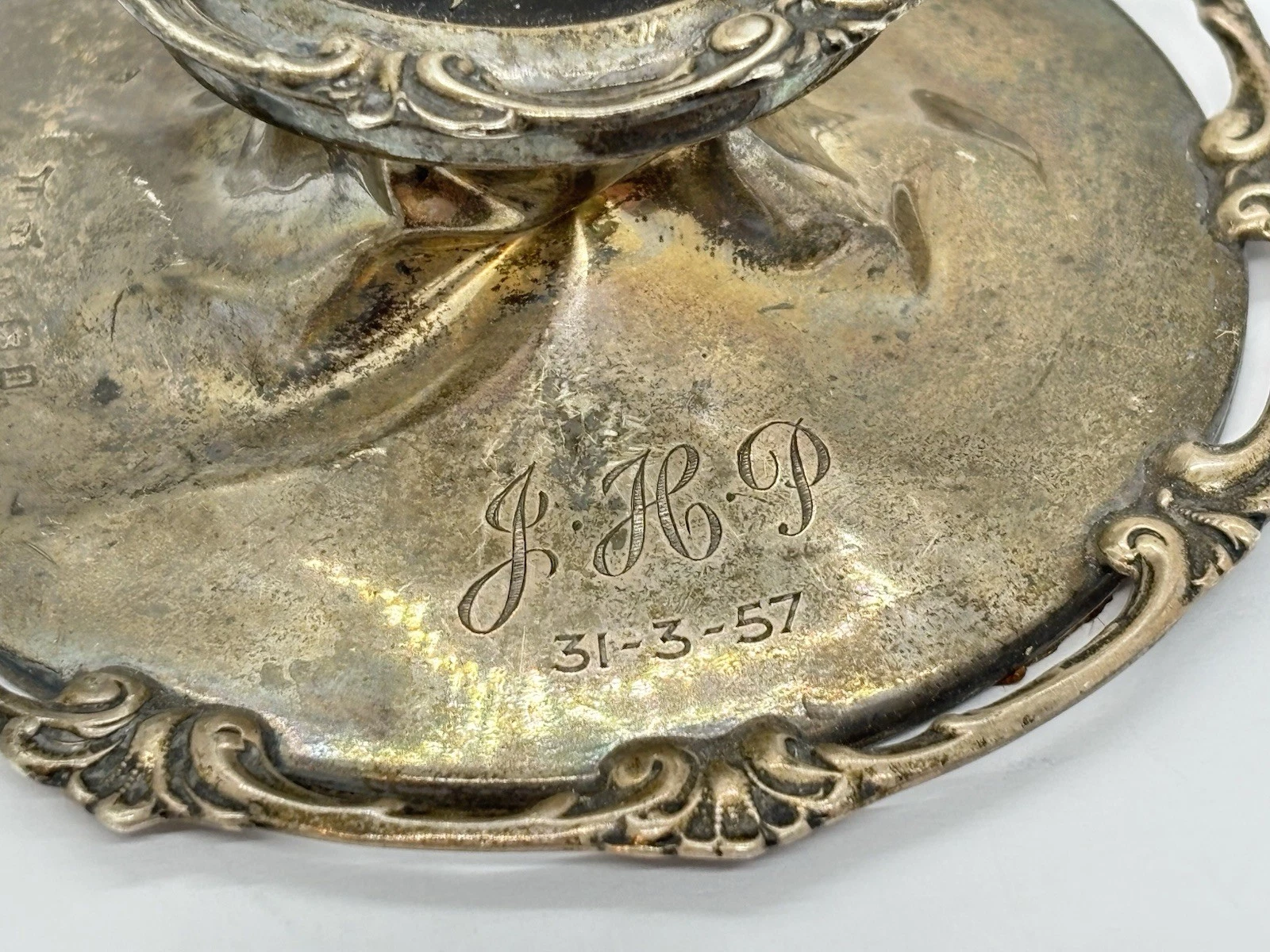
- Engraving: The front of the base is professionally engraved with the initials “J.H.P.” and the date “31-3-57”, likely indicating it was given as a commemorative gift.
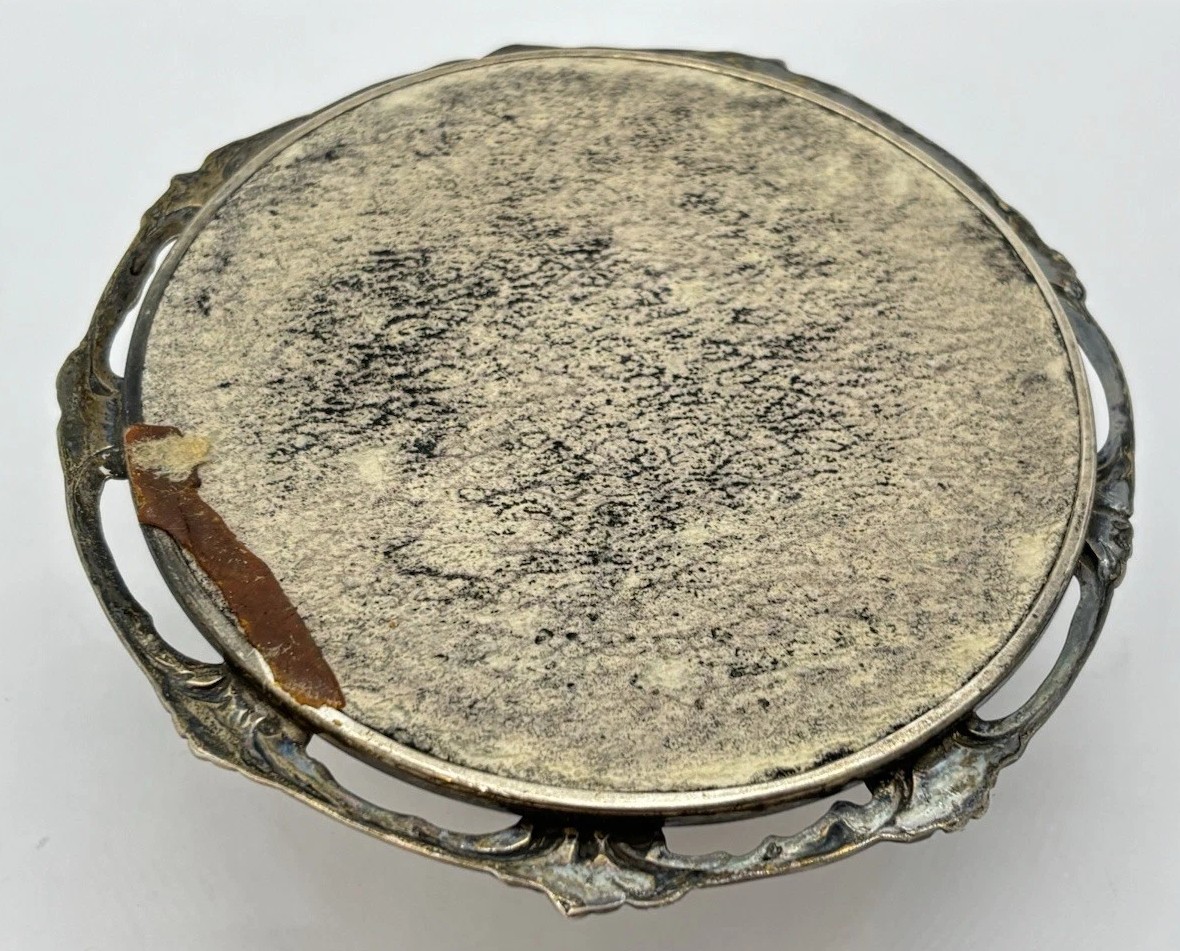
- Construction: The underside is weighted and finished with a leatherette pad to provide stability on a writing desk. The interior is missing its glass insert.
Levi & Salaman Historyu
Levi & Salaman was a prominent and highly successful firm of manufacturing silversmiths based in Birmingham, England, specifically known for their high-quality “small-work” and luxury novelties.
Founding and Early Growth
The company was established in 1870 by Phineas Harris Levi and Joseph Wolff Salaman.
- Early Production: The firm initially focused on manufacturing gilt costume jewelry but quickly transitioned into more expensive silver jewelry and luxury goods.
- Acquisition of Potosi Silver: In 1878, the partners expanded their business by purchasing the Potosi Silver Co., a small specialist in silver-plated flatware (spoons and forks).
- The Potosi Works: By 1885, demand for their work necessitated a move to larger premises on Newhall Street, which they named the “Potosi Works”.
Evolution of the Firm
The partnership lasted for forty years until a major reorganization in the early 20th century:
- Conversion to “Ltd”: Following the death of Phineas Harris Levi in 1910, the business was converted into a limited liability company, Levi & Salaman Ltd.
- Leadership: The new board consisted of the surviving founder, Joseph Salaman, alongside Clive Joseph Levi (the son of Phineas) and Lewis Henry Salaman.
- Amalgamation: In 1921, the company and its subsidiary, Potosi Silver, were merged with another famous Birmingham firm, Barker Brothers (Silversmiths) Ltd.
Specialties and Artistic Style
Levi & Salaman was particularly renowned for their skill in producing detailed, imaginative, and collectible “small silver” items.
- Novelty Items: They are famous for their novelty pin cushions, which were often modeled in the shapes of animals (such as pigs, rhinoceroses, and camels), shoes, or motor cars.
- Souvenir Ware: The firm produced a vast array of souvenir spoons and novelty pieces for the tourist market during the late Victorian and Edwardian eras.
- Dressing Table Sets: They were specialists in luxury desk and vanity accessories, frequently combining sterling silver with enamel or piqué-work tortoiseshell.
Tortoiseshell Piqué Work
This inkwell is an excellent example of a style they were specifically known for during the Edwardian era (1901–1910) and the following years.
- Process: Piqué work involved heating genuine tortoiseshell until it was malleable and then pressing silver (or gold) wire or sheet into the surface.
- Refined Design: Levi & Salaman often utilized classical Neoclassical motifs for their piqué designs, such as the floral wreaths and ribbon bows seen here, to create a sophisticated and tactile luxury product.
Sold for $86 in January 2026
Content disclaimer. The information posted is the owner’s best knowledge and may not have been vetted by the SOIC. We welcome comments, corrections, and additions, working to make our website information comprehensive and accurate.
Join the Society of Inkwell Collectors (SOIC) – it’s free!
Founded in 1981 as a non-profit organization,
we are documenting inkwells (and accessories).
We’re here to help and inform!