





Sterling Presentation Inkstand – P.S.A. (Pleasant Sunday Afternoon) Society
| Categories | Presentation Piece |
| Material | Glass, Silver |
| Markings | See Narrative |
| Manufacturer | Charles Boyton II |
| Origin | England |
| Date or Era | circa 1897 |
| Measuring | Diameter: 8 ⅛”; 3 ½” high |
This is a magnificent example of Late Victorian sterling silver, showcasing the ornate repoussé technique. The inkstand combines exceptional silversmithing with a documented piece of British social history.
Description
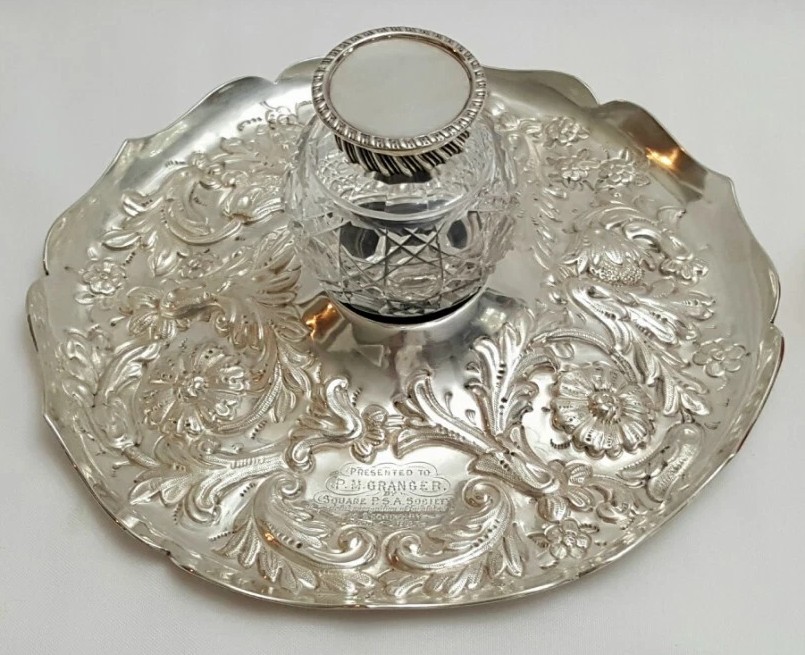
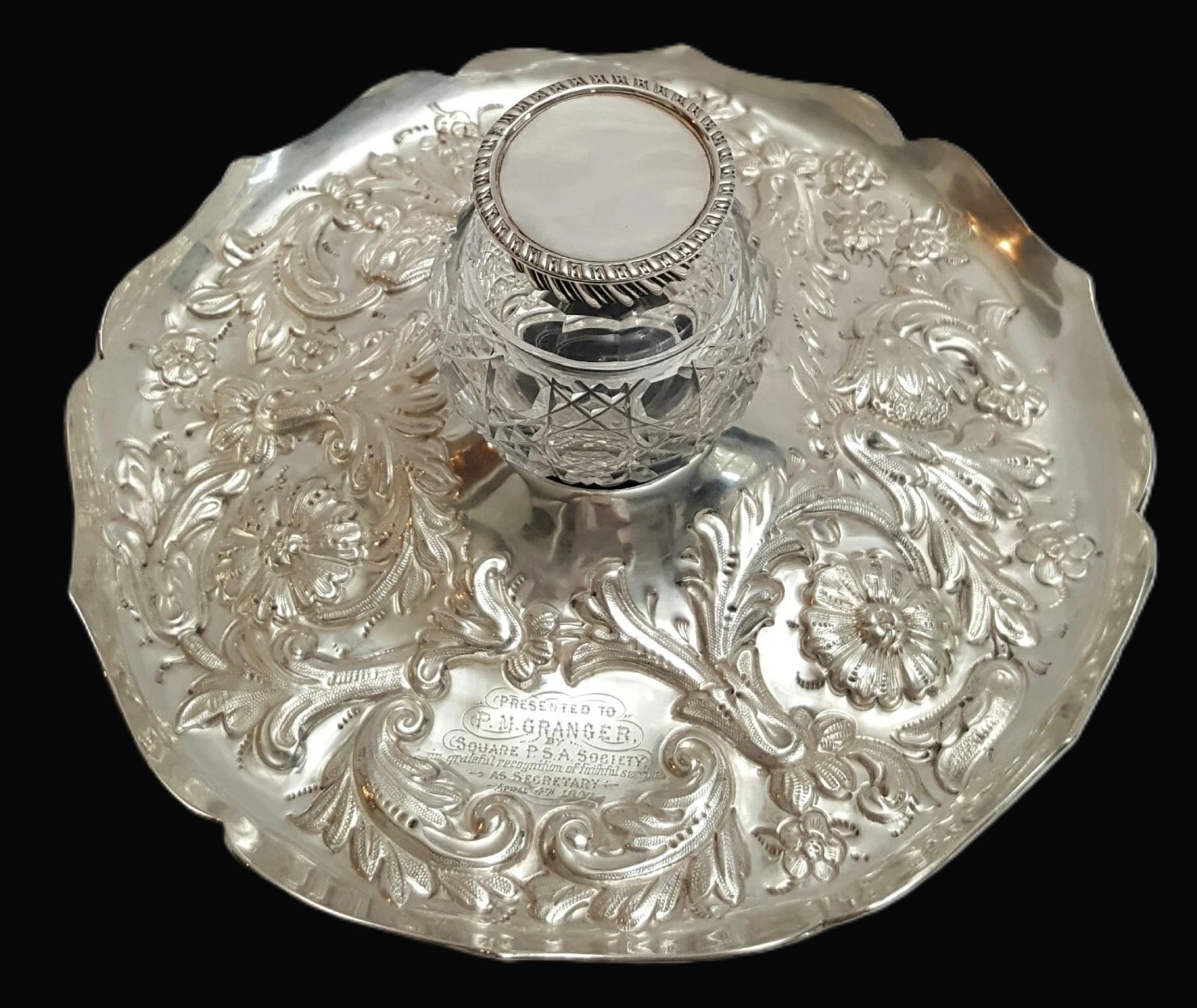
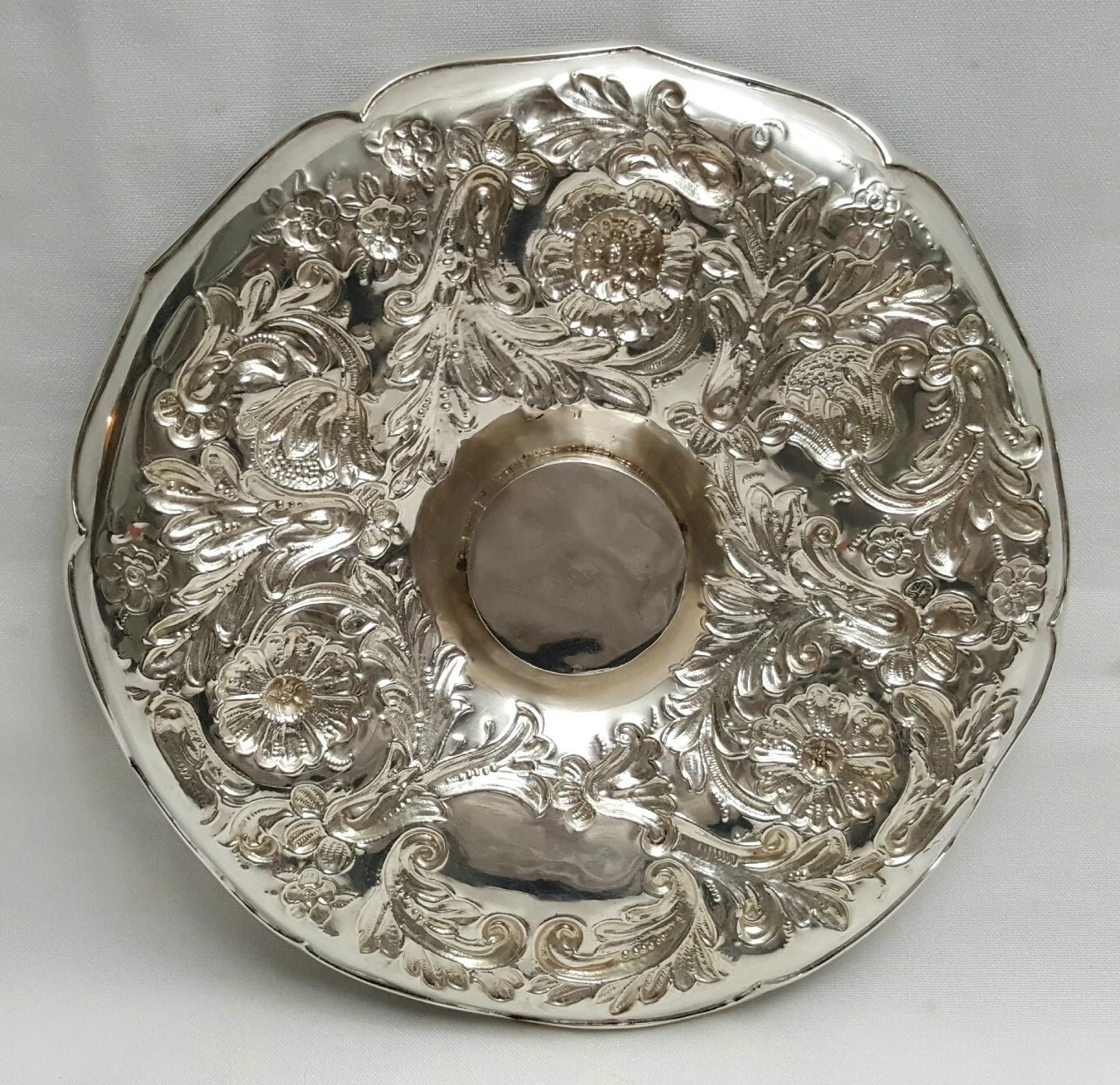
The inkstand is designed as a wide, circular tray with a raised central mount for a single inkwell.
- Repoussé Detail: The tray is decorated in deep relief with an elaborate foliate and floral pattern. The design features large, blooming chrysanthemums or dahlias intertwined with scrolling acanthus leaves and smaller wildflowers.
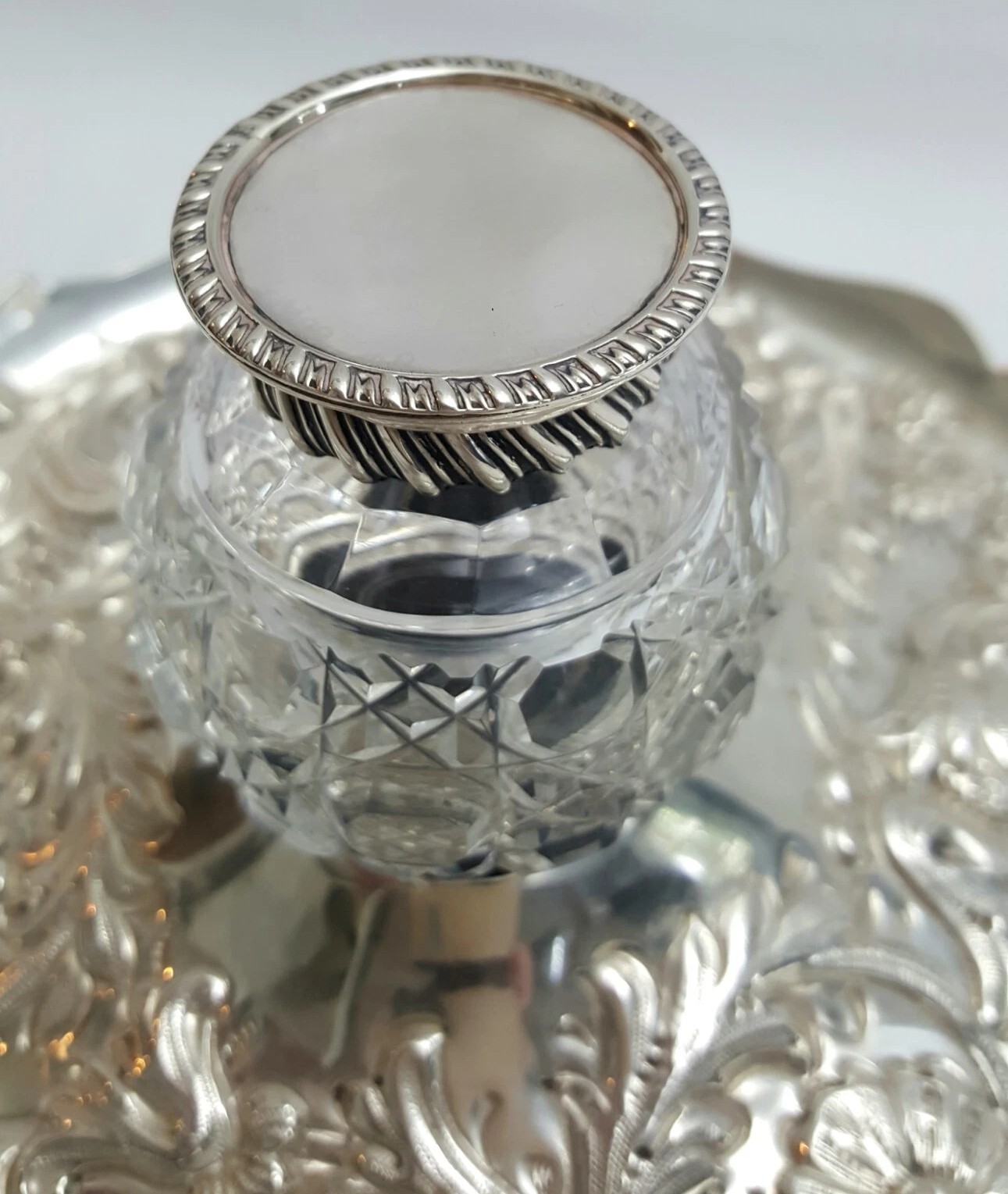
- The Inkwell: A spherical, heavy cut-crystal inkwell sits in the center. It is topped with a sterling silver lid that features a matching gadrooned (rope-twist) border.
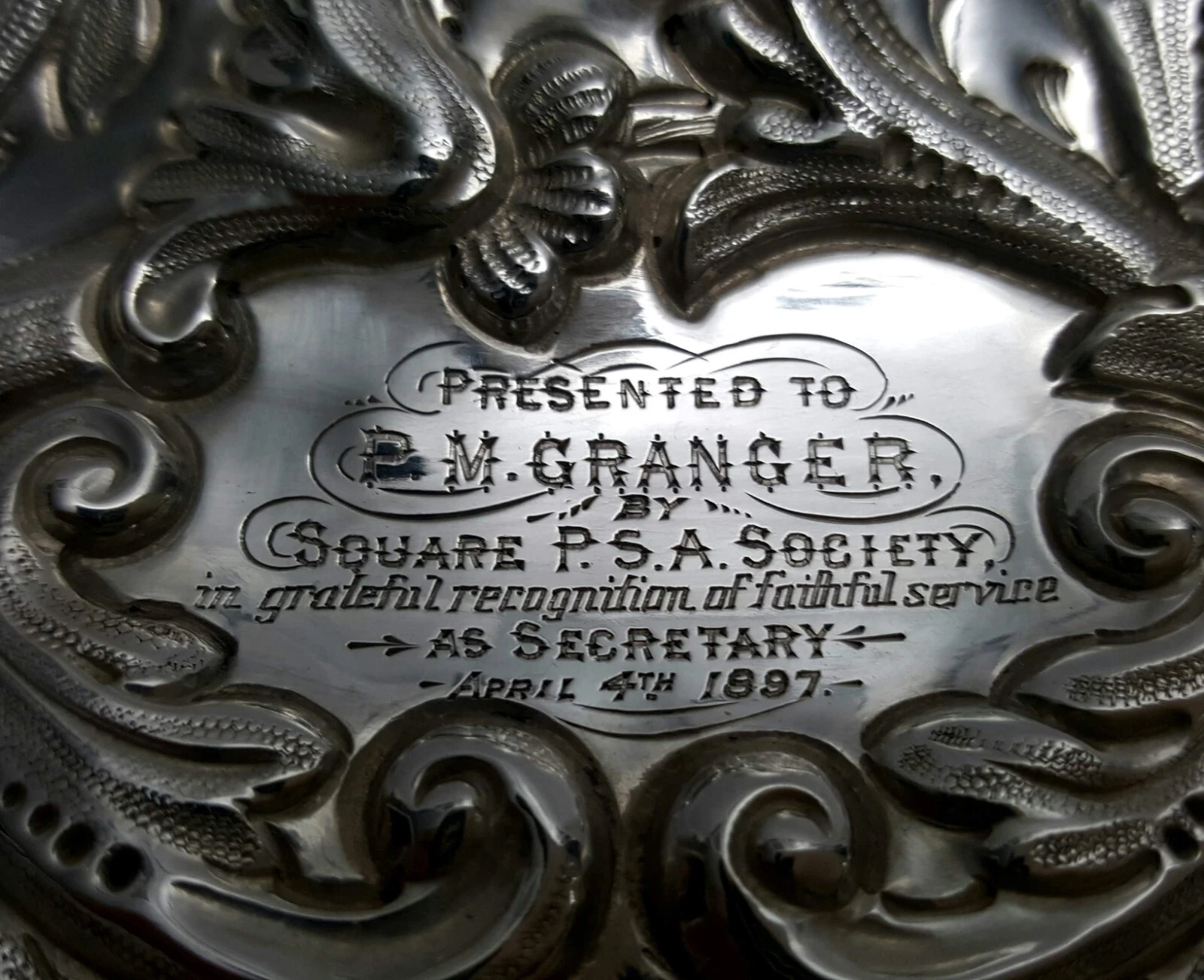
- Presentation Cartouche: At the base of the tray, the foliate pattern parts to reveal a smooth, polished cartouche containing a professional copperplate engraving.
The Hallmarks and Maker
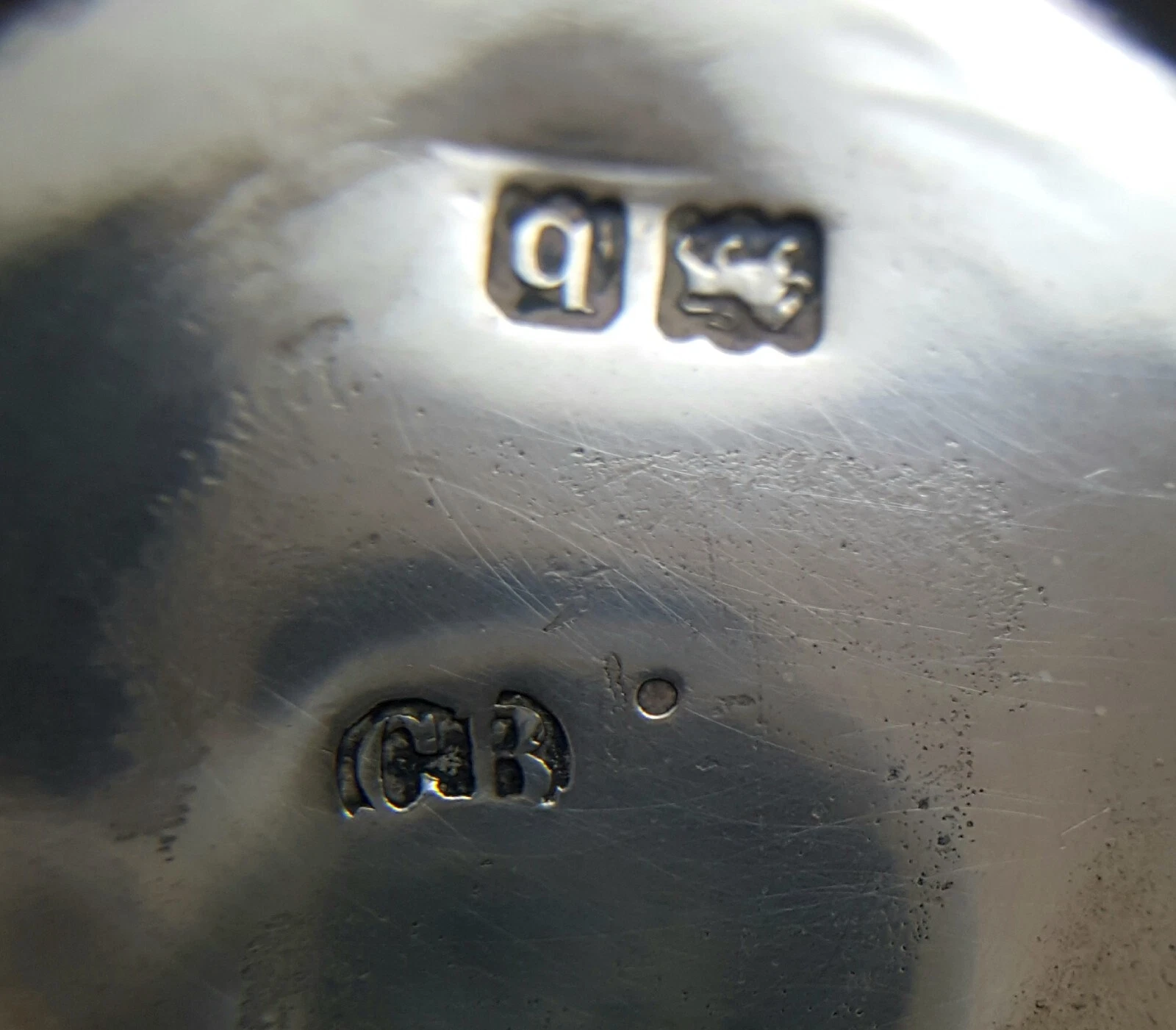
The piece bears clear British hallmarks on the tray and inside the lid:
- Maker’s Mark (“CB”): This identifies the silversmith as Charles Boyton II, a prominent London manufacturer known for high-quality decorative plate.
- Lion Passant: The mark for Sterling Silver (.925 purity).
- Leopard’s Head: The assay office mark for London.
- Date Letter (“a”): This lowercase letter in a shield corresponds to the London assay year of 1896–1897.
The Presentation Engraving
The engraving provides a specific historical context:
“Presented to P.M. Granger, by Square P.S.A. Society, in grateful recognition of faithful service as secretary, April 4th 1897.”
The Organization: Square P.S.A. Society
The P.S.A. (Pleasant Sunday Afternoon) movement was a major social and religious phenomenon in late-Victorian Britain.
- Philosophy: Founded on the motto “Brief, Bright, and Brotherly,” the PSA sought to provide a welcoming alternative to formal church services for working-class men. Meetings typically featured music, secular lectures on social ethics, and communal fellowship rather than strict liturgy.
- The “Square” Connection: The name refers to the Square Congregational Church in Halifax, West Yorkshire. Known locally as “Crossley’s Cathedral” because it was funded by the industrialist Crossley family, it was one of the largest and most influential Nonconformist churches in northern England.
- Social Impact: The Square PSA was a particularly large and active chapter. Receiving a substantial sterling silver gift like this suggests that the recipient, P.M. Granger, was a central figure in the church’s community work during a time when Halifax was a powerhouse of the textile industry.
P.M. Granger: The Secretary
As the Secretary of the Square PSA Society, P.M. Granger would have been responsible for the daily administration of the society’s massive membership, organizing weekly programs, and managing its social welfare initiatives.
- The Presentation: The date April 4th, 1897, marks the specific occasion when the Society gathered to honor his “faithful service”. In the hierarchy of Victorian presentation gifts, a sterling silver inkstand by a prestigious London maker was a high-honor token, indicating deep respect and possibly a long tenure in his role.
The Ceremony: April 4th, 1897
The date on this inkwell—April 4th, 1897—was a Sunday. This was the primary meeting day for the P.S.A. (Pleasant Sunday Afternoon) societies.
- The Venue: The presentation likely took place in the schoolroom or the main hall of the Square Congregational Church in Halifax.
- The Atmosphere: Meetings were known for being “packed to the rafters” with working-class men from the local textile mills. A presentation to a long-serving secretary would have been a major highlight of the afternoon’s program, likely accompanied by a brass band or choral performance.
Who was P.M. Granger?
While “P.M. Granger” was a local Halifax resident, his role as Secretary was arguably the most demanding position in a P.S.A. society.
- Administrative Load: He would have managed a membership that, for a church as large as “The Square,” likely numbered in the high hundreds or even thousands.
- Social Welfare: Secretaries of these societies often ran “Slate Clubs” (sick pay and burial funds), which were essential social safety nets for Victorian workers before the advent of the modern welfare state.
The Man Behind the Inkstand: Percy M. Granger
Based on the census data, here is a profile of the man who likely received your gift:
- Profession: In the 1891 Census, he is listed as a Commercial Clerk, and by 1901, he had advanced to a Cashier for a local firm.
- Significance: This profession fits the “Secretary” role perfectly. Commercial clerks and cashiers in Victorian Halifax were highly literate, detail-oriented, and often served as the backbone of local voluntary organizations like the P.S.A.
- Home Life: He was born around 1866, making him approximately 31 years old when he received the inkstand in 1897. He lived in the central Halifax district, within easy walking distance of the Square Road Congregational Church.
A Connection to the “Square”
The Square Road Congregational Church was the spiritual and social center for many of Halifax’s professional clerks and middle-class tradesmen.
- The PSA Secretary’s Role: As a cashier by day, Granger would have possessed the exact organizational skills required to manage the PSA’s complex “Slate Club” (savings and insurance fund).
- The Society’s Gratitude: The gift of a sterling silver inkstand by a London maker was not just a “thank you”; it was a significant investment. In 1897, such a piece could cost several weeks’ salary for a clerk, indicating that the Society’s hundreds of members likely pooled their small change to honor him.
Historical Perspective
When Percy M. Granger dipped his pen into those crystal wells, he was likely recording the minutes of meetings that discussed the burning social issues of the day—workers’ rights, temperance, and the booming textile economy of Halifax. The inkstand represents the exact moment when the “Brotherhood” of the PSA was at the peak of its influence in British society.
The Significance of the Gift
Commissioning a custom-engraved piece from a London silversmith like Charles Boyton II was an intentional choice.
- Status: It signaled that the Society had significant funds and wished to provide a gift of “metropolitan quality”.
- Utility: An inkwell was the standard gift for a Secretary, symbolizing the countless hours of correspondence and record-keeping he performed for the “brotherhood”.
The “Square” Legacy
The church itself, designed by architect Joseph James and finished in 1857, was a Gothic masterpiece. Though the main church building was tragically destroyed by fire in the 1970s, the Square Chapel (the smaller building next to it) still stands as an arts center today. This inkwell is one of the few surviving tangible links to the personal lives of the men who built that community.
The Silversmith: Charles Boyton II
The “CB” mark identifies the firm of Charles Boyton & Son, a prominent London silversmithing dynasty founded in 1825.
- Management: At the time this inkstand was assayed (1896/1897), the firm was under the management of Charles Boyton II, the son of the founder. He led the company during a period of significant growth and reputation-building until his death in 1899.
- Workshop: The firm operated out of a workshop in Northampton Square, Clerkenwell, a historic hub for London’s clock making and silver trades.
- Reputation: Boyton was renowned for producing high-quality Victorian flatware and decorative hollowware. His work often featured the deep relief and ornate floral motifs seen in this piece, reflecting the late Victorian taste for heavy, tactile ornamentation.
Summary of the Piece
- Assay Year: 1896 (Letter “a”)
- Assay Office: London (Leopard’s Head)
- Provenance: Halifax, West Yorkshire (Square Congregational Church)
Sold for $475 in January 2026
Content disclaimer. The information posted is the owner’s best knowledge and may not have been vetted by the SOIC. We welcome comments, corrections, and additions, working to make our website information comprehensive and accurate.
Join the Society of Inkwell Collectors (SOIC) – it’s free!
Founded in 1981 as a non-profit organization,
we are documenting inkwells (and accessories).
We’re here to help and inform!