


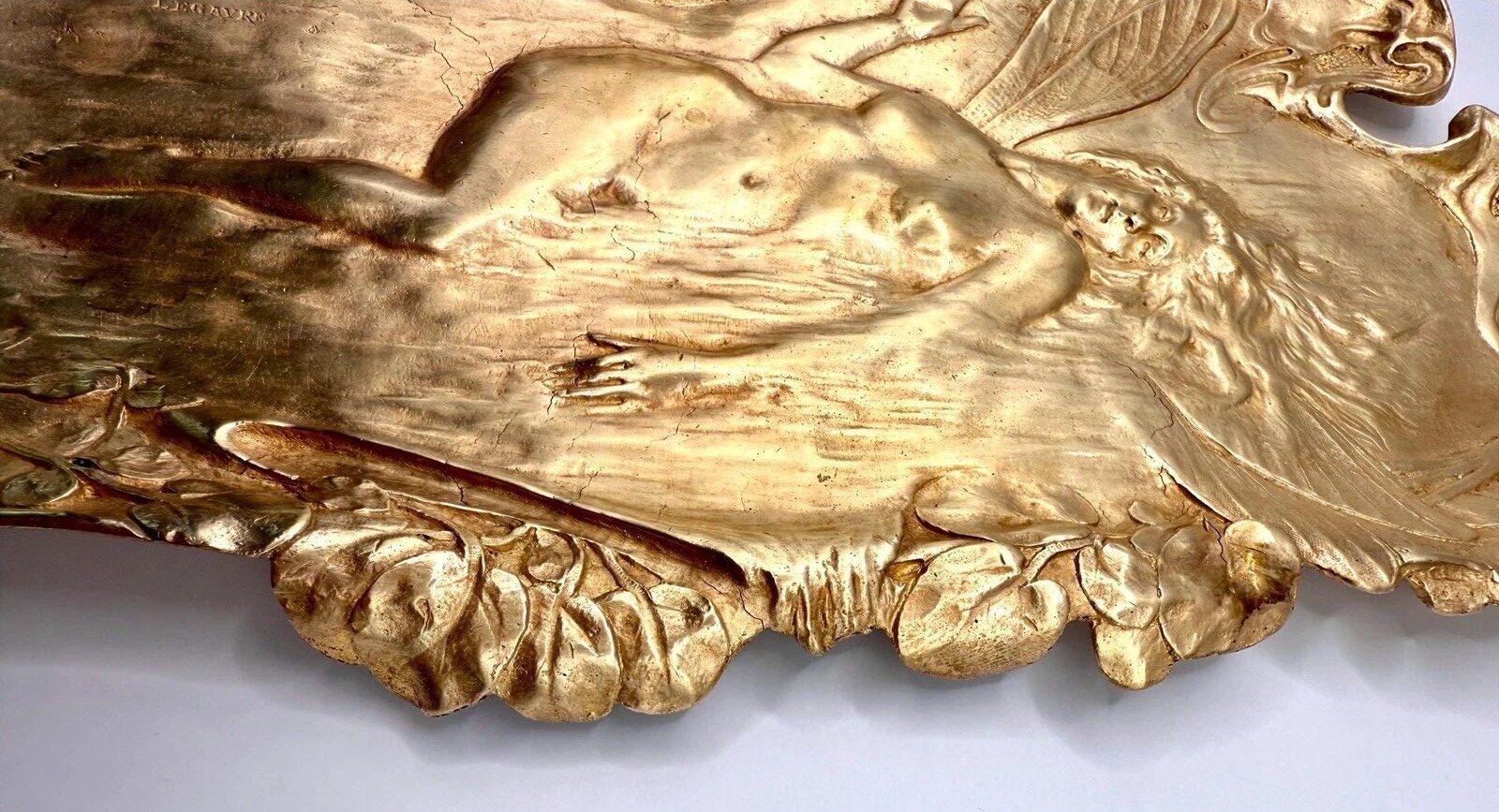


Winged Nymph Inkstand
| Categories | Art Nouveau, Presentation Piece |
| Material | Gilt Bronze |
| Markings | See Narrative |
| Manufacturer | Undetermined |
| Origin | France |
| Date or Era | circa 1906 |
| Measuring | 12 ¼” x 8 ⅝” |
This Art Nouveau inkstand exemplifies the Belle Époque’s fascination with nature and the “ethereal feminine.”
The Figure: Nymph
The focal point is a winged nymph (often called a “fairy” in modern descriptions). In Art Nouveau iconography, these figures represent the fusion of womanhood and nature. Her wings are reminiscent of a dragonfly or butterfly, and she appears to be emerging from or floating upon a stylized pond, surrounded by flowering botanicals (possibly water lilies or cyclamen) and the signature “whiplash” curves of the era.
The Inscription: “Souvenir des Noces d’Argent”
- Language: French.
- Translation: “Souvenir of the Silver Wedding [Anniversary], 1906, Legavre.”
- Meaning: This piece was a commemorative gift for a 25th wedding anniversary (Noces d’Argent) celebrated in 1906.
- “Legavre”: This is likely the surname of the couple who received the gift or the family who commissioned it. It is a common French surname, particularly in northern France.
The Artist and Signature
The signature on the lower edge reads “Jacq. Callot”.
- The Identity: There is a famous historical Jacques Callot (1592–1635) who was a master printmaker. However, this inkstand is clearly from the Art Nouveau period (c. 1890–1910).
- The Connection: It was common for 19th-century metalworkers and foundries to use names of historical masters as a “signature style” or for artists with the same surname to work in the decorative arts. There are records of a Jacques Callot (sometimes listed as J. Callot) who produced small Art Nouveau bronzes and decorative objects in France during this period.
- Style: The signature is rendered in a casual, incised script typical of bronze foundries or sculptors of the time who specialized in objets d’art.
Observations
- Material: It appears to be gilt bronze (bronze doré).
- Function: The circular opening at the top would have originally held a small glass or porcelain inkwell insert, which is now missing. The flat areas at the bottom were designed to serve as a pen rest.
Sold for $486 in January 2026
Content disclaimer. The information posted is the owner’s best knowledge and may not have been vetted by the SOIC. We welcome comments, corrections, and additions, working to make our website information comprehensive and accurate.
Join the Society of Inkwell Collectors (SOIC) – it’s free!
Founded in 1981 as a non-profit organization,
we are documenting inkwells (and accessories).
We’re here to help and inform!