




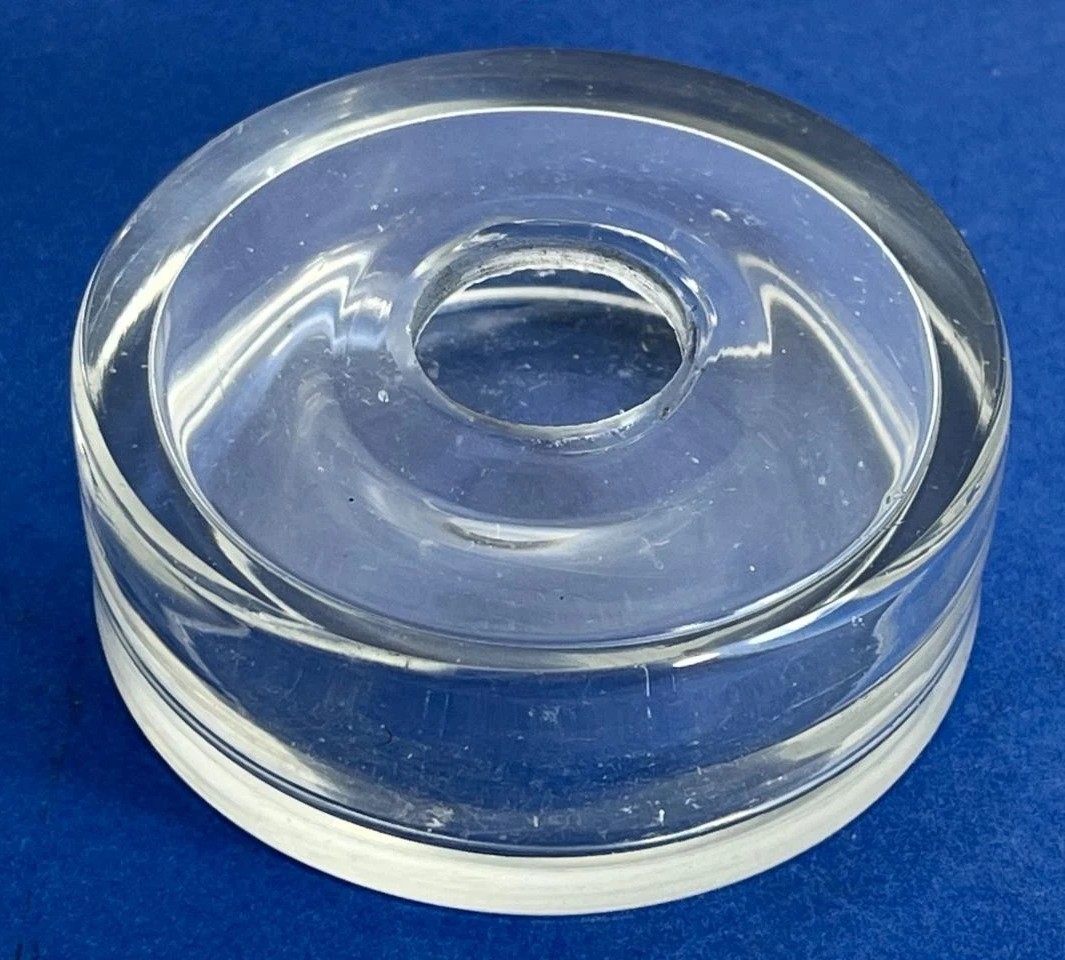
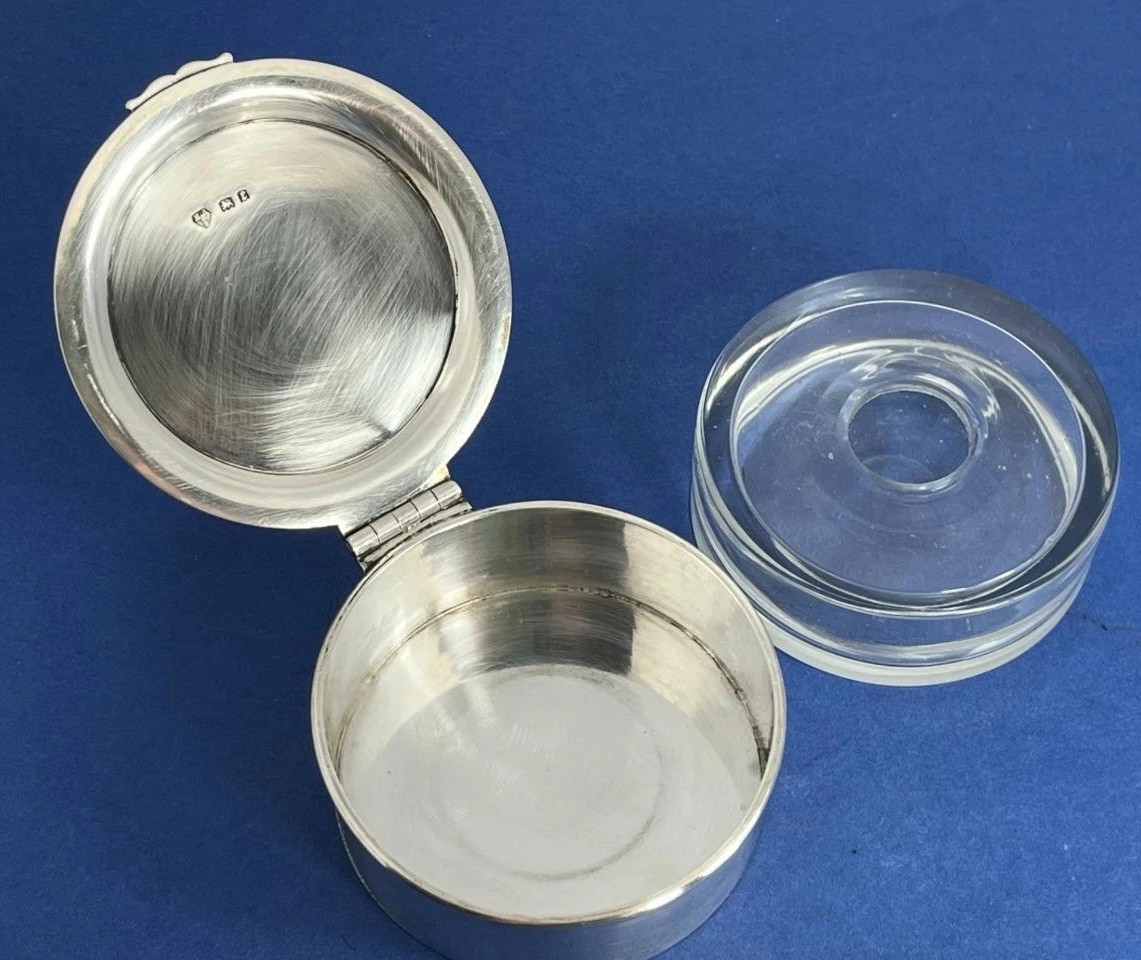
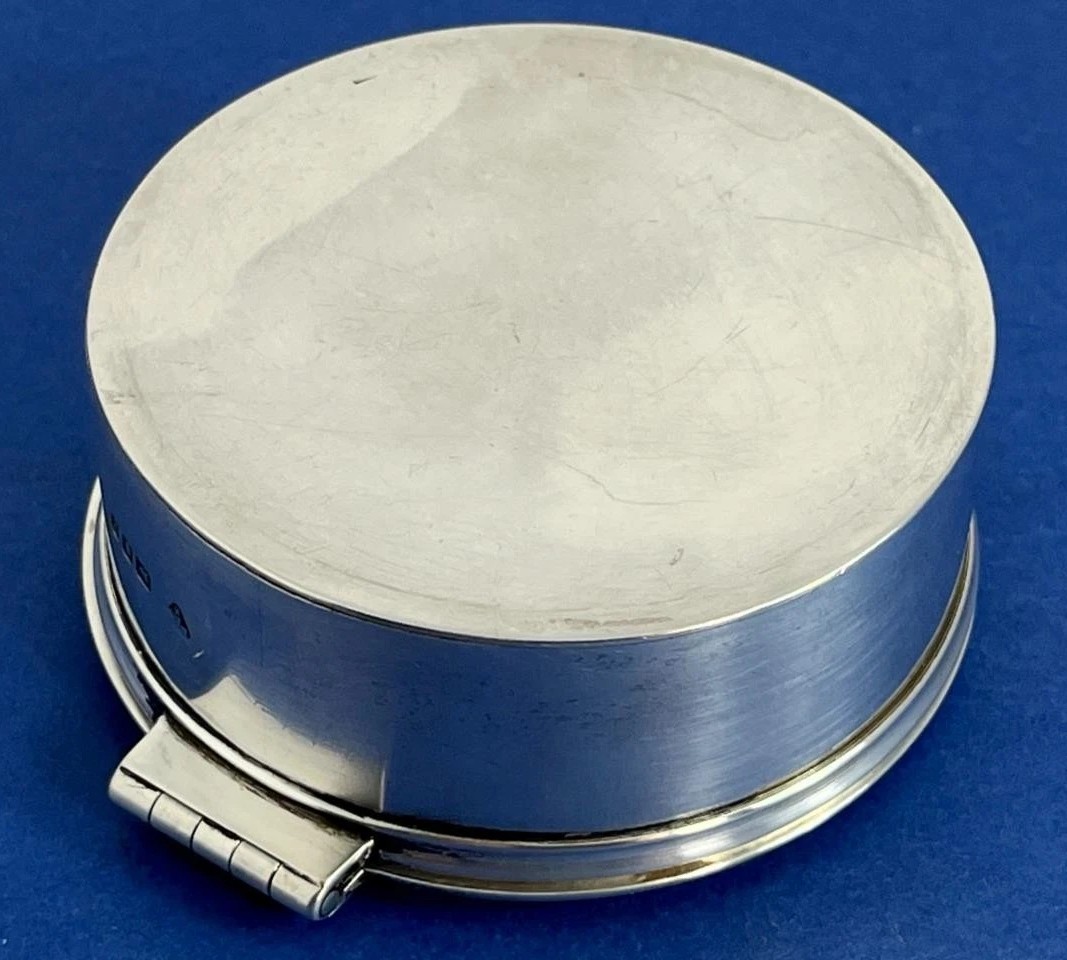
Hallmarked Silver Inkwell – Military Connection
| Categories | Presentation Piece |
| Type | Military |
| Material | Glass, Silver |
| Markings | See Narrative |
| Manufacturer | Holland, Aldwinckle & Slater |
| Origin | England |
| Date or Era | circa 1920 |
| Measuring | 3” diameter; 1 ⅜” high |
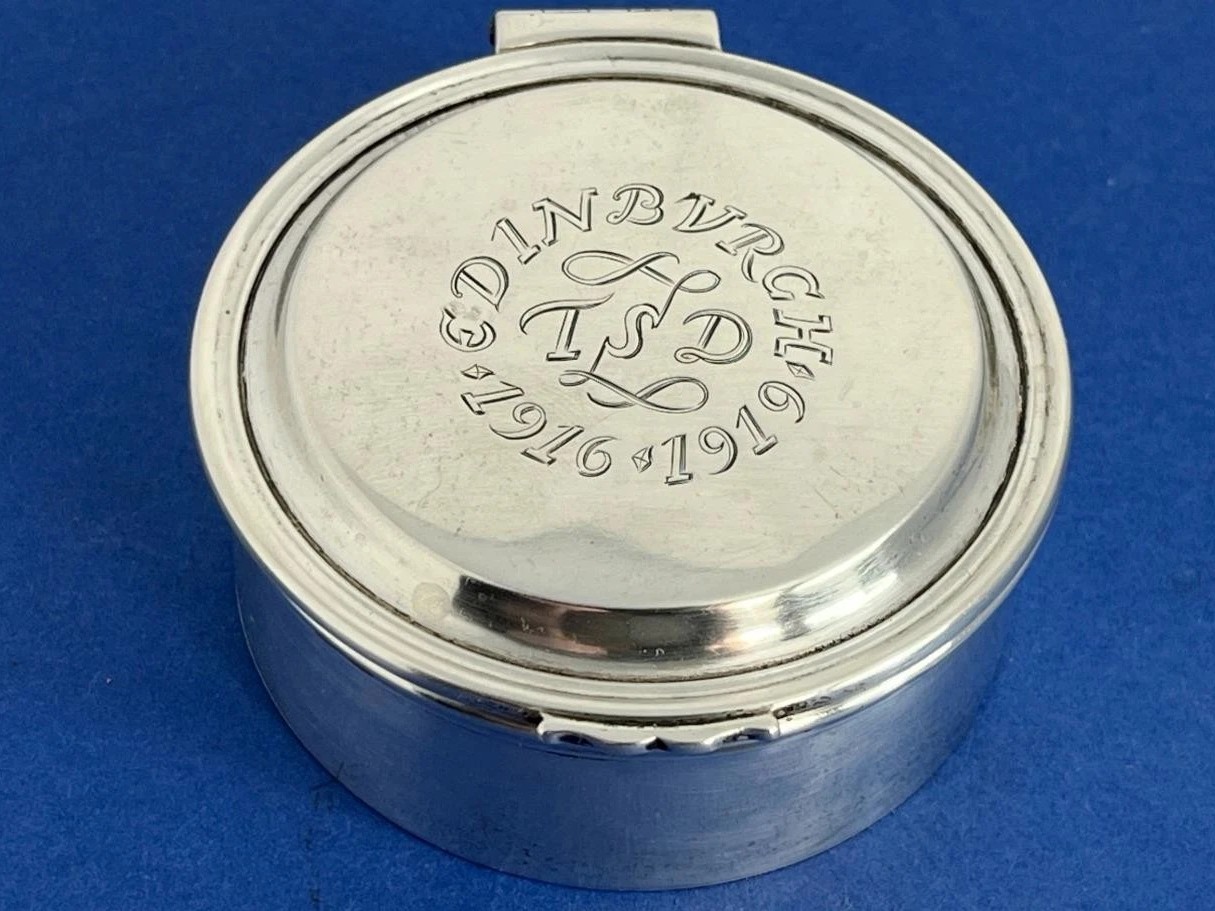
This George V-era sterling silver inkwell is a poignant historical artifact, blending the high-end craftsmanship of a premier London silversmith with a likely military or commemorative provenance from the First World War.
The Manufacturer: Holland, Aldwinckle & Slater
The hallmarks confirm the piece was produced by one of the most respected firms of the late 19th and early 20th centuries.
- The Maker: Holland, Aldwinckle & Slater was a high-status London firm known for their exceptional ecclesiastical and presentation silver. They often produced pieces for top-tier retailers like Garrard’s.
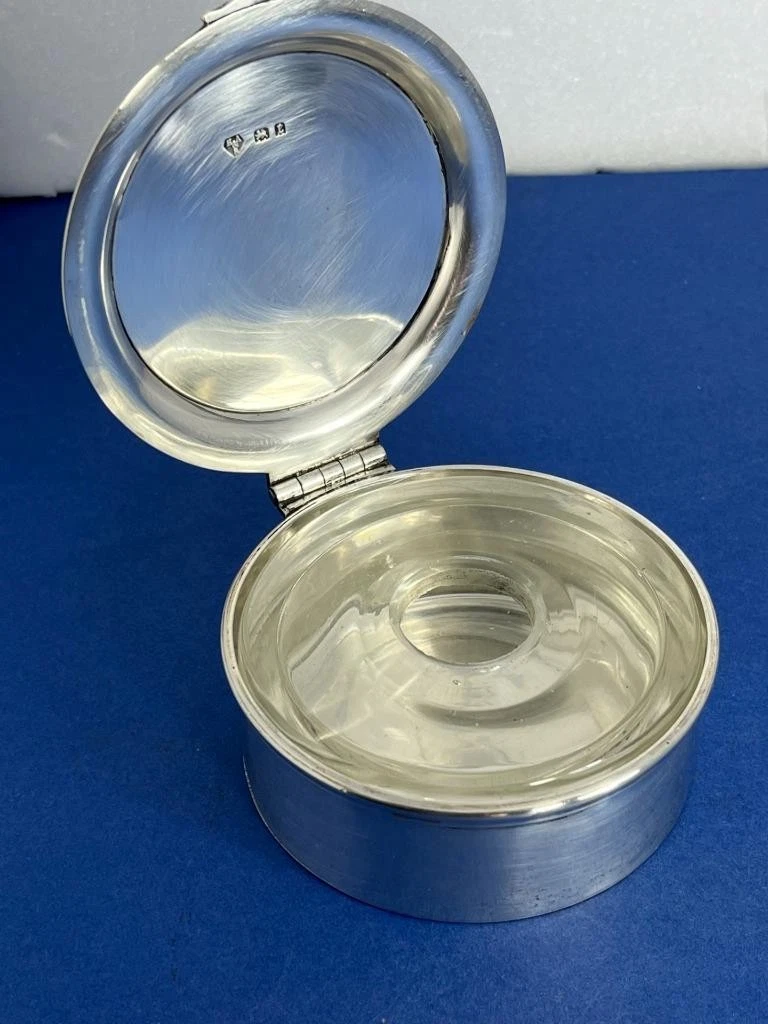
- Assay Marks: The piece bears the Leopard’s Head (London), the Lion Passant (Sterling purity), and the date letter “e” for the year 1920.
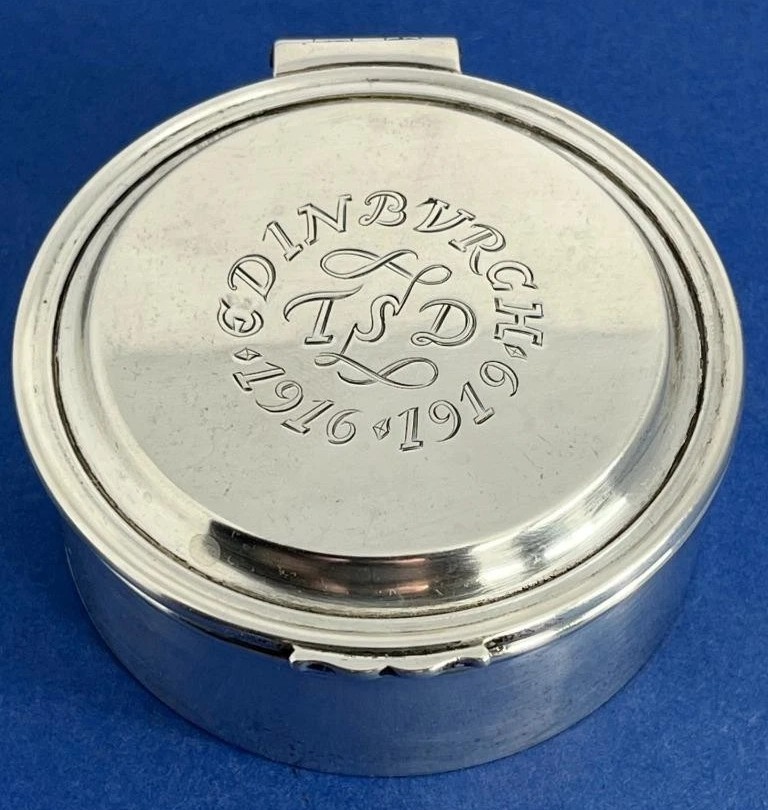
- Design: The glass reservoir is elegantly encased in a silver frame with a matching hinged lid.
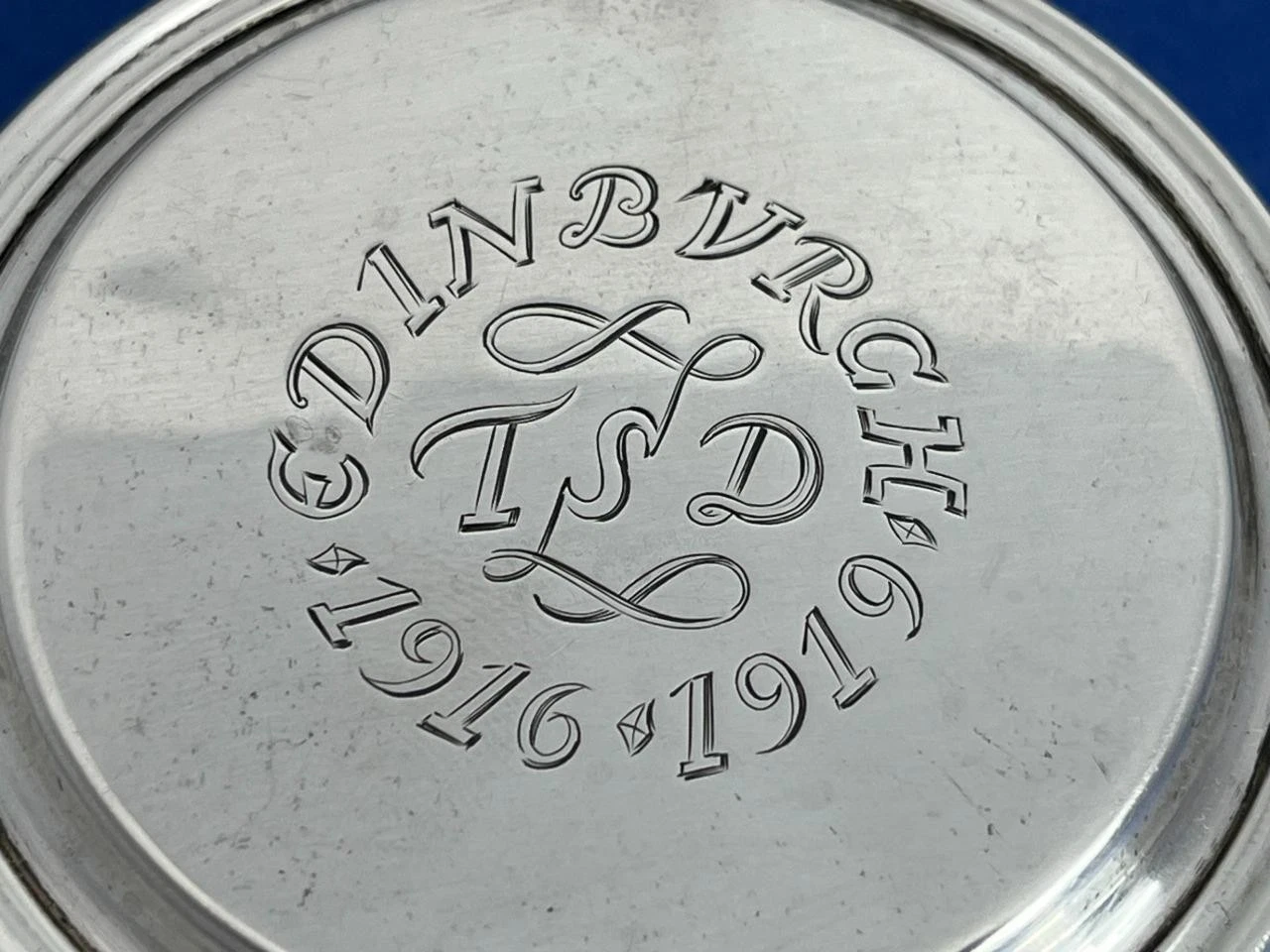
The Inscription: “Edinburgh 1916 – 1919”
The hand-engraved inscription and the initials “TSD” provide a lead for its historical context.
- The Military Connection: The dates 1916–1919 encompass the final years of World War I and the immediate post-war demobilization period. Edinburgh served as a vital naval and military hub during this time, notably housing the Royal Naval Air Service (RNAS) and the Redford Barracks.
- The Zeppelin Raid: On the night of April 2–3, 1916, Edinburgh was bombed by two German Zeppelins (L14 and L22), resulting in significant damage to the city and several casualties.
- Post-War Presentation: While the events occurred between 1916 and 1919, the silver was assayed in 1920. This indicates the inkwell was commissioned as a presentation gift shortly after the war ended, to honor the service of “TSD” in the city during those tumultuous years.
Historical Significance
The Timber Supplies Department (Departmental)
A possible explanation for the initials “T.S.D.” alongside “Edinburgh 1916–1919” is the Timber Supplies Department of the Board of Trade.
- The Role: During WWI, the TSD was responsible for sourcing the massive amounts of wood needed for trench shoring, telegraph poles, and fuel.
- Edinburgh Connection: The Home Grown Timber Committee (the precursor to the TSD) was headquartered in Edinburgh and led by Sir John Stirling Maxwell and John D. Sutherland.
- The Dates: The department was most active between 1916 and 1919, until it was transitioning its responsibilities back to civilian forestry (leading to the creation of the Forestry Commission in 1919).
- The Context: It was common for senior officials or “specialists” in these wartime departments to be presented with engraved silver upon the department’s dissolution or their departure in 1919.
Summary Table
| Detail | Identification |
| Maker | Holland, Aldwinckle & Slater (London) |
| Date Assayed | 1920 |
| Inscription | “Edinburgh 1916 – 1919 / TSD” |
| Probable Origin | Military or Civic Presentation for WWI Service |
Sold for $415 in January 2026
Content disclaimer. The information posted is the owner’s best knowledge and may not have been vetted by the SOIC. We welcome comments, corrections, and additions, working to make our website information comprehensive and accurate.
Join the Society of Inkwell Collectors (SOIC) – it’s free!
Founded in 1981 as a non-profit organization,
we are documenting inkwells (and accessories).
We’re here to help and inform!