

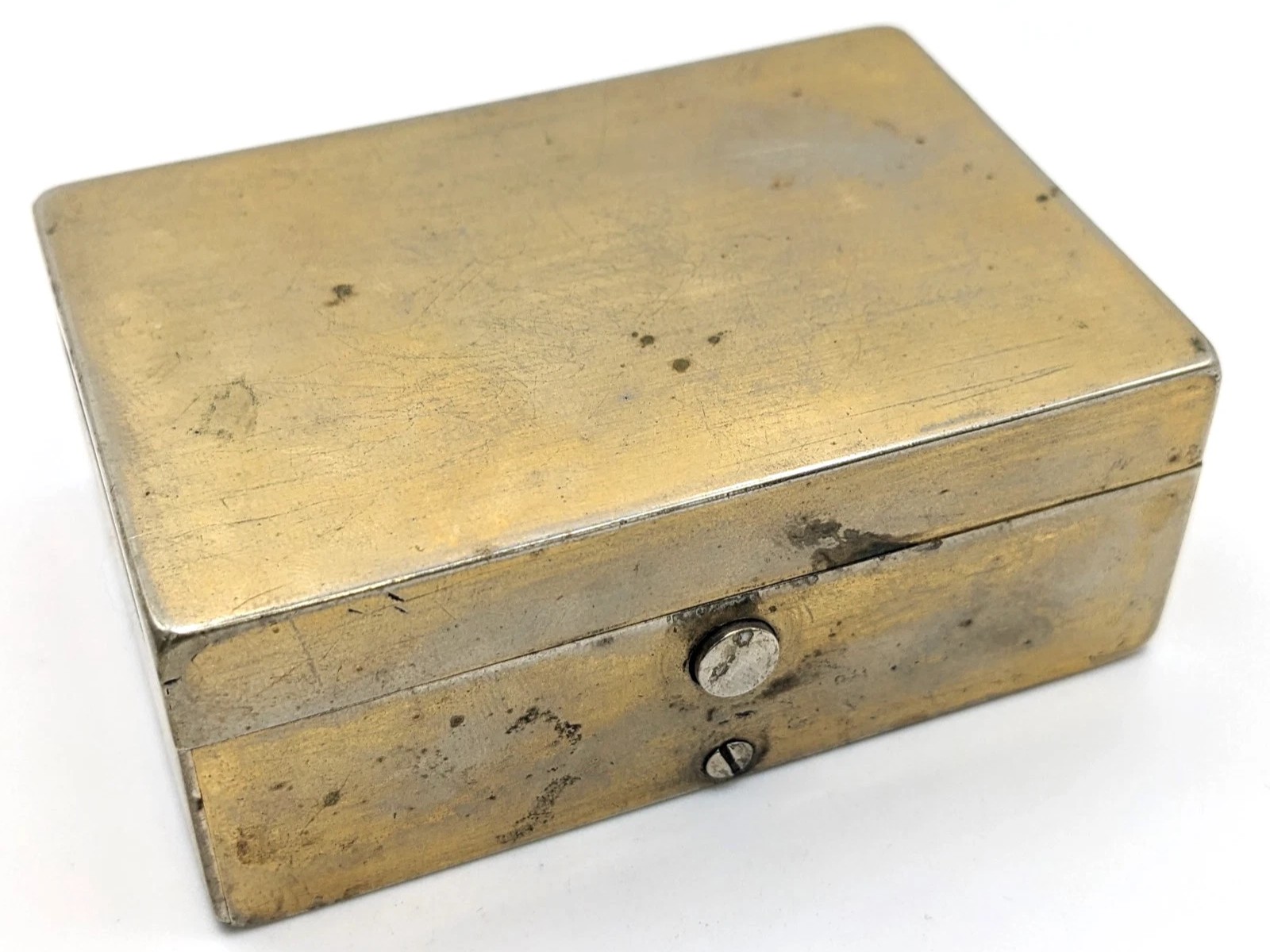


S. Mordan & Co. Traveling Writing Compendium
| Categories | Travel |
| Type | Compendium |
| Material | Brass |
| Markings | See Narrative |
| Manufacturer | Sampson Mordan & Co |
| Origin | England |
| Date or Era | circa 1870 |
| Measuring | 3 ¼” x 2 ¼” x 1 ½” high |
This is a high-quality, compact, and elaborate piece of antique writing equipment designed for travel or keeping in a pocket/desk drawer.
Detailed Description of the Piece
- Exterior: The case is rectangular and features a flat, hinged lid secured by a small push-button latch/opening mechanism on the front. It is made of brass, finished with a gold wash.
- Interior Features (The Compendium): The internal organization is designed to hold everything needed for writing on the go:
- Inkwell: A small, built-in ink reservoir with a round sealing lid attached to the external hinged lid, making the inkwell leak-proof when the case is closed.
- Storage Compartment: A covered rectangular area (ribbed metal plate) that flips open to reveal a storage space, likely for stamps, wafers, or small amounts of writing paper.
- Pen/Pencil Holder: A circular mount for the retractable pen.
- Fold-Out Side and Drawer: A section of the side panel folds out, revealing a pull-out drawer for small accessories (nibs, sealing wax, etc.) and an adjacent circular holder (possibly for a seal, a small candle for sealing wax).
- The Pen: Built into the lid is a telescopic (or extending/retractable) pen. The one pictured is silver-toned metal (likely silver or plated) and is marked: “S. Mordan & Co.”
The Maker: S. Mordan & Co. (Samson Mordan & Co.)
- Mordan & Co. is one of the most famous and respected names in the history of Victorian-era silver and gold-smithing, particularly for elaborate mechanical and novelty items.
- Founding and Specialty: The firm was founded in 1822 in London by Samson Mordan and his partner, John Isaac Hawkins. They specialized in mechanical pencils (patentable), high-end writing equipment, novelty silver objects, and luxury goods like this compendium.
- Reputation: The company was known for its high quality, ingenuity, and intricate mechanical designs – all of which are evident in this traveling inkwell. They often used silver, gold, and fine materials like agate, ivory, and exotic woods.
- Compendium Maker: S. Mordan & Co. almost certainly manufactured the entire compendium, including the case and the telescopic pen. They were masters of creating these complete, luxury writing sets. The inclusion of a pen explicitly marked with their name is an assurance of the piece’s maker.
Age Estimate
The period of S. Mordan & Co.’s greatest influence and the style of the compendium place it firmly in the Victorian era.
- Company Activity: Samson Mordan’s firm was operational from 1822 until the 1940s, but the design and complex brass/gilt mechanics of this compendium are typical of the firm’s output during the mid-to-late 19th century.
- Style and Materials: The use of a sealed inkwell, telescopic pen, and numerous hidden compartments reflects the high Victorian demand for ingenious, multi-purpose travel accessories.
- The Telescopic Pen: Mordan was famous for his propelling pencils and retractable pens, which peaked in popularity from the 1840s onward.
The most likely age range for your S. Mordan & Co. Traveling Writing Compendium is: circa 1850 – 1880.
The Patented Mordan Mechanism
Samson Mordan’s fame and fortune were largely built upon his mastery of mechanical writing instruments. This telescopic pen is a direct descendant of his initial patent.
- The Propelling Pencil Patent (The Foundation)
- The Key Invention: In 1822, Samson Mordan and his partner, John Isaac Hawkins, filed the first patent in Great Britain for a metal pencil with an internal mechanism for propelling the graphite (“lead”) shaft forward during use. This became known as the propelling pencil (or “ever-pointed pencil”).
- The Mechanism: Unlike earlier “leadholders” which just clamped the lead, Mordan’s design used a twist-screw mechanism (later followed by spring-loaded and ratchet systems) that continuously advanced the lead with each use. This meant the pencil never needed sharpening and allowed the user to wear the instrument down to the very last stub of lead.
- Adapting the Technology to the Pen
The telescopic pen contained in this compendium uses the same principles of compactness and precision as the propelling pencil, but for a pen holder:
- Telescopic Action: The pen in this compendium is “telescopic,” meaning it retracts and extends into itself. This is achieved via a sliding action, which is a variation of Mordan’s early mechanisms. For a traveling piece, this feature was essential for safety, portability, and neatness. When retracted, the nib is protected and the case remains compact; when extended, the pen achieves a comfortable writing length.
- The Oblique Pen: Mordan also worked with inventor William Brockedon and, in 1831, patented the oblique pen and pen holder. Mordan was constantly inventing and improving all aspects of steel pens and holders.
- Combination Pen/Pencil: The search results show Mordan also created combination units (pen and pencil in one) often using an unusual twist mechanism to propel one and retract the other. While this piece is a pen holder for a dip pen nib within a compendium, it shows Mordan’s commitment to ingenious, multi-function mechanical design.
- The Markings and Legacy
- “S. Mordan & Co.”: This marking was used after Mordan’s partnership with Gabriel Riddle ended in 1836, supporting the age estimate of 1850 to 1880. More specific markings like “S MORDAN & CO MAKERS” were used from 1845 to 1852, while the simpler “S MORDAN & CO” was used from 1853 to circa 1941.
- Victorian Luxury: Mordan pens and pencils were considered luxury goods, often made of silver and gold and sometimes shaped into whimsical, elaborate “figural” designs. The high quality and complex functionality of this traveling compendium place it firmly in this tradition of high-end Victorian objets de vertu.
This S. Mordan & Co. traveling inkwell is a beautiful example of how mechanical ingenuity, born from the need for a better writing instrument, was applied to create the ultimate portable writing station for the affluent traveler of the Mid-Victorian era.
Sold for $262 in October 2025
Content disclaimer. The information posted is the owner’s best knowledge and may not have been vetted by the SOIC. We welcome comments, corrections, and additions, working to make our website information comprehensive and accurate.
Join the Society of Inkwell Collectors (SOIC) – it’s free!
Founded in 1981 as a non-profit organization,
we are documenting inkwells (and accessories).
We’re here to help and inform!