




Pump Inkwell – H. Boquet
| Categories | Mechanical - Pump / Siphon |
| Type | Pump |
| Material | Brass, Porcelain |
| Markings | See Narrative |
| Manufacturer | Boquet |
| Origin | France |
| Date or Era | circa 1860 |
| Measuring | 6 ½” diameter; 3 ¼” high |
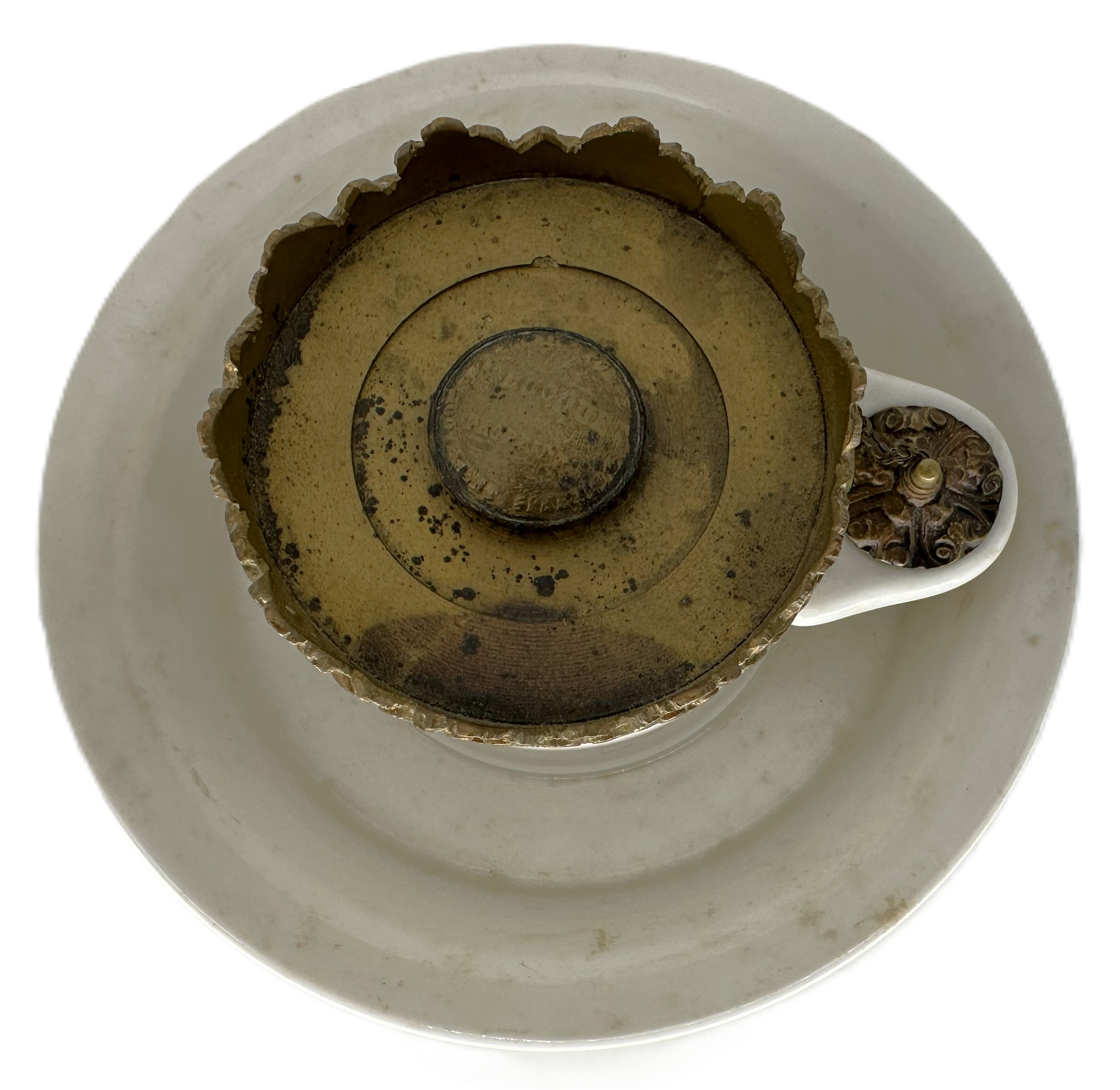
The impressed writing on the brass knob of this pump-style inkwell confirms it as a product of H. Boquet, the inventor who pioneered this specific “pump” technology in Paris.
Reading the Mark
According to the stamp on the knob, the text reads:
- BOQUET BREVETÉ S.G.D.G.
Decoding the Information
- H. Boquet: This refers to Louis Honoré Boquet, a prominent Parisian engineer and manufacturer. In 1839, Boquet was awarded a Silver Medal (Médaille d’Argent) at the Paris Industrial Exposition for his invention of the “Encrier à Siphon” (Siphon Inkstand), which is the grandfather of the pump mechanism you see here.
- Breveté: The French word for “Patented.” * S.G.D.G.: This stands for Sans Garantie du Gouvernement (Without Guarantee of the Government). This was a mandatory legal disclaimer used in France from 1844 to 1968, which meant the government granted the patent but did not guarantee the technical effectiveness of the invention.
This “H. Boquet” pump inkwell is a historically significant piece of office engineering, representing the peak of 19th-century French mechanical stationery.
This piece is directly linked to the original inventor who pioneered the technology, Louis Honoré Boquet (and his son Jean-Louis Adolphe Boquet).
Physical Description and “Crown” Pen Rack
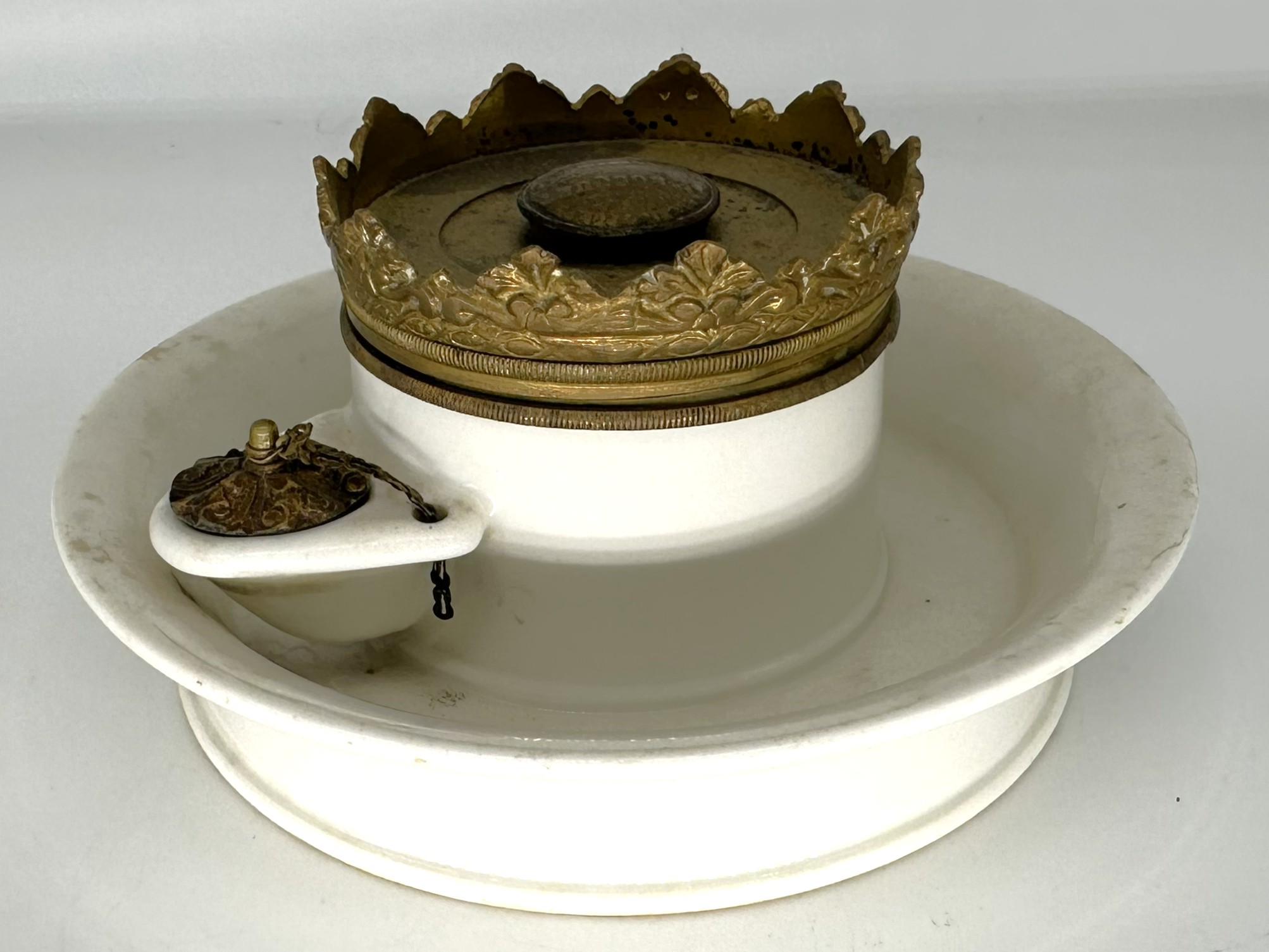
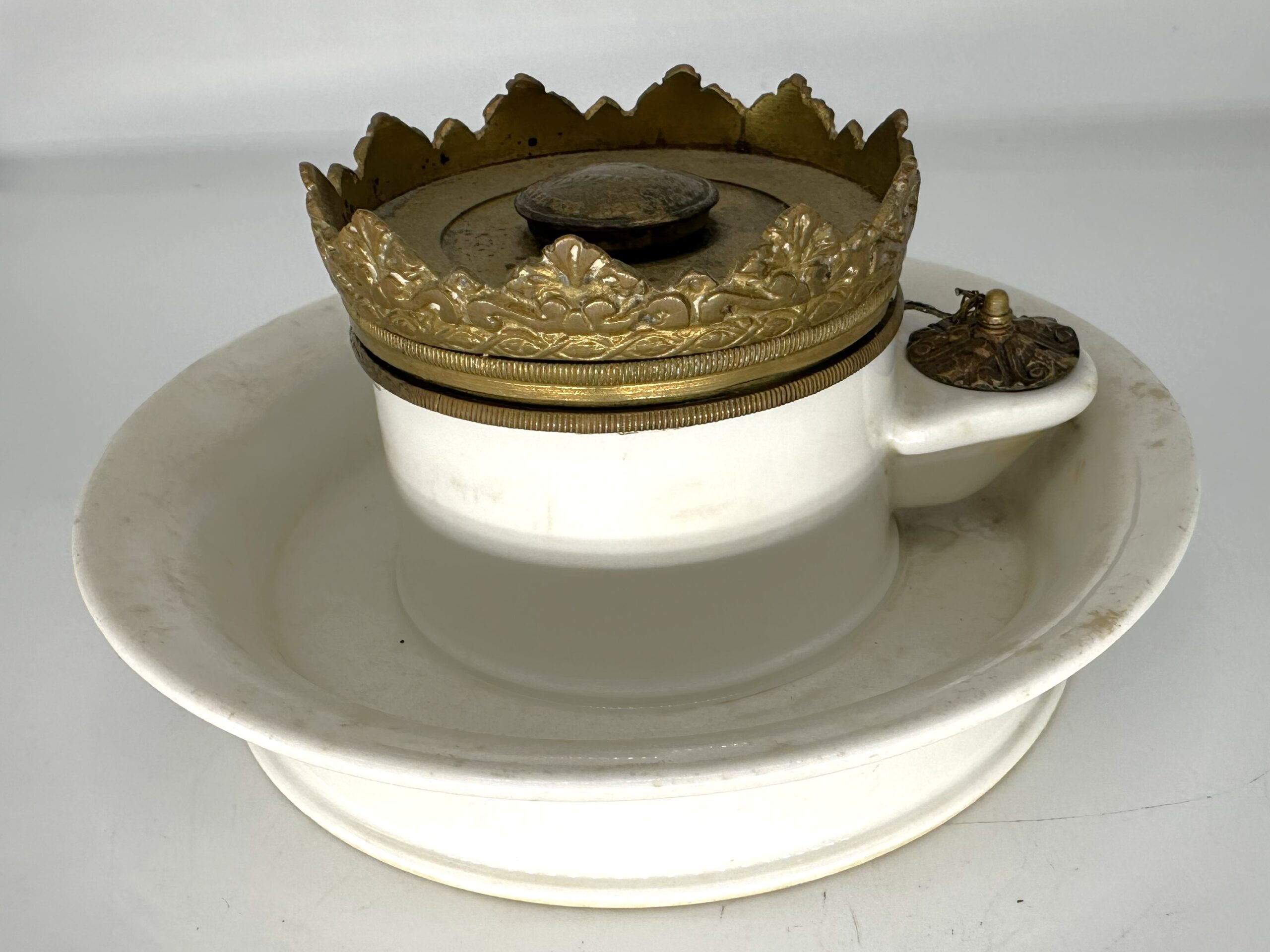
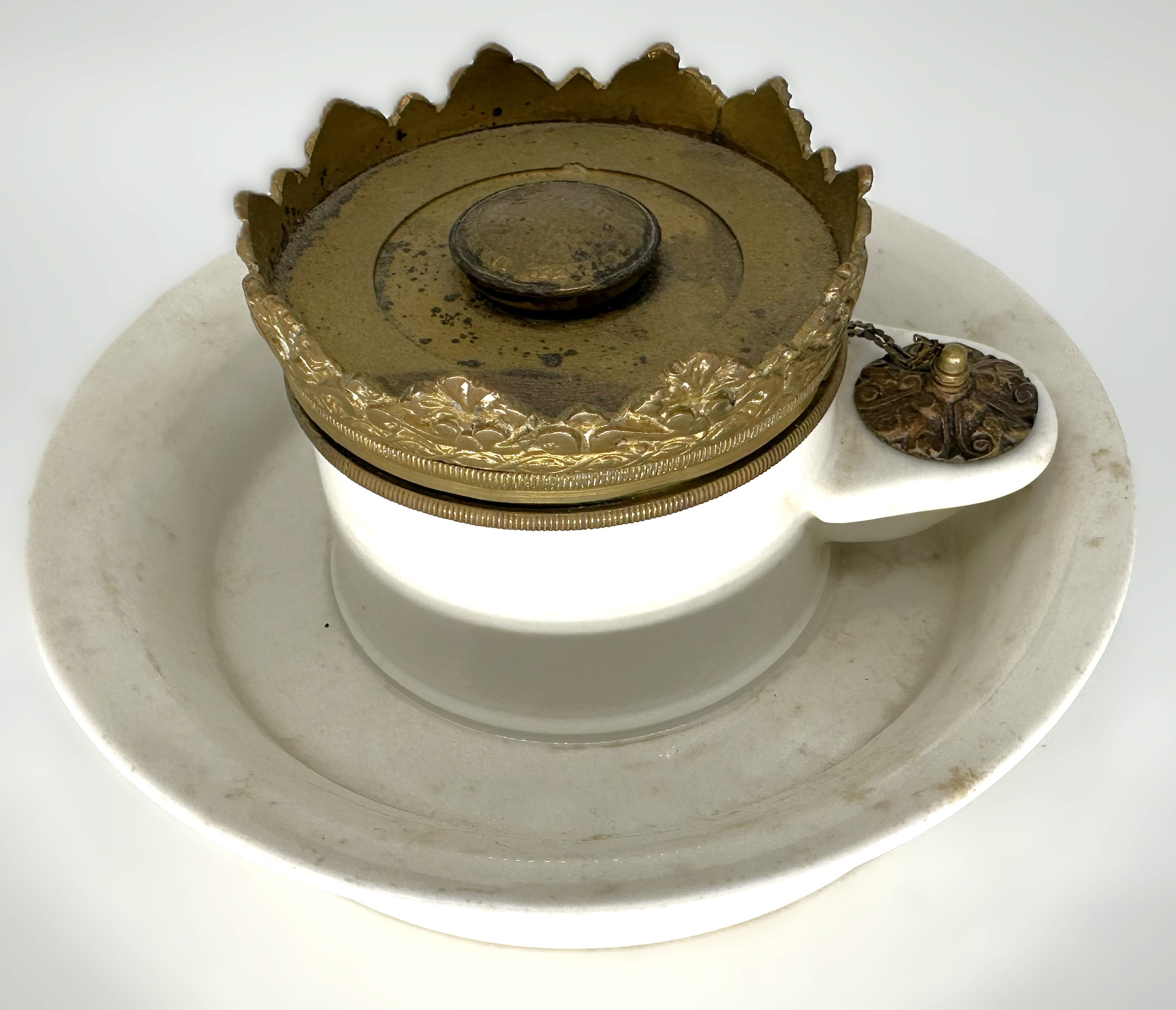
- The Porcelain Unit: The central reservoir is a white porcelain cylinder set within a wide, integrated saucer base.
- The Crown Pen Rack: The brass fixture at the top is not just a lid; it is an elaborate, decorative pen rack cast in a crown or “crenelated” form. The raised, leaf-shaped points of the crown serve as cradles to hold multiple dip pens horizontally when they are not in use.
- The Font: A small, heart-shaped font projects from the front, protected by a brass lid secured by a safety chain.
The Boquet Mechanism: How it Functions
Based on the specific markings on the knob (H. BOQUET BREVETÉ S.G.D.G.), this inkwell uses a manual displacement pump.
- The “Schlesinger” Groove: This model features the grooved plunger innovation. The porcelain plunger has a vertical notch that matches a “keyway” molded into the reservoir wall. This prevents the plunger from spinning as one turns the top knob, allowing it to move strictly up and down in a smooth, regulated motion.
- Pressure Displacement: When the user rotates the brass crown at the top, a threaded internal rod forces the porcelain plunger downward into the ink-filled chamber.
- The Fountain Effect: This downward movement displaces the ink, forcing it to rise through an internal channel and fill the small front font. This provides a constant, fresh supply of ink for the pen without exposing the main reservoir to air, which prevented the common Victorian problem of ink becoming thick or “sludgy”.
Historical Significance & Maker
- Manufacturer: Louis Honoré Boquet (with later refinements by Boquet fils). Boquet was a celebrated inventor who won a silver medal at the 1839 Paris Exposition for this specific siphon design.
- Age: This specific model—incorporating the grooved plunger—likely dates to the mid-to-late 19th century (circa 1850–1880).
- The Mark: The S.G.D.G. mark confirms it was produced under the French patent laws established in 1844.
Estimated Value: $150
Content disclaimer. The information posted is the owner’s best knowledge and may not have been vetted by the SOIC. We welcome comments, corrections, and additions, working to make our website information comprehensive and accurate.
Join the Society of Inkwell Collectors (SOIC) – it’s free!
Founded in 1981 as a non-profit organization,
we are documenting inkwells (and accessories).
We’re here to help and inform!