





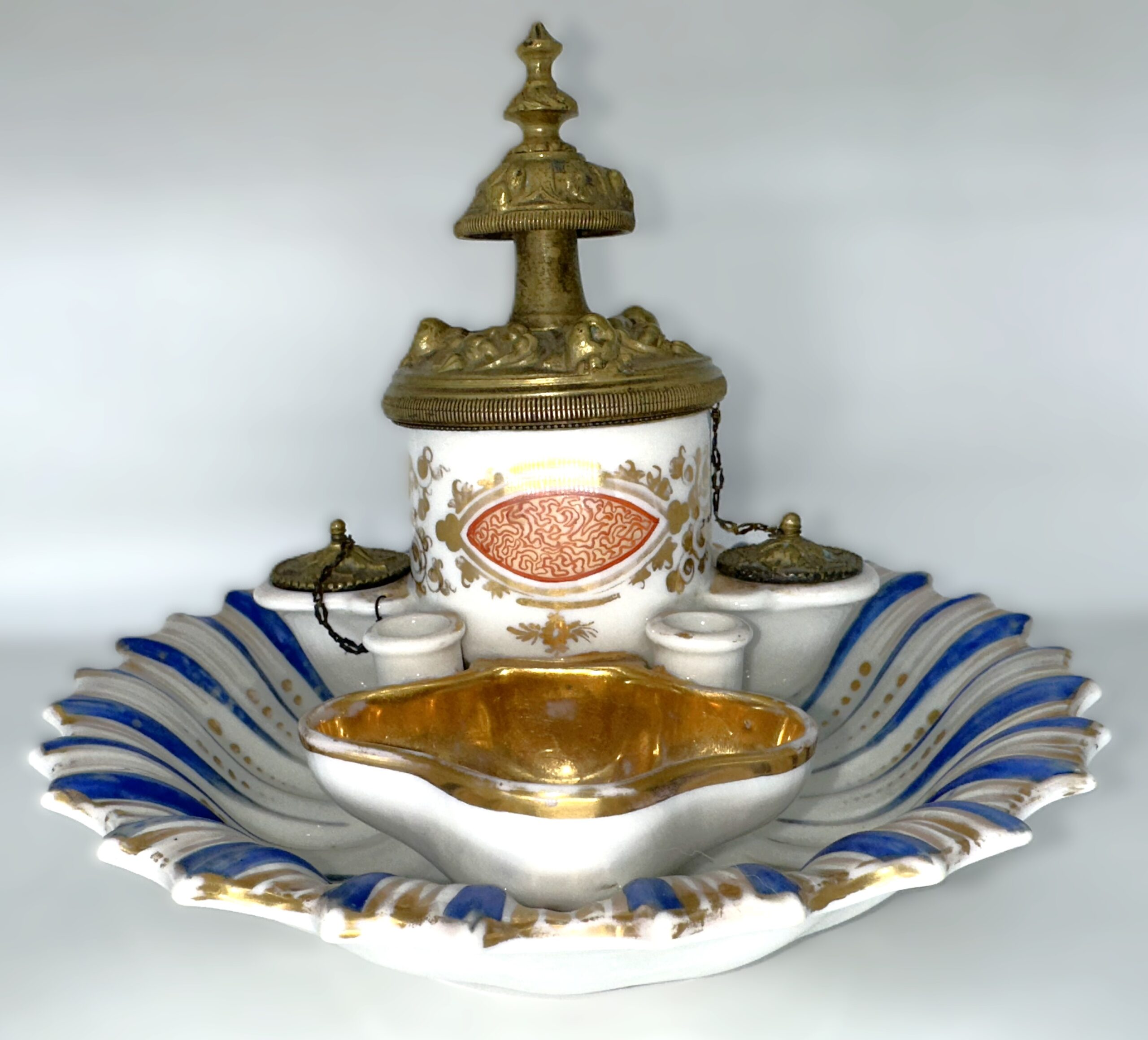
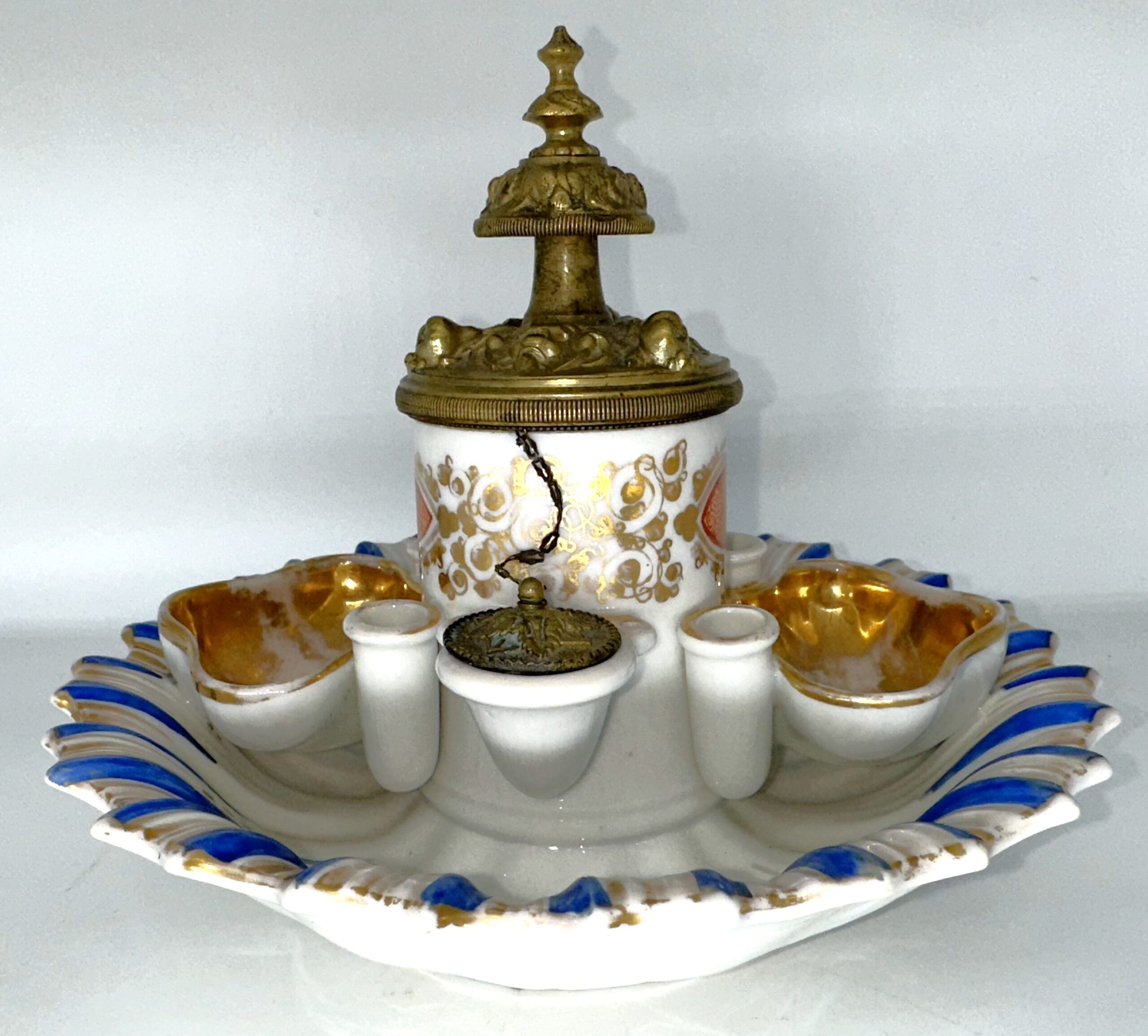

Pump Inkstand – Dual Font Configuration
| Categories | Mechanical - Pump / Siphon |
| Type | Pump |
| Material | Porcelain |
| Markings | Unmarked |
| Manufacturer | Undetermined |
| Origin | France |
| Date or Era | circa 1875 |
| Measuring | 8 ½” diameter; 7” high |
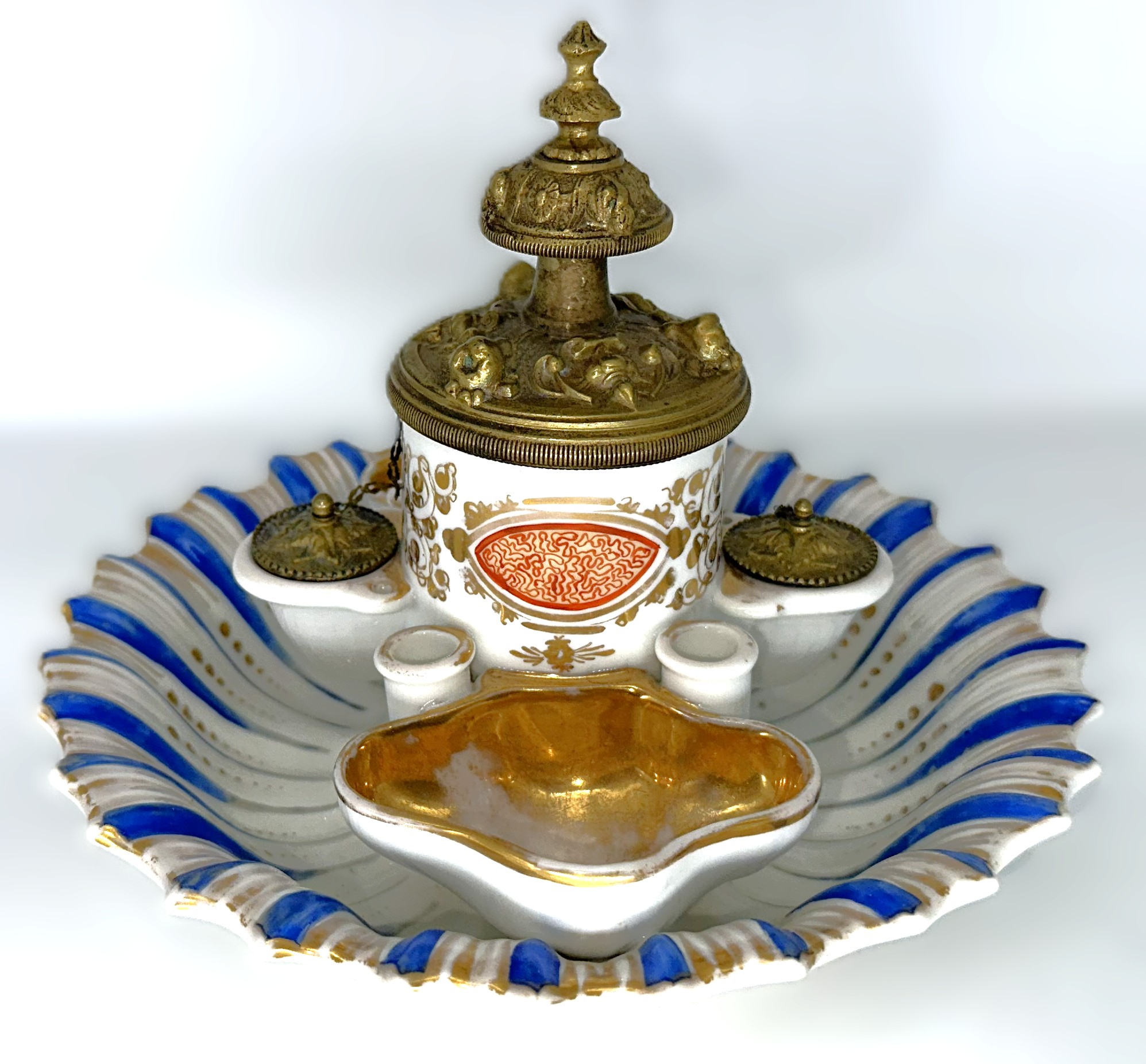
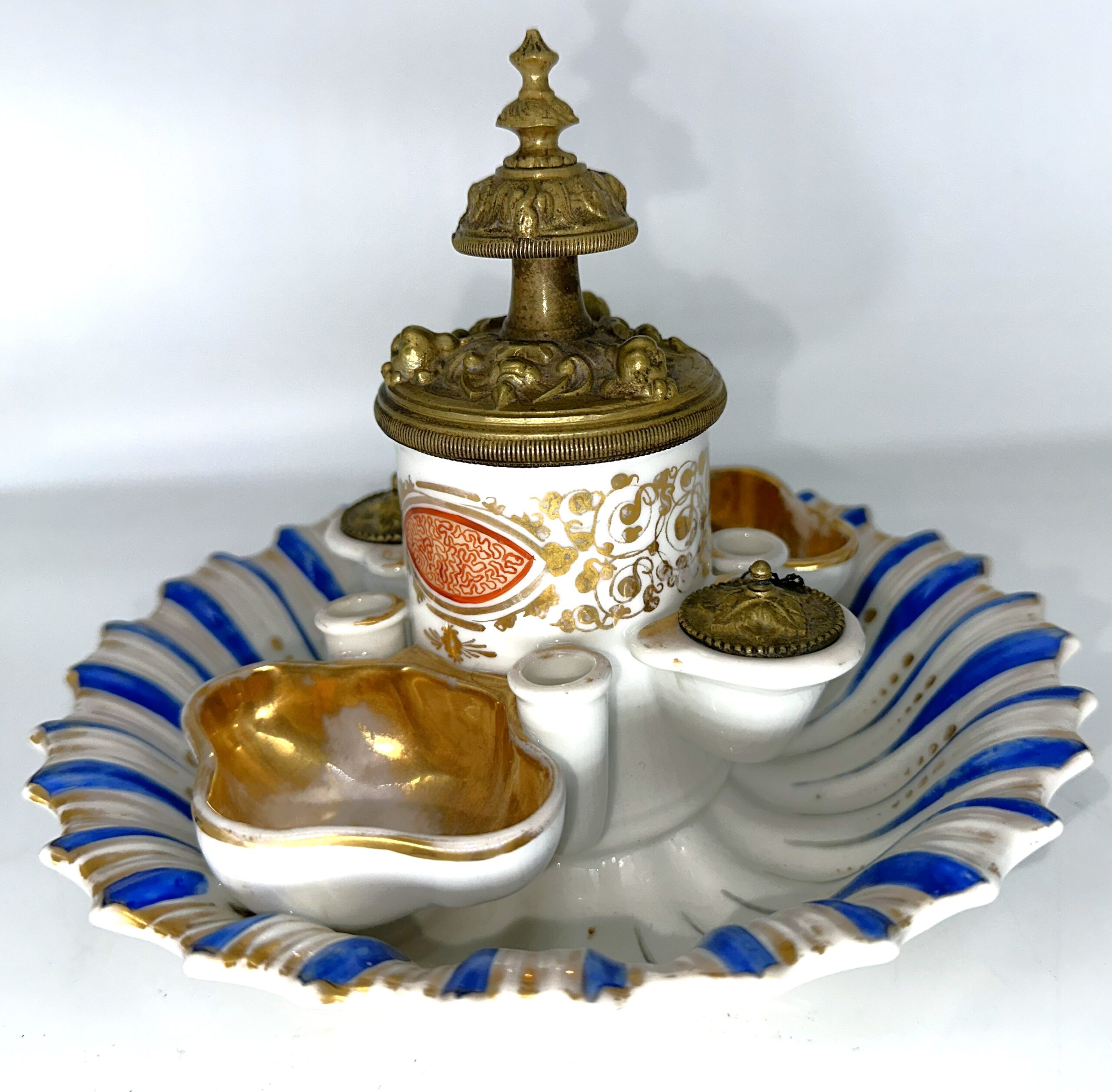
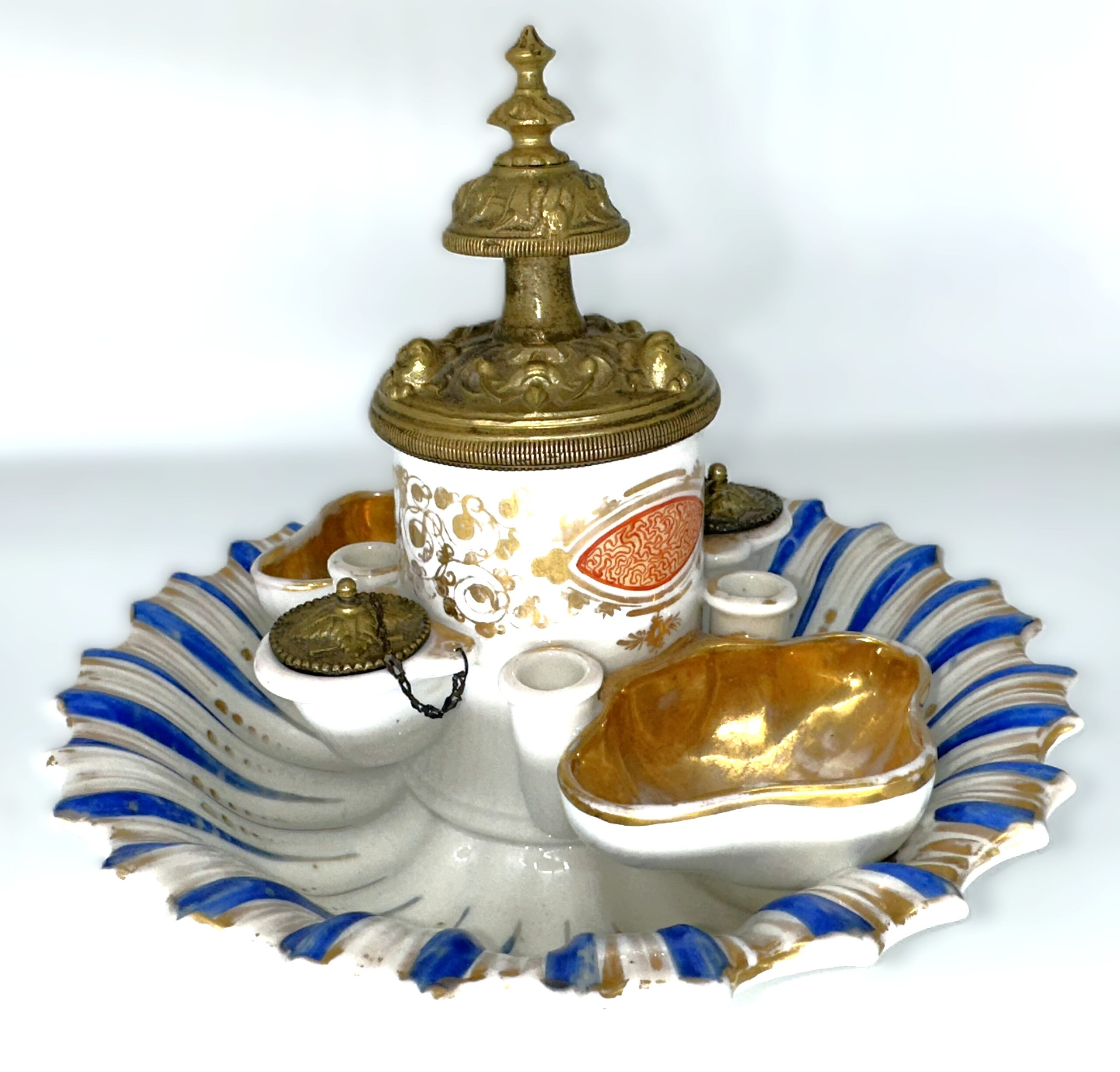
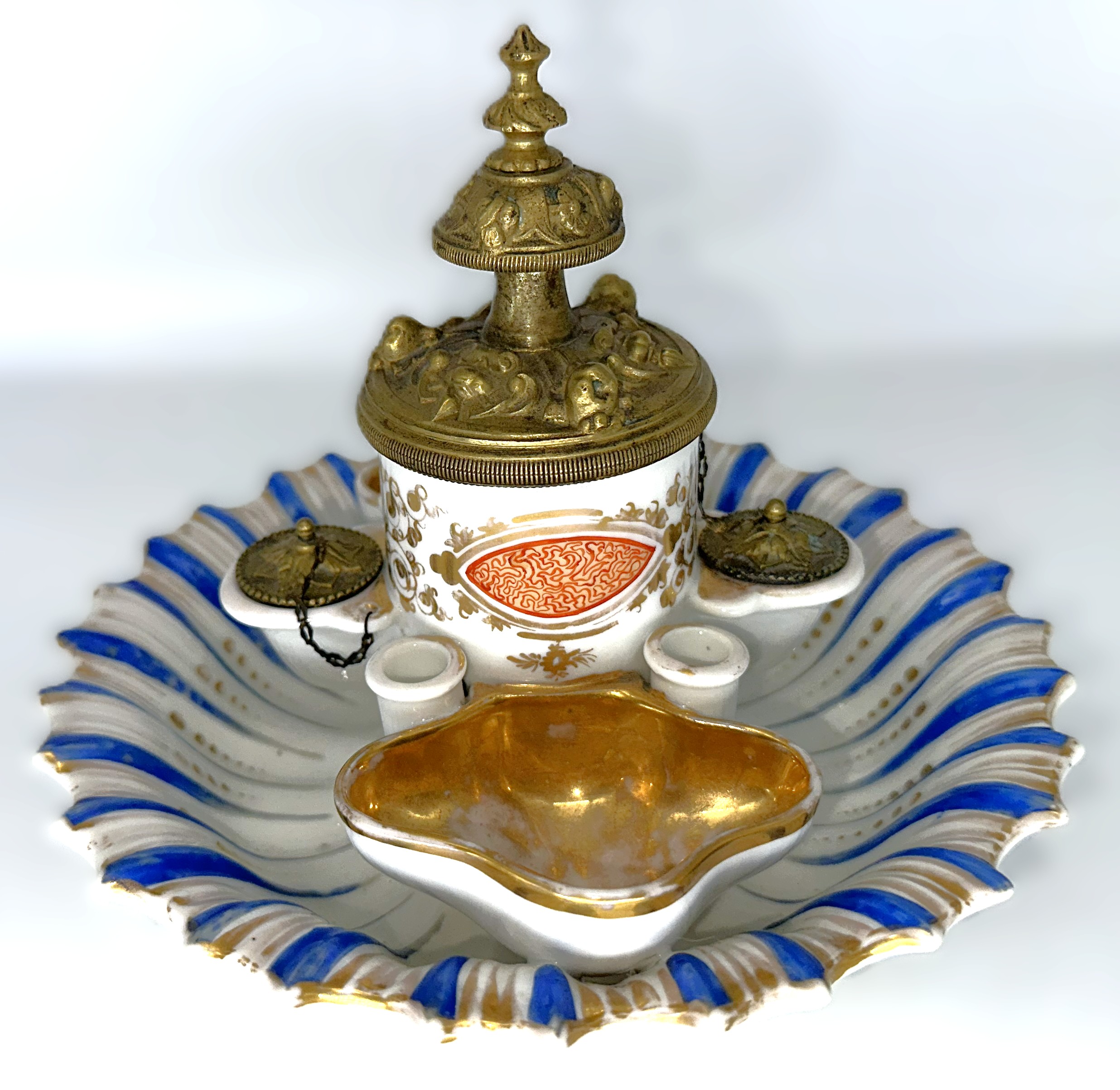
This unmarked two-font pump inkstand is a rare and prestigious example of a “Partner’s Model” mechanical desk set, designed for a shared workspace.
Description and Components
- Central Reservoir: The ink is held in a large, cylindrical porcelain container in the middle of the stand. It is decorated with intricate gold-gilt scrollwork and a central orange/terracotta cartouche featuring a swirling “cracked ice” or vermicular pattern.
- Lateral Fonts: Unusually, this model features two separate fonts (dipping areas) projecting from the sides of the central cylinder. Both fonts have small, brass lids secured by delicate safety chains. This design allowed two writers to share the same ink supply or facilitated the use of two different nib styles simultaneously.
- The Saucer Base: The entire assembly is integrated into a wide, fluted porcelain saucer with a scalloped edge. It features a vibrant pattern of radiating cobalt blue stripes accented with gold dots.
- Storage and Utility:
- Quill Holders: Four small, vertical porcelain tubes are positioned at the center for holding quills upright.
- Gilt Bowls: Flanking the ink reservoir are two shallow, shell-shaped basins heavily finished in gold gilt. These were used for small desk items like wafers, nibs, or sealing wax.
- Mechanical Knob: The top brass knob is uniquely tiered, featuring a tall, vase-like finial atop a base cast with small, raised floral decoration.
Mechanical Operation
While unmarked, the tiered brass knob and cylinder design confirm this operates on the piston displacement system. Turning the large finial forces an internal plunger downward into the main reservoir, displacing the ink and causing it to rise into the two lateral fonts. This system effectively protected the bulk of the ink from evaporation while keeping it fresh for use.
Identifying the Manufacturer
Even without a stamp, several stylistic clues point to a specific origin:
- The Style: The combination of “Vieux Paris” (Old Paris) floral/vermicular patterns with high-quality brass casting is a hallmark of Jean-Louis Journet or Théodore Haviland.
- The Knob Design: The design on the mechanical knob is a specific decorative choice often associated with the Maison Alpha or Benn-Lévy luxury retail workshops in Paris. These firms often purchased “mechanical blanks” and fitted them with custom, high-end hardware for their elite clientele.
- Two-Font Model: This specific “two-font” model is rarer than single-font versions. These have occasionally been attributed to Gisclard, another prominent 19th-century French maker who specialized in “siphon” desk accessories.
Age: Based on the Rococo-revival aesthetic and the mechanical complexity, this piece dates to circa 1860–1885.
Catalog Profile: L’Encrier à Pompe “Double Font”
Origin: Paris, France (Likely manufactured for Maison Alpha or Benn-Lévy)
Style: Neo-Rococo / Second Empire
Era: Circa 1860–1885
Technical Attribution: Boquet Patent Displacement System
Design and “Partner’s Desk” Context
The defining feature of this set is the dual lateral font system. In the 19th century, these were often referred to as Partner’s Inkstands.
- Shared Reservoir: Both dipping wells draw from the same central cylinder. This allowed two writers (e.g., business partners or a husband and wife) sitting across from one another to share a single, mechanically regulated ink supply.
The Mechanism
This inkstand operates on a piston-driven siphon system:
- Positive Pressure: Turning the tiered knob forces an internal porcelain plunger down into the main reservoir.
- Siphon Flow: Because the reservoir is airtight, the displaced ink has only one path to escape—up through two internal siphon tubes that lead directly to the lateral dipping fonts.
- Efficiency: This kept the bulk of the ink away from the air, preventing the “sludging” or thickening caused by evaporation, a primary benefit highlighted in original Boquet patent advertisements.
Estimated value: $300
Content disclaimer. The information posted is the owner’s best knowledge and may not have been vetted by the SOIC. We welcome comments, corrections, and additions, working to make our website information comprehensive and accurate.
Join the Society of Inkwell Collectors (SOIC) – it’s free!
Founded in 1981 as a non-profit organization,
we are documenting inkwells (and accessories).
We’re here to help and inform!