





Silver Presentation Inkstand to WWI Nurse
| Categories | Presentation Piece |
| Type | Military |
| Material | Glass, Silver |
| Markings | See Narrative |
| Manufacturer | James Dixon & Sons |
| Origin | England |
| Date or Era | circa 1908 |
| Measuring | 5” x 5” x 2 ⅜” high |
Description
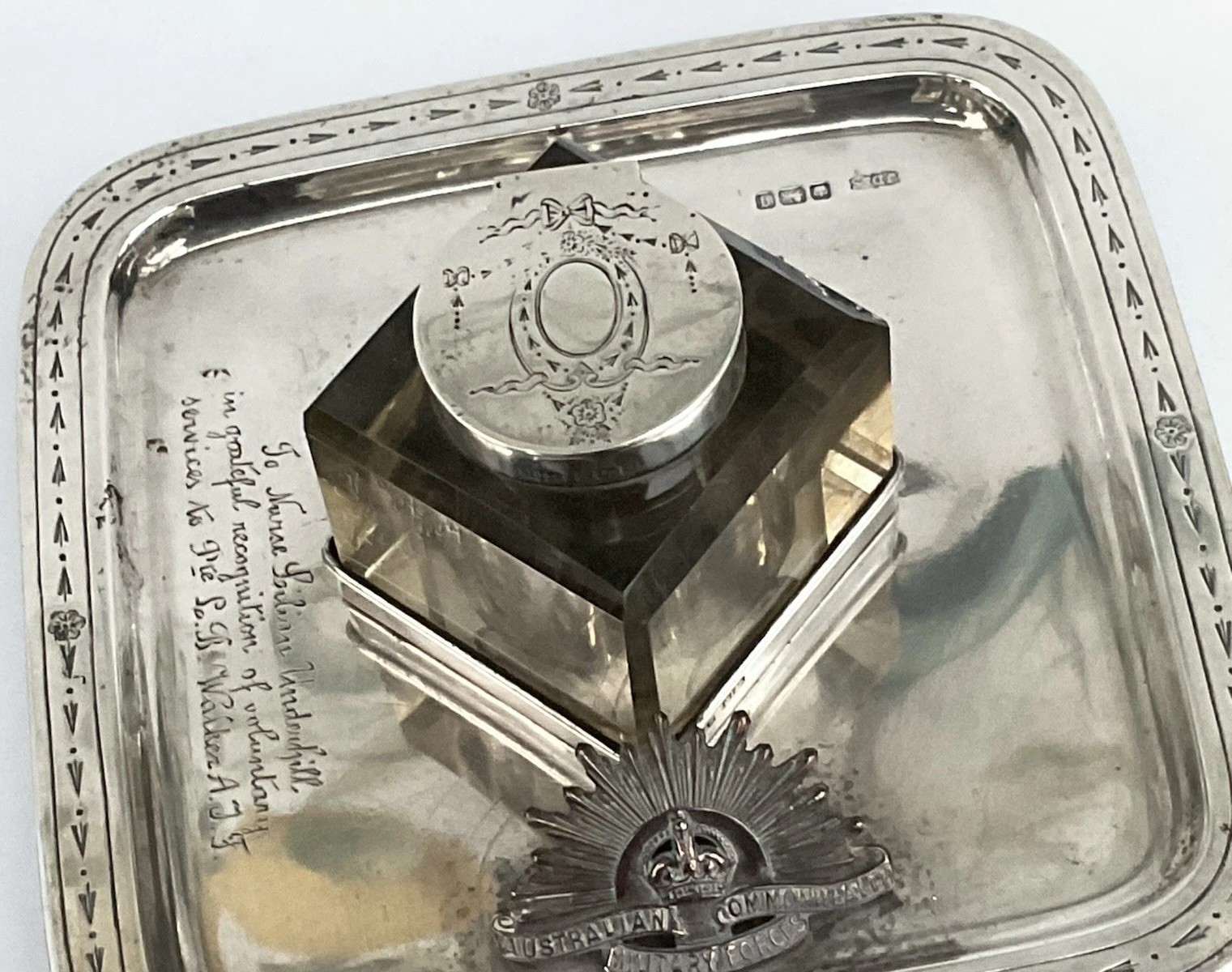
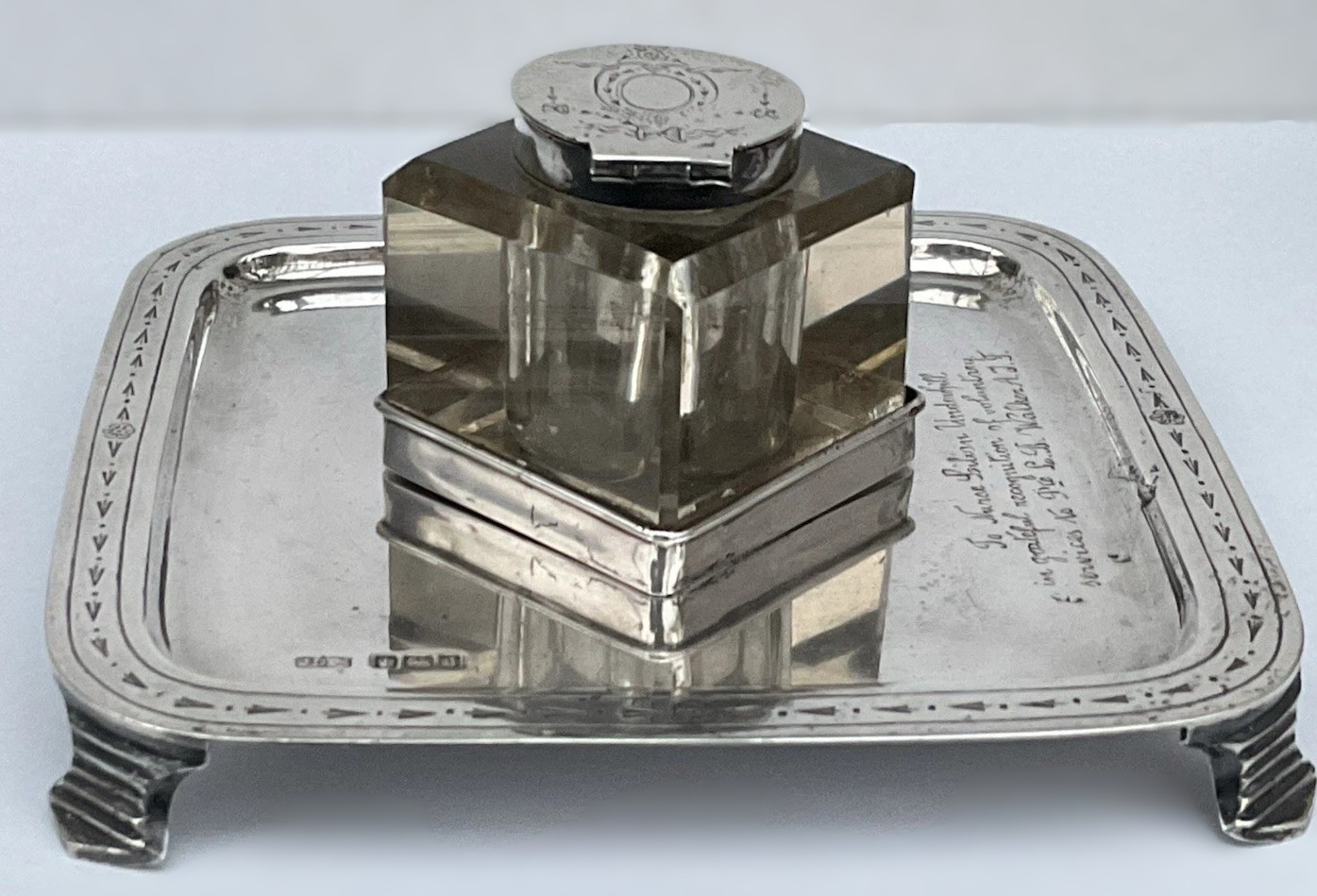
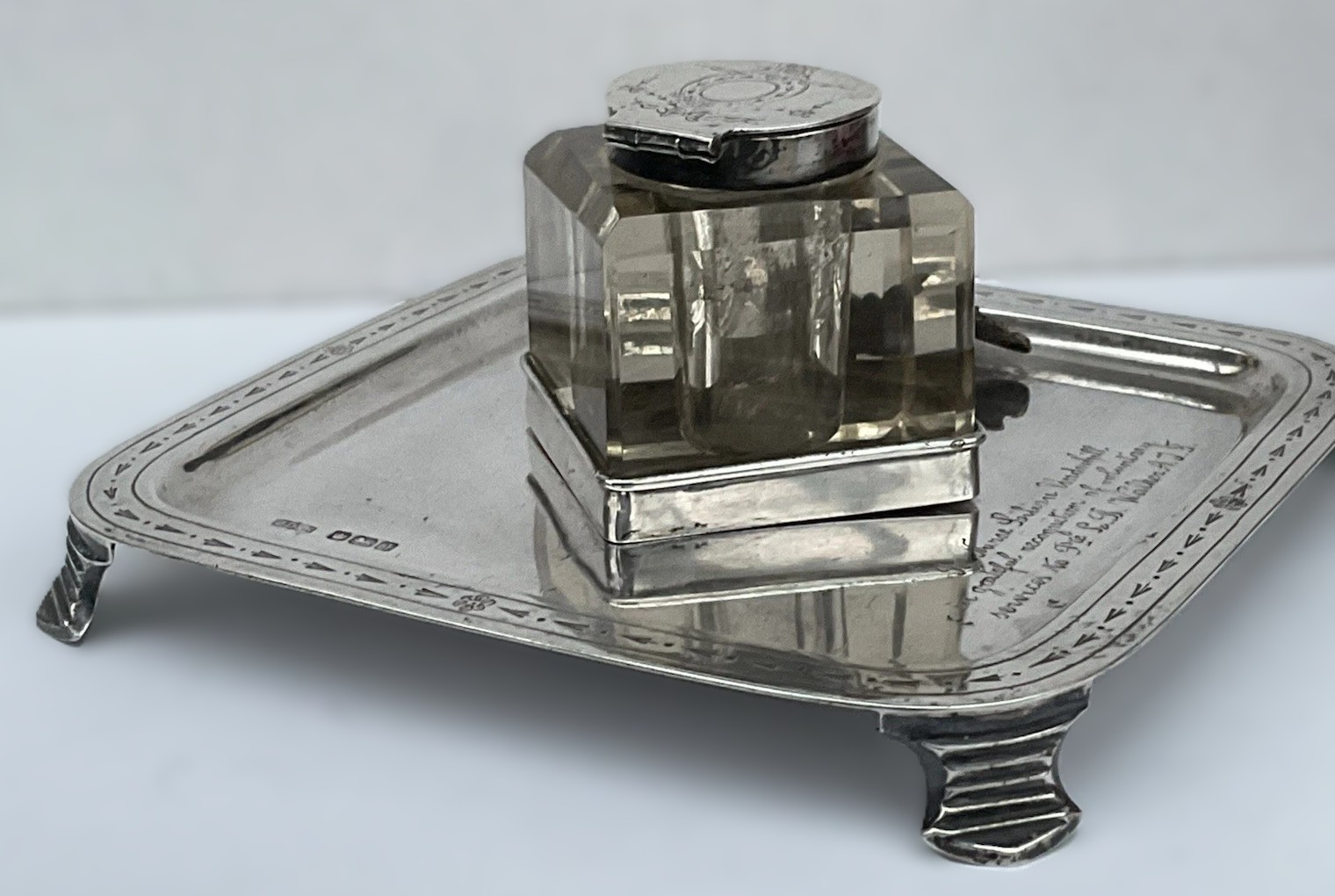
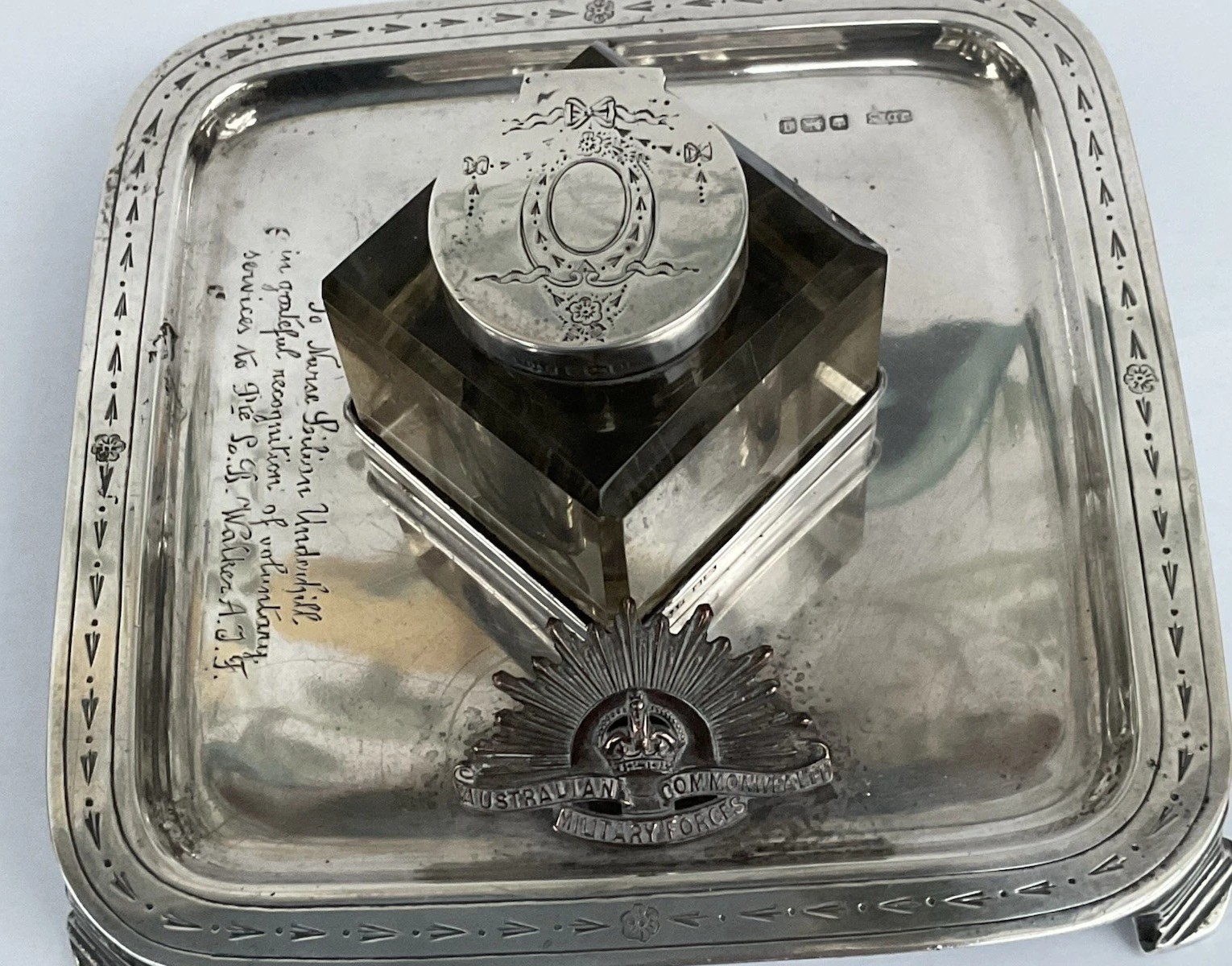
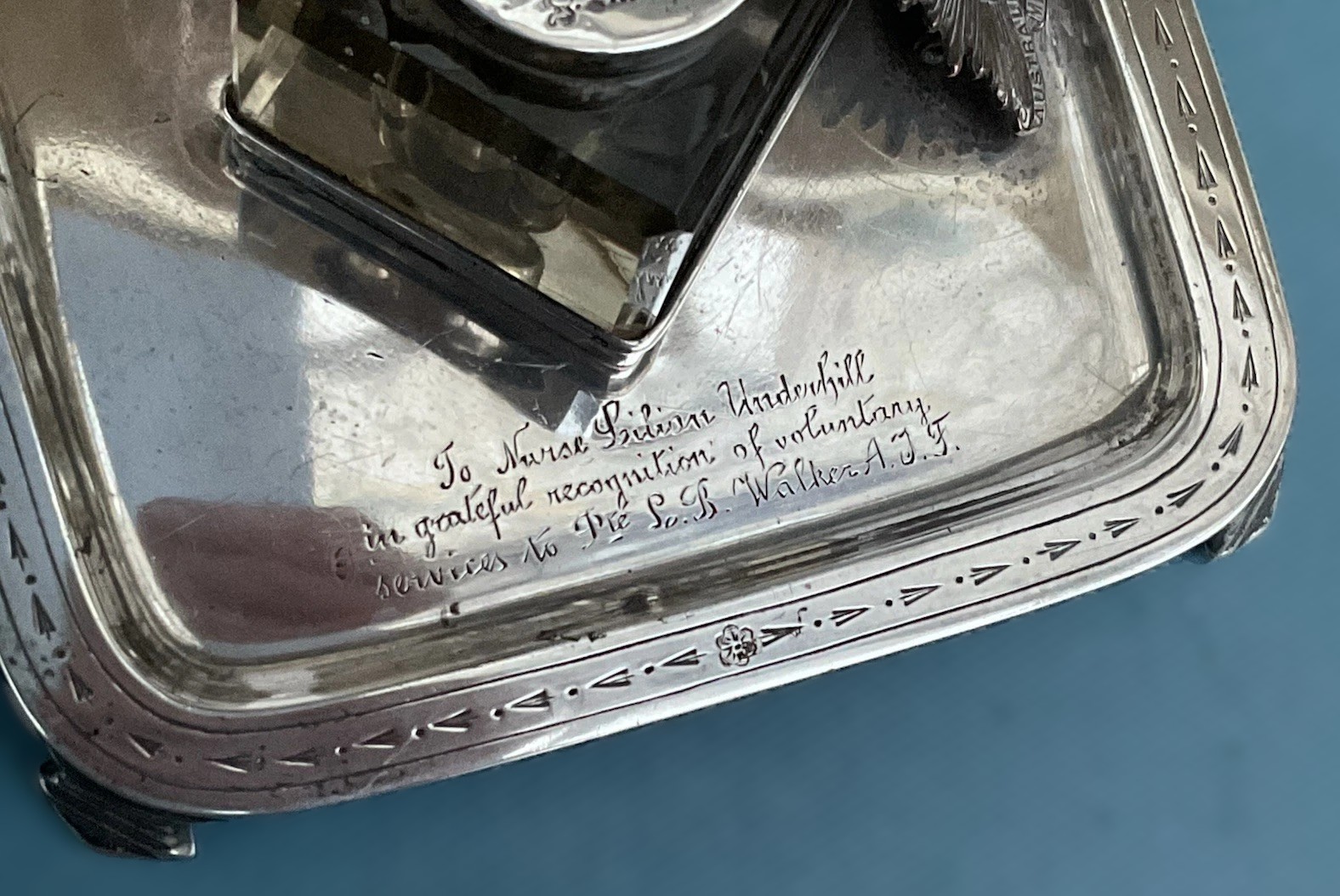
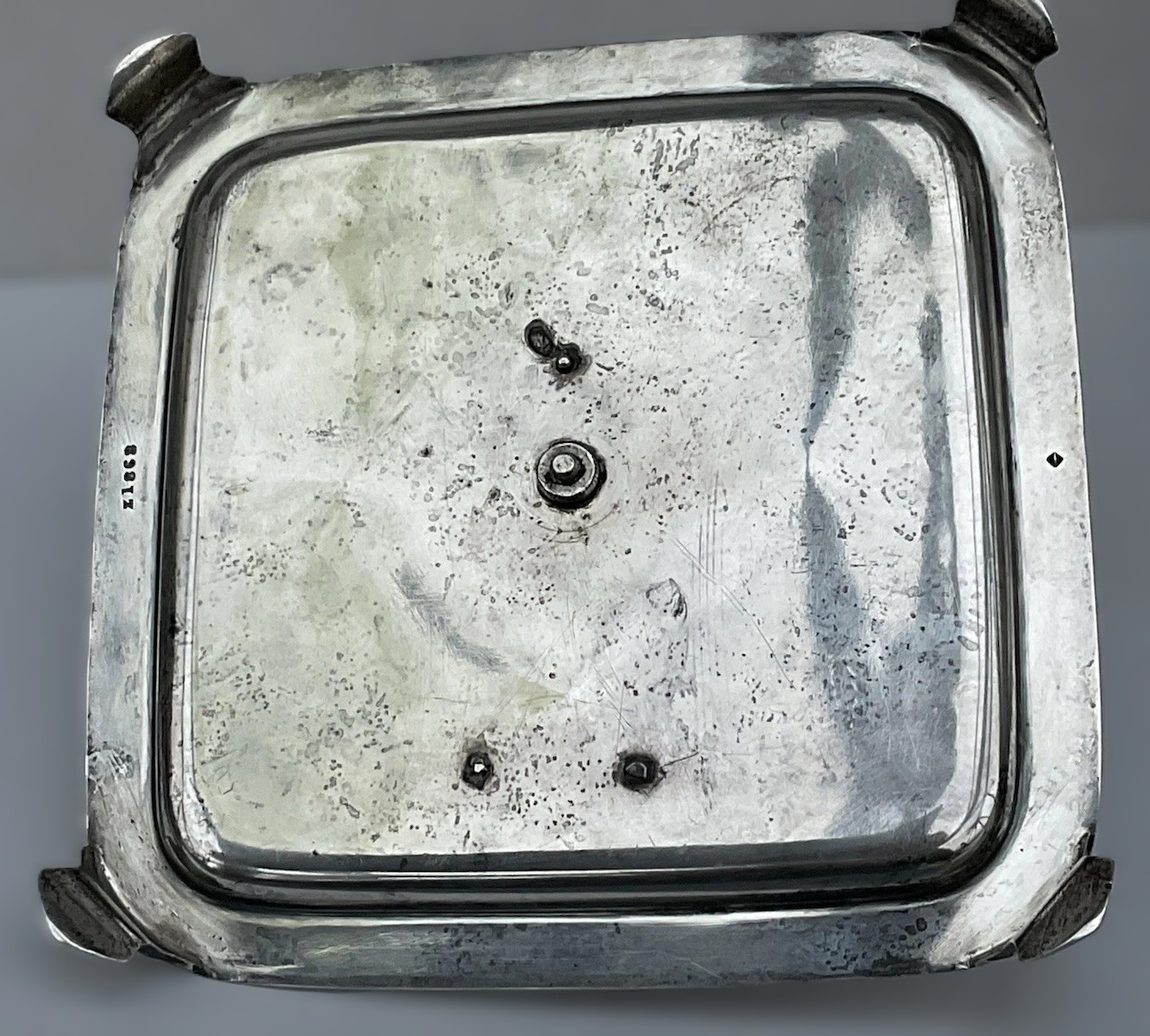
- The Stand: The inkstand consists of a square sterling silver tray with rounded corners and a raised, decorative gallery rim. It is supported by four integrated, stepped feet.
- The Rim Decoration: The tray features an intricate hand-chased border around the outer rim. This design consists of a repeating pattern of stylized foliate sprays and small florets, framed within a delicate line-and-dot border.
- The Inkwell: A heavy, square-cut clear glass inkwell sits within a fitted silver collar at the center of the tray. The glass is cut with deep vertical miters that catch and refract light.
- The Lid: The hinged sterling silver lid is decorated with hand-chased floral scrollwork. The center of the lid features an unengraved oval cartouche, surrounded by a ribbon-and-wreath motif.
Hallmarks and Manufacturer
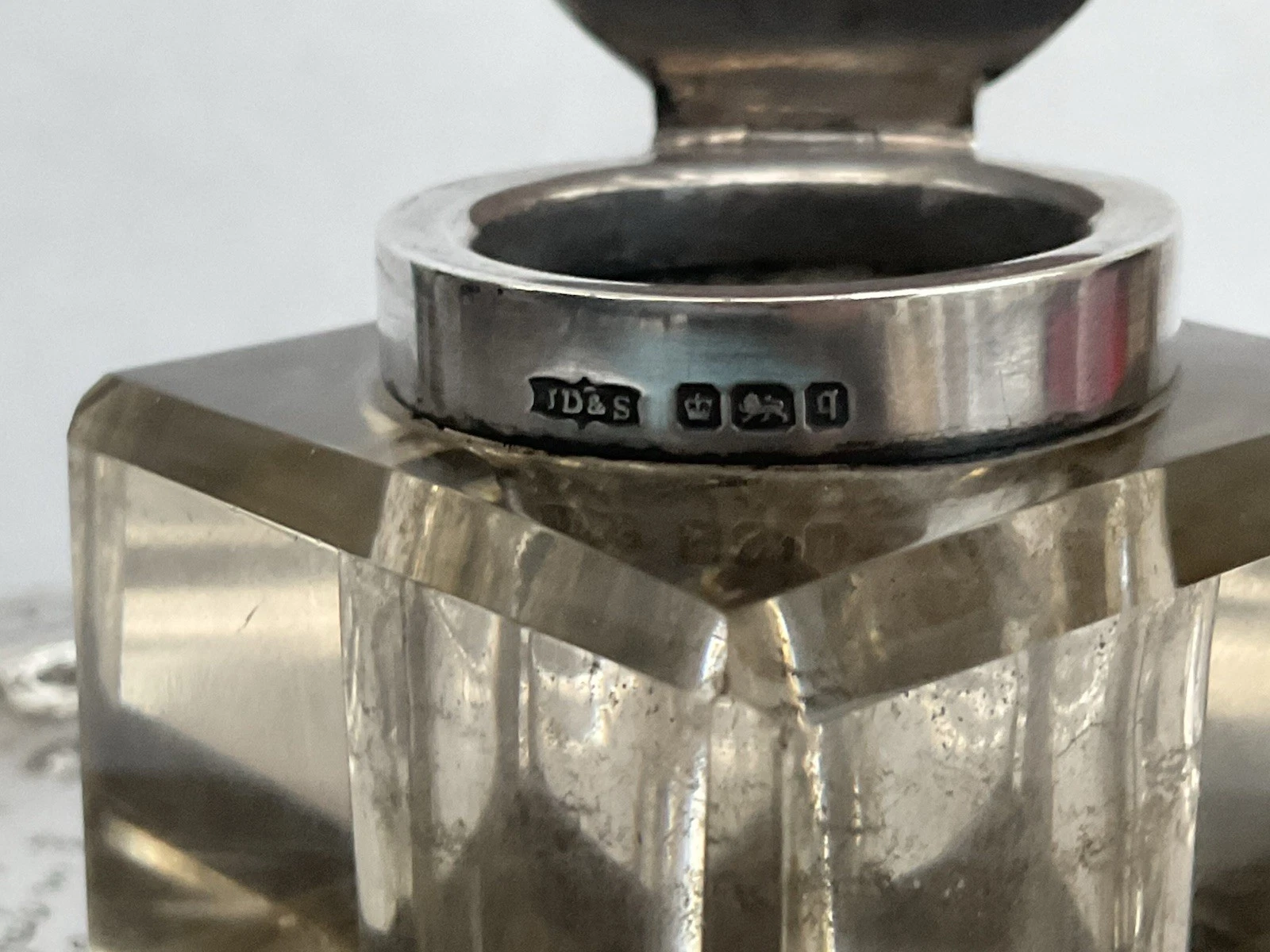
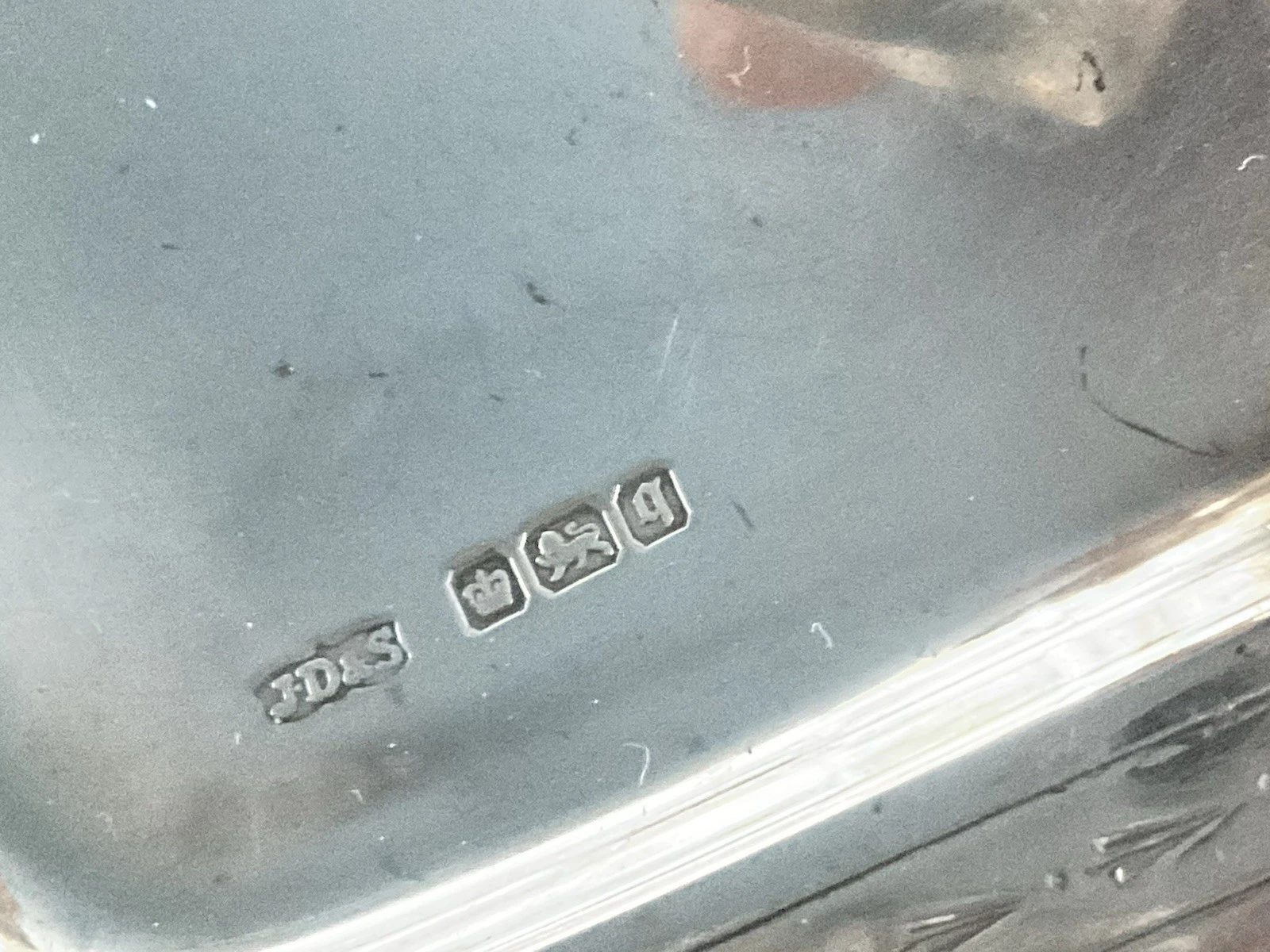
All silver components are fully hallmarked for Sheffield, 1908:
- Maker’s Mark (JD&S): The initials for James Dixon & Sons, one of the most prominent Sheffield firms of the 19th and early 20th centuries.
- Crown: The town mark for the Sheffield Assay Office.
- Lion Passant: The standard mark for .925 sterling silver.
- Date Letter (q): The lowercase gothic “q” confirms the assay year of 1908–1909.
The Military Connection and Inscription
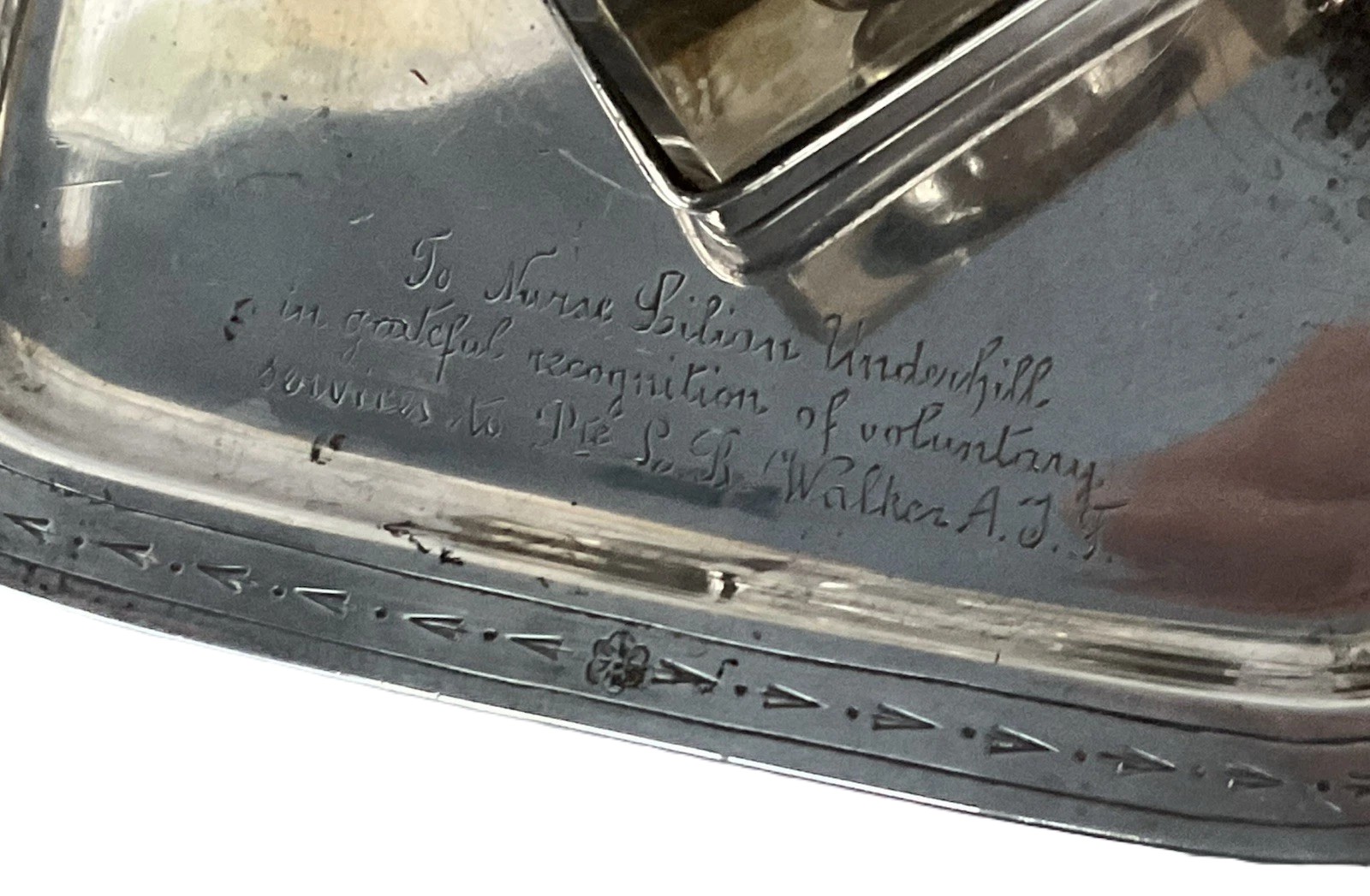
The stand is engraved with a poignant dedication:
“To Nurse Lilian Underhill in grateful recognition of voluntary services to Pte So.B. Walker A.I.F.”
- The Inscription: The engraver’s “A.I.F.” stands for the Australian Imperial Force.
- The Badge: Affixed to the front of the tray is a silver “Rising Sun” cap badge for the Australian Commonwealth Military Forces. This specific pattern, featuring the imperial crown, was used by Australian troops during both World Wars.
- Historical Context: While the silver was made in 1908, the inscription was likely added during or shortly after World War I (circa 1914–1919). Voluntary aid nurses (often members of the Red Cross or St. John Ambulance) played a crucial role in the recovery of soldiers. This gift likely represents a private token of gratitude from an Australian private to a nurse who cared for him during his convalescence.
Historical Background
The historical records reveal a direct connection between Nurse Underhill and Private Walker, placing them together at a major military hospital in England during the height of World War I.
Identifying Nurse Lilian Underhill
Lilian Underhill was a volunteer member of the Voluntary Aid Detachment (V.A.D.), a group of civilians who provided nursing assistance to the medical services during the war.
- Service: She is recorded as serving with the British Red Cross Society in the East Lancashire branch.
- Location: Her primary service was at the 2nd Western General Hospital in Manchester, England. This large facility was one of the primary receiving centers for soldiers evacuated from the Western Front.
- Voluntary Status: The “voluntary services” mentioned in the inscription specifically refers to her status as a V.A.D.; unlike professional military nurses, V.A.D.s were often unpaid or received only a small allowance, making this gift a significant acknowledgment of her sacrifice.
Identifying Private S. B. Walker
The “Pte So.B. Walker” in the inscription is almost certainly Private Sydney Bernard Walker (Service Number 2501) of the 30th Battalion, Australian Imperial Force (A.I.F.).
- The Battle of Fromelles: Private Walker was severely wounded in action on July 20, 1916, during the Battle of Fromelles in France—the first major battle involving Australian troops on the Western Front.
- Evacuation: He suffered a gunshot wound to the right thigh and was evacuated from the front lines.
- The Connection: Military medical records show he was admitted to the 2nd Western General Hospital in Manchester on July 25, 1916. This is the exact hospital where Nurse Underhill was serving.
The Meaning of the Gift
This inkstand was likely presented to Nurse Underhill upon Private Walker’s discharge from the hospital or before his return to Australia.
- A Token of Survival: For a soldier like Walker, who survived the devastating casualties of Fromelles, the care provided by a volunteer nurse was often the difference between life and death.
- Symbolism of the Badge: The attached “Rising Sun” badge on the tray served as a permanent reminder of the nationality of the soldier she saved.
- The Silver’s Age: While the silver tray was hallmarked in 1908, it was common for soldiers or their families to purchase “New Old Stock” high-quality silver or to repurpose an existing fine piece to be engraved as a special presentation gift.
Sold for $300 in December 2025
Content disclaimer. The information posted is the owner’s best knowledge and may not have been vetted by the SOIC. We welcome comments, corrections, and additions, working to make our website information comprehensive and accurate.
Join the Society of Inkwell Collectors (SOIC) – it’s free!
Founded in 1981 as a non-profit organization,
we are documenting inkwells (and accessories).
We’re here to help and inform!