

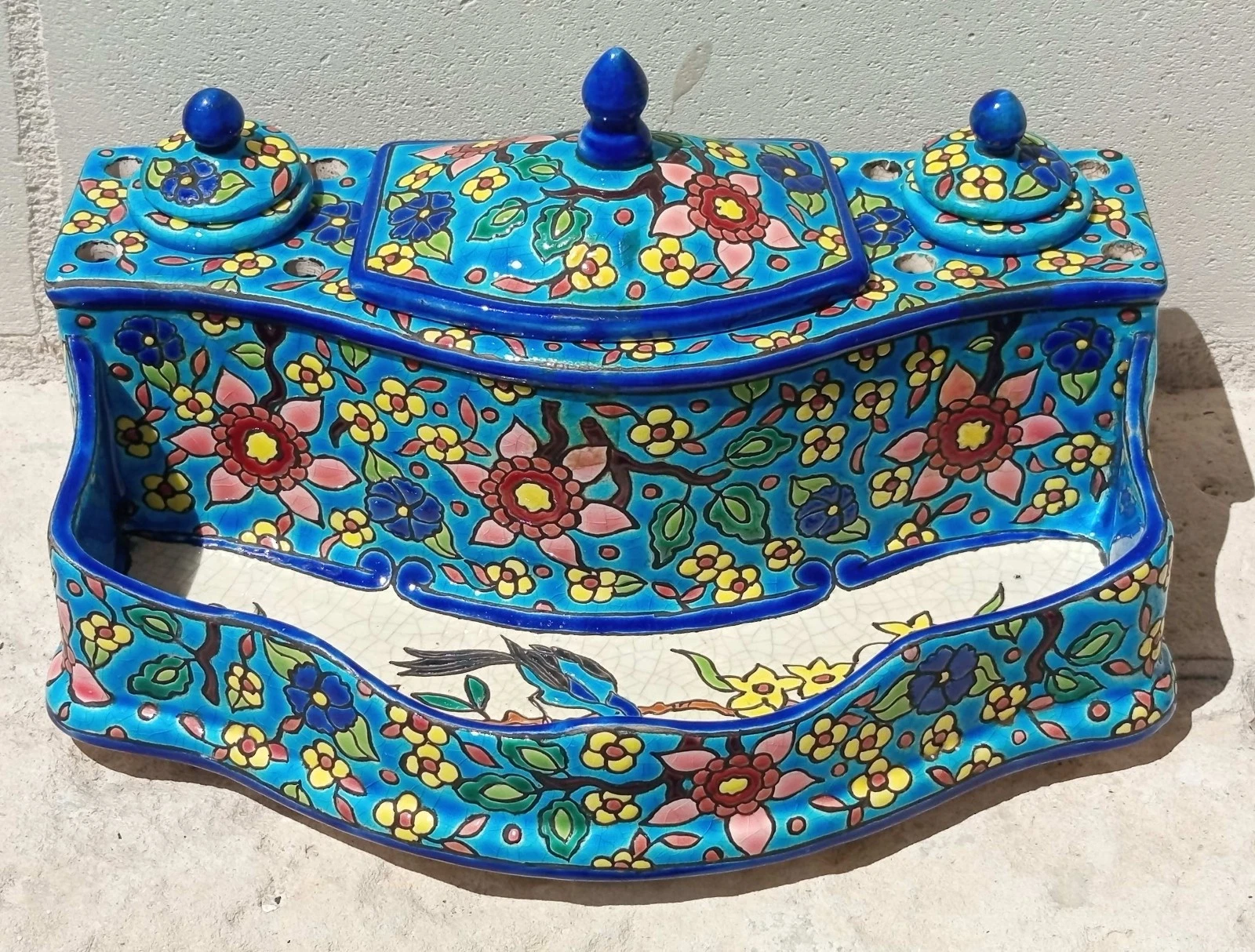
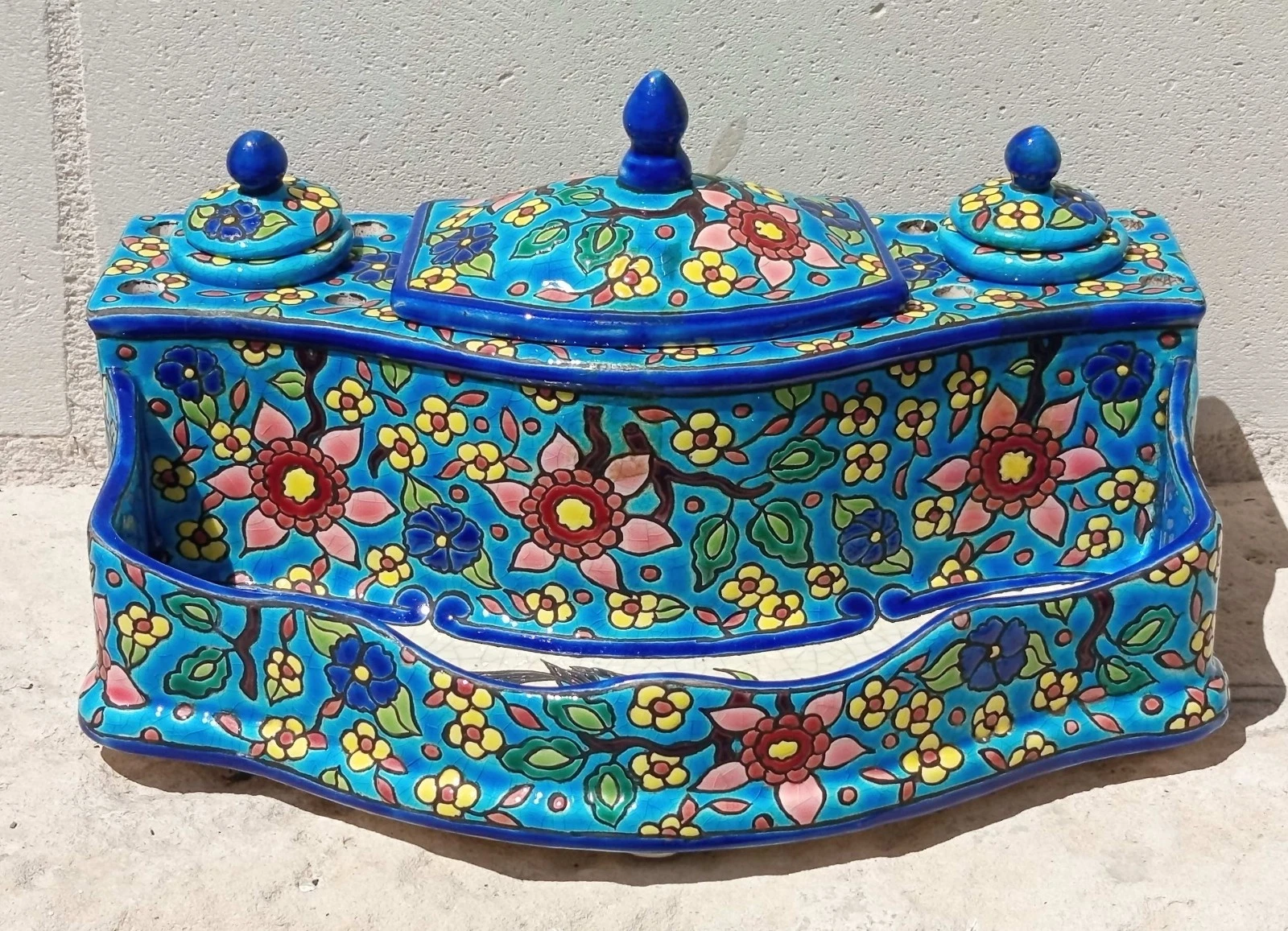
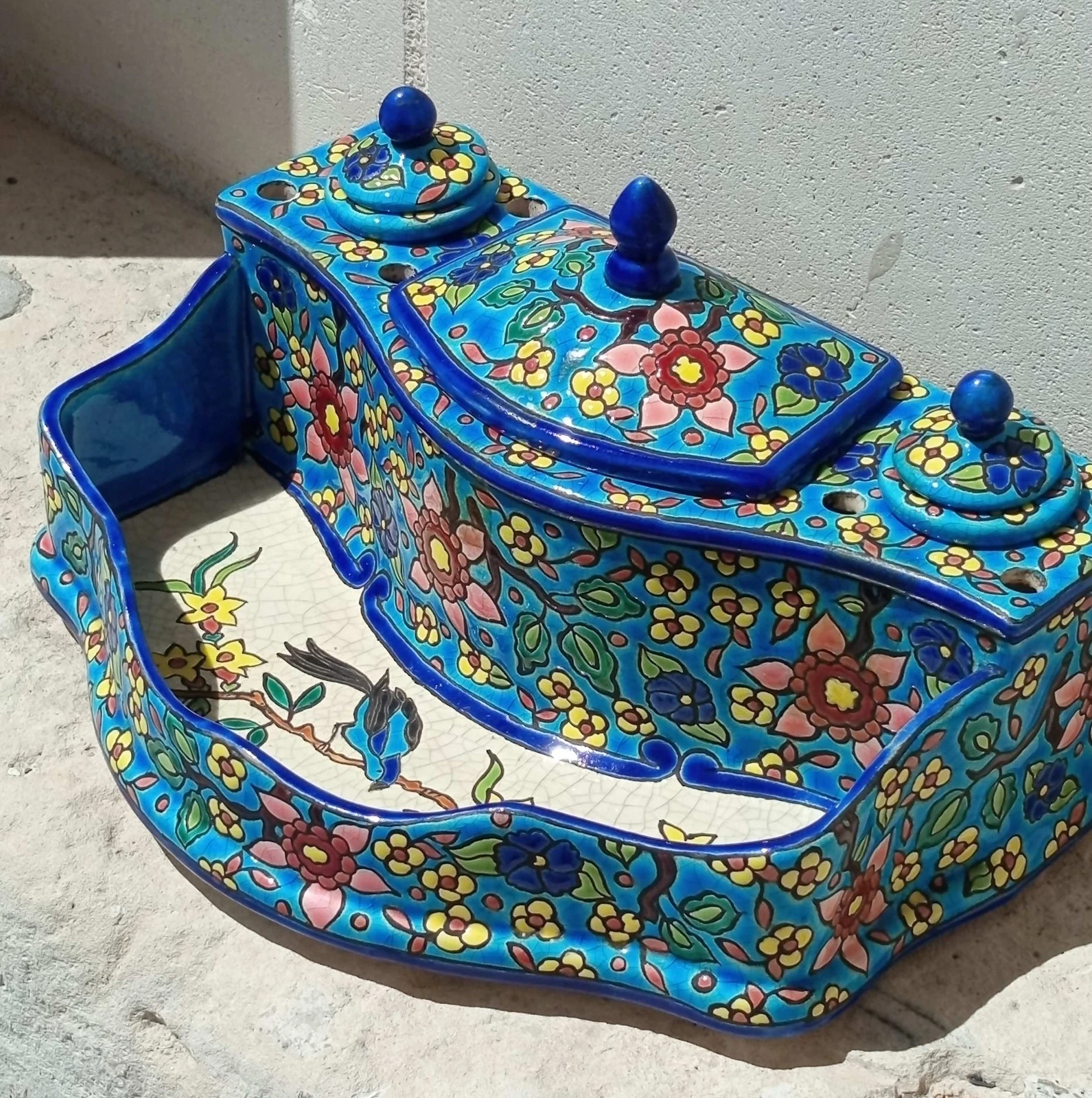
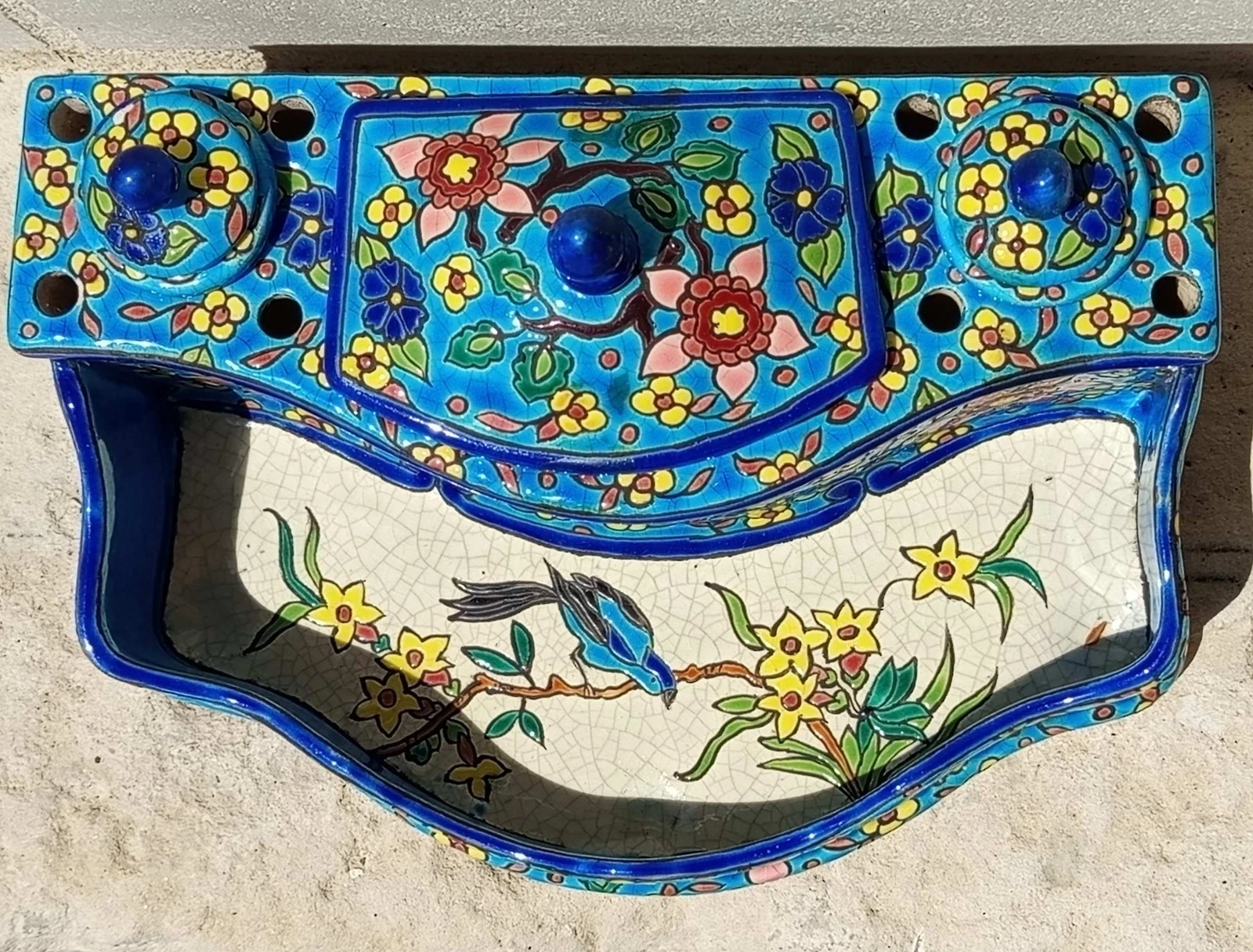
Émaux de Longwy Turquoise Floral Ceramic Double Inkstand
| Categories | Ceramics/Porcelain "Named" Makers |
| Markings | See Narrative |
| Manufacturer | Longwy |
| Origin | France |
| Date or Era | circa 1930 |
| Measuring | 9 ¼” x 6 ½” x 4 ¾” high |
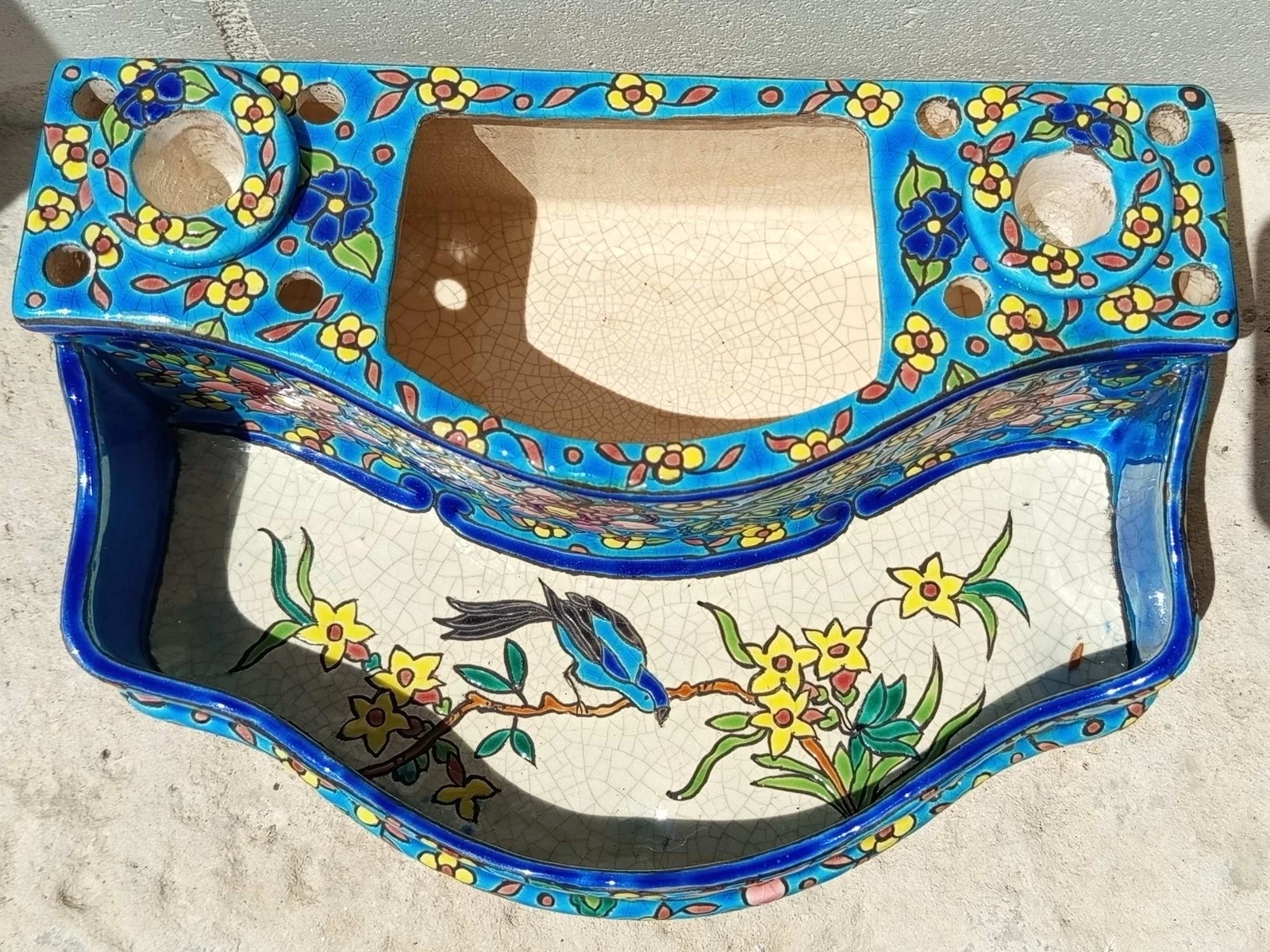
This vibrant faience double inkstand is a classic example of Émaux de Longwy, renowned for its distinctive relief enamels that mimic the appearance of traditional cloisonné.
Form and Structure
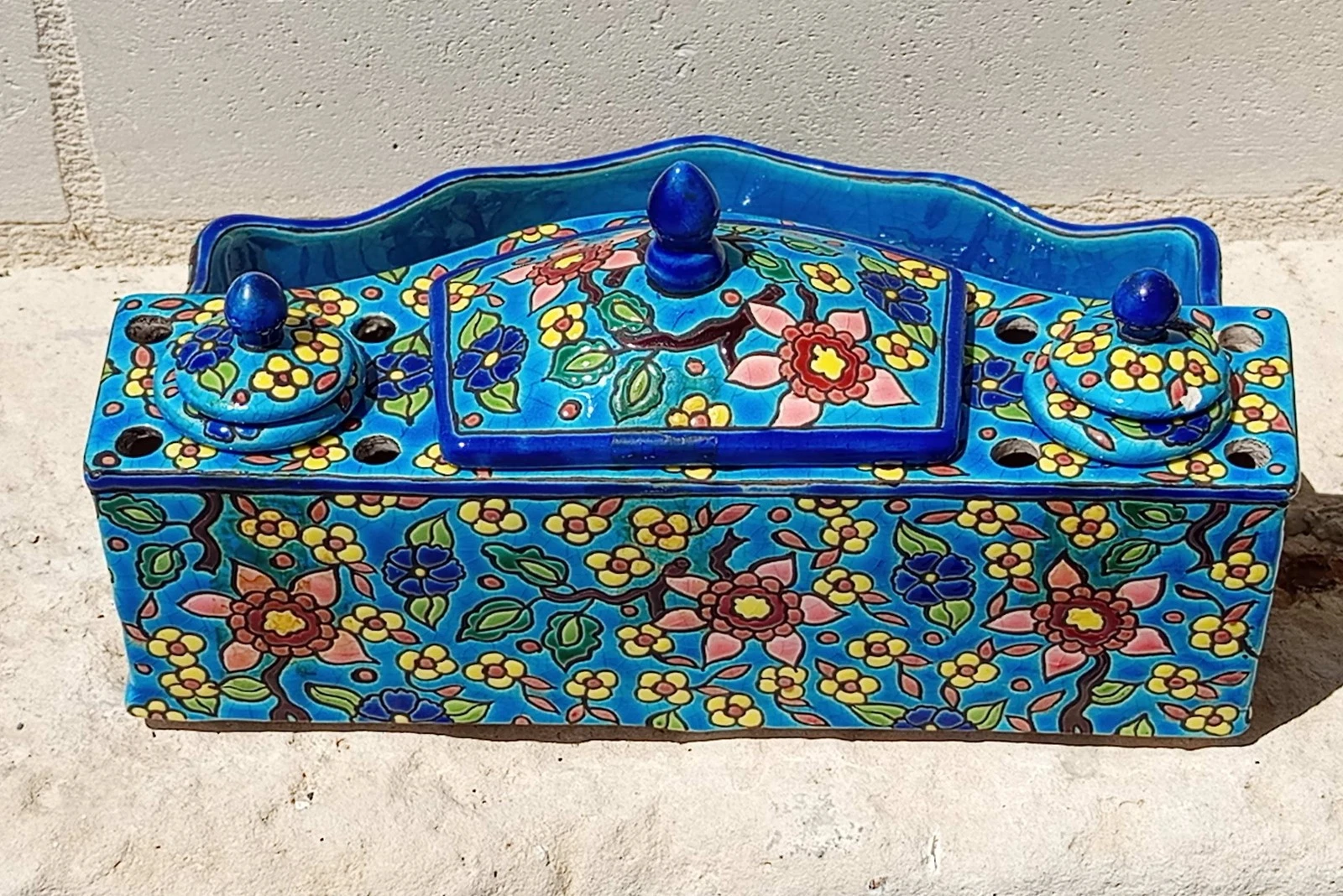
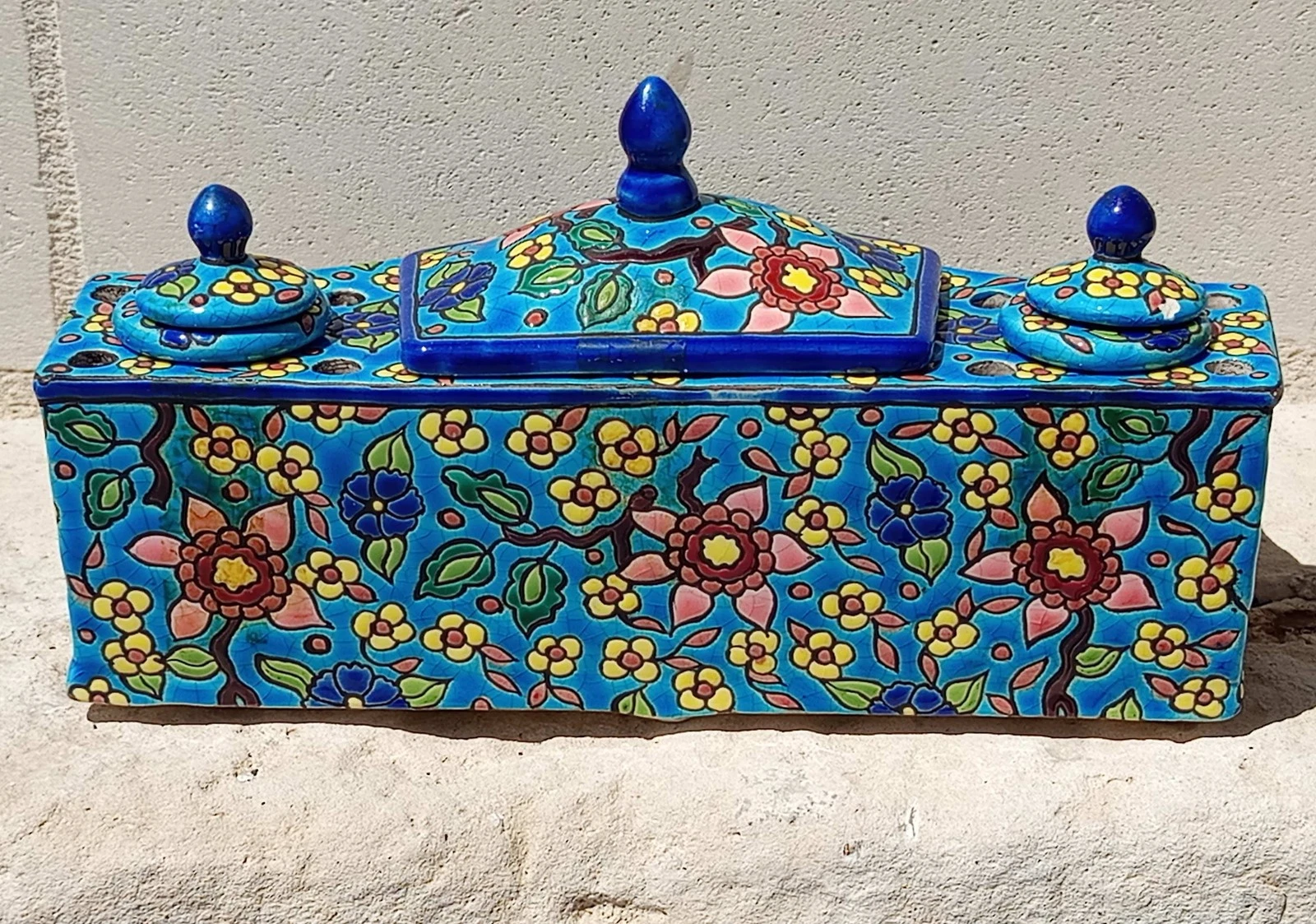
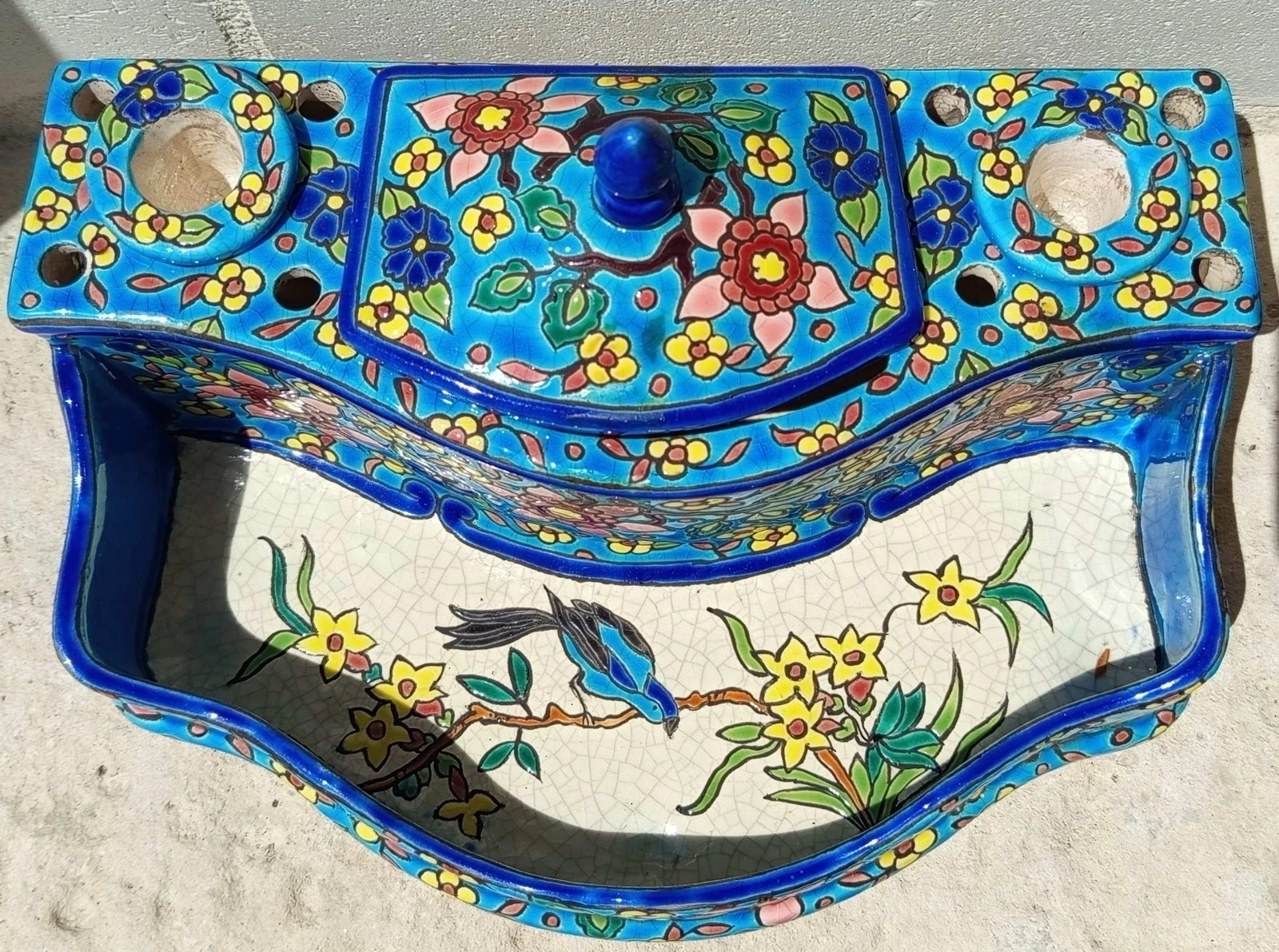
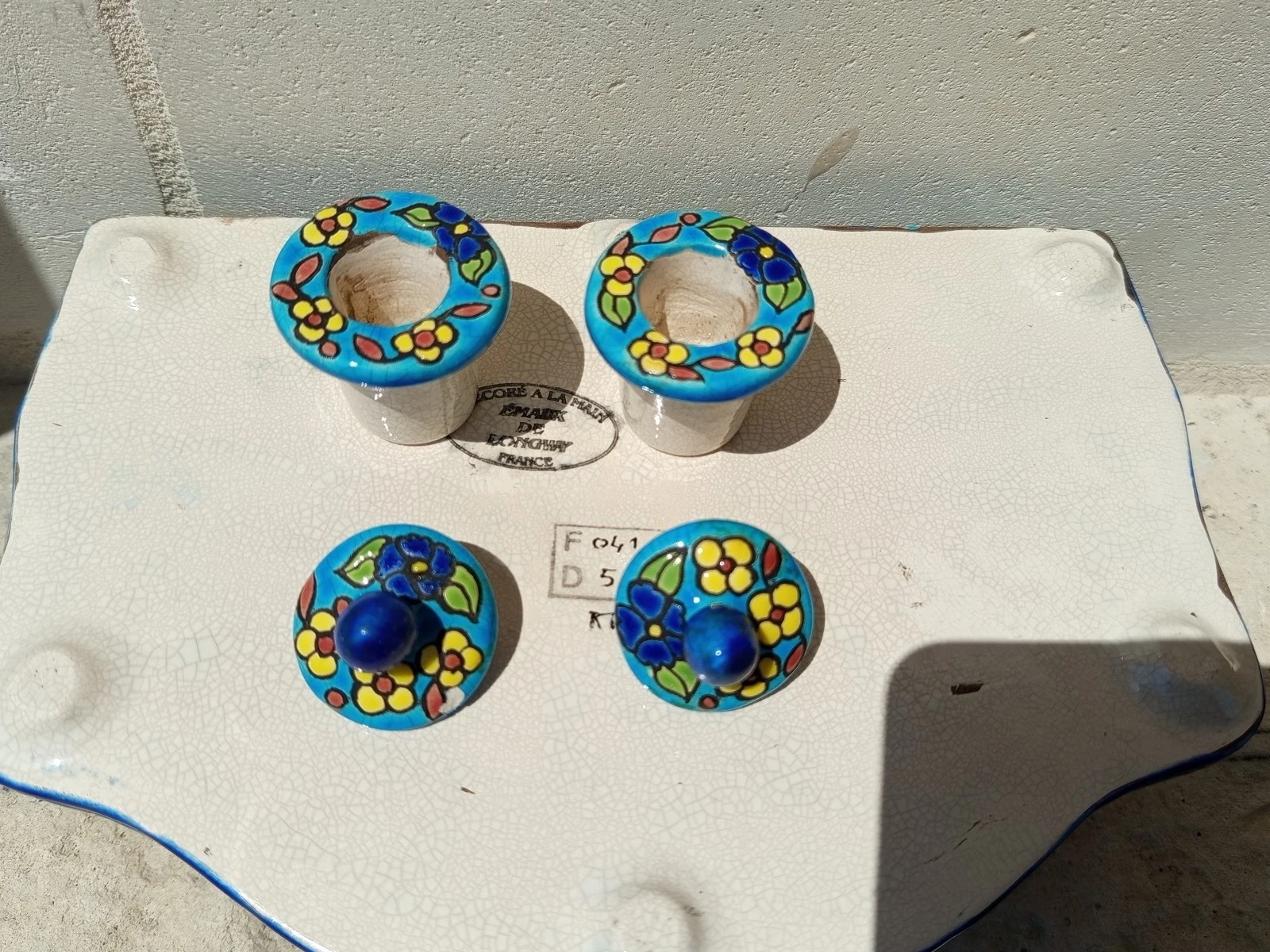
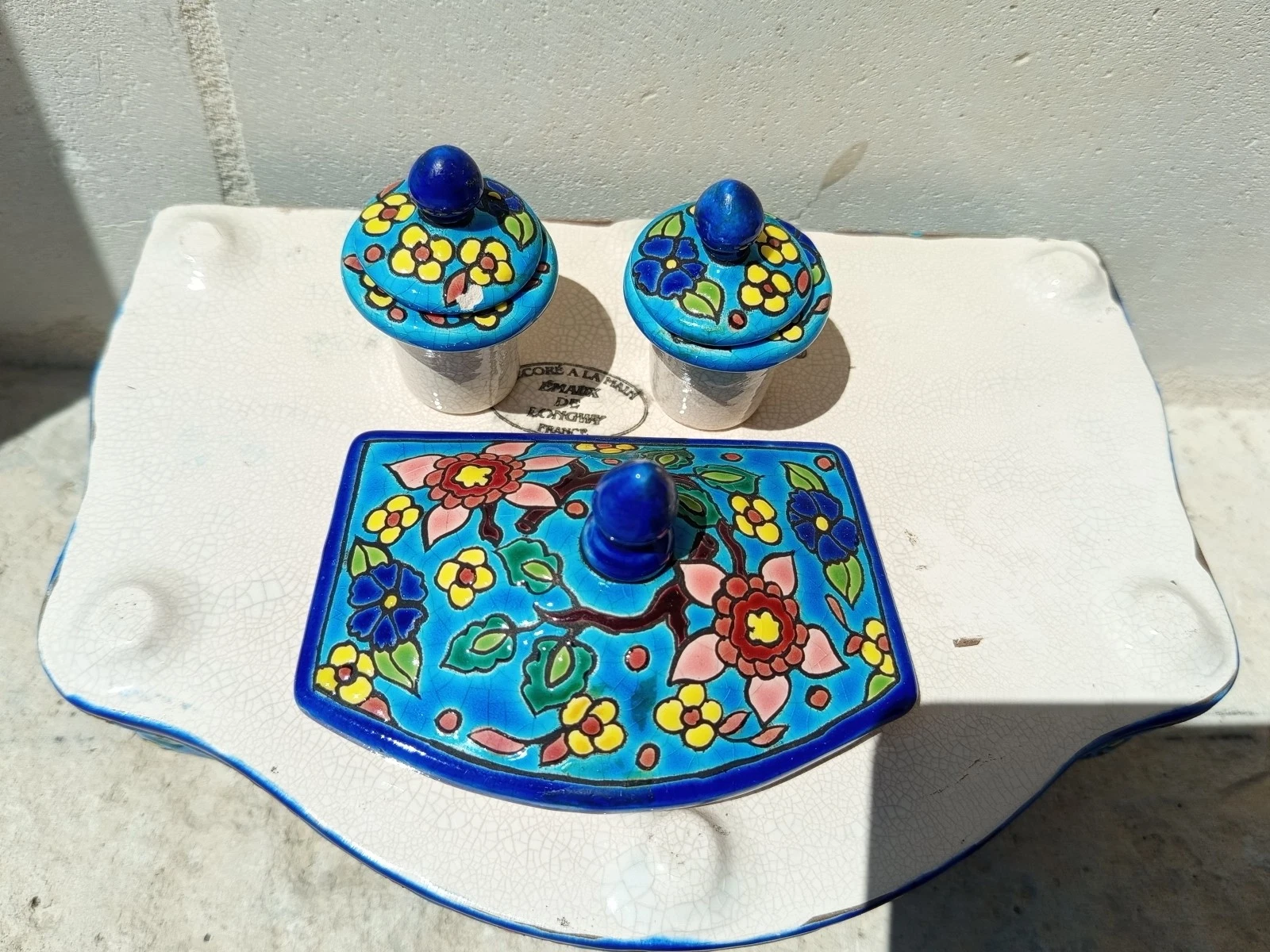
- Layout: The stepped design features a raised upper deck housing two removable cylindrical inkpots and a central rectangular compartment with a fitted lid, intended for storing nibs, stamps, or sealing wax.
- Pen Storage: The upper deck is pierced with four circular holes—two flanking each inkwell—designed to hold dipping pens upright. A curved, open trough at the front serves as a traditional horizontal pen tray.
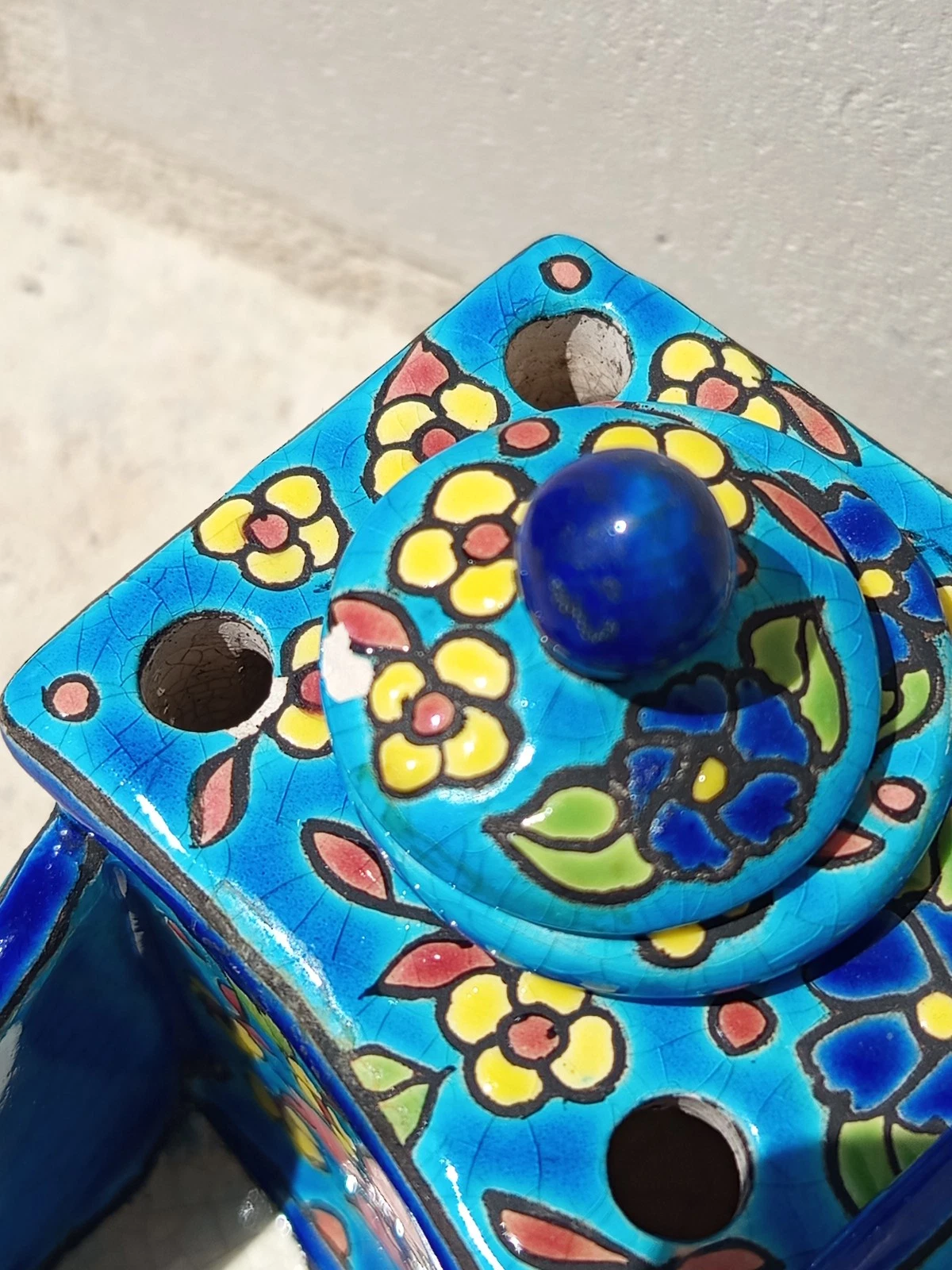
- Lids: Both the central compartment and the two inkwells feature domed lids topped with solid, deep cobalt blue finials.
Glaze and Decoration
- Primary Motif: The exterior walls, upper deck, and lids are decorated with a vivid turquoise blue crackle glaze ground. This surface is densely ornamented with outlined, polychrome floral branches featuring pink, deep red, yellow, and dark blue blossoms with green foliage.
- Tray Detailing: The recessed pen tray offers a stark contrast, utilizing a cream-colored crackle glaze background to showcase a hand-painted blue and black long-tailed bird perched on a branch alongside yellow star-shaped flowers.
- Condition: The piece exhibits standard crazing typical of aged faience, along with minor wear such as a small enamel chip on the rim of the left inkwell lid.
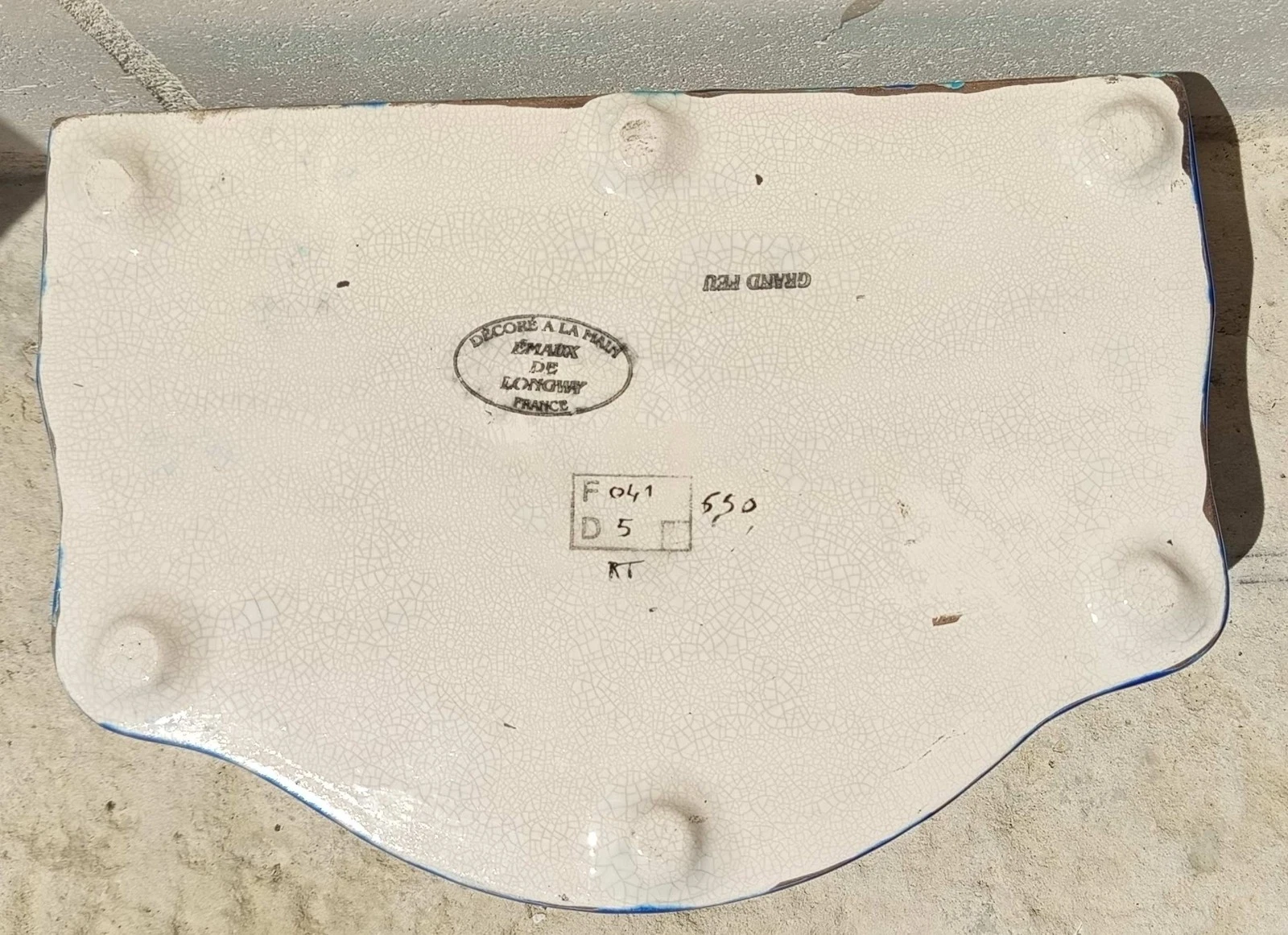
Underside Markings The underside is finished in a cream crackle glaze, supported by six raised, integrated ceramic feet, and bears several key diagnostic marks:
- Factory Stamp: A black oval cartouche reads “DECORÉ A LA MAIN / ÉMAUX / DE / LONGWY / FRANCE”, confirming it as a hand-decorated product of the historic French pottery.
- Firing Mark: A straight-line stamp reading “GRAND FEU” signifies the piece underwent high-temperature firing, a process that ensures the durability of the glaze and brilliance of the enamels.
- Pattern and Artisan Codes: A hand-painted black box contains the codes “F 041” over “D 5”, alongside the initials “KT” below the box, which identify the specific decor pattern and the individual artisan responsible for the enameling. The number “550” is hand-painted just to the right of this box.
This Longwy enameled inkstand dates to the interwar Art Deco period, circa 1920–1939 (with production of this style extending into the early 1940s–1950s).
The primary dating evidence comes directly from the marks on the underside:
- Factory Stamp Style: The printed black oval cartouche reading “DÉCORÉ A LA MAIN / ÉMAUX / DE / LONGWY / FRANCE” replaced earlier 19th-century shield-and-crest marks (such as the d’Huart family coat of arms) and was introduced around 1920, remaining in regular use through the mid-20th century.
- Export “France” Designation: The presence of “FRANCE” at the base of the stamp indicates manufacture intended for international distribution following trademark regulations, typical of 20th-century production.
- Catalog & Decorator Grid: The hand-painted grid containing “F 041” (the mold/form number) and “D 5…” (the decor pattern number), accompanied by the artisan enhancer’s initials (“KT”) and inventory/batch number (550), follows Longwy’s standardized cataloging system established during the 1920s.
- Style and Motif: The combination of traditional émaux cernés (cloisonné-style raised enamel) in Chinoiserie turquoise with the flat cream crackle reserve and stylized songbird was a staple decorative theme during Longwy’s prolific Art Deco era.
Sold for $165 in July 2026
Content disclaimer. The information posted is the owner’s best knowledge and may not have been vetted by the SOIC. We welcome comments, corrections, and additions, working to make our website information comprehensive and accurate.
Join the Society of Inkwell Collectors (SOIC) – it’s free!
Founded in 1981 as a non-profit organization,
we are documenting inkwells (and accessories).
We’re here to help and inform!