


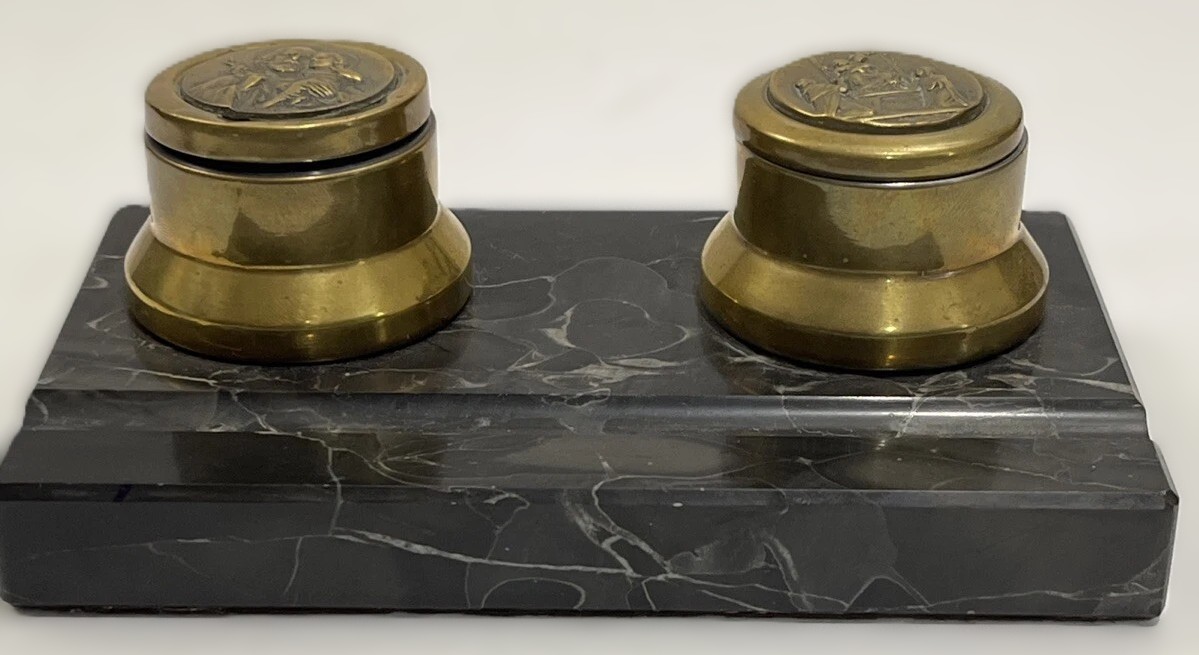
Double Inkstand with Religious Imagery
| Categories | Figural - Mythology; Literature; Religion; Fictional |
| Type | Religion |
| Material | Brass, Marble |
| Markings | See Narrative |
| Manufacturer | Undetermined |
| Origin | France |
| Date or Era | circa 1910 |
| Measuring | 6 ½” x 4” x 2 ½” high |
This late 19th to early 20th-century devotional inkstand combines high-quality materials—likely Belgian Black or Nero Marquina marble—with finely cast brass or bronze work.
Description
The piece features a rectangular black marble base with prominent white veining. A deep, polished pen channel (or pen rest) is carved into the front to hold a dip pen. Mounted on the base are two circular brass inkwells with flared pedestals and hinged lids.
The Signature & Artist
The signature visible on the lids is “Ruffony”, specifically Lucien Ruffony (1867–1940).
Ruffony was a well-known French sculptor and medalist active in Paris. He specialized in religious art, particularly high-relief medals and plaques. His work is characterized by a “soft” sculptural style that emphasizes the emotional connection between the figures. Finding his work on an inkstand suggests this was a “boutique” religious item rather than a mass-produced souvenir.
Imagery on the Lids
The lids depict two of the most significant figures in Catholic devotion:
- Left Lid (St. Joseph): This depicts Saint Joseph holding the Christ Child. Joseph is traditionally shown holding a lily, which symbolizes his purity and his role as the earthly protector of Jesus.
- Right Lid (The Virgin Mary): This depicts the Madonna and Child enthroned. The text “AVE MARIA” (Hail Mary) is clearly inscribed at the base. The two kneeling figures are likely Saint Dominic and Saint Catherine of Siena, a classic representation of Our Lady of the Rosary.
Origin and Purpose
- Where was it made? It was almost certainly made in France (likely Paris) between 1890 and 1920. France was the epicenter for high-end “Art Religieux” during this period.
- Why religious symbolism? In the 19th century, faith was integrated into every facet of daily life, including the act of writing.
- Who used it? The Clergy: This is a classic “Priest’s desk” item. A parish priest or a bishop would use such an inkstand for signing official documents, certificates, or writing sermons.
- Religious Institutions: It likely sat on the desk of a Mother Superior in a convent or a headmaster at a Catholic school.
- Devout Laypeople: It could also have been a gift for a “Confirmation” or “First Vows,” used by a wealthy layperson who wanted their workspace to reflect their piety.
While many smaller religious items were sold as souvenirs at pilgrimage sites like Lourdes or Lisieux, the presence of Lucien Ruffony’s signature and the substantial marble base move this into the category of a fine decorative art object rather than a simple trinket.
Sold for $204 in April 2026
Content disclaimer. The information posted is the owner’s best knowledge and may not have been vetted by the SOIC. We welcome comments, corrections, and additions, working to make our website information comprehensive and accurate.
Join the Society of Inkwell Collectors (SOIC) – it’s free!
Founded in 1981 as a non-profit organization,
we are documenting inkwells (and accessories).
We’re here to help and inform!