

Inkipedia
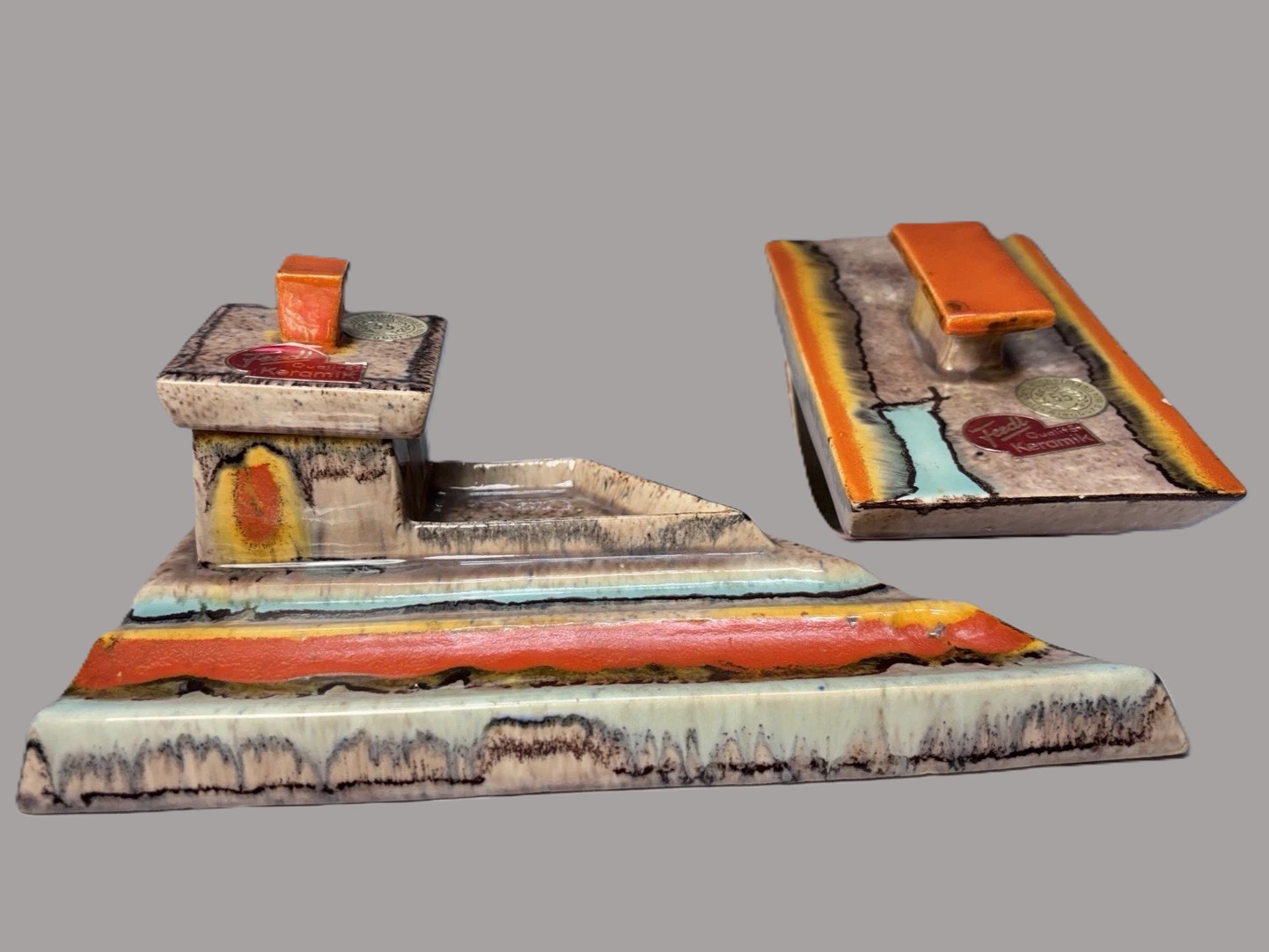


Art Deco German Art Pottery
| Categories | Art Deco |
| Material | Pottery |
| Markings | See |
| Manufacturer | Ferdinand Reiff |
| Origin | Germany |
| Date or Era | circa 1934 |
| Measuring | Inkwell: 5 ¾” x 9 ½” |
Manufacturer & History
- The Maker: Ferdi is the trade name for Ferdinand Reiff, a ceramics manufacturer based in Agathenhof (near Siegburg), Germany. They were known for these thick, expressive glazes well before the “Fat Lava” craze of the 1960s hit its peak.
- The Retailer Seal: The silver circular seal is particularly telling. It celebrates the 55th anniversary of Carl Richelmann, a prominent ceramic and glass retailer in Siegburg.
- The Math: Since the seal explicitly lists 1879–1934, the “55” refers to the years between those dates (1879 + 55 = 1934). This suggests the set was likely produced in or around 1934 as a commemorative item or part of a special run for that anniversary.
- Style Note: This “running glaze” technique (Laufglasur) was a hallmark of high-end German art pottery in the 1930s.
Component Breakdown
- The Inkstand (Inkwell)
- Base Shape: The footprint is an asymmetrical wedge or an irregular trapezoid. It features a tiered, architectural design that feels very “Machine Age.”
- The Reservoir: On the higher “block” of the base sits a square-topped reservoir.
- The Insert: The set includes a removable square ceramic insert (white/pale turquoise glaze).
- The Lid: A square, flat lid with a prominent, cubic tangerine-orange finial/knob.
- Pen Tray: An integrated, sunken rectangular area is built into the sloped portion of the base to hold pens or nibs.
- The Rocker Blotter
- Design: A rectangular ceramic top with a wide, curved bridge handle in solid tangerine orange.
- Construction: The underside is curved to allow the user to “rock” the blotter over fresh signatures. It has been outfitted with a piece of blotting paper wrapped around the wooden or metal core usually tucked beneath the ceramic shell.
Glaze & Aesthetic
The aesthetic is a masterclass in controlled chaos:
- Glaze Technique: This is a “Running Glaze” (Laufglasur). The thick, frothy dark brown/black lines are used to “corral” the colors, creating a volcanic, bubbly texture.
- The Palette: Primary: A vibrant, glossy Tangerine Orange.
- Secondary: Bands of Turquoise/Aqua and a sunny Yellow transition.
- Background: A “salt-and-pepper” or oatmeal-textured tan glaze that provides a matte contrast to the glossy colored bands.
- Bottom Mark: The base is incised with the mold number 3256.
- Mold Number 3256 & Colorways
The mold number 3256 belongs to a series of desk accessories produced by the Reiff factory in Siegburg.
- Identified Variants: These sets were produced in “families” of colors. While this one features the striking tangerine and turquoise, this mold has been seen in:
- “Aurora” Brown/Orange: A more muted, earthy version with heavy manganese brown and dark orange streaks.
- Monochromatic Cobalt: A deep blue running glaze, without the bright contrasting bands.
- Pastel Deco: Earlier 1930s versions sometimes used softer “splatter” glazes in mint green or pale pink, though the “Fat Lava” texture here confirms it is from the bolder 1934-1940s era.
- The Carl Richelmann Connection: Because this set has the 55th Anniversary seal, it was a specific retail commission. It is likley that for the 1934 anniversary, Richelmann ordered a limited run in this specific high-contrast colorway to showcase modern 1930s tastes.
Sold for $135 in September 2026
Content disclaimer. The information posted is the owner’s best knowledge and may not have been vetted by the SOIC. We welcome comments, corrections, and additions, working to make our website information comprehensive and accurate.
Join the Society of Inkwell Collectors (SOIC) – it’s free!
Founded in 1981 as a non-profit organization,
we are documenting inkwells (and accessories).
We’re here to help and inform!