

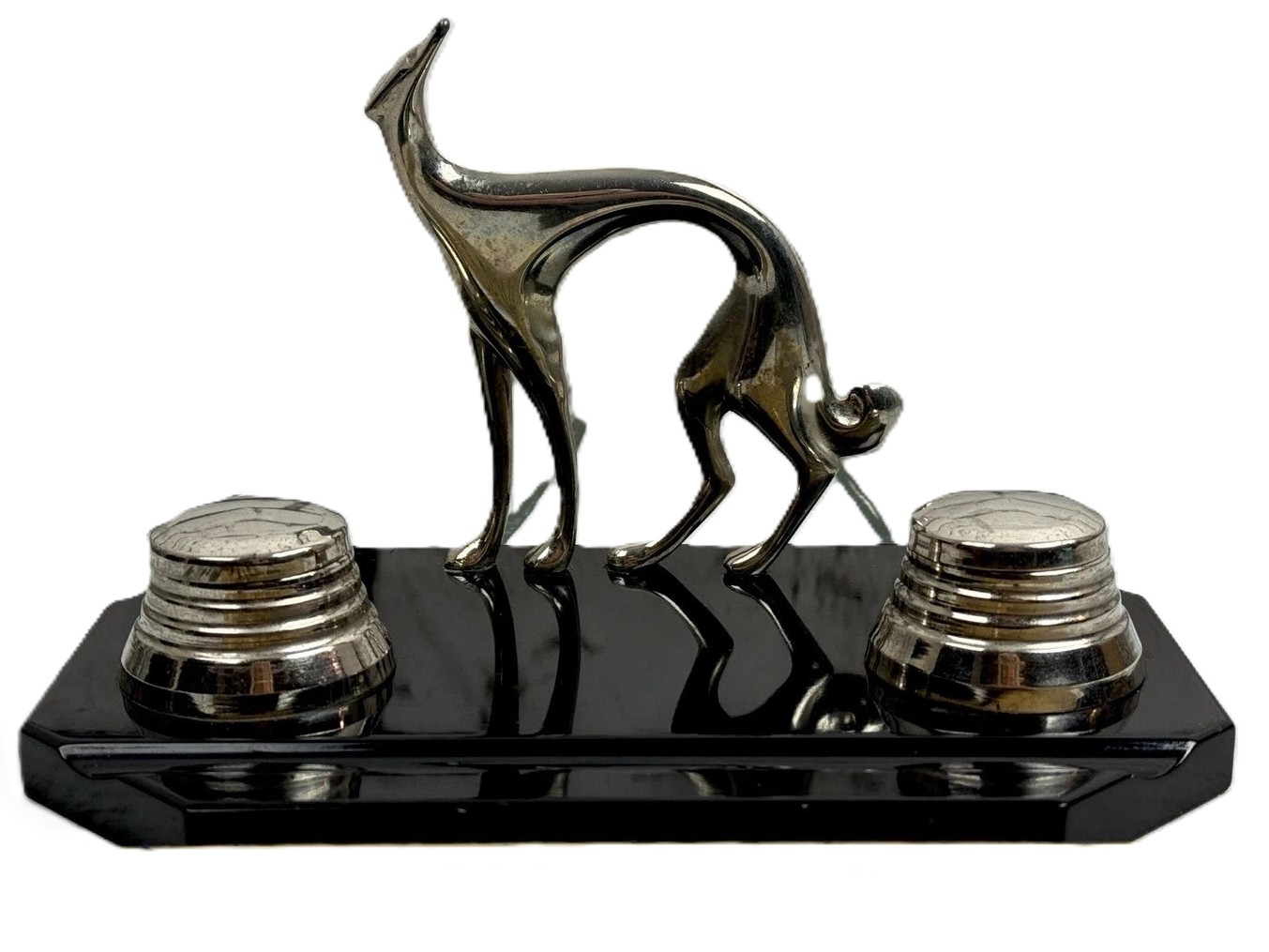




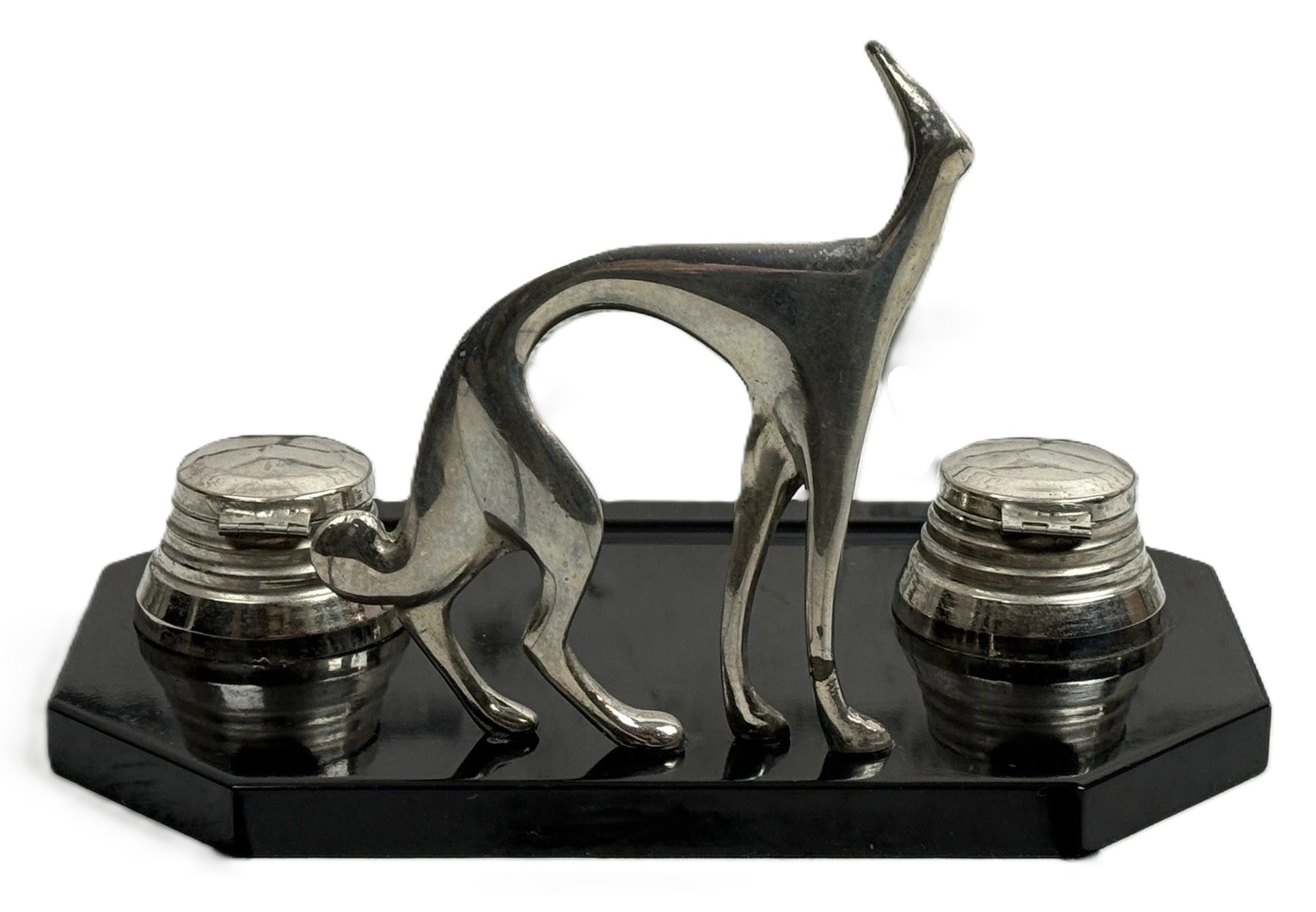
Art Deco Greyhound Double Inkstand
| Categories | Art Deco |
| Type | dog |
| Material | Chrome, Glass |
| Markings | Unmarked |
| Manufacturer | Undetermined |
| Origin | Austria |
| Date or Era | circa 1930 |
| Measuring | 8 ½” across; 5 ¼” high |
This Art Deco double inkstand is a textbook example of the “Viennese Style” popularized by the Werkstätte Hagenauer (Wien) during the interwar period.
Description
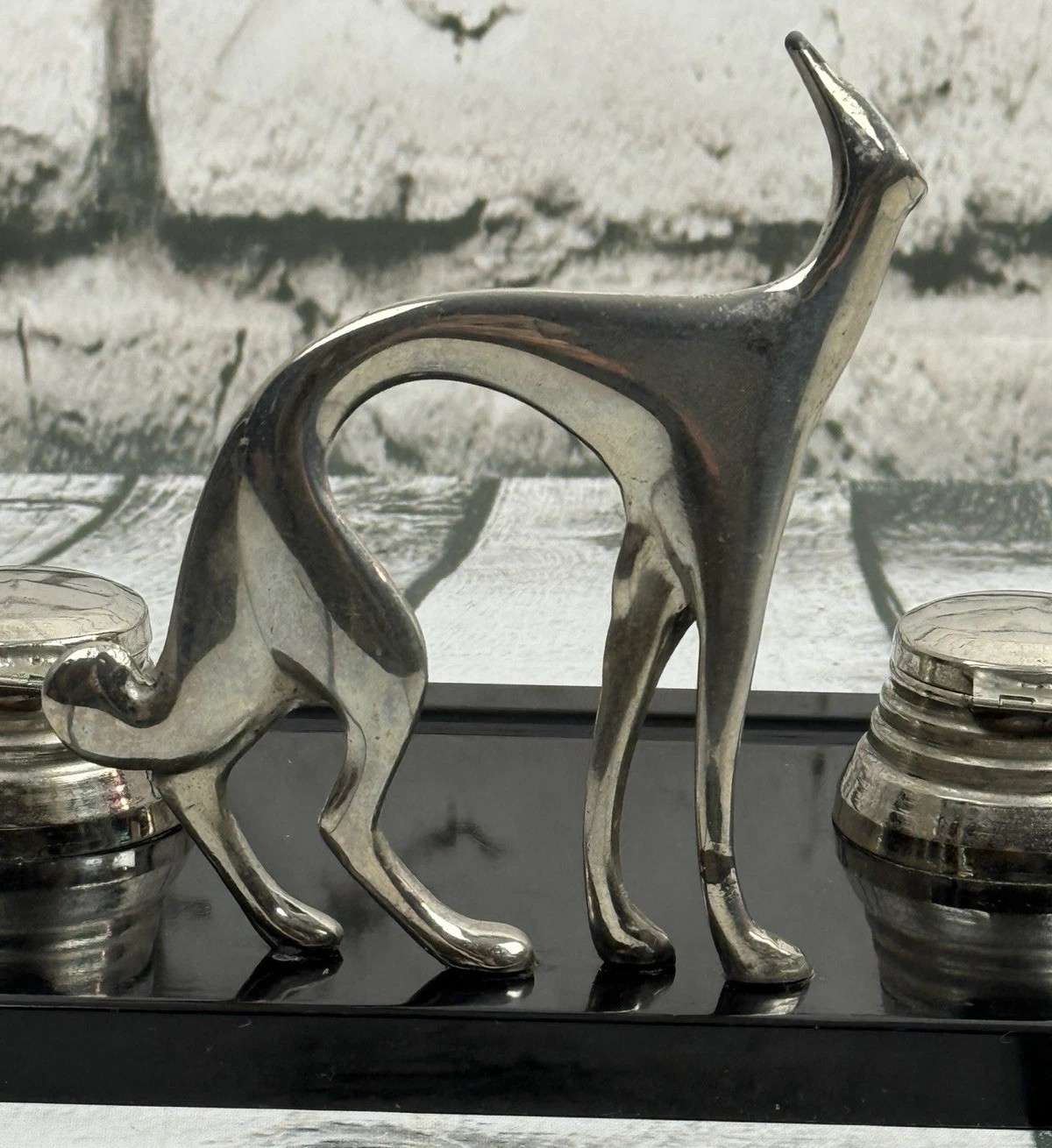
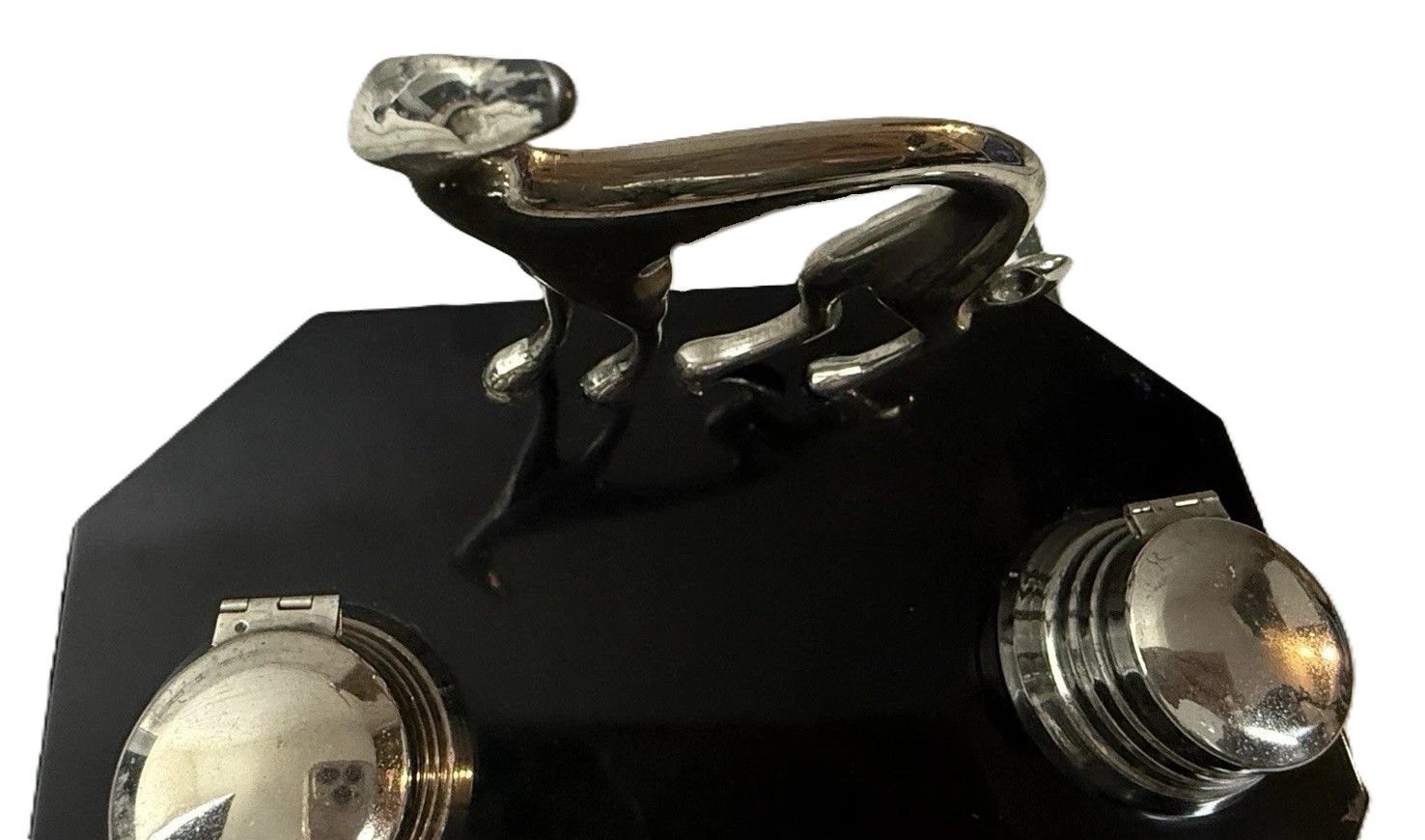
- The Greyhound: The centerpiece is a highly stylized, streamlined greyhound in a “startled” or arched pose. Its elongated neck, pin-head, and exaggerated thinness are hallmarks of the modernist animal silhouettes designed by Karl Hagenauer (1898–1956). The design prioritizes the “line” over anatomical realism, capturing the essence of speed and grace central to Art Deco aesthetics.
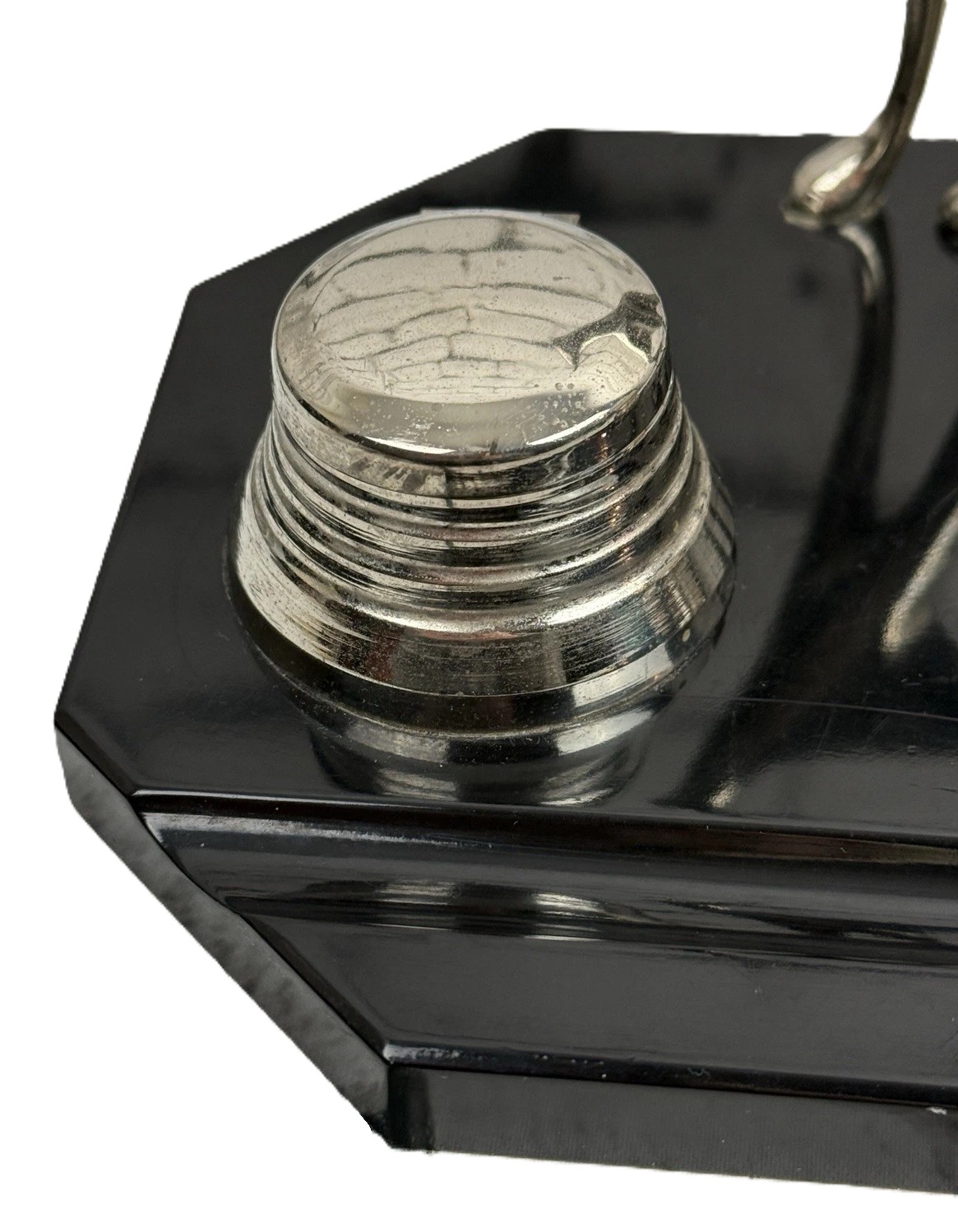
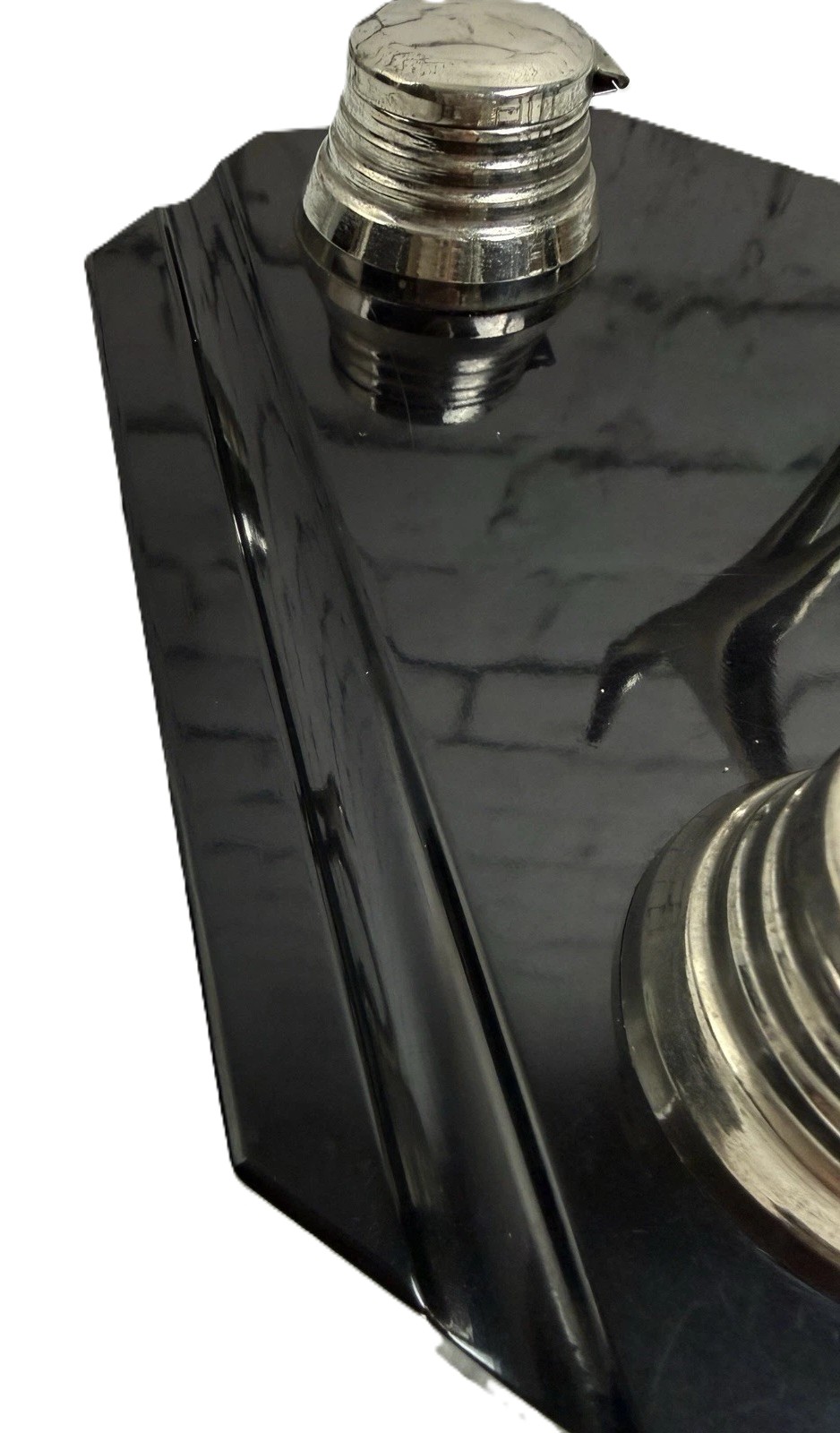
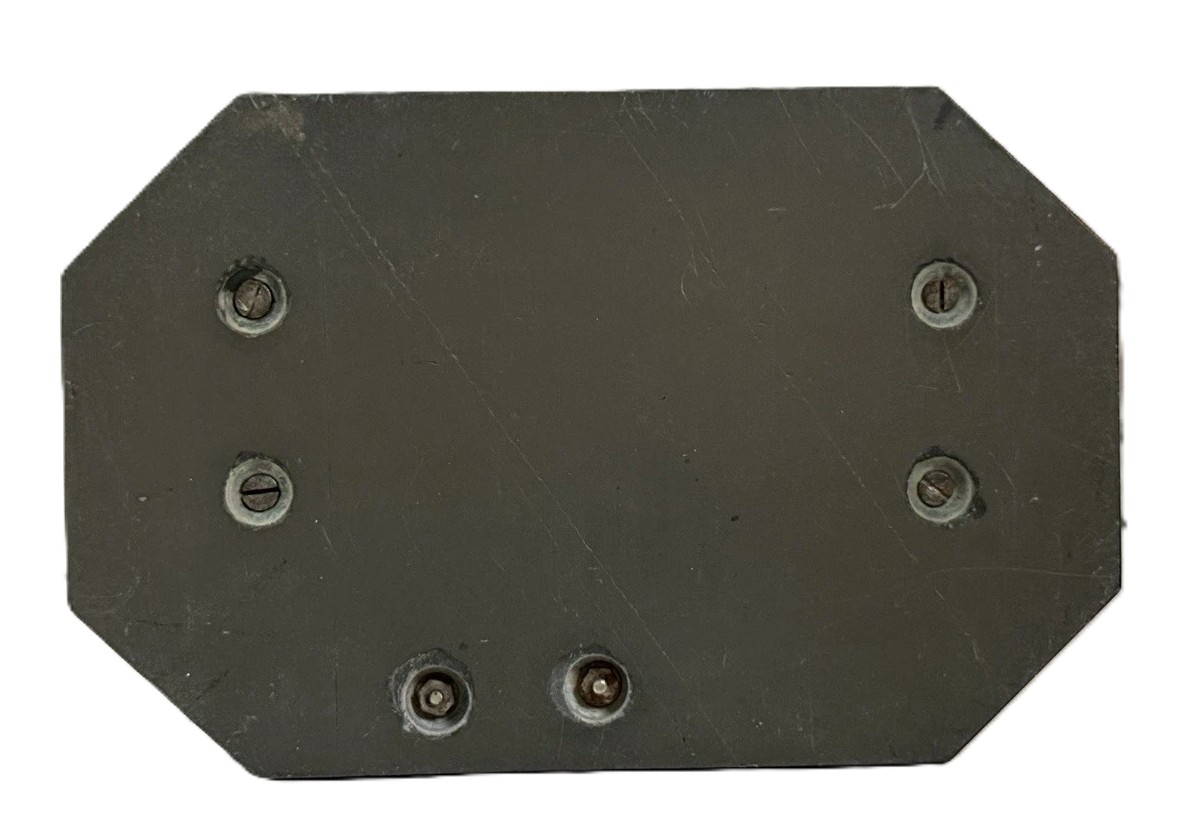
- Contrast of Materials: The piece relies on the high-contrast “Black & Silver” palette typical of the 1930s. The chrome-plated metal provides a cool, industrial sheen against the deep, reflective black octagonal base (made of Vitrolite or black glass).
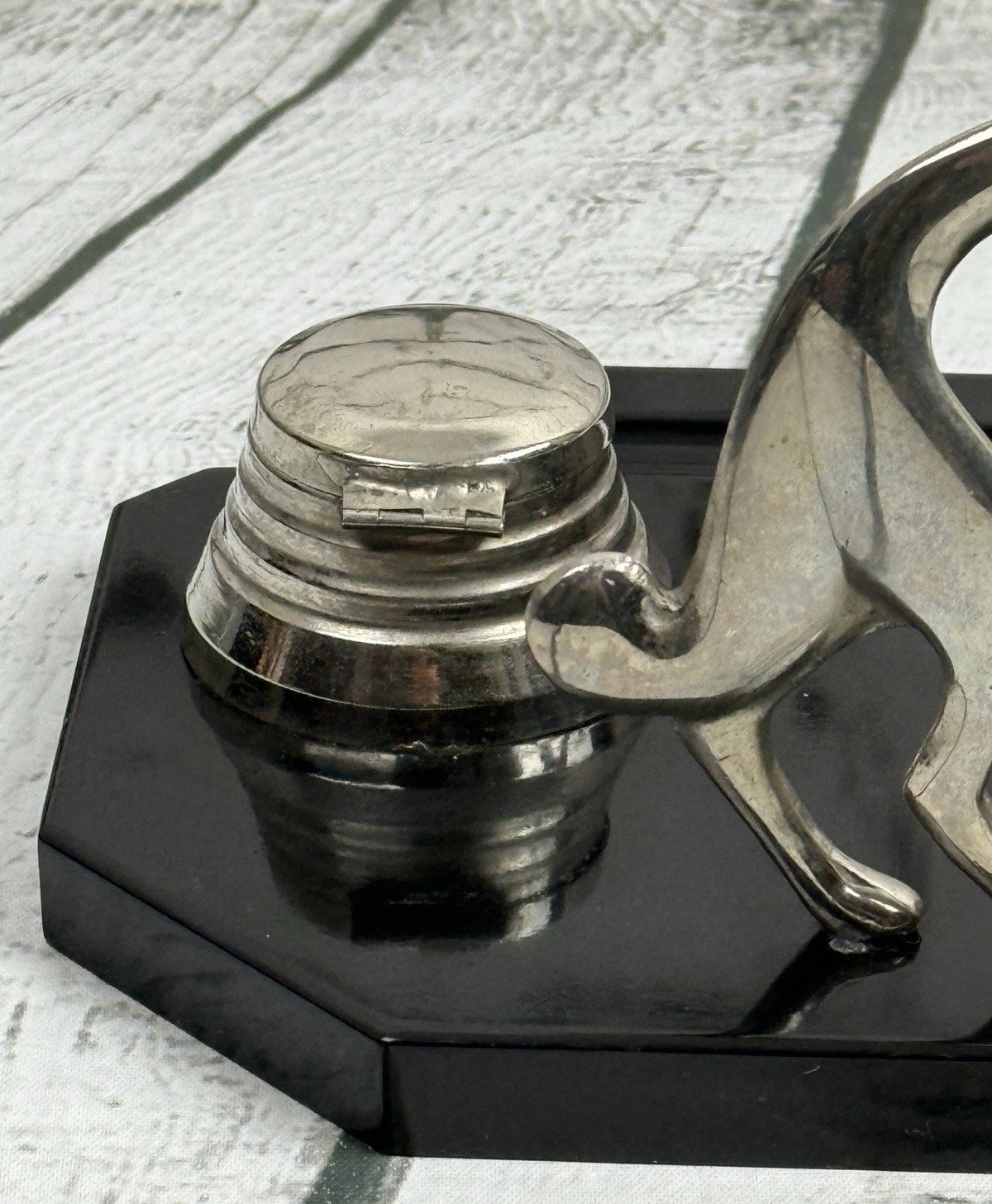
- The Inkwells: The two tiered, “wedding cake” style inkwell covers are geometrically consistent with the base. Inside, the presence of metal inserts suggests high-quality functional construction.
Provenance and Identification
While unmarked, this piece is almost certainly Austrian (Vienna) in origin.
| Feature | Details |
| Maker | Werkstätte Hagenauer Wien (attributed). Karl Hagenauer was the primary designer of these stylized animal figures. |
| Alternative Makers | It could also be by Richard Rohac, a former Hagenauer craftsman who opened his own shop and used a similar “Hagenauer style,” though Rohac’s pieces are more frequently marked with a mirrored “RR.” |
| Estimated Age | Circa 1930–1935. This was the peak of the “Jazz Age” demand for these sleek desk accessories. |
| Place of Origin | Vienna, Austria. Many pieces were exported to high-end boutiques like Rena Rosenthal’s in New York, where they were often sold unmarked or with simple “Austria” stamps that have since worn away. |
Why is it unmarked?
Hagenauer pieces were usually marked with the “wHw” (Werkstätte Hagenauer Wien) logo or “Made in Austria.” However, unmarked examples are common. They were often produced for export where paper labels were used instead of stamps, or they were contemporary “in the manner of” pieces made by other skilled Viennese workshops capitalizing on the popular style.
Research into the Werkstätte Hagenauer archives and various Art Deco auction records reveals that while this inkstand is a classic of the genre, the specific “tiered” lid design provides some interesting clues about its likely origin and age.
The “Tiered” Design & Catalog Connections
The “wedding cake” or tiered geometry of the inkwell lids is a signature Viennese architectural motif. In known Hagenauer catalogs (specifically reissues of the 1928 and 1957 editions), Karl Hagenauer utilized these stepped, geometric forms to complement his sleek animal silhouettes.
- Stylistic Match: Karl Hagenauer’s 1925-1930 desk sets often featured this “tiered” construction in the bases and lids. A similar set, documented circa 1925, utilized this exact stepped-metal language to transition from the flat base to the functional inkwell.
- The Greyhound Figure: The specific arched, “startled” pose of the dog is cataloged as a recurring Hagenauer model. While many of his dogs are shown leaping or sitting, this “hollow-back” stretch was designed to create a sense of tension and motion, often appearing as a single sculpture or a bookend.
Who Made It & Where?
| Potential Maker | Evidence |
| Karl Hagenauer (Primary) | The most likely candidate. The use of nickel-plated brass over a black glass/Vitrolite base was his preferred material combination for desk accessories in the early 1930s. |
| Richard Rohac | A former Hagenauer craftsman who often worked in an identical style. Rohac frequently produced “unmarked” pieces for the export market, particularly for high-end shops in London and New York. |
Origin & Age
- Made In: Vienna, Austria.
- Date: Circa 1928–1934. The lack of a mark actually points toward this period; during the early 1930s, many Austrian pieces intended for the US market were only marked with paper labels or simple “Austria” stamps that were easily cleaned off the polished metal or glass.
- The Base: The octagonal base is Vitrolite (an opaque, pigmented structural glass) or black onyx. Hagenauer was famous for pairing these cold, industrial materials with his “lithe” animal figures.
Sold for $173 in February 2026
Content disclaimer. The information posted is the owner’s best knowledge and may not have been vetted by the SOIC. We welcome comments, corrections, and additions, working to make our website information comprehensive and accurate.
Join the Society of Inkwell Collectors (SOIC) – it’s free!
Founded in 1981 as a non-profit organization,
we are documenting inkwells (and accessories).
We’re here to help and inform!