

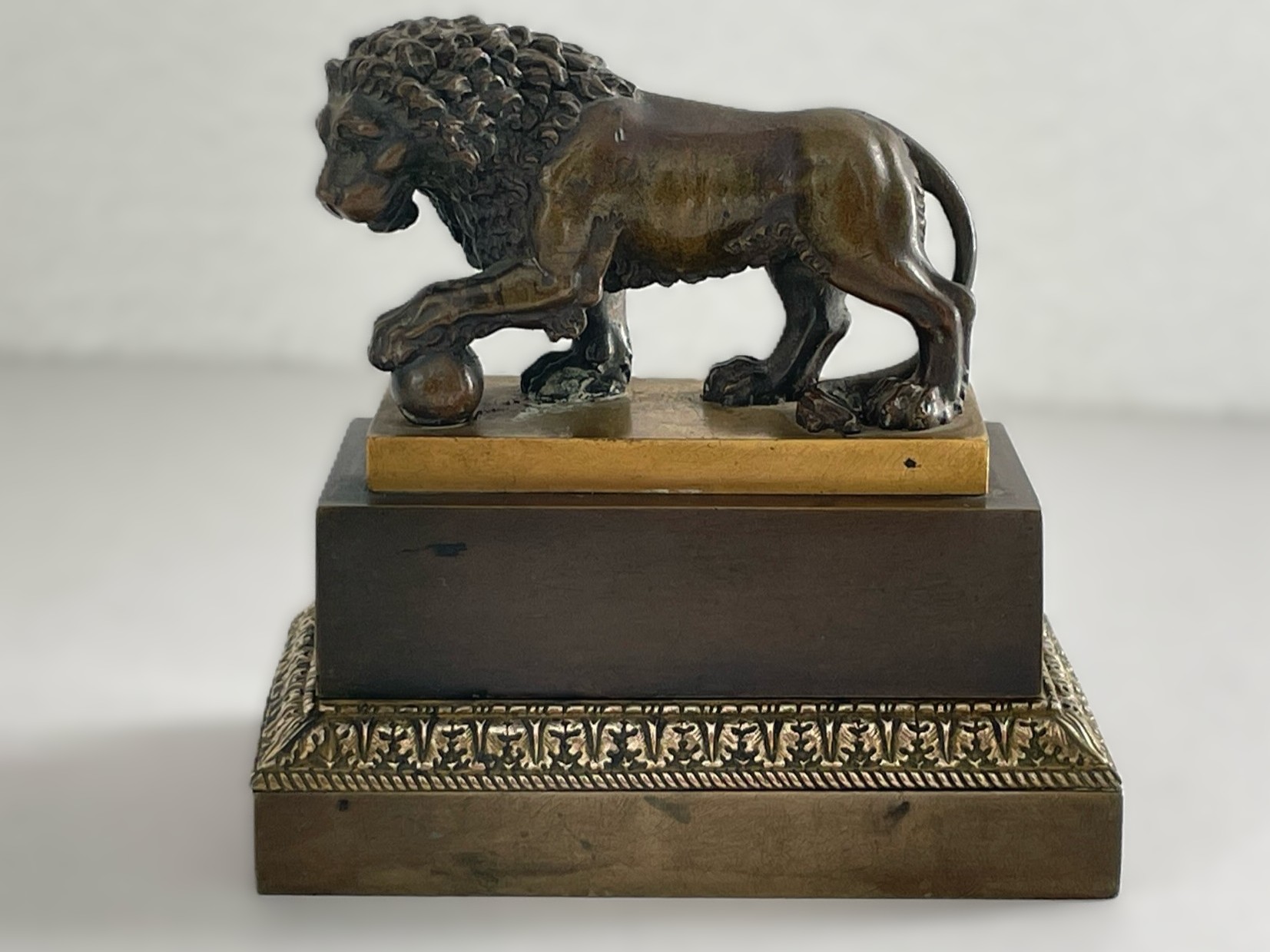
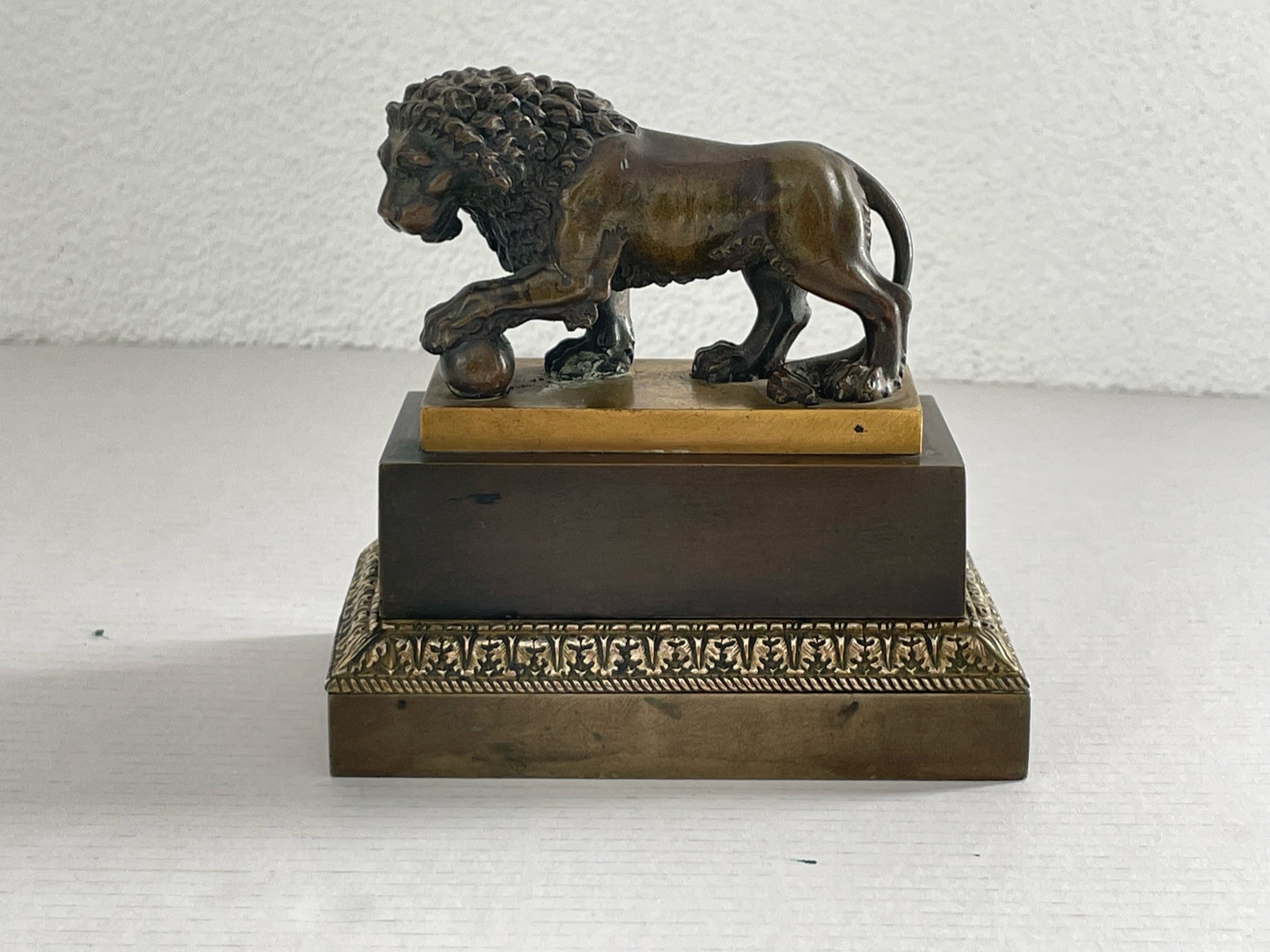
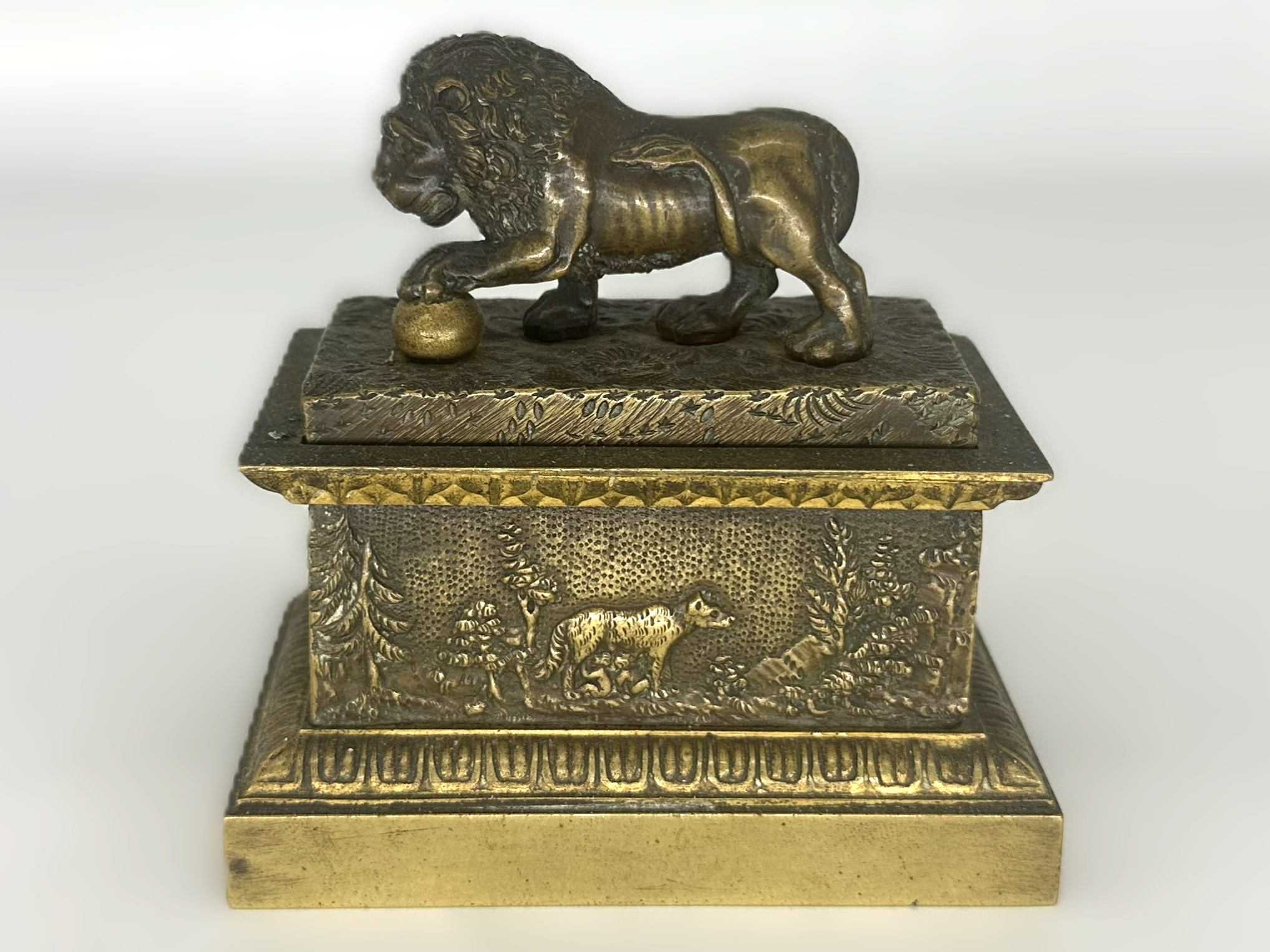
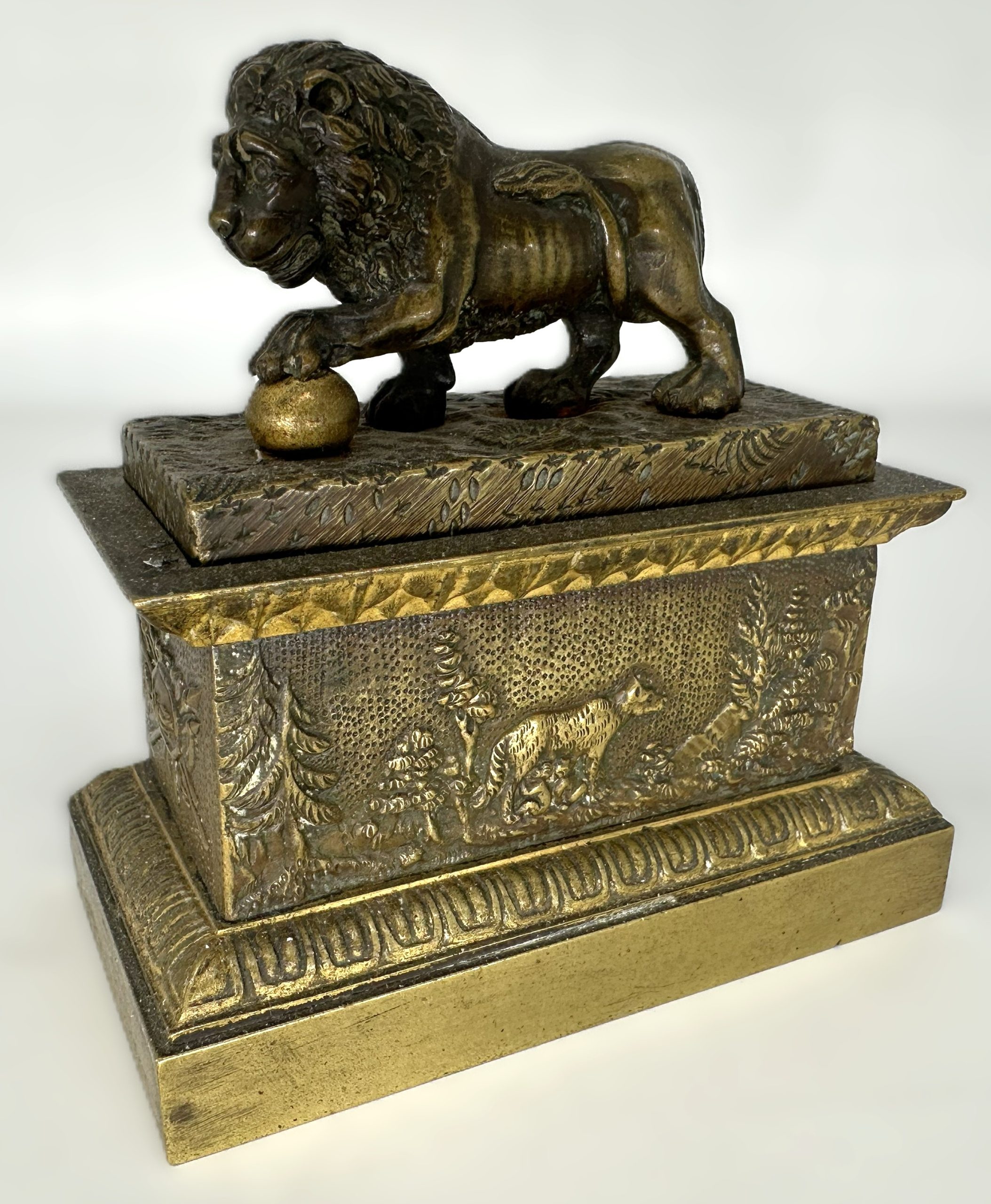
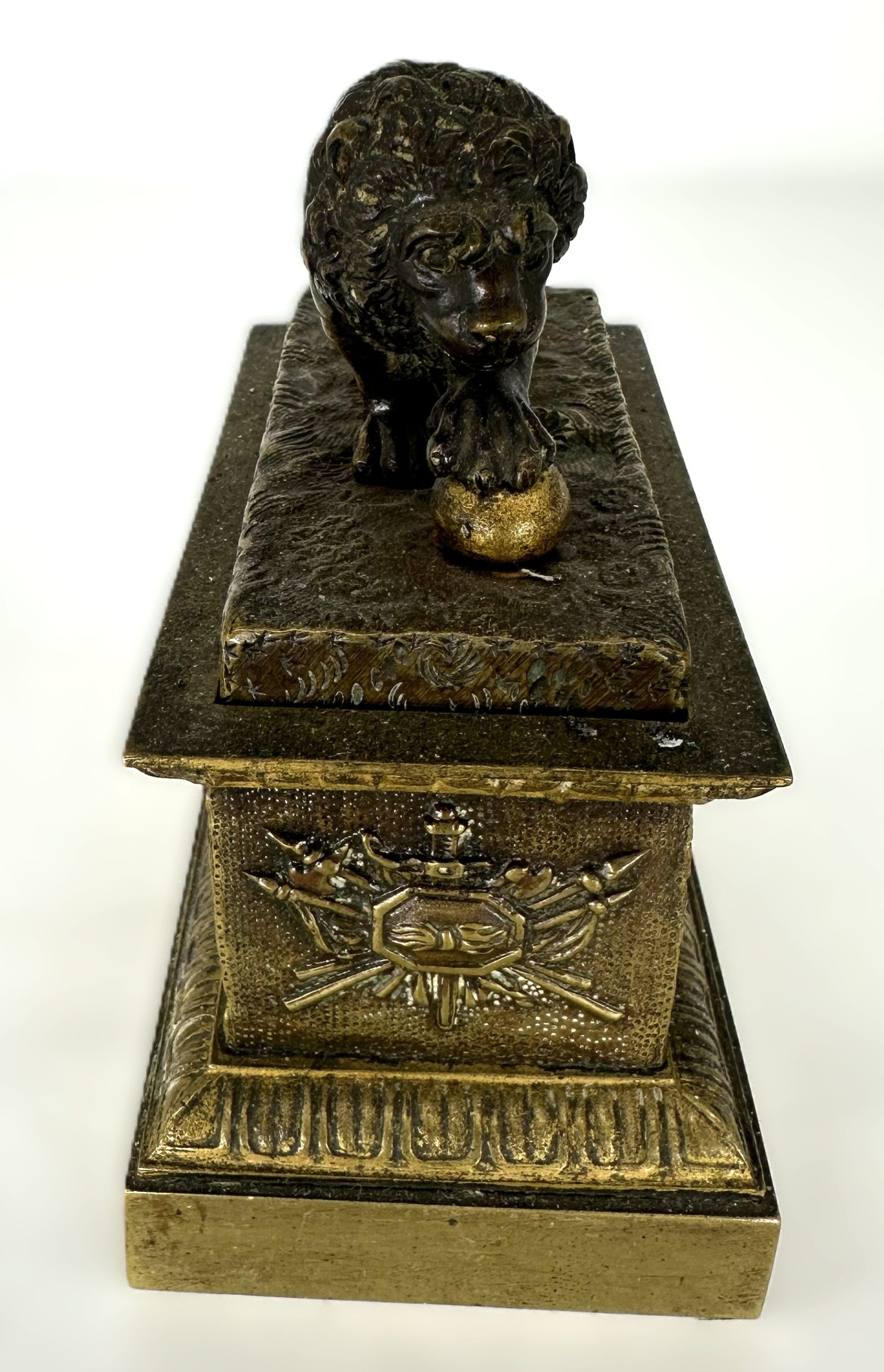
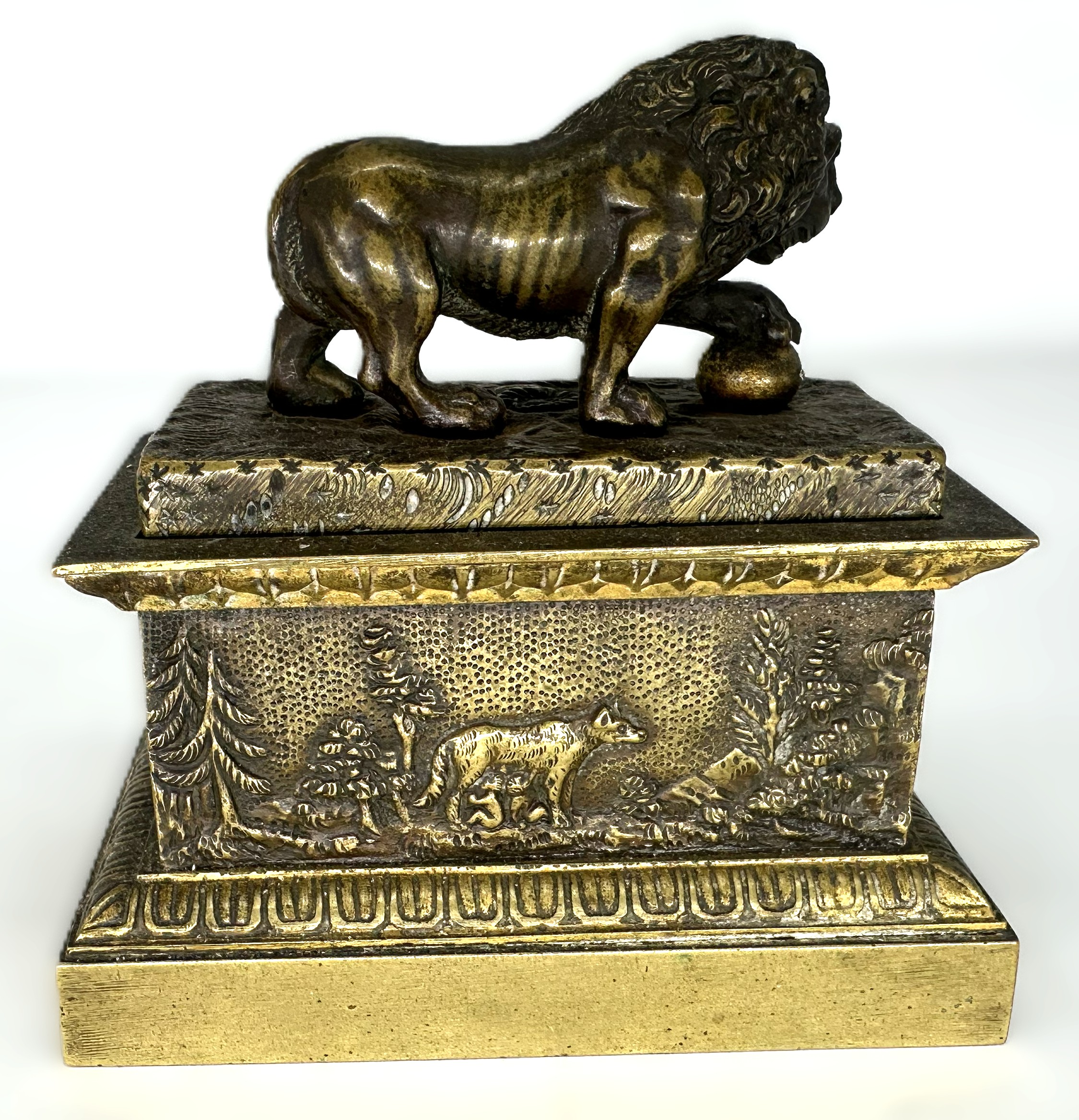
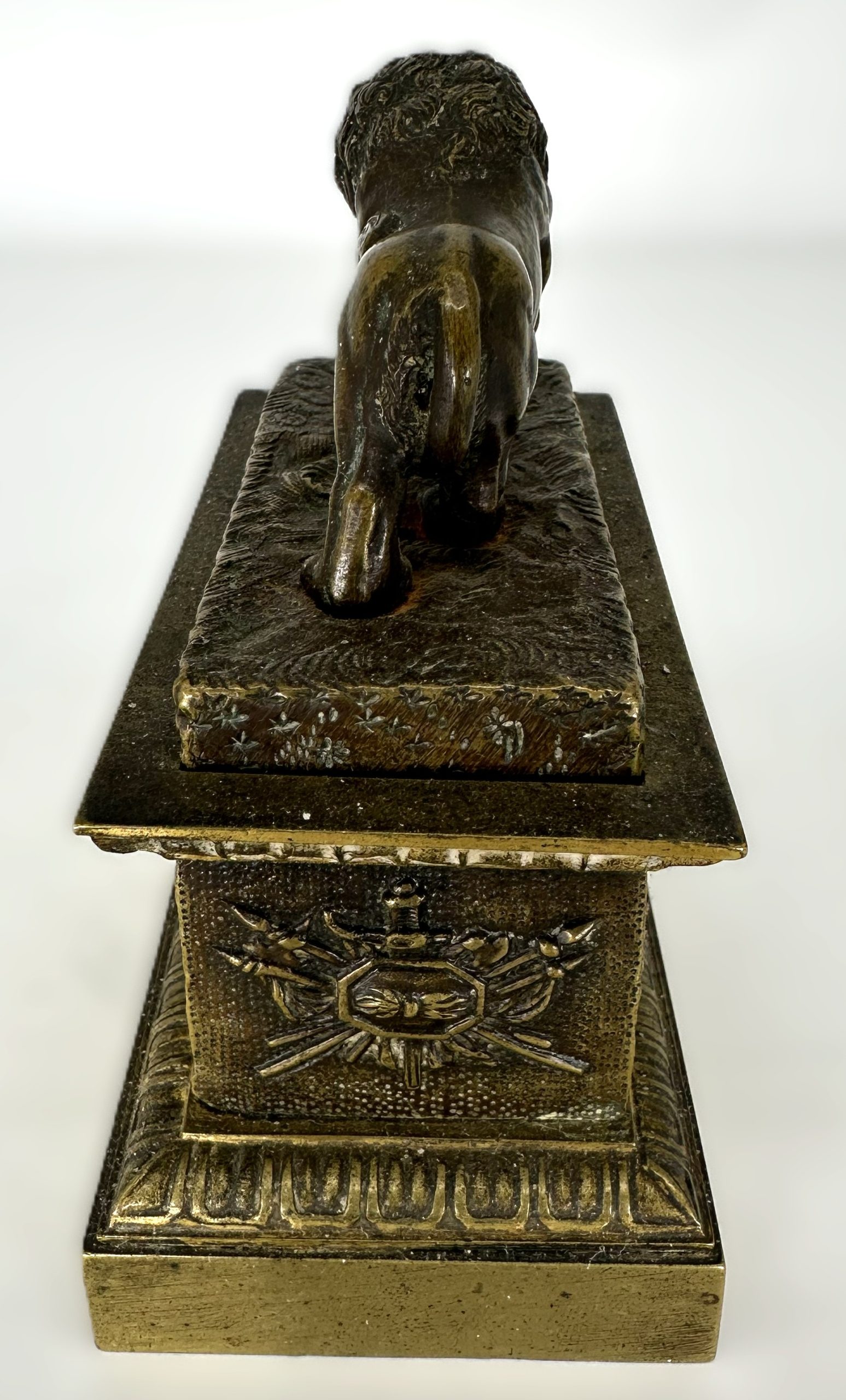
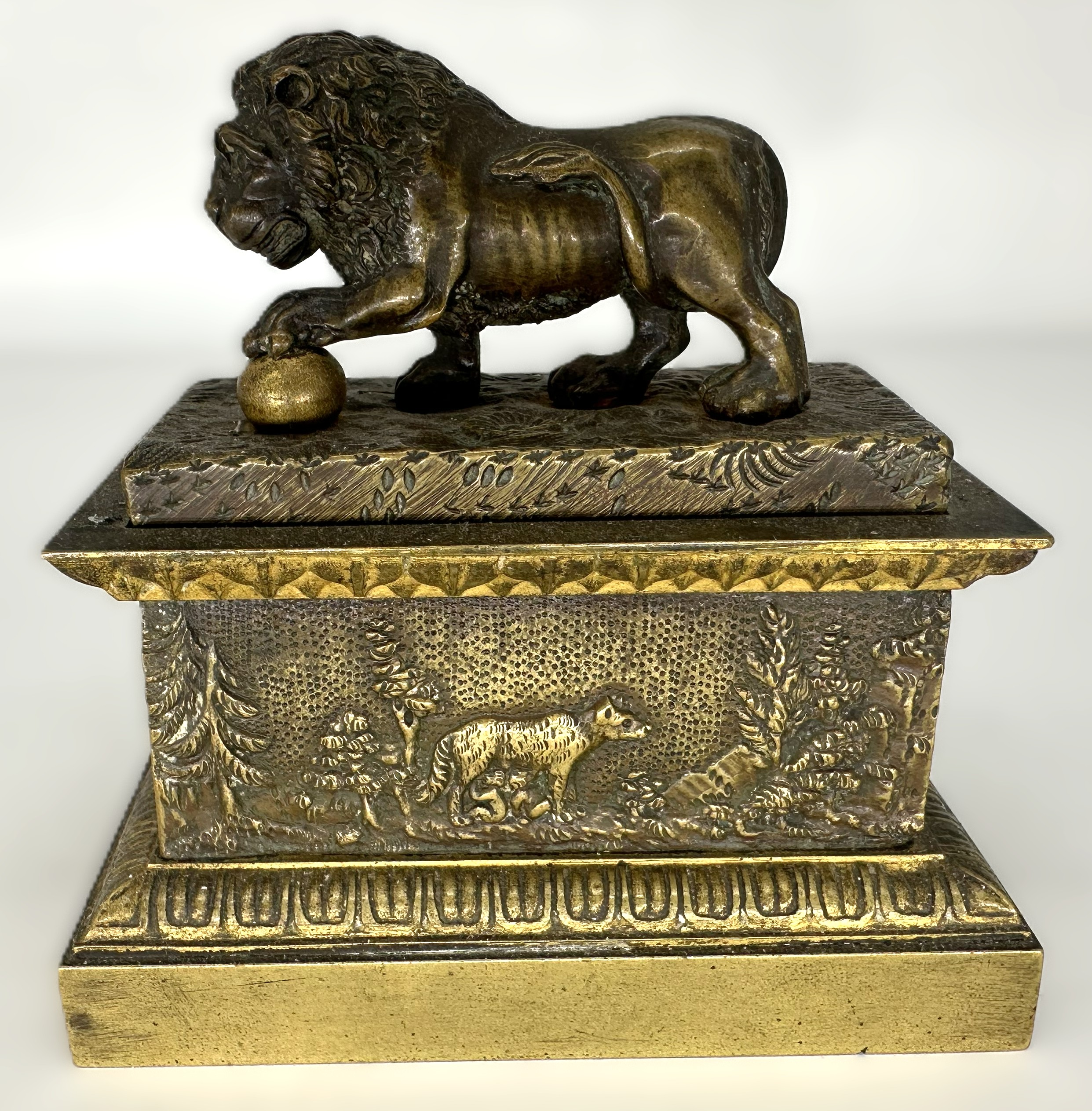
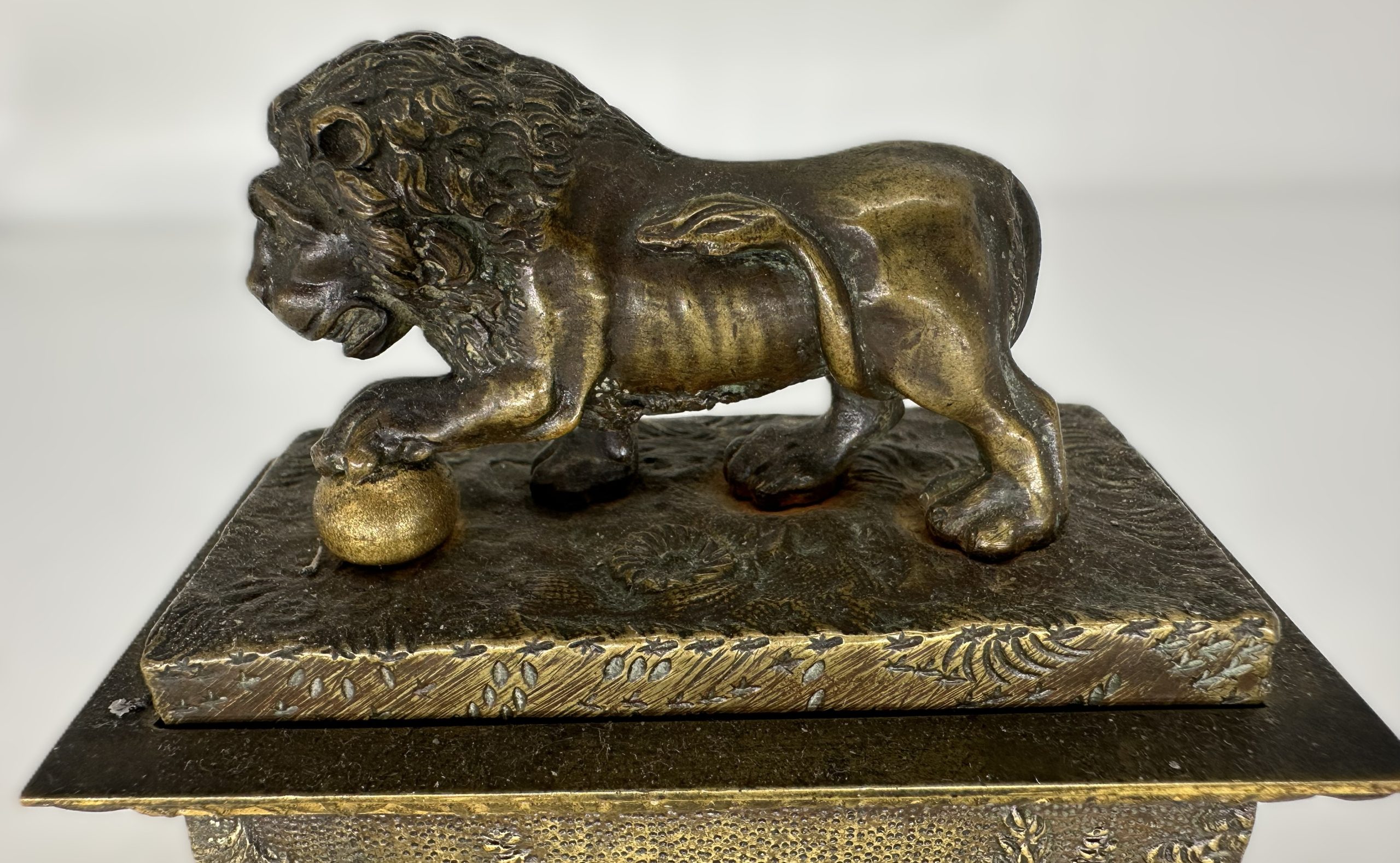
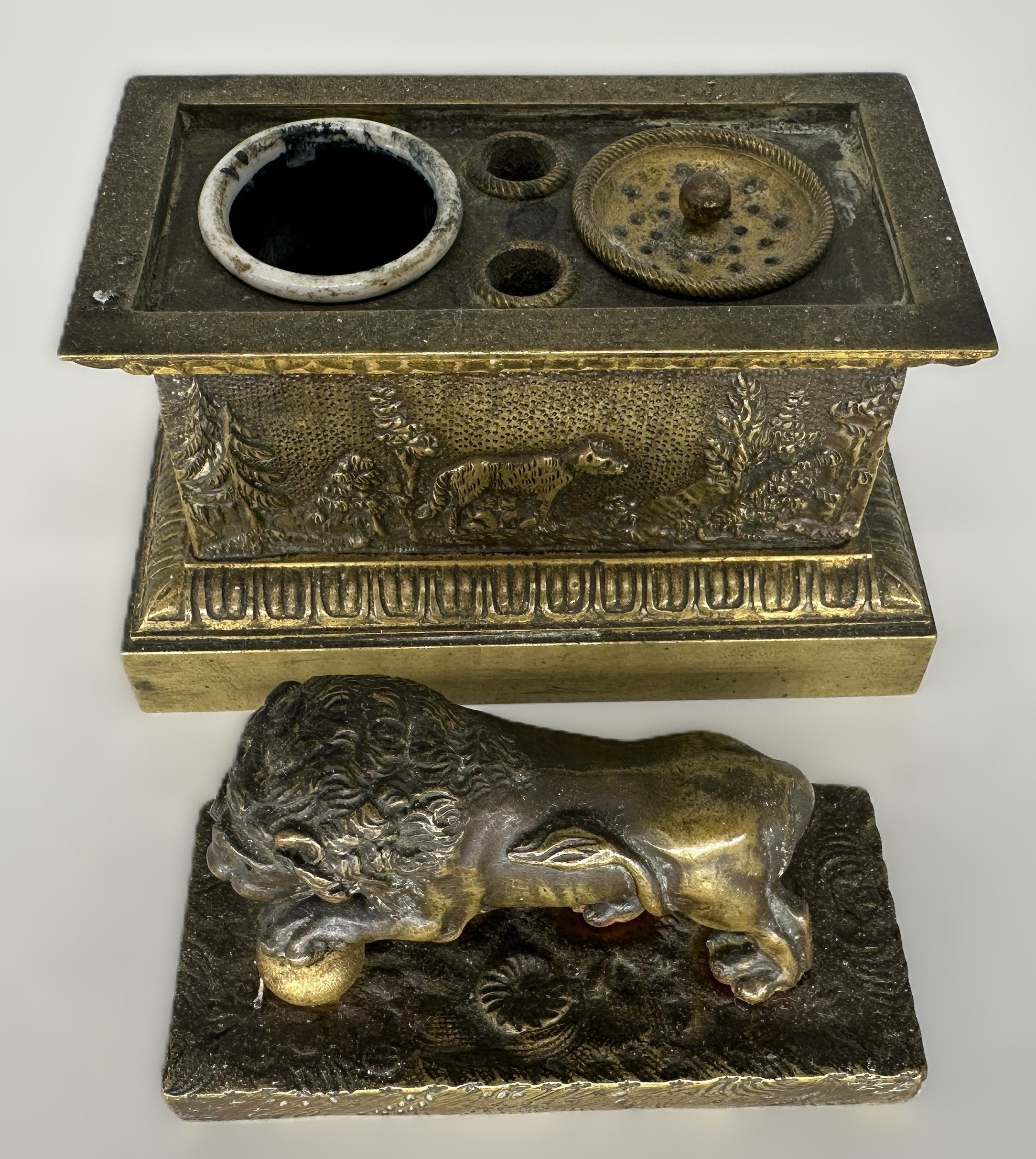
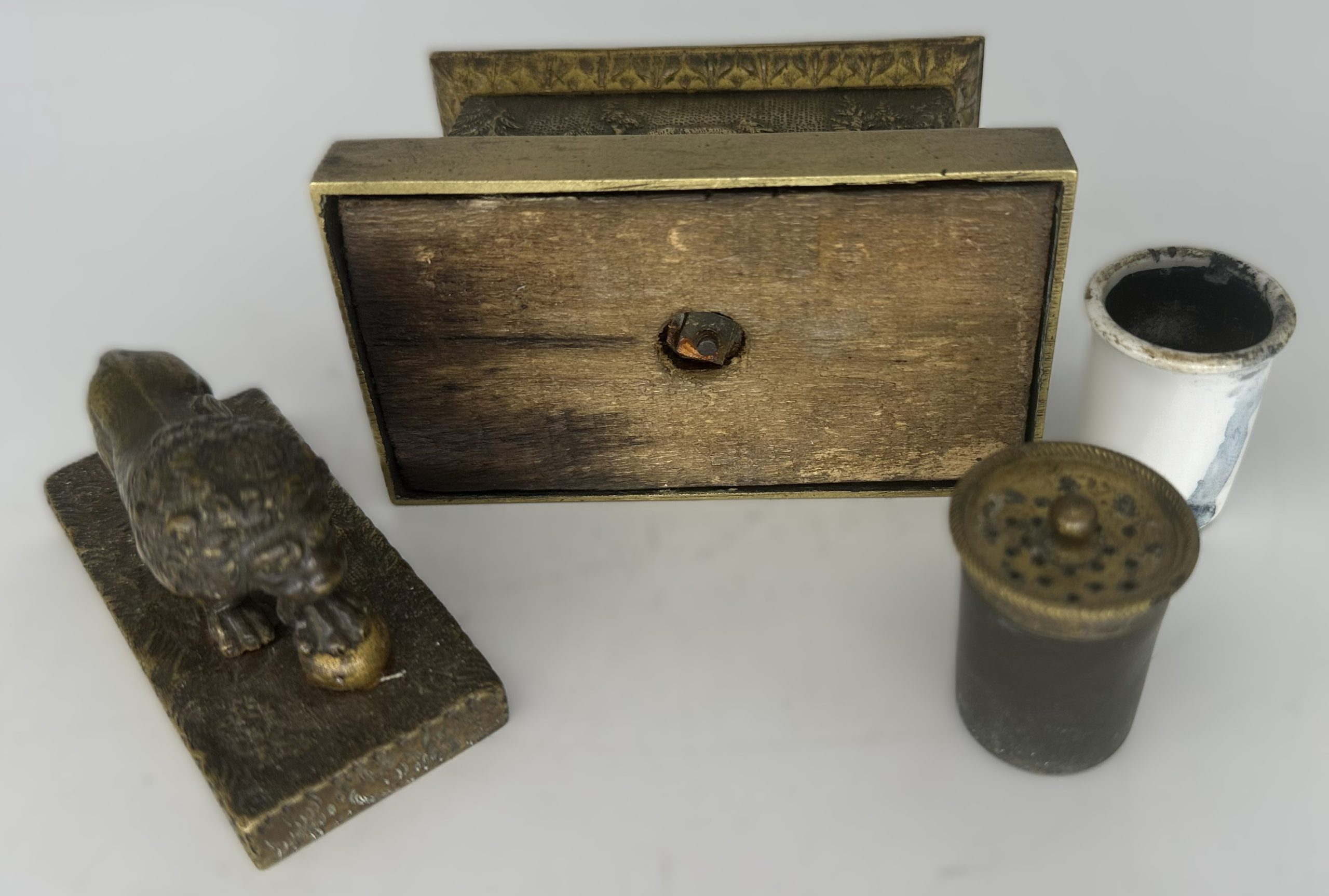
Bronze Medici Lion Inkstand
| Categories | Figural - Animals & Living Creatures |
| Type | Lion |
| Material | Bronze |
| Markings | None |
| Manufacturer | Undetermined |
| Origin | France |
| Date or Era | Circa 1830 |
| Measuring | 12 x 6 cm |
An inkwell made in both patinated and guiled bronze. Its a typical inkwell from the ‘restauration’ period in France. The Bourbon Restoration was the period of French history during which the House of Bourbon returned to power after the first fall of Napoleon on 3 May 1814. Briefly interrupted by the Hundred Days in 1815, the Restoration lasted until the July Revolution of 26 July 1830. The style is still alike the empire style, but the statues are clearly a breach with the empire. The lion is similar to the memorial statue of the lion on the battlefield of Waterloo where the final battle against Napoleon took place.
The inkwell contains a porcelain inkpot and a bronze pot for sand.
From the Collection of Hubert Kerstens
8/27/26 – Example #2 added.
The historical context described above is accurate. The attribution of the lion motif requires an art-historical correction.
Historical & Iconographic Analysis
- Iconography (The Medici Lion, not Waterloo): While the Lion of Waterloo (inaugurated 1826) features a paw on a sphere, the design on this inkwell directly replicates the famous Medici Lion (Leone de’ Medici). Originally sculpted in marble in the late 16th century by Flaminio Vacca for the Villa Medici in Rome (now in the Loggia dei Lanzi, Florence), this iconic posture—a walking lion with one forepaw resting on a ball or sphere—was a staple of neoclassical decorative bronzes throughout the early 19th century.
- Period & Date: Circa 1820–1835 (Charles X to early Louis-Philippe period). The stepped rectangular plinth, the mix of dark brown patinated bronze and fire-gilded bronze (ormolu), and the chased water-leaf / anthemion frieze along the stepped base are hallmark traits of French Restoration desk accessories.
- Makers & Attribution: 19th-century French bronze desk objects were rarely signed by individual sculptors or foundries unless cast by major houses like Barbedienne or Thomire. Instead, they were produced in Parisian bronze workshops (bronziers), where master founders cast the animal figures and fitted them to standardized ormolu inkstand bases. As an unmarked piece, it is best attributed as French Restoration School, Parisian foundry.
Summary Description – Lion #1
French Restoration Patinated & Gilt Bronze Inkstand
France, circa 1825–1830
Surmounted by a finely cast patinated bronze figure of a Medici lion with one paw resting upon a sphere, the tiered rectangular cover lifts to reveal the original interior compartments for an inkpot and sand pounce pot. The plinth is set upon a stepped base embellished with a chased gilt-bronze (ormolu) anthemion and water-leaf border, exemplifying the refined neoclassical taste of the Bourbon Restoration.
Lion #2 – Age & Iconography
- Date: Circa 1820–1835 (French Restoration / Charles X period), making it contemporaneous with Lion #1.
- Statue Replicated: Like #1, the surmounting figure replicates the classical Medici Lion (Leone de’ Medici), characterized by its posture standing with one forepaw resting upon a sphere.
- Relief Iconography: The plinth sides are cast in low relief with forest landscapes featuring wild canines (wolves or hunting dogs), while the short ends display military trophies (crossed lances/spears, daggers, and a central radiant cartouche)—a holdover of late First Empire martial symbolism popular through the Restoration.
Comparison: Lion #1 vs. Lion #2
| Feature | Lion #1 | Lion #2 |
| Plinth Decoration | Smooth, plain patinated bronze body with minimal ornamentation | Low-relief cast pictorial friezes (wildlife/trees on front & back; military trophies on sides) |
| Lid Surface | Smooth, stepped polished gilt-bronze terrace | Stippled/textured bronze terrain simulating earth/ground foliage |
| Base Molding | Chased anthemion / stylized water-leaf frieze | Classic egg-and-dart / tongue-and-dart border band |
Manufacturing Origin & Attribution for Lion #2
- Same Workshop as Lion #1? Unlikely to be the exact same maker, but they originate from the same Parisian bronze manufacturing ecosystem.
- Production Context: In early 19th-century Paris, specialized founders and chasers often purchased standardized castings (such as Medici lion finials and base moldings) and combined them with different relief-molded box bodies. Lion #2 exhibits a more decorative, textured pictorial treatment, whereas Lion #1 leans toward austere architectural neoclassicism.
Lion #2 – Summary Description
French Restoration Ormolu & Patinated Bronze Inkstand
France, circa 1825–1830
Surmounted by a patinated bronze figure of the Medici lion resting its paw on a sphere over a textured naturalistic ground. The rectangular chest is cast in detailed low relief with wolves traversing woodland scenes to the front and rear, flanked by military trophy cartouches to the sides. The cover lifts to reveal original white porcelain inkwell and gilt-bronze sand pounce pot flanked by twin quill apertures. Supported on a stepped plinth with egg-and-dart molding and retained by its original weighted wood-core base.
See this Inkipedia listing for similar: Recumbent Lion on a Plinth – The Society of Inkwell Collectors (SOIC)
Value 450 Euro. Bought in 2019 at the Marche des Antiquairs Sablon in Brussels (Belgium). The previous owners are unknown.
Content disclaimer. The information posted is the owner’s best knowledge and may not have been vetted by the SOIC. We welcome comments, corrections, and additions, working to make our website information comprehensive and accurate.
Join the Society of Inkwell Collectors (SOIC) – it’s free!
Founded in 1981 as a non-profit organization,
we are documenting inkwells (and accessories).
We’re here to help and inform!