

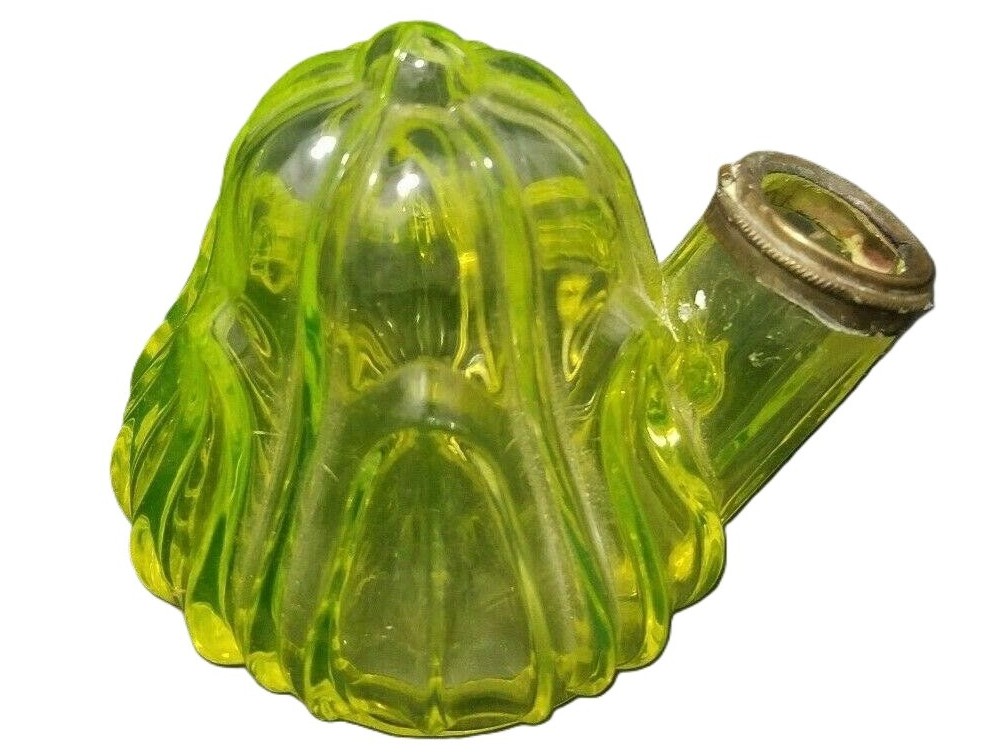


Vaseline Glass Teakettle Inkwell
| Categories | Ink Bottle, Mechanical - Pump / Siphon |
| Type | Tea Kettle, Vaseline |
| Material | Glass |
| Markings | Unmarked |
| Manufacturer | Undetermined |
| Origin | United States |
| Date or Era | circa 1890 |
| Measuring | 3” high |
Description
This inkwell is molded in a distinct, sculptural shape reminiscent of organic botanical forms.
- Color: It is crafted from a vibrant canary yellow (often termed “Vaseline”) glass. The glass is highly transparent with a bright, greenish-yellow hue that naturally catches the light.
- Body Design: The main body features heavy, vertical molded ribs or panels that taper upward into a rounded, dome-like top, culminating in a small central finial or point.
- Neck and Collar: Emerging at an angle from the lower side of the body is a distinct, integrated filling spout or dipping neck. This neck is fitted with its original brass metal collar featuring a finely beaded or textured rim, which would have originally held a small metal cap or lid.
- Base: The bottom of the inkwell is relatively smooth and slightly concave, showing the characteristic wear pattern and mold marks.
The Science of the “Glow”
The brilliant, neon-green fluorescence this piece exhibits under a UV blacklight is the defining characteristic of genuine uranium glass.
The Additive: Sodium Diuranate
To achieve this specific canary yellow color, glassmakers added a small amount of uranium oxide—specifically in the form of sodium diuranate ($\text{Na}_2\text{U}_2\text{O}_7$), historically referred to as “uranium yellow”—to the molten glass batch. Typically, this accounted for about 1% to 2% of the total mix by weight.
The Luminescent Phenomenon
The glow itself is a result of photoluminescence, specifically fluorescence:
- When ultraviolet (UV) light strikes the glass, the high-energy UV photons are absorbed by the uranyl ions present within the glass matrix.
- This absorption causes the electrons within the uranium atoms to jump to a higher, “excited” energy state.
- Because this excited state is unstable, the electrons almost instantly drop back down to their stable “ground” state.
- As they fall back, they release that excess energy in the form of visible light.
Because some energy is lost in the process, the emitted light has a longer wavelength than the invisible UV light that triggered it, placing it perfectly within the bright green spectrum (around 520 to 530 nanometers).
A Note on Safety: Despite containing uranium, the radioactivity levels emitted by these pieces are exceedingly low—often barely registers above natural background radiation—and the uranium is safely trapped inside the vitrified silica matrix.
Form and Classification: “Ribbed Pear”
- “Ribbed Pear” (or Teakettle Pear): This is the most accurate and widely recognized term for this specific silhouette. The asymmetrical shape—where a heavy, bulbous, paneled body tapers upward and features a side-protruding spout—strongly mimics a hanging pear fruit. The “teakettle” designation specifically refers to any pocket or novelty inkwell where the dipping neck extends from the side like a kettle spout.
Provenance: Where and When Was It Made?
Period of Production
This inkwell dates safely to the late 19th century, specifically between 1880 and 1895.
The 1880s marked the peak of the “novelty” inkwell craze, where glasshouses produced whimsical shapes (animals, fruits, stoves, kettles) to satisfy a growing literate middle class. Production of this specific canary/uranium color fell sharply by the turn of the century and was halted entirely during WWII when uranium became a tightly regulated strategic material.
Origin
Teakettle inkwells of this exact ribbed pear design were manufactured in two primary regions:
- The United States (Ohio River Valley / Pittsburgh District): Prominent pressed glass companies like Richards & Hartley (Tarentum, PA) or Hobbs, Brockunier & Co. (Wheeling, WV) were famous for their mastery of canary yellow/uranium glass and produced vast quantities of novelty pocket inkwells.
- Europe (France / Bohemia): French glasshouses and various Bohemian manufacturers produced high-quality molded and cut teakettle inkwells in “Ouraline” (the French term for uranium glass) with similar brass collars.
Given the distinct panel structure and the specific style of the beaded metal collar, this piece is highly characteristic of an American pressed glass house catering to the booming late-Victorian stationery market.
Fluid Dynamics – Teakettle Inks
The “teakettle” inkwell—with its distinct, angled side spout—was not just a whimsical Victorian design; it was a clever solution to a messy, everyday problem.
Before the widespread adoption of the fountain pen, writing with a steel dip pen required a constant balancing act. If you dipped your pen into a standard, wide-open ink bottle, it was incredibly easy to submerge the nib too deeply, overloading it with ink and causing giant blots on your paperwork.
Teakettle inkwells solved this using basic principles of fluid dynamics and atmospheric pressure. Here is how they functioned to control ink flow.
- The Atmospheric Pressure Principle (The “Bird Fountain” Effect)
Many teakettle inkwells operated on a partial vacuum system.
- The Air-Tight Seal: The main, bulbous body of the pear-shaped inkwell acted as the primary reservoir. When filled, the top cap or lid on the main body (if it had one) or the metal collar on the spout had to be sealed tightly.
- The Equilibrium: Because the main body was sealed, atmospheric pressure pushed down on the small amount of ink exposed in the open side spout. This pressure prevented the ink inside the main reservoir from rushing out of the spout all at once. The ink level in the neck would naturally equalize at a stable, low height—just enough to wet a nib, but never high enough to overflow.
- Preventing Over-Dipping and Sludge
The narrow, angled design of the side neck acted as a built-in guide for the writer.
- Controlled Depth: The diameter of the spout was engineered to accommodate a standard dip pen holder. Because the neck emerged at an angle (usually around 45 degrees), it physically restricted how far down the pen could travel. The writer could blindly dip their pen into the spout, and the steel nib would only submerge to its ideal filling point—usually just up to the vent hole of the nib.
- Avoiding Sediment: Iron gall ink, the standard ink of the 19th century, was notorious for throwing down a heavy, thick sediment (sludge) at the bottom of the well as it aged. In a standard inkwell, a dipping pen would constantly scrape the bottom, picking up this sludge and ruining the pen’s flow. In a teakettle well, the sediment settled to the flat, wide bottom of the main reservoir, keeping the ink rising up into the side spout clean and fluid.
Sold for $555 in July 2020
Content disclaimer. The information posted is the owner’s best knowledge and may not have been vetted by the SOIC. We welcome comments, corrections, and additions, working to make our website information comprehensive and accurate.
Join the Society of Inkwell Collectors (SOIC) – it’s free!
Founded in 1981 as a non-profit organization,
we are documenting inkwells (and accessories).
We’re here to help and inform!