

Utilitarian Brass Writer’s Box with Inkwell and Sander
| Categories | Early - Primitive, Travel |
| Material | Brass |
| Markings | Unmarked |
| Manufacturer | Undetermined |
| Origin | Undetermined |
| Date or Era | circa 1700 |
| Measuring | 3 ¾” x 3 ¾” x 2 ¾” high |
This is a fine example of a 17th-to-early-18th-century European traveling writing box.
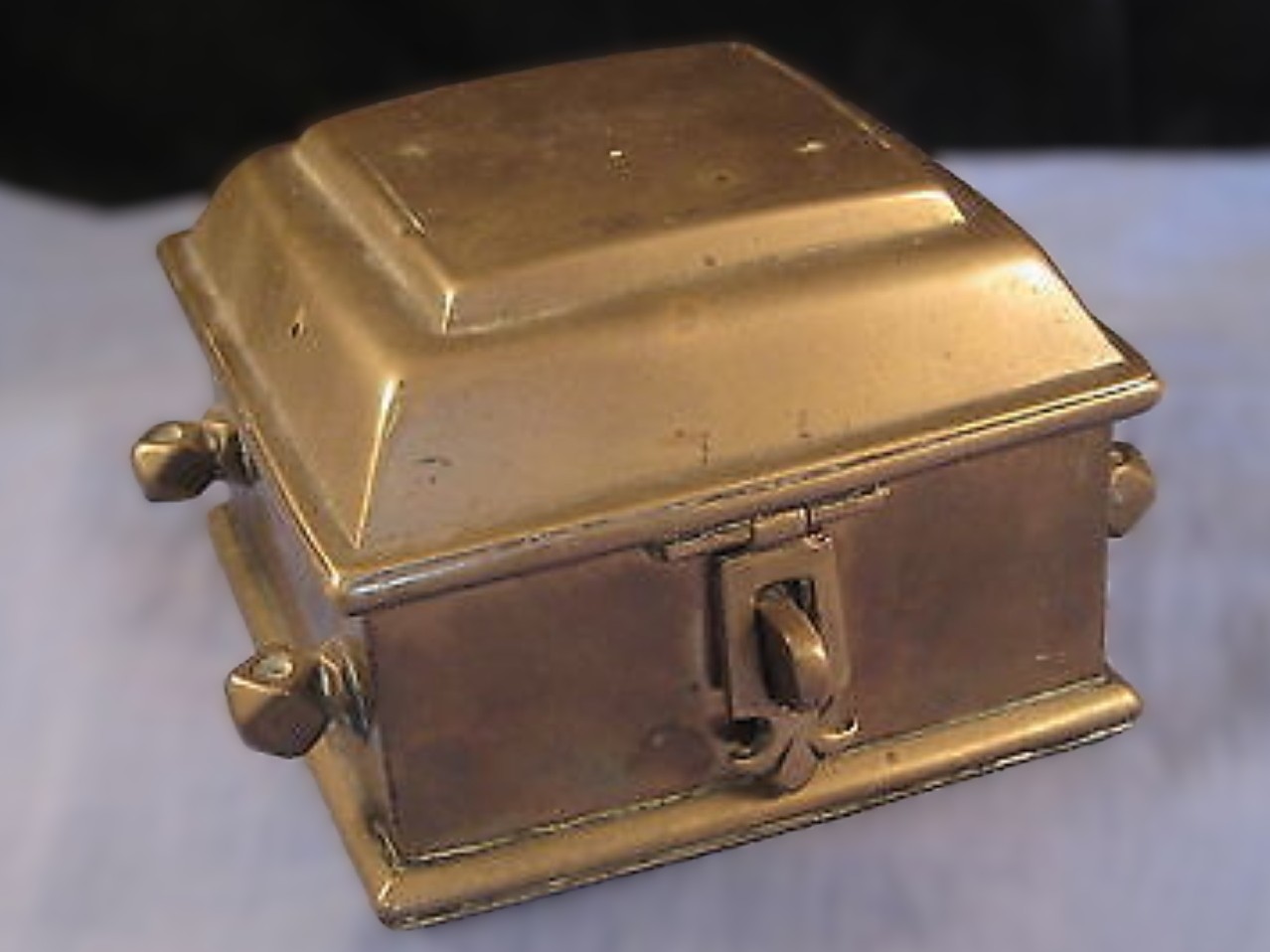
Measuring 3¾” x 3¾” and standing 2¾” high, this compact brass chest was engineered for the itinerant writer requiring a self-contained, spill-resistant writing apparatus on the road.
Age and Origin
- Estimated Age: Late 17th Century to c. 1700 (circa 1680–1710).
- Manufacturing Style & Characteristics: The heavy sand-cast brass construction and the distinctive scrolled/fleur-de-lis-shaped hinged clasp point toward the Baroque period. Similar utilitarian pocket standishes were produced across Western Europe, most notably in England, the Low Countries (Netherlands/Flanders), and Nuremberg, Germany—the great historical centers of brass founding and metalwork during the seventeenth century. Nuremberg, in particular, exported thousands of cast-brass domestic utility boxes and inkstands across the continent.
Detailed Description & Exterior Features
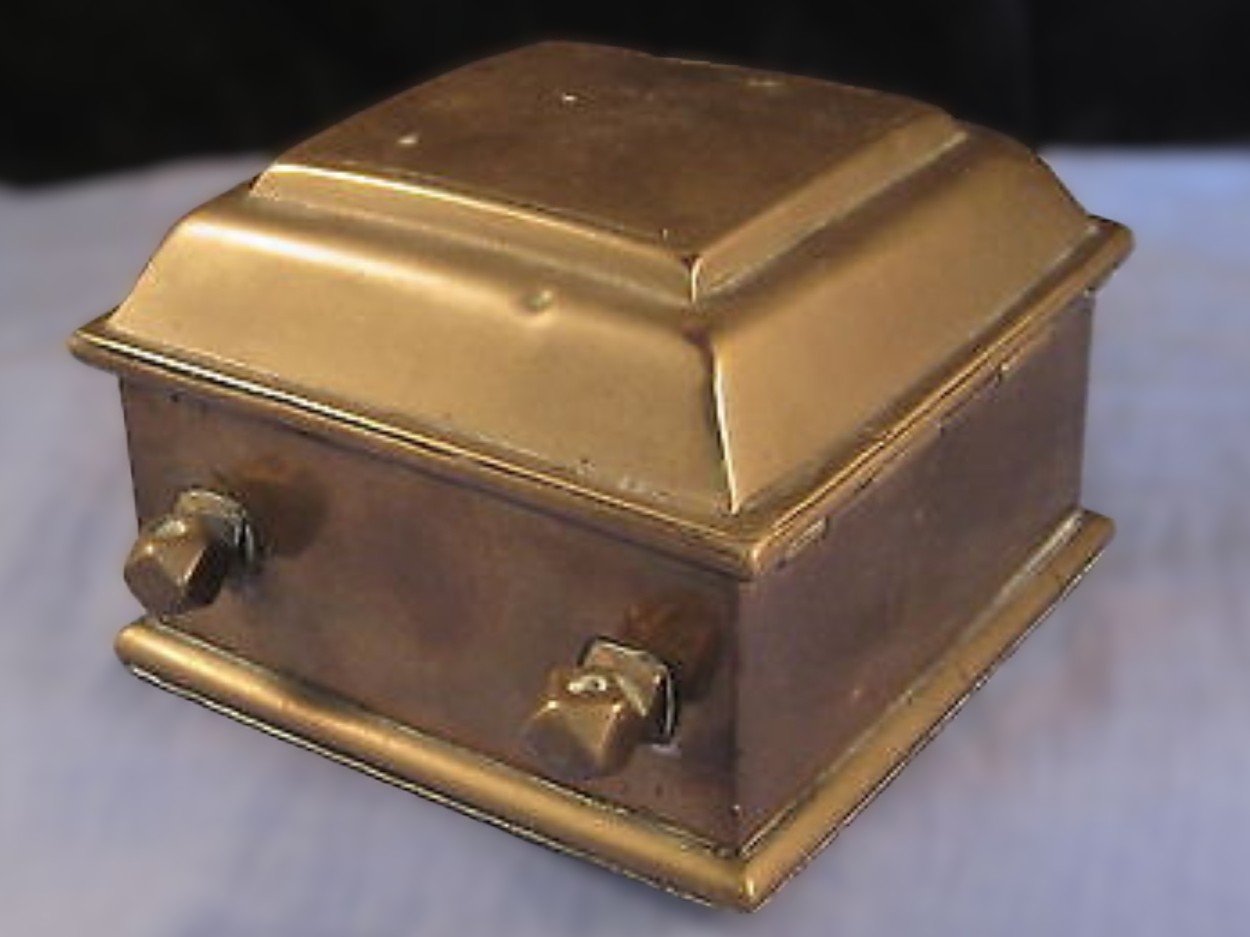
- Form and Metalwork: The box features a heavy cast-brass body with a stepped, domed lid designed to accommodate the height of the internal vessels while protecting from dust and moisture.
- Securing Mechanism: The front showcases a hinged strap-clasp with a pierced tongue that fits over a fixed post, originally secured with a small pin, cord, or miniature padlock to prevent the lid from jarring open during transport.
- Side Lugs: The exterior sides feature cast loop lugs or finials, which would have originally accommodated a leather carrying strap or cord harness, allowing the owner to sling or secure the inkstand to a valise, belt, or saddlebag.
Internal Components
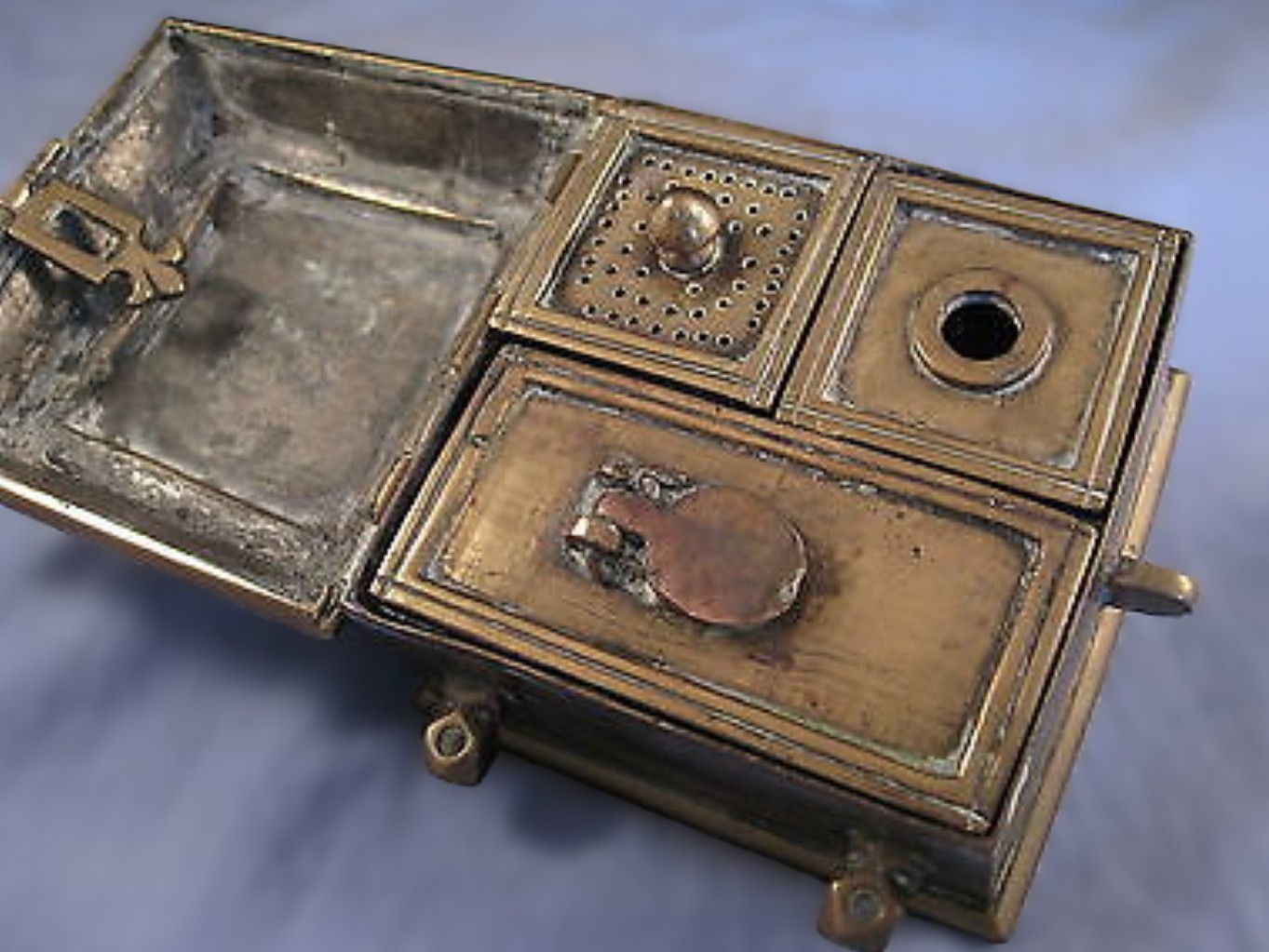
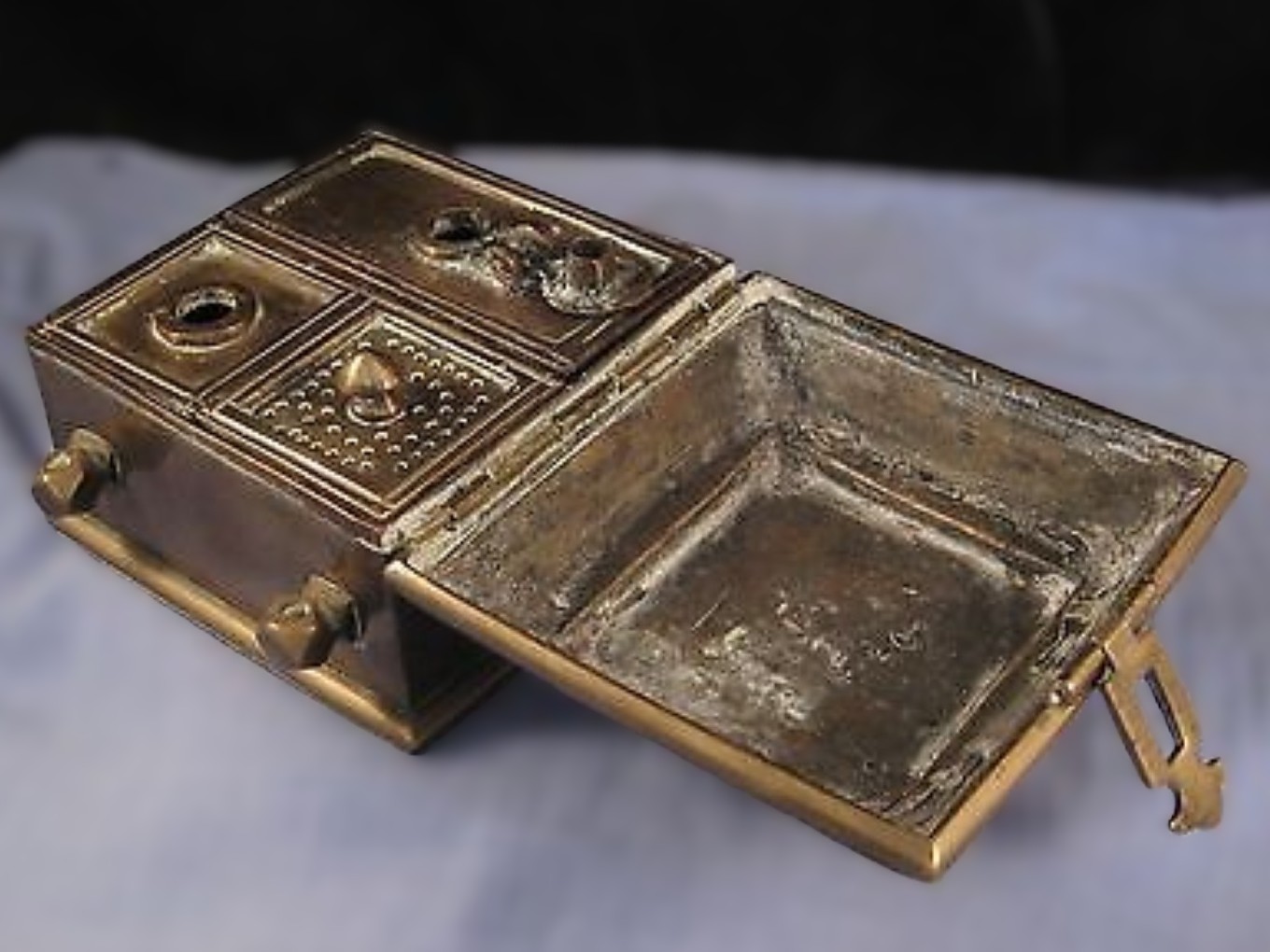
Upon opening the hinged lid, the interior reveals a compartmentalized housing with its original cross-dividers intact, designed to keep the three drop-in vessels secure and upright:
- The Inkwell: Featuring a hinged flat lid designed to seal liquid ink securely when traveling.
- The Pounce Pot: Centered at the top, recognizable by its distinctive flat, perforated top plate pierced with numerous tiny holes. Before the widespread adoption of blotting paper in the 19th century, writers sprinkled pounce (a fine powder made from powdered cuttlefish bone, sand, or resin) over fresh ink to dry it and smooth the parchment or paper surface.
- The Pen Holder / Wafer Box Component: While functioning partly as a compartment for sealing wax or communion/letter wafers, the paired vertical collars serve as a pen stand designed to hold quill pens upright when in use at a temporary desk.
Sold for $1544 in November 2014
Content disclaimer. The information posted is the owner’s best knowledge and may not have been vetted by the SOIC. We welcome comments, corrections, and additions, working to make our website information comprehensive and accurate.
Join the Society of Inkwell Collectors (SOIC) – it’s free!
Founded in 1981 as a non-profit organization,
we are documenting inkwells (and accessories).
We’re here to help and inform!