


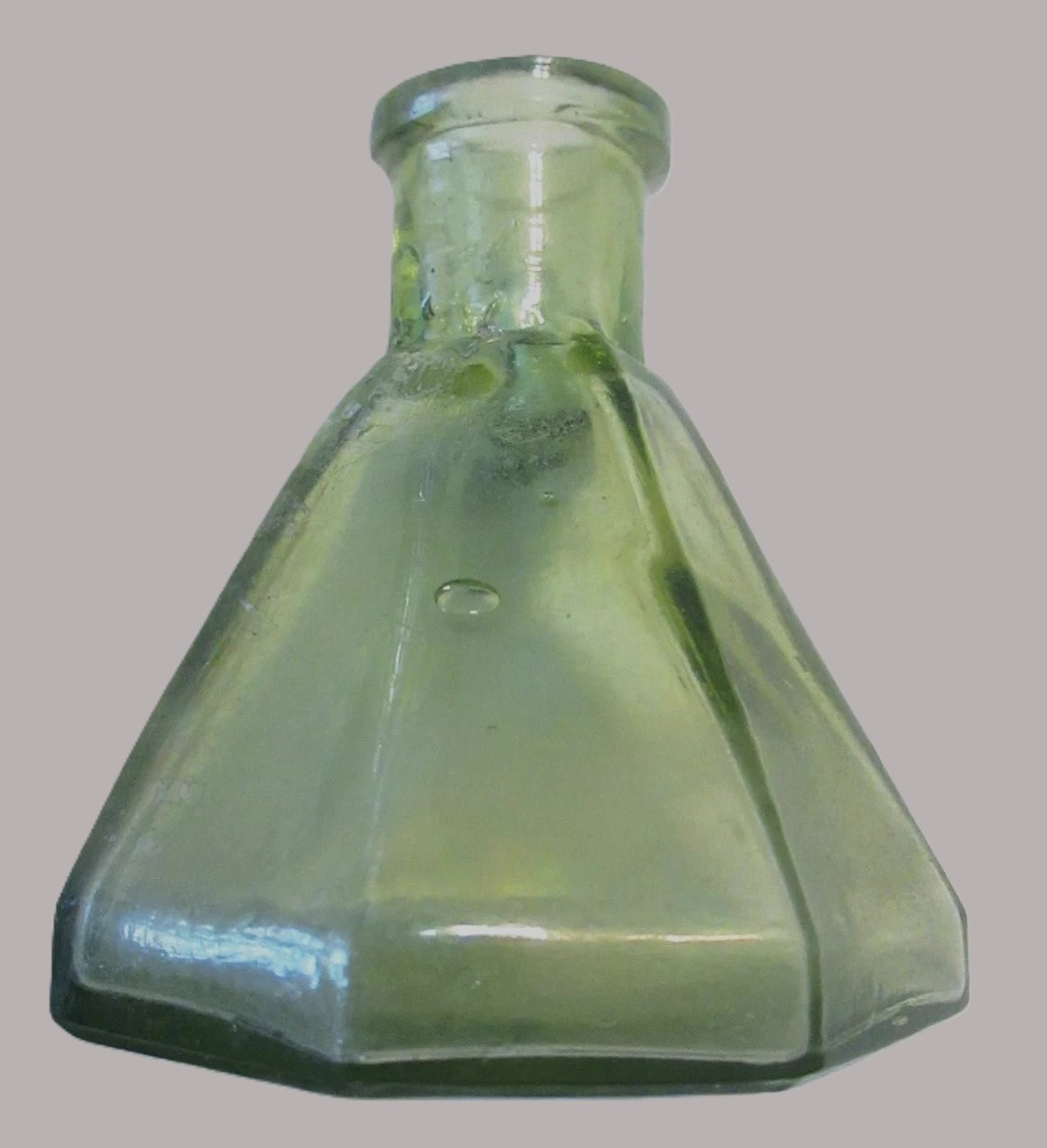
Umbrella Ink Bottle – Citron Yellow-Green
| Categories | Ink Bottle |
| Type | Umbrella |
| Material | Glass |
| Markings | Unmarked |
| Manufacturer | Undetermined |
| Origin | United States |
| Date or Era | circa 1880 |
| Measuring | 2 ½” high |
This umbrella-style ink bottle features a classic 8-sided octagonal footprint that tapers upward into a graceful pyramidal form.
Color and Glass Character
The bottle is rendered in a vibrant light citron yellow-green, a color that catches the light beautifully through the thick, irregular glass. The glass itself is full of character, containing numerous tiny air bubbles (seeds) and subtle striations that are characteristic of early glass manufacturing.
Form and Finish
- Body: The eight distinct panels are well-defined, with soft, rounded edges at the base that transition into sharp vertical ridges.
- Neck and Lip: The bottle features a short, cylindrical neck topped with a tooled lip. The flared finish was hand-formed, giving it a slightly asymmetrical, organic look. There is a small, visible chip on the upper edge of the rim.
- Base: The underside is a smooth base, slightly concave and octagonal in shape, indicating it was likely produced in a later 19th-century mold that did not leave a rough pontil mark.
Determining the exact glasshouse for an unembossed umbrella ink is challenging because this “8-sided” mold was a standard pattern used by dozens of glasshouses across the United States and Europe. However, the combination of the tooled lip, smooth base, and specific color provides strong evidence for the era and region of production.
Decade of Production: 1870s – 1880s
- The Lip and Neck: The “tooled” or “applied” finish (the flared rim) indicates it was made before the transition to fully machine-made bottles in the early 1900s. In the 1840s and 50s, these lips were often more crudely applied. The refined shape of this tooled lip suggests 1870s to 1880s.
- The Smooth Base: Most umbrella inks from the 1840s through the early 1860s have a “pontil mark” (a rough scar from the iron rod used to hold the bottle during finishing). By the late 1860s, glasshouses transitioned to using “snap cases” that held the bottle without leaving a mark. The smooth, slightly concave base on this bottle firmly places its production between 1870 and 1890.
Potential Glass Houses
While identification is not certain without a manufacturer’s mark, the light citron yellow-green color is a clue.
- South Jersey Glasshouses (e.g., Whitney Glass Works): The Glassboro, New Jersey area was prolific in producing umbrella inks. They are well-known for “South Jersey” colors—lighter, brighter greens and yellows. Whitney Glass Works, in particular, was one of the largest producers of ink bottles in the late 19th century and utilized this exact 8-sided mold.
- Mid-Atlantic/Philadelphia Area: Many glasshouses in the Pennsylvania and Maryland region produced utilitarian “citron” glass. This color was often the result of using “natural” sand with specific iron impurities, though sometimes it was intentionally tinted to appear more premium than standard aqua glass.
- New England (Keene or Stoddard): While New England houses produced many umbrella inks, their glass tended to be much darker—deep olive greens and “black glass” (very dark amber). The brightness of this citron bottle makes a Mid-Atlantic or Jersey origin more likely.
Summary of Attributes
The citron color is significantly more desirable to collectors than the common aqua or amber versions of this bottle. During the 1870s, these were mass-produced but often sold as “unbranded” stationery supplies, which is why this one lacks a base mark. The small chip on the lip is a common “character mark” for bottles that saw actual use on a 19th-century writing desk.
Sold for $161 in February 2026
Content disclaimer. The information posted is the owner’s best knowledge and may not have been vetted by the SOIC. We welcome comments, corrections, and additions, working to make our website information comprehensive and accurate.
Join the Society of Inkwell Collectors (SOIC) – it’s free!
Founded in 1981 as a non-profit organization,
we are documenting inkwells (and accessories).
We’re here to help and inform!