

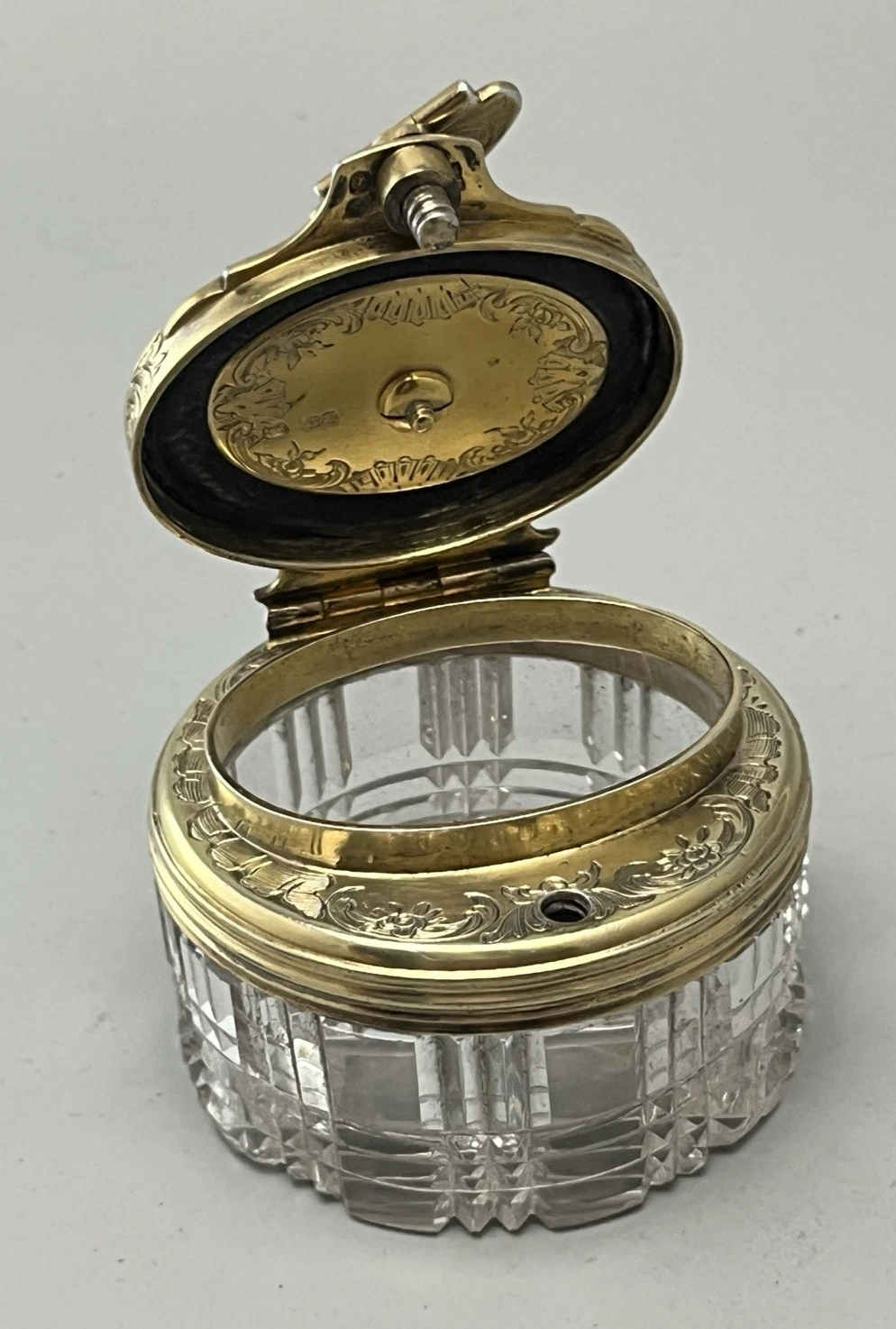
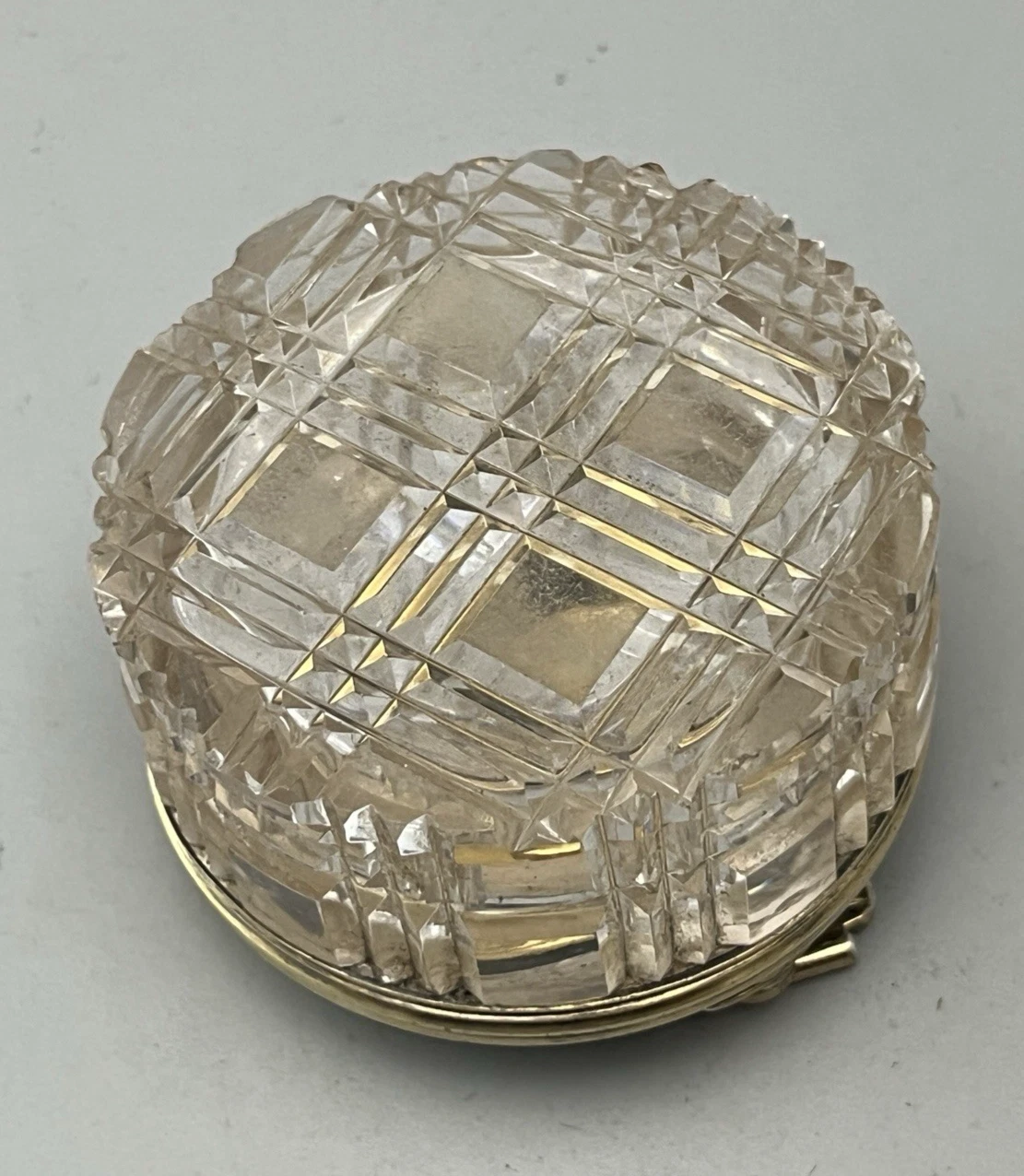
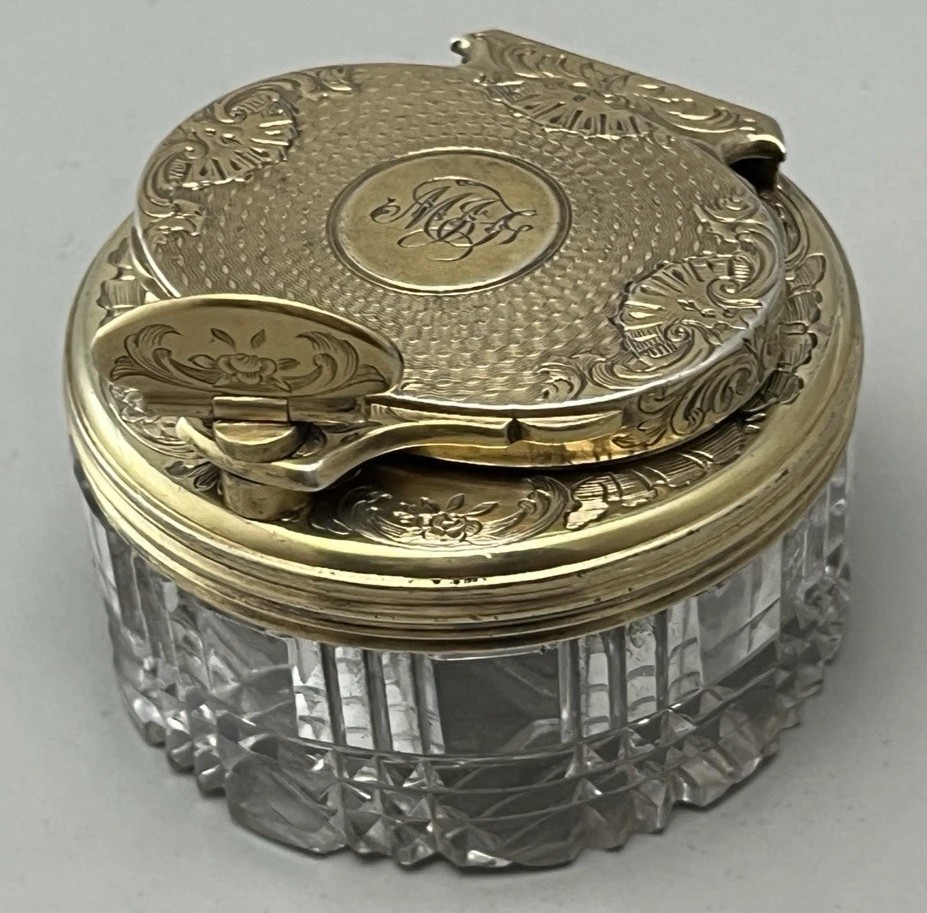
Thomas Diller Lock-Down Traveling Inkwell
| Categories | Travel |
| Material | Glass, Silver |
| Markings | See Narrative |
| Manufacturer | Thomas Diller |
| Origin | England |
| Date or Era | circa 1844 |
| Measuring | 2 ⅜” diameter; 1 ½” high |
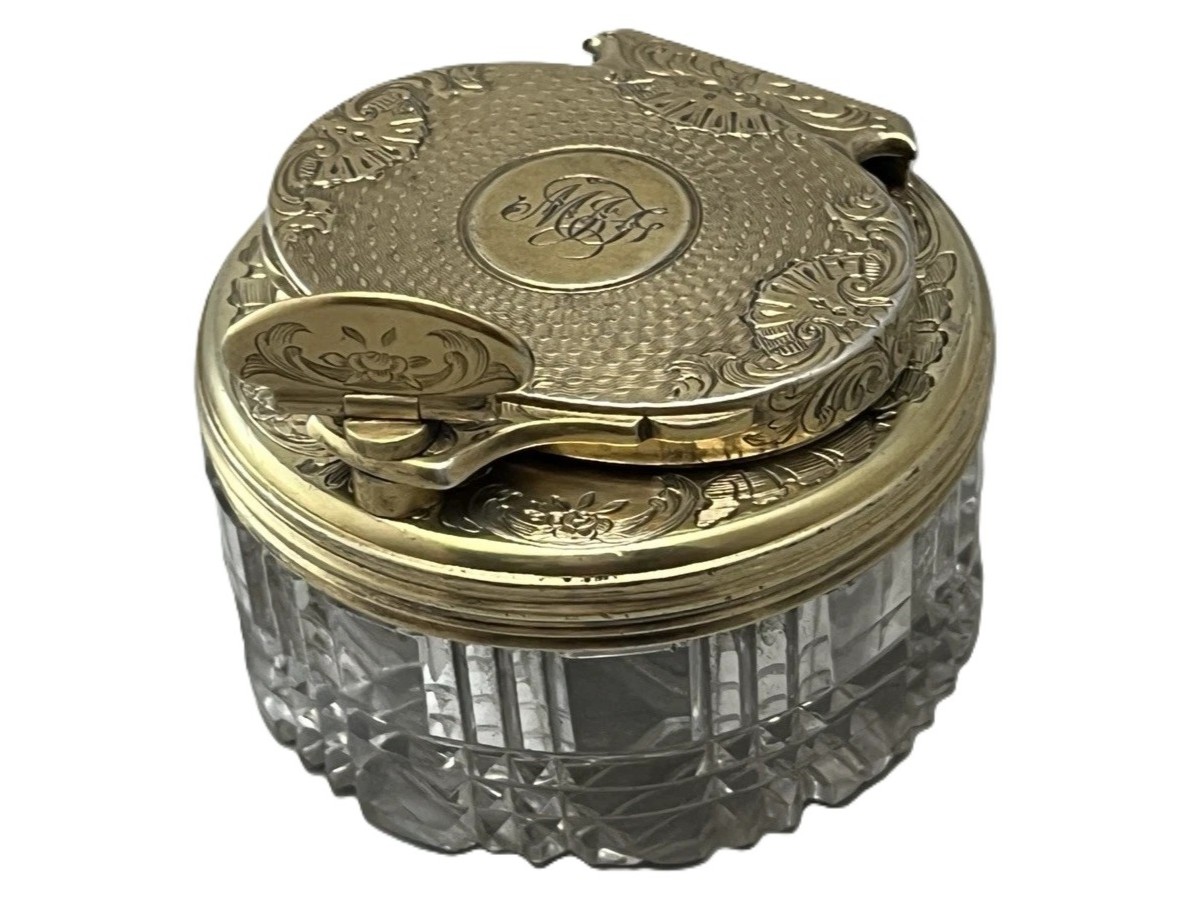
This is a sophisticated example of a mid-Victorian traveling inkwell, combining the security required for transport with the high-end craftsmanship of a prominent London silversmith.
Design & Construction
- The Mount: The inkwell features a heavy silver-gilt mount (sterling silver finished with a layer of gold).
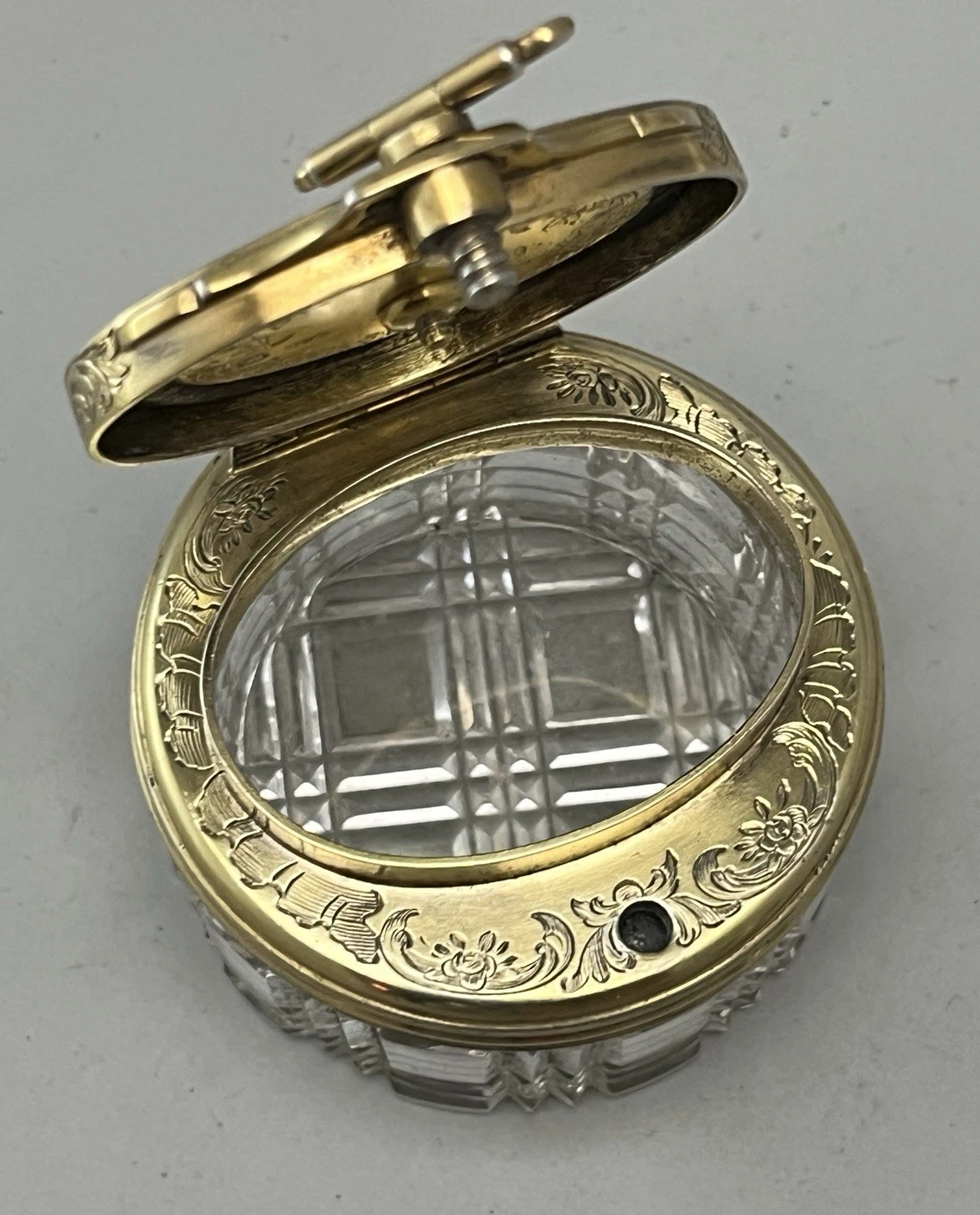
- The Lid Mechanism: True to its “traveling” purpose, it utilizes a screw-down sealed lid. This design includes a threaded internal post and a leather gasket to prevent ink leakage while in a briefcase or trunk.
- The Body: The base is made of thick, high-quality cut glass with a deep diamond and prismatic pattern. The underside reveals a star-cut base, which was a hallmark of luxury glasswork, providing both brilliance and a steady weight.
Artistic Decoration
The silver-gilt lid is a masterclass in Late Regency/Early Victorian Rococo Revival style:
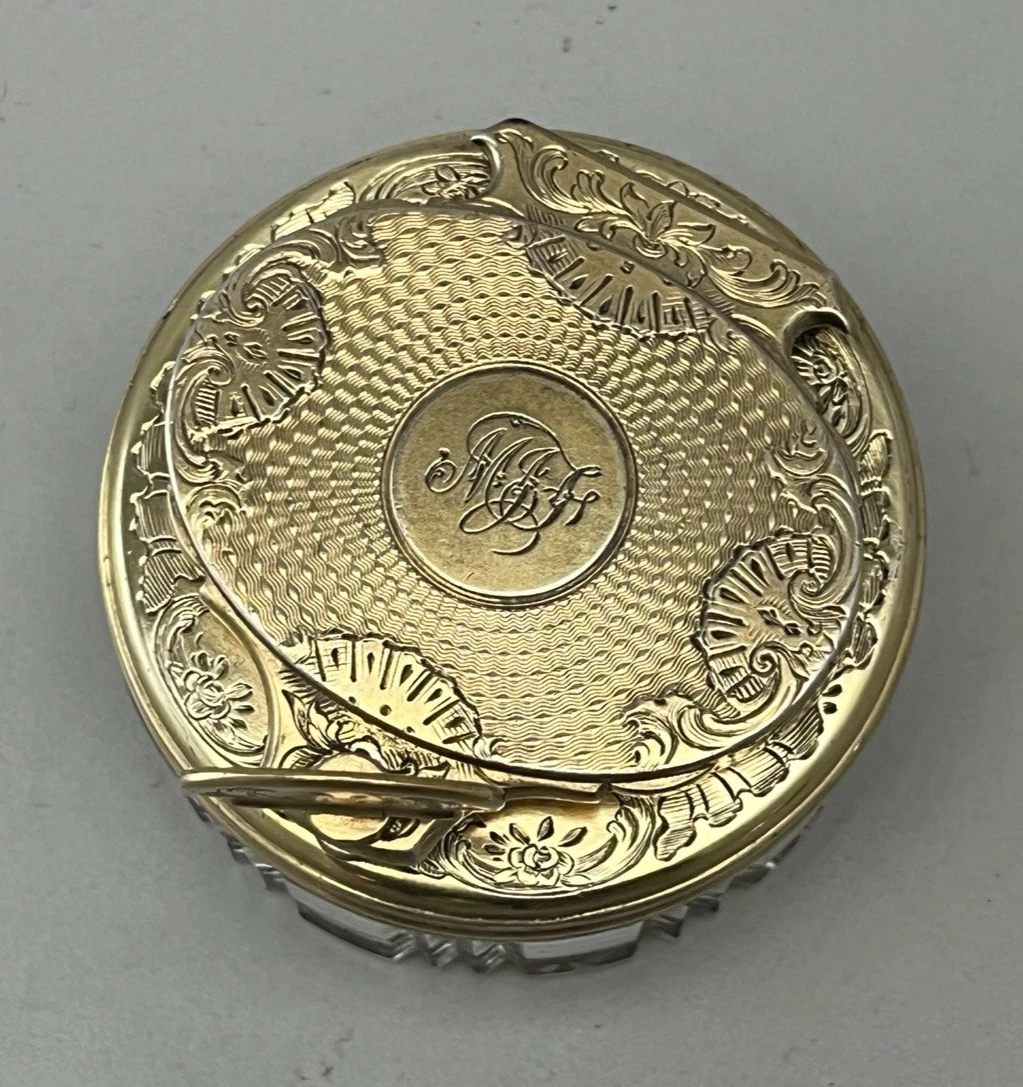
- Engraving: The top is centered with a circular reserve containing an elaborate intertwined monogram in cursive script. Surrounding this is a fine engine-turned (guilloché) pattern of concentric waves.
- Repoussé & Chasing: The outer borders of the lid and the stationary collar are decorated with high-relief scrolls, floral motifs, and stylized shells.
- The Thumbpiece: The opening tab is uniquely shaped and engraved with a single flower, providing both a functional grip and an aesthetic flourish.
Hallmarks
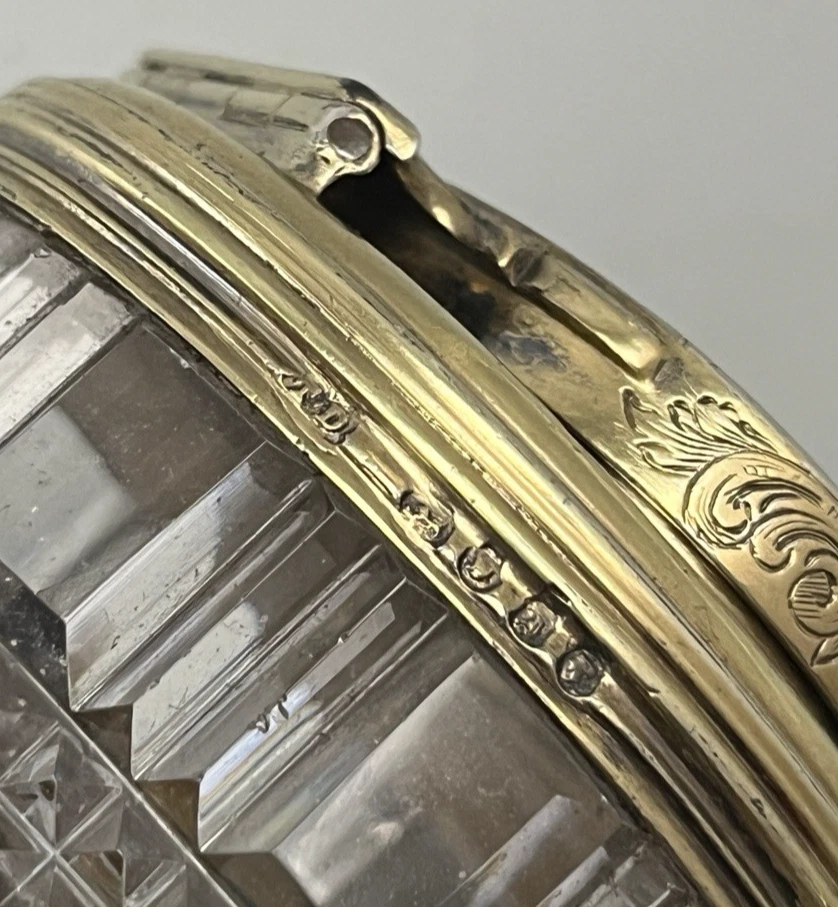
The piece bears a clear set of English hallmarks on the side of the mount:
- Maker’s Mark: “TD” for Thomas Diller, a well-regarded specialist in high-quality silver-mounted bottles and desk furniture.
- Town Mark: The Leopard’s Head for London.
- Date Letter: The lowercase “i” corresponding to 1844.
- Standard Mark: The Lion Passant, certifying .925 sterling silver.
- Duty Mark: The profile of Queen Victoria, indicating the tax was paid to the crown.
Thomas Diller was a specialist in luxury traveling appointments during the 1830s and 1840s. His work is characterized by high-density engraving, robust mechanical seals, and the frequent use of silver-gilt to prevent corrosion from acidic 19th-century inks.
Based on his recorded works from the mid-1840s, here is more context regarding his traveling inkwells:
- Mechanical Innovation: The “Total Seal”
While many Victorian inkwells used a simple hinged lid, Diller specialized in the screw-down compression mechanism.
- Leak Prevention: Diller’s designs often integrated a threaded central post that worked in tandem with a secondary internal plate. When the exterior thumbpiece was turned, it compressed an internal washer (usually leather or cork) against the glass rim.
- Traveling Security: This was specifically marketed to the “campaign” or “traveling” market—officers, diplomats, and wealthy tourists who needed an inkwell that could be tossed into a trunk or writing slope without the risk of ruining documents.
- Artistic Style: The Rococo Revival Specialist
This piece, dated 1844, sits at the peak of the Rococo Revival period. Diller was known for:
- Shell and Foliate Borders: He frequently utilized the “Shell and Scroll” motif seen on this mount’s collar. This was a signature of the 1840s London style, meant to showcase the silversmith’s skill in chasing (detailing from the front) and repoussé (pushing from the back).
- Guilloché (Engine Turning): The wavy, concentric lines on the lid were produced by a lathe. Diller used this technique not just for beauty, but because the textured surface hid scratches and fingerprints—a practical feature for a traveling object.
- Collaborative Luxury: Diller and Asprey
Diller didn’t just sell under his own name; he was a key supplier to the most prestigious retailers in London.
- High-End Retailing: He frequently manufactured the silver components for Asprey of Bond Street. If you were to find a luxurious mid-Victorian “Nécessaire de Voyage” (traveling dressing case) from Asprey, the inkwells and perfume bottles inside were often commissioned from Thomas Diller.
- The “TD” Legacy: Diller took over the business of his predecessor, Archibald Douglas, in 1835. He continued Douglas’s tradition of making “heavy gauge” silver items, which explains why this inkwell feels more substantial and “solid” than later, mass-produced Victorian versions.
Historical Value
Items by Thomas Diller from the 1840s are highly collectible because they represent the final era of hand-crafted bench-work before industrial silver production became the norm. An 1844 silver-gilt piece in this condition is considered a “Cabinet Piece”—meant to be both a functional tool and a display of status.
Sold for $410 in February 2026
Content disclaimer. The information posted is the owner’s best knowledge and may not have been vetted by the SOIC. We welcome comments, corrections, and additions, working to make our website information comprehensive and accurate.
Join the Society of Inkwell Collectors (SOIC) – it’s free!
Founded in 1981 as a non-profit organization,
we are documenting inkwells (and accessories).
We’re here to help and inform!