

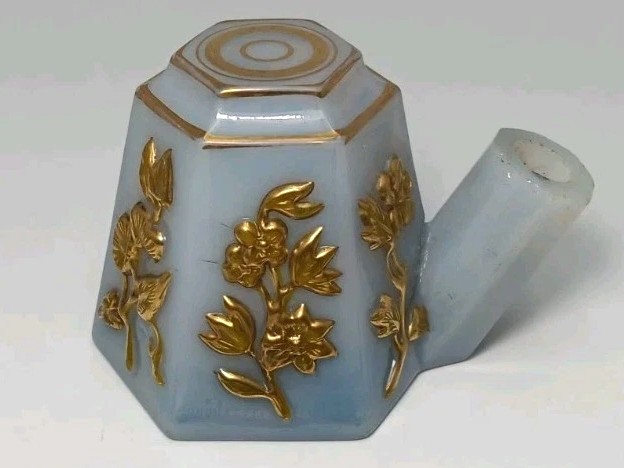


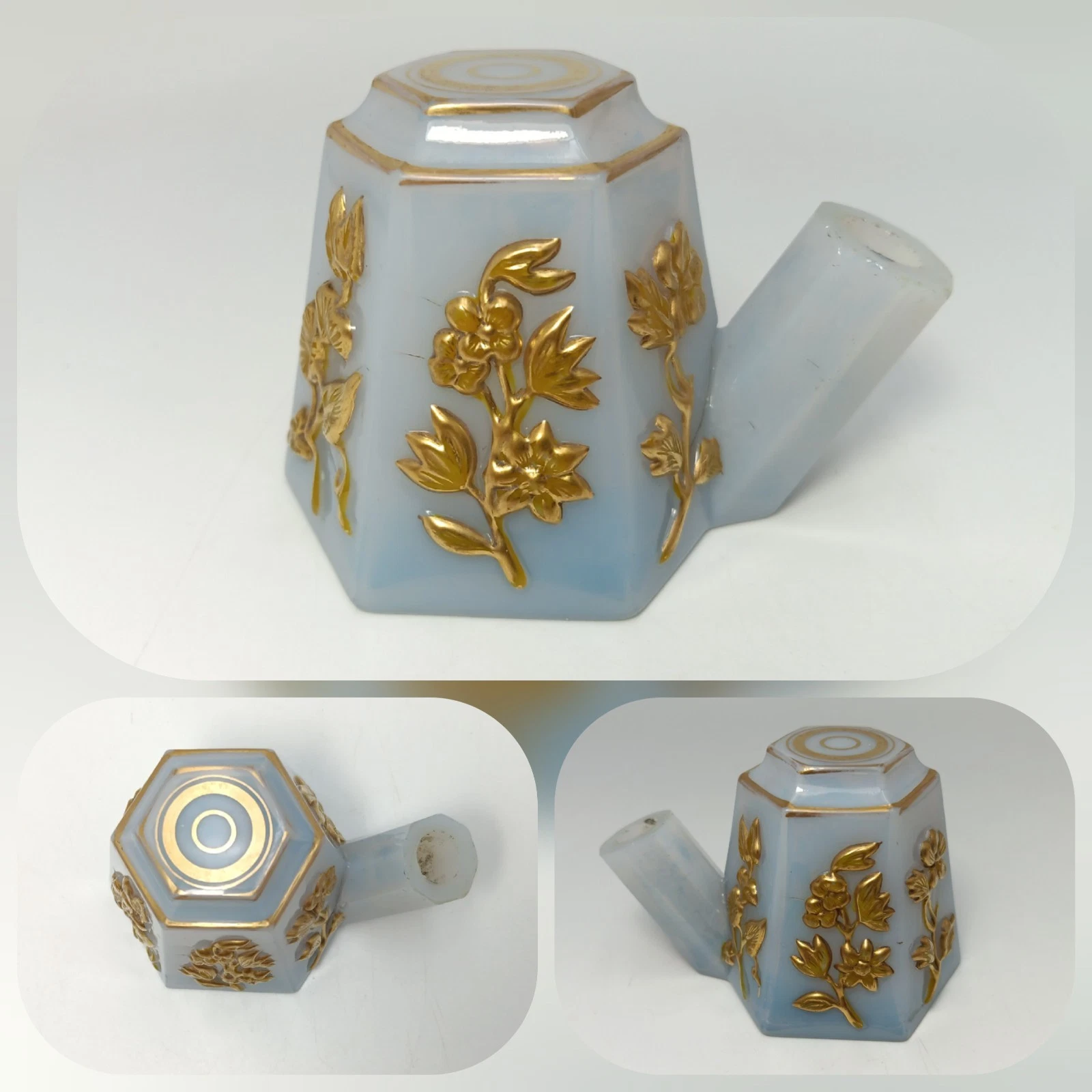
Teakettle Inkwell with Gold Embossed Floral Design
| Categories | Ink Bottle, Mechanical - Pump / Siphon |
| Type | Tea Kettle |
| Material | Glass |
| Markings | Unmarked |
| Origin | France |
| Date or Era | circa 1880 |
| Measuring | 3 ½” wide with spout; 2 ½” diameter; 2 ¼” high |
This “teakettle” inkwell, known historically as an Encrier Siphoide (Siphon Inkwell), is a combination of 19th-century French glass artistry and physics.
Detailed Description
- The Shape: This design is nicknamed the “Teakettle” because of its distinctive silhouette. It features a main hexagonal reservoir and a protruding spout where the pen is dipped.
- The Material: It is made of French Opaline Glass in a shade often called “Robin’s Egg Blue” or “Turquoise.” This semi-opaque, hand-blown glass was a specialty of the French glasshouse Portieux Vallerysthal.
- Artistry: The hexagonal panels are decorated with raised enamel floral designs (“cold-painted” with gold leaf). The gold highlighting on the edges and flowers is characteristic of the Napoleon III era aesthetic.
- Origin: Most authentic “Siphoide” inkwells were made in France during the 1880s, though the design was patented earlier in the century.
The Mechanism: Atmospheric Pressure & The Siphon
The “Siphoide” system was a revolutionary “fountain” inkwell designed to solve a common problem: ink drying out or becoming clogged with dust.
How it works:
- The Vacuum Seal: When the main reservoir is filled and the top is capped (or sealed by the liquid itself), the air trapped above the ink in the main body is at a lower pressure than the outside air.
- Atmospheric Balance: The weight of the ink in the reservoir wants to push it out through the spout. However, the atmospheric pressure of the outside air pushes back against the small surface area of ink in the open spout.
- The Barometric Principle: Because the main reservoir is airtight, the ink only flows into the spout until the pressure of the ink column balances with the atmospheric pressure. This keeps the ink level in the spout perfectly consistent—just enough to dip a pen—without the main tank overflowing.
- Automatic Refilling: As you use ink or as it evaporates from the spout, a tiny bubble of air eventually escapes into the main reservoir. This momentarily equalizes the pressure, allowing a small amount of “fresh” ink to flow down from the tank into the spout to refill it.
Historical Significance
The Encrier Siphoide was popularized by Noël Pierre Chaulin, who patented a version of this “system” inkwell in 1836. By the 1880s, these became high-fashion desk accessories.
This teakettle-style inkwell matches the distinctive designs produced by the Portieux Vallerysthal glassworks in France during the 1880s.
Pattern and Catalog Match
- Manufacturer: Portieux Vallerysthal (formed by the merger of the Portieux and Vallerysthal glasshouses in 1872) was the primary French producer of “Turquoise Blue” or “Robin’s Egg Blue” opaline glass.
- The Hexagonal Design: The hexagonal base and body were standard for their molded “fancies” of the late 19th century. These pieces often featured the raised gold floral pattern which was applied by hand using thick enamel and 22k gold leaf.
- Identification: In factory records, this style is often identified as “Decor Main” (hand-decorated). While the blue color is synonymous with “Opaline,” the factory often referred to this specific material in their 1880s catalogs as Pâte de Riz or Bleu de Sèvres to distinguish it from translucent glass.
How to Fill the Siphoide Inkwell
Filling a siphon-style “teakettle” inkwell requires a specific technique to establish the necessary vacuum:
- Tilt the Inkwell: Grasp the inkwell and tilt it backward until the spout is pointing straight up toward the ceiling.
- Pour into the Spout: Using a small funnel or a steady hand, slowly pour the ink directly into the spout opening.
- The Bubbling Process: As you pour, the ink will flow down the spout and into the main hexagonal reservoir. You may need to gently “rock” the inkwell back and forth to help air bubbles escape out of the spout as the ink replaces the air inside.
- Leveling: Once the main reservoir is nearly full, carefully return the inkwell to its flat, horizontal position on the desk.
- The Result: Because the main body is airtight, atmospheric pressure will push against the ink in the spout, preventing the ink in the reservoir from flowing out. This leaves a small, fresh pool of ink in the spout for dipping your pen, which is automatically replenished from the main tank as you use it.
This method ensured most of the ink stayed sealed away from the air, preventing the evaporation and thickening that plagued standard open-top inkwells.
Sold for $256 in December 2025
Content disclaimer. The information posted is the owner’s best knowledge and may not have been vetted by the SOIC. We welcome comments, corrections, and additions, working to make our website information comprehensive and accurate.
Join the Society of Inkwell Collectors (SOIC) – it’s free!
Founded in 1981 as a non-profit organization,
we are documenting inkwells (and accessories).
We’re here to help and inform!