




Sterling Silver Presentation Inkstand to British Officer
| Categories | Presentation Piece |
| Material | Silver |
| Markings | See Narrative |
| Manufacturer | William Hutton & Sons |
| Origin | England |
| Date or Era | circa 1919 |
| Measuring | 4” x 3 ¼” x 1 ¾” high |
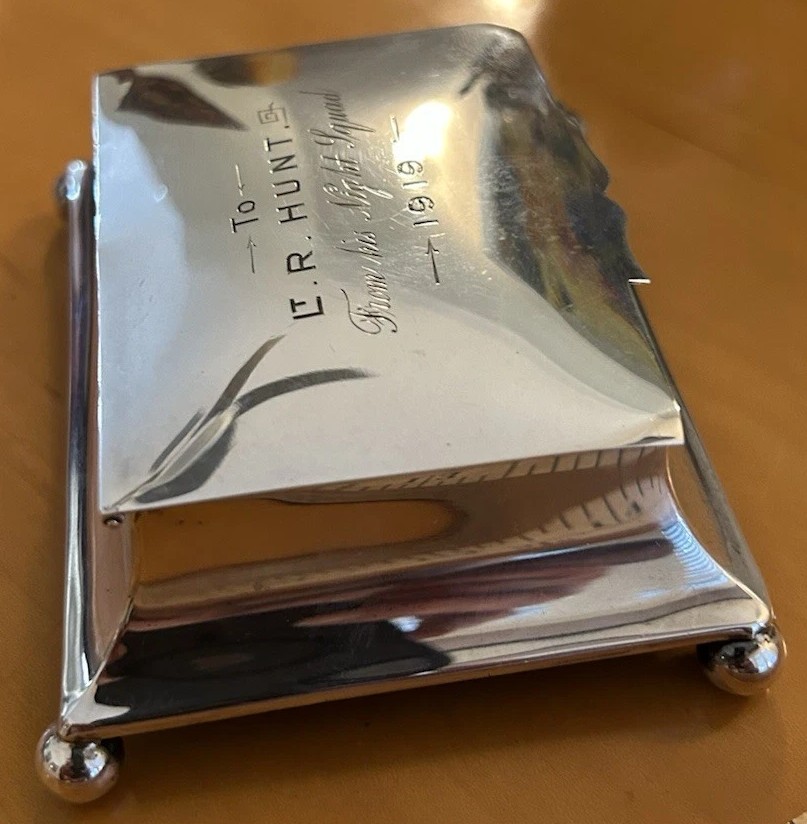
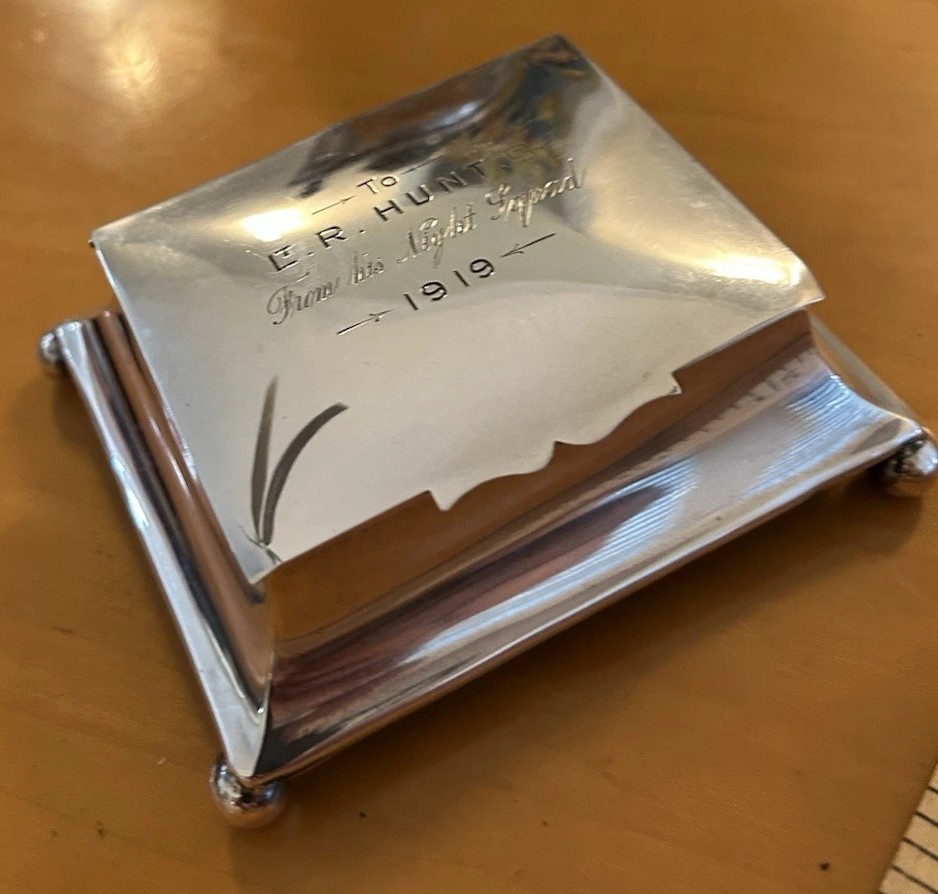
This sterling silver presentation inkstand commemorates the service of a British officer at the close of World War I.
Hallmark and Origin Identification
The hallmarks on the interior of the lid provide a precise record of its manufacture:
- Maker’s Mark (W.H): The mark for William Hutton & Sons Ltd, a prestigious firm based in Sheffield and London.
- Sterling Standard: The Lion Passant stamp confirms it is made of .925 high-quality sterling silver.
- Assay Office: The Leopard’s Head identifies that the piece was officially tested and hallmarked in London.
- Date Letter: The lowercase “d” in the specific shield shape confirms the assay year was 1919–1920.
Description
- Architectural Design: The stand features a clean, “trench” design, which became popular in the early 20th century for its stability and modern, geometric aesthetic. It sits on four polished silver ball feet.
- The Lid and Hinge: The heavy, flat-topped lid is secured by a sturdy piano hinge. When opened, it reveals the hallmarks and the housing for the ink.
- Original Glass Insert: The piece retains its original clear glass well, which is removable for cleaning and features a wide, flared rim to prevent ink from spilling onto the silver shoulders.
- Base Construction: The underside is finished with a black leather pad. This served as a “paperweight” feature, ensuring the heavy inkstand would not slide on a polished mahogany desk or scratch the wood.
The 1919 Inscription and the “Night Squad”
The engraving reads: “To Lt. R. Hunt from his night squad 1919”.
In the context of the immediate post-WWI era (1919), a “Night Squad” refers to a specialized military or police unit tasked with nighttime security and patrol duties during the demobilization period.
- Occupation Duties: Following the Armistice, many officers like Lt. Hunt were stationed in occupied territories (such as the Rhineland) where “Night Squads” maintained curfews and guarded against civil unrest.
- Home Defense: It could also refer to a specific unit within the Royal Flying Corps (which became the RAF in 1918) or an Anti-Aircraft battery. These units operated in “night squads” to defend against Zeppelin and Gotha bomber raids during the war.
- The Gift: Such an inkstand was a traditional “farewell gift” presented to an esteemed commanding officer by his men when the unit was being disbanded or when the officer was returning to civilian life.
What was a “Night Squad” in 1919?
While “Night Squad” is not a formal regimental designation, it was common 1919 slang for three specific types of service:
- The Irish “Night Patrols”: The Irish War of Independence began in January 1919. British officers in Ireland frequently formed small, mobile “Night Squads” to enforce curfews and counter IRA activity under the cover of darkness. An inkstand would be a classic “farewell” gift from men who served in such a high-stress, small-unit environment.
- The Rhine “Security Squads”: After the Armistice, the British Army of the Rhine (BAOR) occupied parts of Germany. Officers like Lt. Hunt would lead “Night Squads” to prevent smuggling and maintain order in occupied cities like Cologne.
- Civil Unrest in London (1919): 1919 saw significant industrial strikes and riots in the UK (such as the “Battle of George Square” and police strikes). Military units were often seconded to the police to form Night Watch Squads to protect infrastructure and banks.
Why the Gift?
The year 1919 was the peak of demobilization. Most of these “Night Squads” were being disbanded as soldiers returned to civilian life. It was a common military tradition for a squad to pool their money to buy their commanding officer a high-quality sterling silver gift (like a William Hutton inkstand) as a token of respect for his leadership during their final year of service.
Sold for $79 in December 2025
Content disclaimer. The information posted is the owner’s best knowledge and may not have been vetted by the SOIC. We welcome comments, corrections, and additions, working to make our website information comprehensive and accurate.
Join the Society of Inkwell Collectors (SOIC) – it’s free!
Founded in 1981 as a non-profit organization,
we are documenting inkwells (and accessories).
We’re here to help and inform!