






Regimental Silver Inkstand
| Categories | Presentation Piece |
| Type | Military |
| Material | Silver |
| Markings | See Narrative |
| Manufacturer | Charles Boyton II |
| Origin | England |
| Date or Era | circa 1888 |
| Measuring | 7 ¼” diameter; 4 ⅞” high |
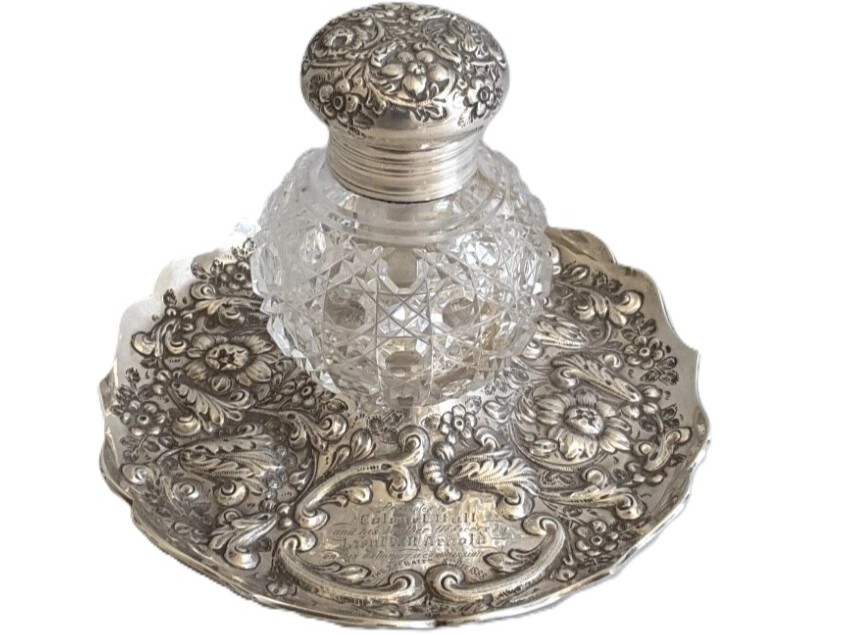
This Victorian regimental solid silver inkstand is a significant historical presentation piece, hallmarked for London, 1888, by the noted silversmith Charles Boyton II.
Description
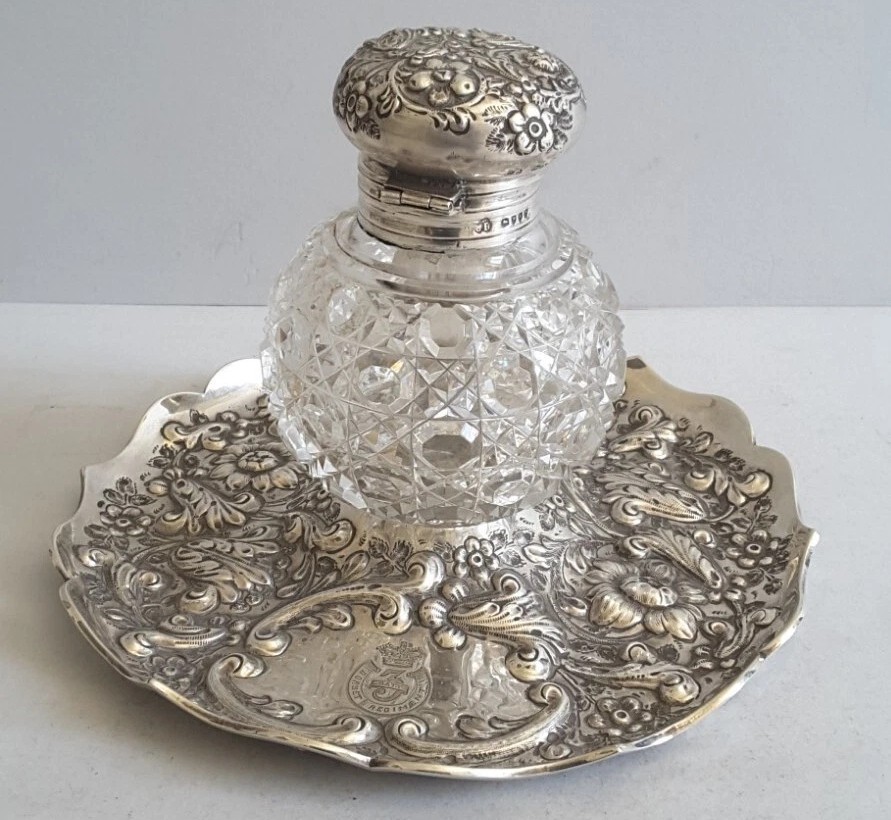
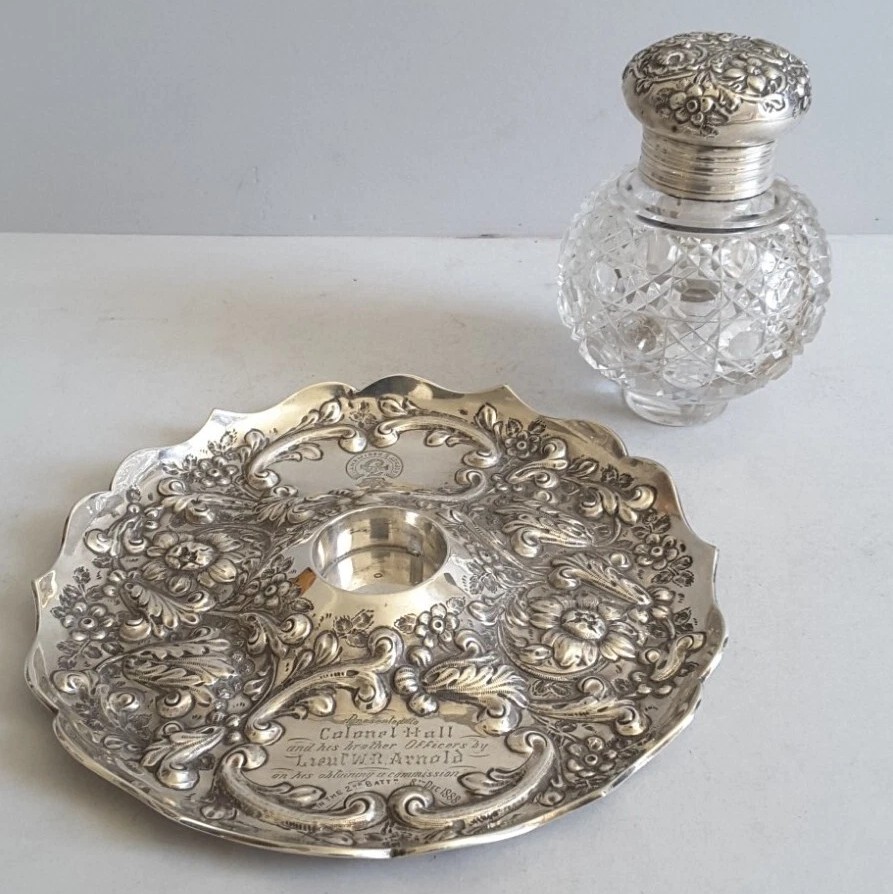
- The Base: The circular sterling silver stand features a wavy, scalloped edge and is heavily decorated with repoussé and chased floral and foliate scrollwork.
- The Inkwell: A heavy, diamond-cut glass globular inkwell fits into a central raised holder on the base. It is topped with a hinged silver lid featuring matching repoussé floral decoration.
- Inscriptions and Insignia:
- Regimental Crest: One large cartouche is engraved with the badge of the 3rd Battalion, Dorset Regiment, featuring a crown over the number “3” and a sphinx, surrounded by the regimental title.
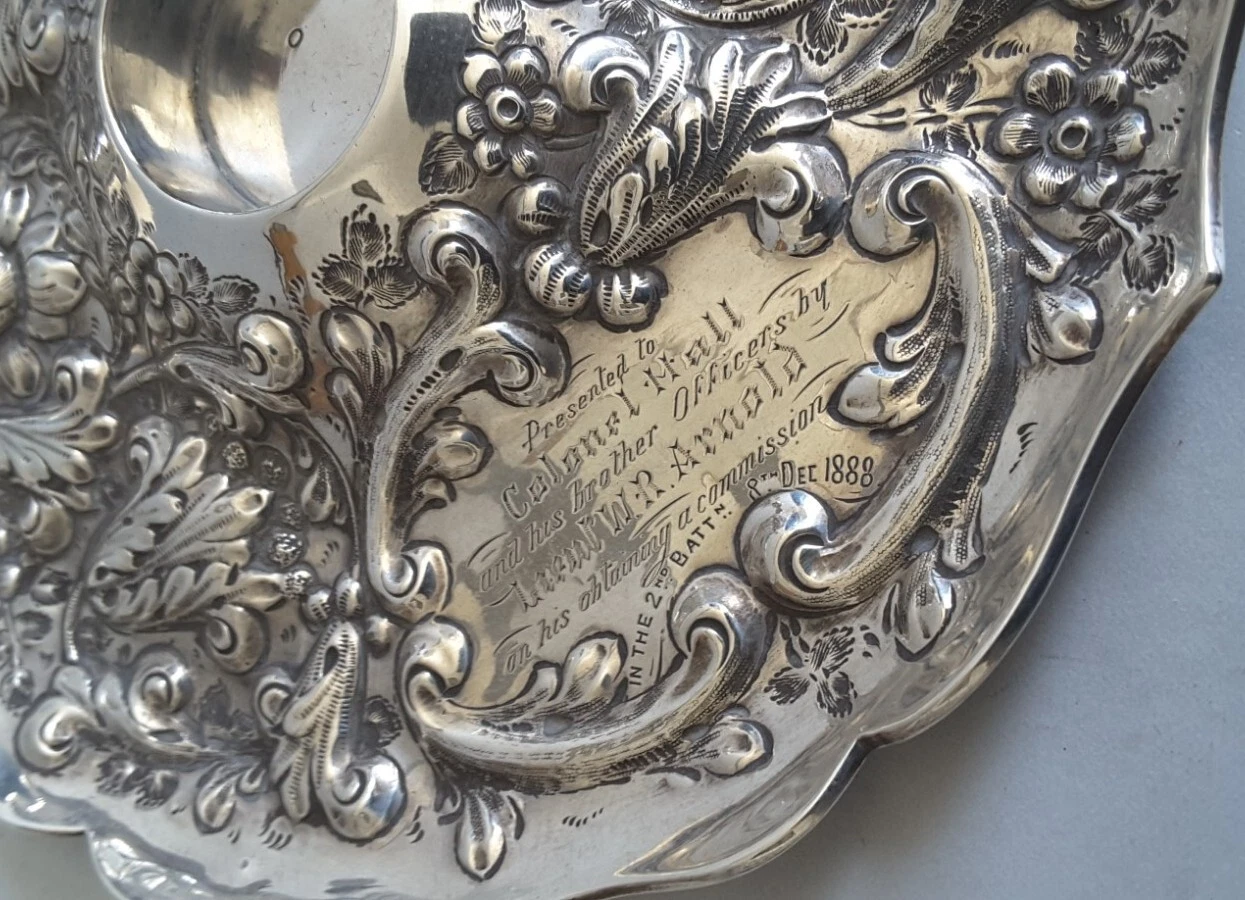
- Presentation Inscription: The opposing cartouche is inscribed: “Presented to Colonel Hall and his brother Officers by Lieut. W.R. Arnold on his obtaining a commission in the 2nd Batt’n 8th Dec 1888”.
Historical Context: The Presentation
This inkstand commemorates a traditional military milestone. In the 19th century, officers moving from a Militia battalion (the 3rd) to a Regular Army battalion (the 2nd) often presented a piece of silver to their original mess.
- The Presenter: Lieutenant W.R. Arnold: William Reginald Arnold was an officer in the 3rd (Militia) Battalion of the Dorsetshire Regiment. On December 8, 1888, he was granted a commission as a Second Lieutenant in the 2nd Battalion, Dorsetshire Regiment, which was part of the regular British Army.
- The Recipient: Colonel Richard Hall: At the time of this presentation, Colonel Richard Hall was the commanding officer of the 3rd Battalion, Dorsetshire Regiment. He was a veteran officer who had overseen the transition of the old Dorset Militia into the 3rd Battalion following the Childers Reforms of 1881.
- The Regiment: The Dorsetshire Regiment (later the Dorsets) was a line infantry regiment. The 3rd Battalion was the Militia element, used for home defense and as a training pipeline for regular officers like Arnold.
About the Silversmith: Charles Boyton II
Charles Boyton II was a prominent London manufacturing silversmith active during the late Victorian period.
- The Business: The Boyton family firm was established in the early 19th century. Charles Boyton II took over the business in the mid-1800s, operating from Upper Charles Street, Clerkenwell, London.
- Reputation: He was highly regarded for producing large-scale presentation silver and ecclesiastical silverplate. His work is characterized by the high-relief, intricate repoussé seen on this inkstand, a style that was exceptionally popular during the 1880s.
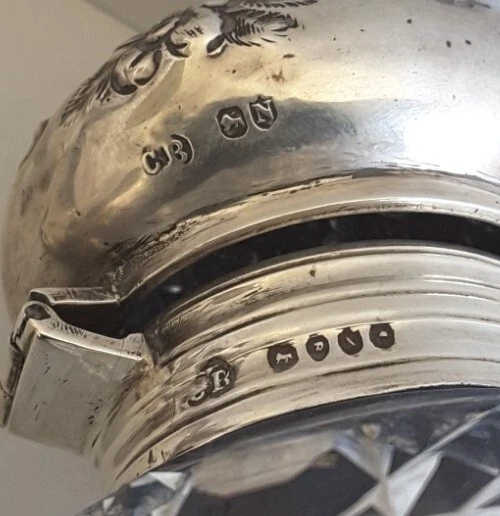
- Hallmarks: The base and the lid of the inkwell both bear his maker’s mark “CB” along with the London lion passant, the leopard’s head, the date letter “N” for 1888, and the duty mark of Queen Victoria.
History of 2nd Lieut. William Reginald Arnold
Following this presentation, William Reginald Arnold had a distinguished, albeit tragic, military career.
- Service: He served with the 1st and 2nd Battalions of the Dorsets across the British Empire.
- The Boer War: Major W. R. Arnold served in the Second Boer War (1899–1902). He was fatally wounded during the Battle of Spion Kop in January 1900 while leading his men, a testament to the “commission” celebrated by this very inkstand.
Sold for $500 in December 2025
Content disclaimer. The information posted is the owner’s best knowledge and may not have been vetted by the SOIC. We welcome comments, corrections, and additions, working to make our website information comprehensive and accurate.
Join the Society of Inkwell Collectors (SOIC) – it’s free!
Founded in 1981 as a non-profit organization,
we are documenting inkwells (and accessories).
We’re here to help and inform!