



Sterling Silver & Amber Cut Glass Inkwell (1920)
| Categories | Glass - Non-figural |
| Material | Glass, Silver |
| Markings | See Narrative |
| Manufacturer | Horace Woodward & Co |
| Origin | England |
| Date or Era | circa 1920 |
| Measuring | 2” x 2” x 2” high |
Design and Aesthetics
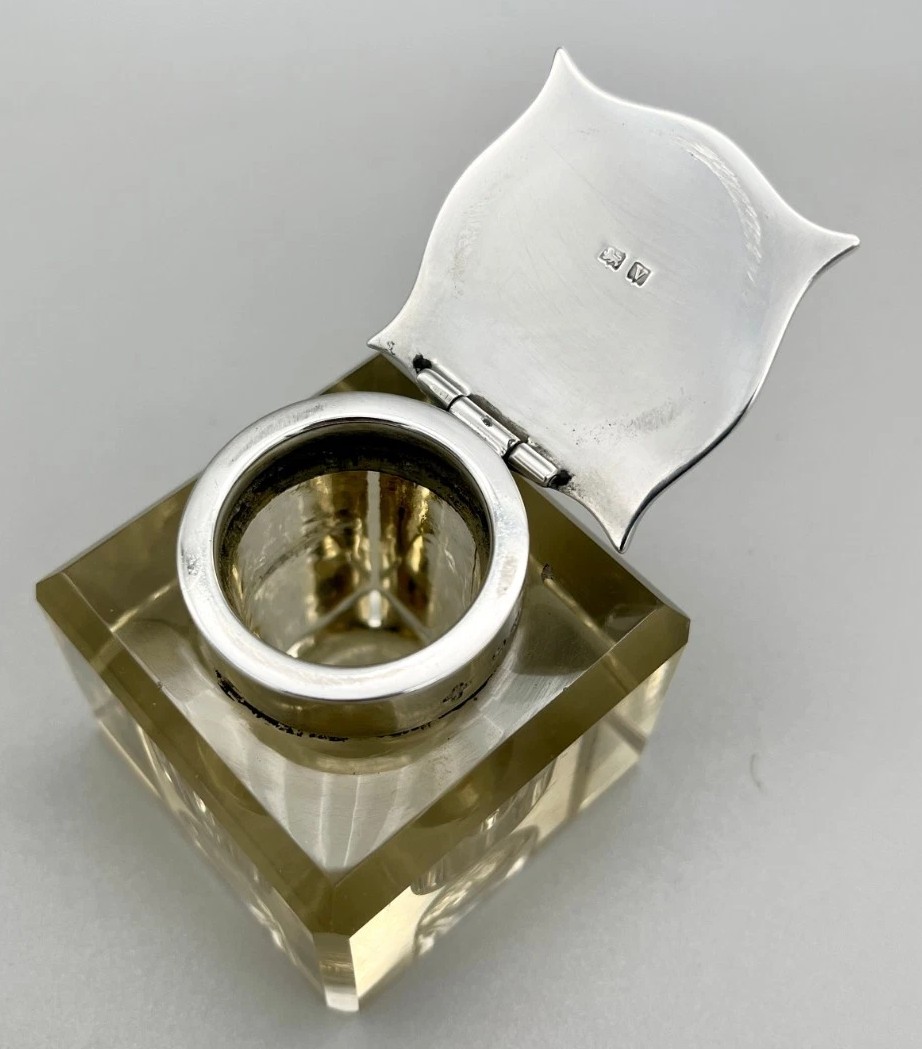
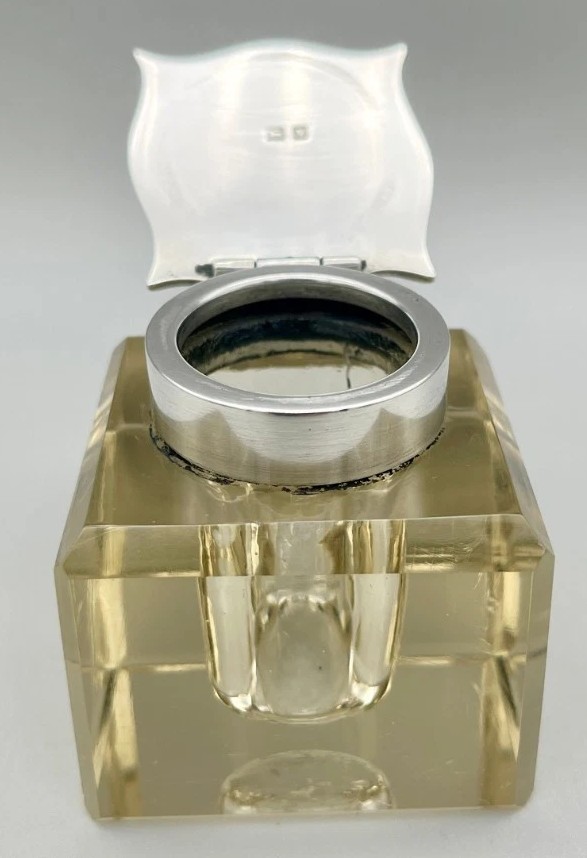
This striking George V period inkwell exemplifies early 20th-century geometric design. The glass base is rendered in a rare honey-topaz cut glass, providing a warm, amber glow that contrasts beautifully with the polished silver.
- The Glass: The base is a heavy, solid glass cube featuring slice-cut chamfered edges, which capture and refract light to highlight the interior ink reservoir.
- The Silver: The lid is made from Sterling Silver with a distinct, four-pointed silhouette. The square top features elegant, outward-bowed sides that taper into crisp points at each corner, creating a clean, architectural profile.
- Minimalism: The piece is free of any initials or personal engravings, preserving its sleek, original aesthetic.
Manufacturer & Provenance
This piece was produced in Birmingham by the firm Horace Woodward & Co in 1920.
Historical Note: Established circa 1850 by George Cartwright and Joseph Hirons, the firm grew significantly after Horace Woodward joined in 1853. Renowned as premier silversmiths and electroplaters, they were celebrated exhibitors at the Great Exhibition of 1851 and several subsequent international world’s fairs. Though Woodward departed in 1883, the company maintained his name as a mark of quality until it was acquired by Adie Brothers in the early 1920s.
Information About the Golden Colored Glass
The golden tint in this 1920 inkwell is by design rather than a byproduct of aging. While “solarization” (color change due to light exposure) is a fascinating phenomenon in antique glass, the rich, uniform honey-hue seen in this piece points toward an intentional artistic choice known as “Topaz” or “Amber” glass.
The Science of Intentional Tinting
In the early 20th century, particularly as the Art Deco movement began to influence design, glassmakers moved away from the Victorian obsession with perfectly clear “flint” glass.
- Chemical Additives: To achieve this specific golden glow, silversmiths like Horace Woodward & Co would commission glass batches infused with specific metal oxides. Iron and sulfur (often combined with carbon) were the most common additives used to create a range from pale straw to deep amber.
- Aesthetic Synergy: Silversmiths often chose these tinted glass bases to complement the warmth of the silver. When polished, the silver reflects the golden glass, creating a much richer visual depth than clear glass would provide.
The “Aging” Theory: Solarization
Glass can change color over decades, but the results are usually quite different from what is seen here:
| Effect | Cause | Resulting Color | Time Period |
| Manganese Solarization | Manganese used as a “decolorizer” to clear glass. | Amethyst / Purple | Pre-1914 (WWI) |
| Selenium Solarization | Selenium replaced manganese after German supplies were cut off. | Straw / Faint Yellow | Post-1915 |
While this inkwell dates to 1920 (the Selenium era), selenium solarization usually results in a faint, slightly “dirty” wheat color that is often uneven—concentrated where the glass was most exposed to the sun. The deep, vibrant, and perfectly even color in this cut-glass cube is the hallmark of a colored glass batch, purposefully melted to look exactly like this from the day it left the Birmingham workshop.
Condition Report
The inkwell is in very good antique condition, especially notable for a functional object over a century old:
- Glass: Excellent clarity with no chips, cracks, or significant fleabites.
- Silver: The silver lid and collar are free of dings or dents. The surface shows only the fine, superficial “whisper” wear expected of authentic antique silver.
- Mechanics: The hinge remains tight and perfectly aligned, allowing the lid to sit completely flush when closed.
Hallmarks
The hallmarks are struck clearly on the exterior of the silver collar for easy identification:
- Lion Passant: The British mark for .925 Sterling Silver.
- Anchor: The city mark for the Birmingham Assay Office.
- Date Letter “v”: Specifically denoting the year 1920.
- Maker’s Mark: The distinctive H W & Co within a quatrefoil frame, the signature of Horace Woodward & Co.
Sold for $150 in April 2026
Content disclaimer. The information posted is the owner’s best knowledge and may not have been vetted by the SOIC. We welcome comments, corrections, and additions, working to make our website information comprehensive and accurate.
Join the Society of Inkwell Collectors (SOIC) – it’s free!
Founded in 1981 as a non-profit organization,
we are documenting inkwells (and accessories).
We’re here to help and inform!