


Amber Glass Inkwell
| Categories | Glass - Non-figural |
| Material | Glass |
| Markings | Unmarked |
| Manufacturer | Undetermined |
| Origin | Undetermined |
| Date or Era | circa 1900 |
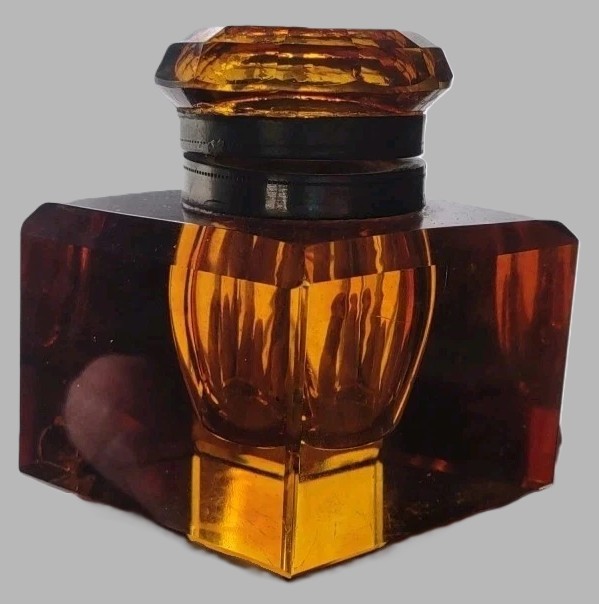
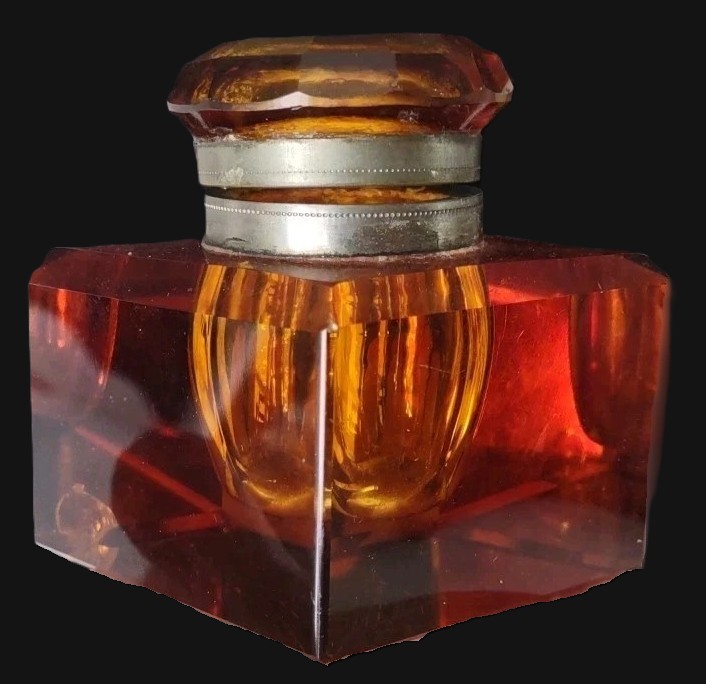
This faceted amber glass inkwell dates to the late 19th or early 20th century (circa 1880–1910). Its distinctive “diamond” or rhomboid shape suggests it was designed as a “stand-alone” desk piece.
Description
The inkwell is crafted from heavy, thick-walled glass with a rich, warm honey-amber hue.
- Form: Rather than a standard square, the body is a rhomboid/diamond shape with clipped or faceted corners. This geometry, combined with the deeply faceted “jewel-cut” lid, was specifically designed to refract light, making the inkwell appear like a large gemstone on the desk.
- Fittings: The collar and hinge are made of nickel-plated brass. The collar features a “milled” or beaded edge.
How the Amber Color Was Achieved
The deep amber color in antique glass was typically achieved through a chemical process involving iron, sulfur, and carbon.
- The Chemistry: These elements were added to the molten “batch” of glass. When melted under “reducing” conditions (where oxygen is limited in the furnace), the sulfur and iron react to form a chromophore that imparts the characteristic amber/brown color.
- Variations: Depending on the concentration and the length of the “cook,” the color could range from a pale honey yellow to a dark, almost black, chocolate brown. This piece falls into the desirable “Golden Amber” range.
Additional Insights
- Stability: These heavy glass inkwells were often marketed as “tip-proof.” Because fountain pens were not yet the norm, a writer needed a heavy base that wouldn’t slide or flip when a dip pen was repeatedly inserted.
- Design Choice: The choice of a diamond shape over a square was often a way for manufacturers to differentiate their “premium” lines from the standard utilitarian office wells found in post offices or counting houses.
Sold for $179 in April 2026
Content disclaimer. The information posted is the owner’s best knowledge and may not have been vetted by the SOIC. We welcome comments, corrections, and additions, working to make our website information comprehensive and accurate.
Join the Society of Inkwell Collectors (SOIC) – it’s free!
Founded in 1981 as a non-profit organization,
we are documenting inkwells (and accessories).
We’re here to help and inform!