





Spelter Cat Inkstand
| Categories | Figural - Animals & Living Creatures |
| Type | Cat |
| Material | Spelter |
| Markings | See Narrtive |
| Origin | France |
| Date or Era | circa 1890 |
| Measuring | 4 ¾” across; 3” high |
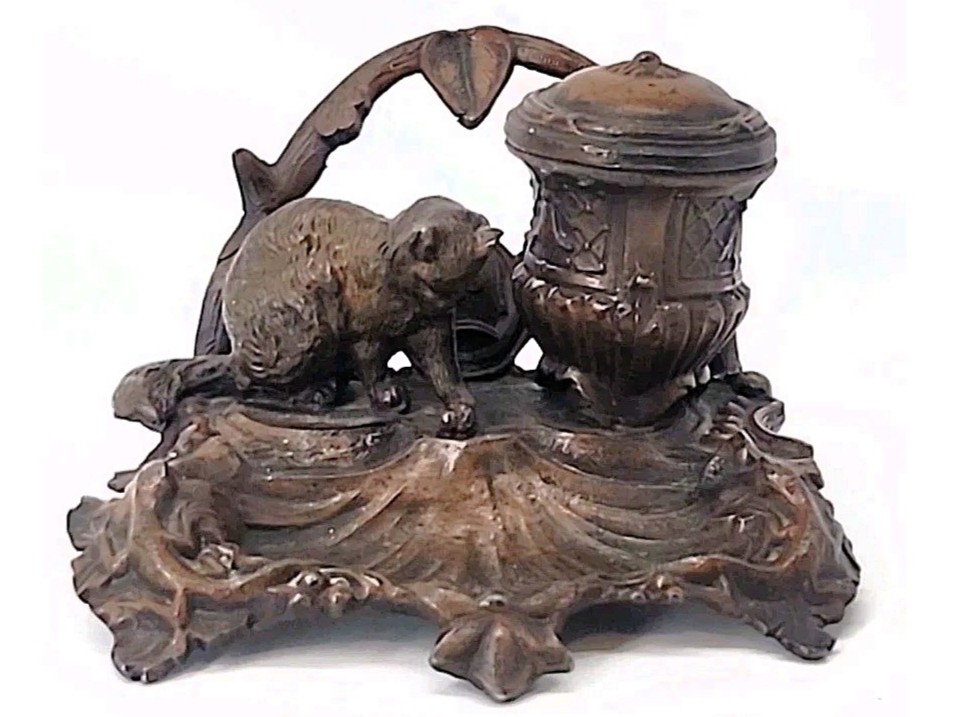
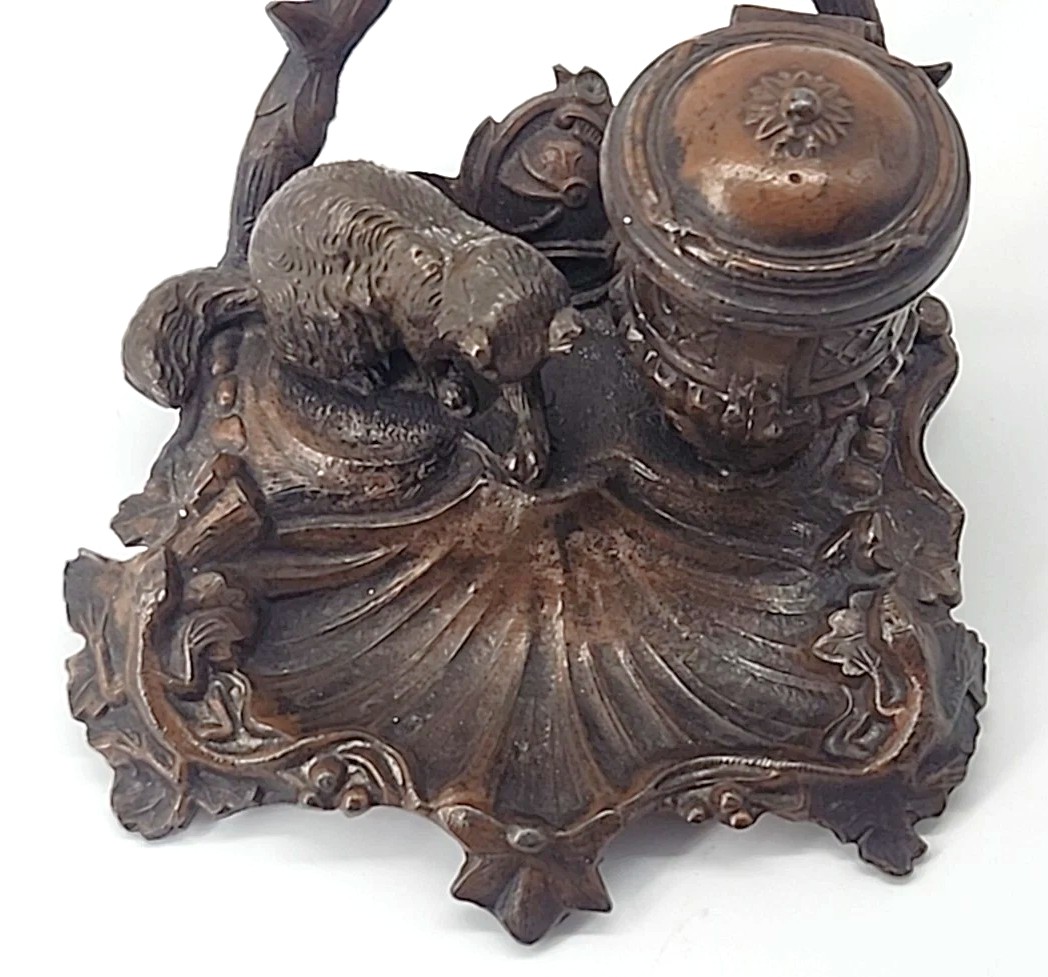
This charming 19th-century spelter metal inkstand features a cat and a decorative pen rest. Spelter, a zinc-based alloy, was a popular material in the late 1800s for creating affordable yet highly detailed “art bronzes.”
Description
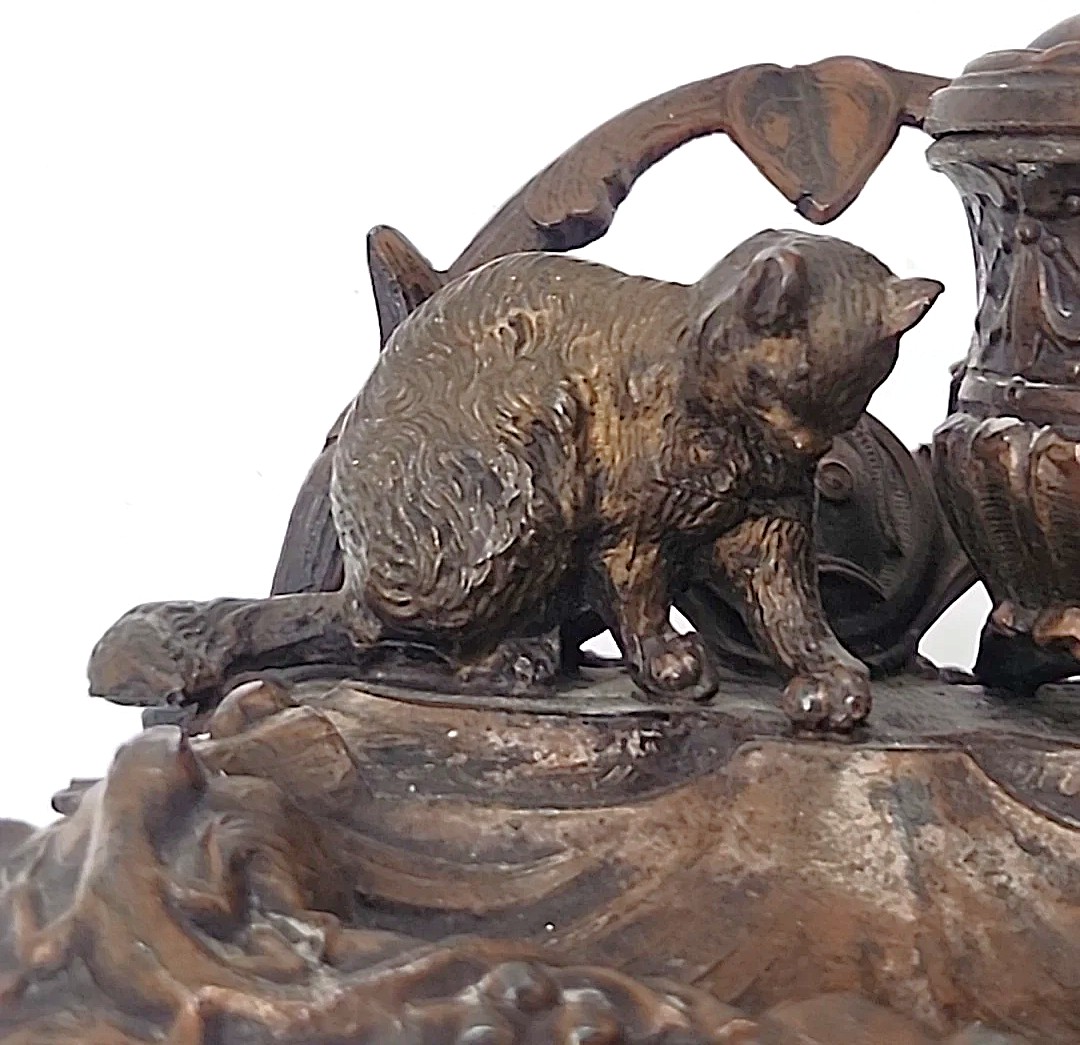
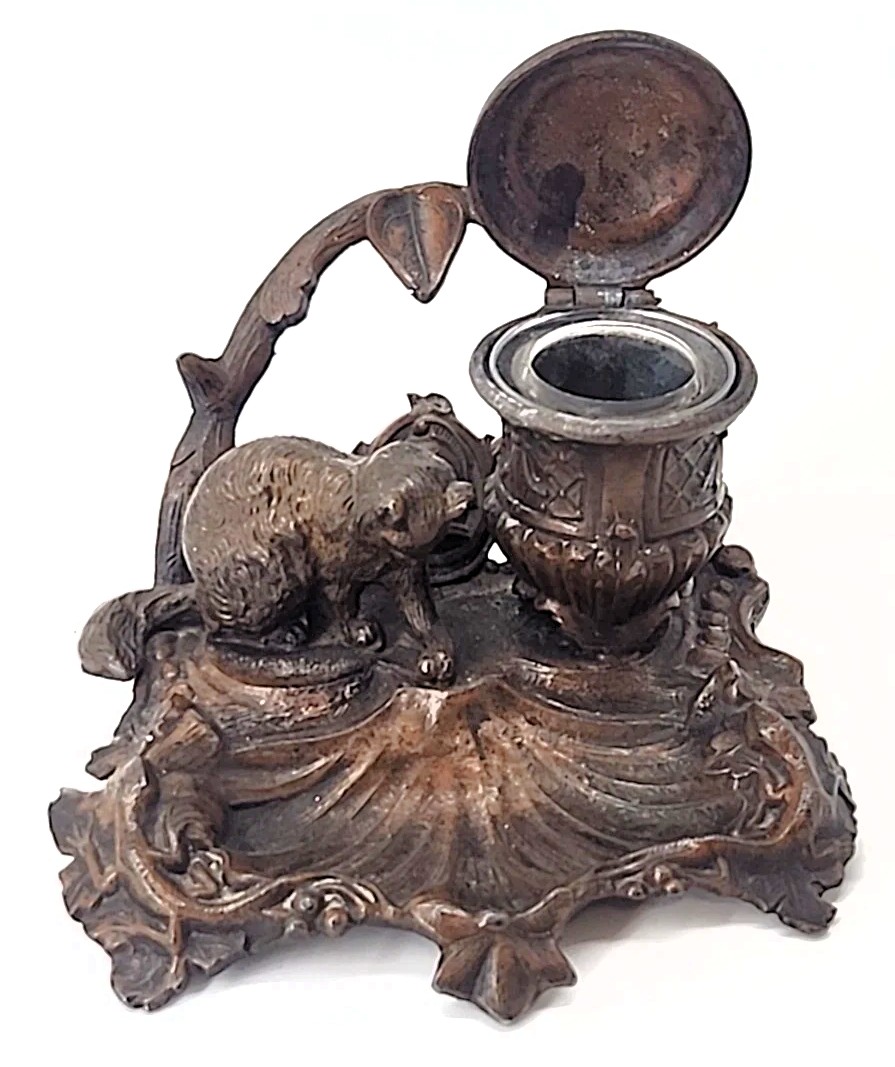
- The Scene: A detailed figure of a cat is positioned in the center of the stand, depicted in a curious, slightly hunched pose. It stands on a rocky, organic-looking terrain that forms the base of the piece.
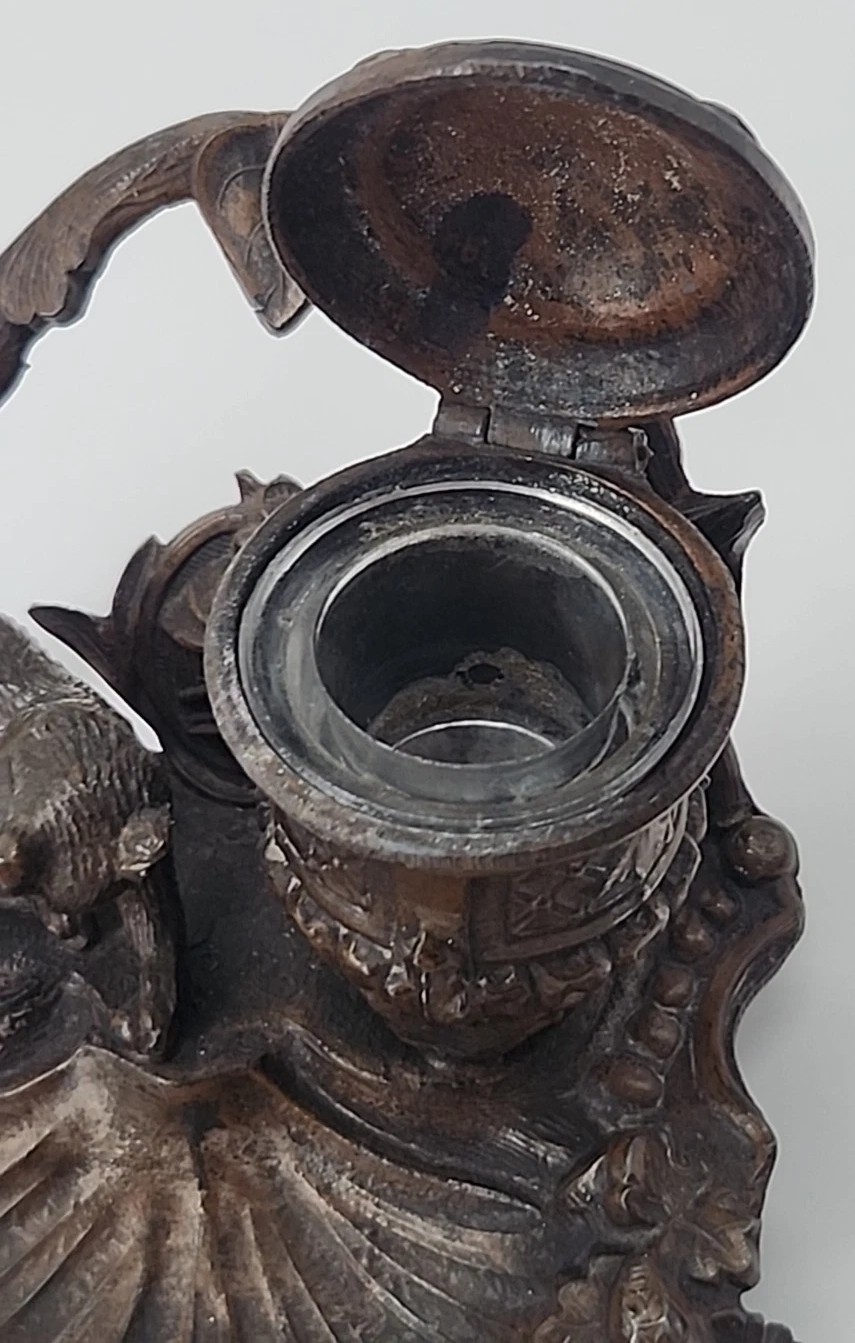
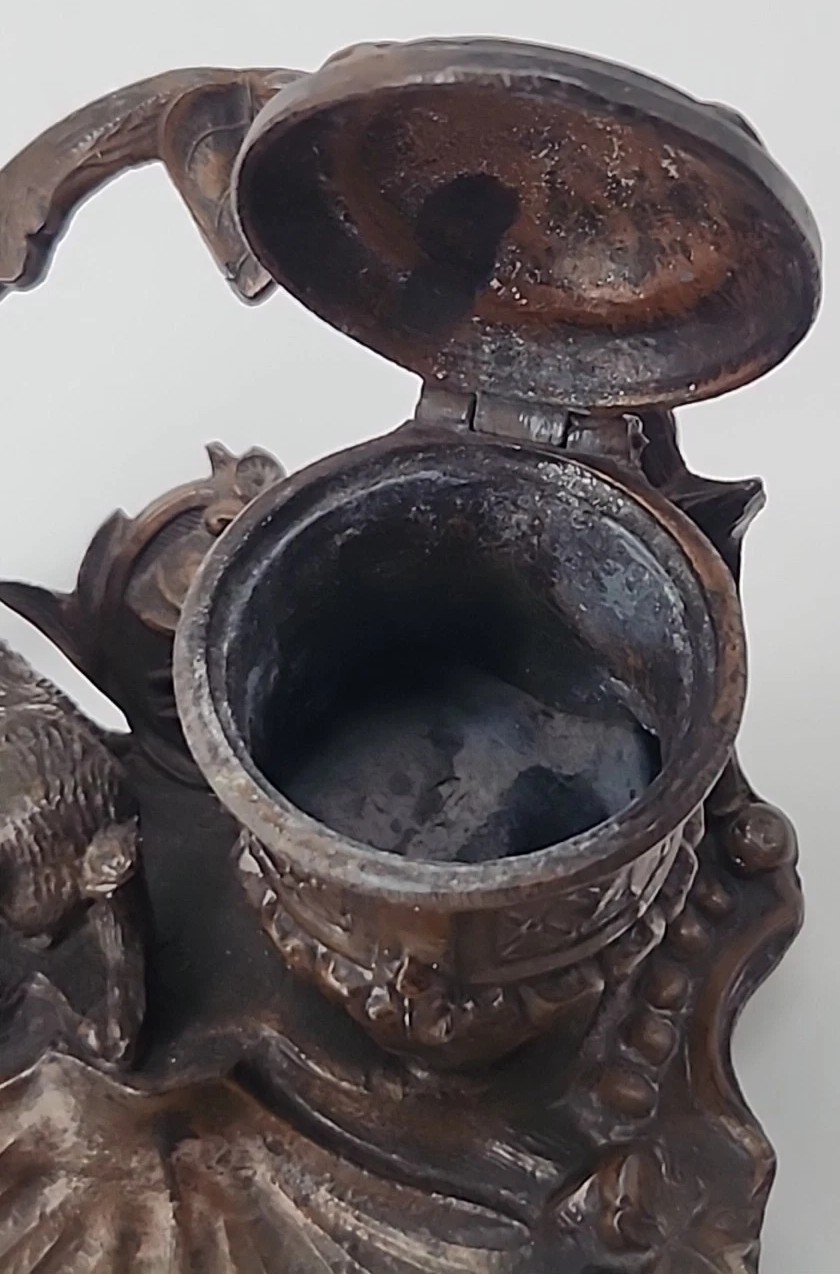
- The Inkwell: Located to the right of the cat, the inkwell is shaped like a classical urn. It features a hinged, domed lid decorated with a floral sunburst pattern.
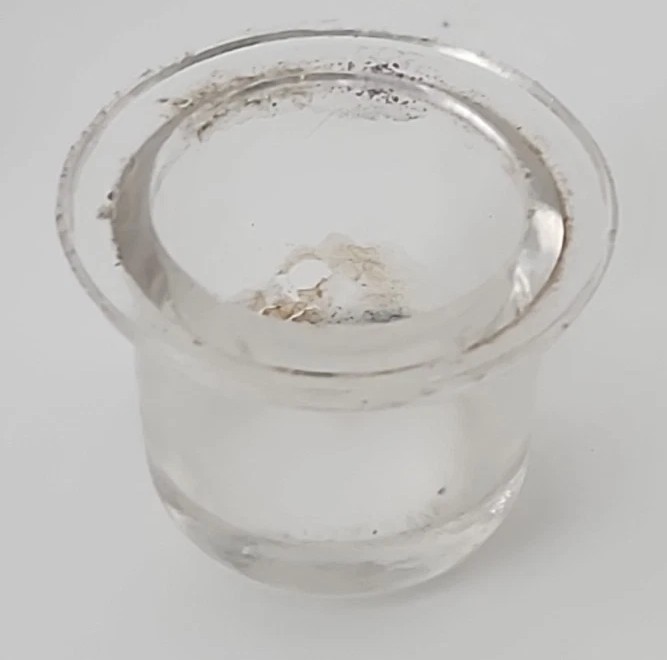
- Glass Insert: The interior of the well contains its original clear glass insert.
- Pen Holder: Behind the cat and the inkwell is an arched, naturalistic branch that serves as a pen holder. The branch includes stylized leaves and thorns, adding to the rustic “garden” aesthetic.
- The Base: The front of the stand features a wide, shell-shaped pen tray (scallop design) integrated into the ornate, scroll-edged base.
Origin and Age
Based on the style and construction, this piece is likely of French origin, dating to the late 19th century (c. 1880–1895). During this time, European foundries mass-produced “Animalier” (animal-themed) desk accessories for the growing middle-class market.
The Marks on the Underside
The underside of the base features two distinct rectangular stamps:
- “AB”: This is the maker’s mark or foundry stamp.
- “221”: This is a catalog or pattern number.
- What it means: High-volume foundries used these numbers to track specific designs in their inventory.
- Significance: It tells us that this was a standardized production model rather than a one-of-a-kind commissioned sculpture. A customer in the 1890s could have ordered “Pattern 221” from a trade catalog.
- The “AB” mark in a rectangular frame on the underside of a 19th-century spelter inkstand is highly characteristic of French production methods from the late Victorian and Belle Époque eras (c. 1880–1900).
- While several small foundries in the Paris and Lyon regions used these initials, the specific presentation of this piece helps narrow down its meaning based on historical catalog standards:
Identity of the “AB” Mark
The most probable candidate for the “AB” mark on a high-quality Animalier (animal-themed) spelter piece is Auguste-Maximilian Bonnefond (or the Bonnefond Brothers Foundry), a Parisian firm active in the late 19th century.
- Specialization: They were known for producing “zinc d’art” (artistic zinc/spelter) that closely imitated more expensive bronze work through sophisticated patination.
- Association with “Animalier” Art: Foundries using the AB mark often collaborated with pupils of famous sculptors like Antoine-Louis Barye or Jules Moigniez to produce affordable versions of their animal models for the growing middle-class market.
The Meaning of the Numbers (“221”)
The number “221” stamped next to the initials is a pattern or model number.
- Trade Catalogs: 19th-century foundries issued massive trade catalogs containing hundreds of designs. If a shopkeeper in London or New York wanted to restock this specific cat inkstand, they would order “Model No. 221” from the foundry’s catalog.
- Mass Production: It signifies that this inkstand was a successful commercial design produced in a series, rather than a unique, hand-crafted commission.
Why Spelter?
In French catalogs of this period, your inkstand would have been listed as “Régule”.
- The Process: It was made using slush casting, where molten zinc was poured into a bronze mold and then quickly poured out, leaving a thin, detailed shell.
- The Finish: The dark “bronzed” look was achieved through a chemical wash or a thin layer of copper applied by electroplating to make the grey zinc look like costly cast bronze.
Sold for $210 in January 2026
Content disclaimer. The information posted is the owner’s best knowledge and may not have been vetted by the SOIC. We welcome comments, corrections, and additions, working to make our website information comprehensive and accurate.
Join the Society of Inkwell Collectors (SOIC) – it’s free!
Founded in 1981 as a non-profit organization,
we are documenting inkwells (and accessories).
We’re here to help and inform!