



Souvenirs of Bournemouth, England
| Categories | Souvenir |
| Material | Glass |
| Markings | See Narrative |
| Manufacturer | Undetermined |
| Origin | England |
| Date or Era | circa 1900 |
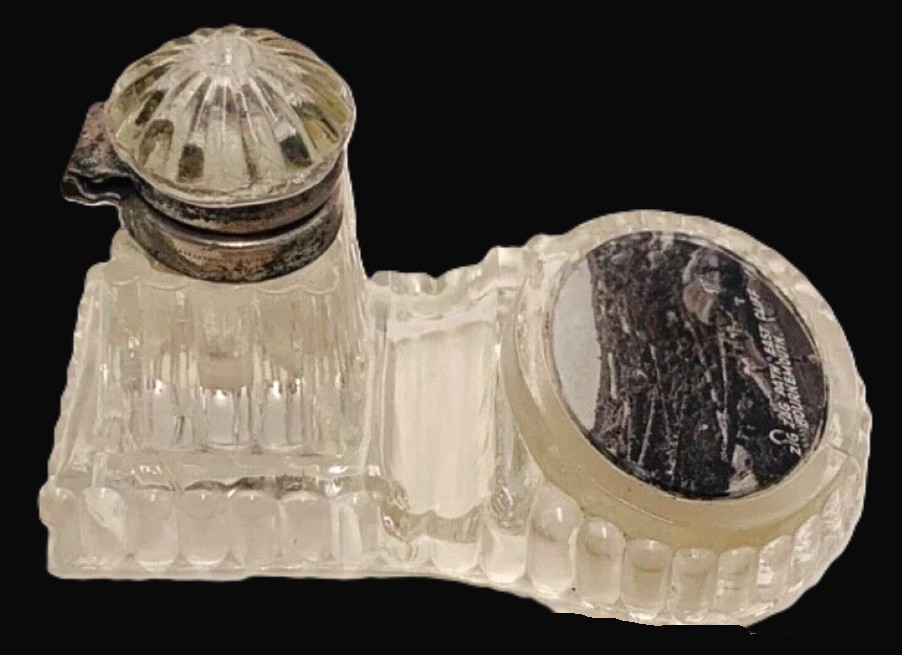
| Measuring | East Cliff: 3” long, 2” high / West Cliff: 5 ¾” x 1 ½” x 2 ¼” high |
These inkwells are charming examples of “souvenir ware,” a category of collectibles that boomed as rail travel became accessible to the middle class.
The Lure of Bournemouth
In the late 19th and early 20th centuries, Bournemouth was the premier “garden city by the sea.” Its primary lures were:
- Health and Pine Air: It was famously promoted by physicians for its mild climate and the “healing” scent of its thousands of pine trees, making it a sanctuary for those with chest ailments.
- The East Cliff: The very location on this inkwell was a center of Victorian leisure, featuring grand hotels and meticulously landscaped cliff-top walks.
- The Zig Zag Path: This specific landmark, depicted in the inkwell’s photograph, was an engineering solution to the steep cliffs, allowing tourists to stroll leisurely from the town down to the sandy beaches.
Description of the Inkwell
This piece is a multi-functional desk accessory, combining a utilitarian inkwell with a visual memento of a seaside holiday.
- The Base and Pen Channel: The inkwell is crafted from heavy, clear pressed glass. The base is rectangular with rounded ends and features a scalloped or “thumbprint” molded pattern around the lower perimeter. In the center, between the ink reservoir and the photograph, is a curved pen channel designed to hold a dip pen horizontally.
- The Souvenir Photograph: On the right side, an oval, black-and-white (sepia-toned) photographic print is embedded under a glass cabochon. It clearly shows the “Zig Zag Path, East Cliff, Bournemouth,” featuring the winding walkways and the rugged vegetation of the cliffside.
- The Ink Reservoir: On the left, a tall, square-shouldered glass reservoir rises from the base. It is decorated with vertical fluting (ribbing) that catches the light.
- The Lid: The inkwell is topped with a domed glass lid held in a metal mount. The metal is a nickel-plated brass with a simple mechanical hinge. The glass on the lid is molded in a radiating sunburst pattern to match the fluted body.
Age Assessment
Based on the style of the pressed glass, the typography on the photograph, and the popularity of Bournemouth as a resort, this inkwell likely dates to the late Victorian or Edwardian era (c. 1890–1910).
The use of “souvenir photographs” in glass paperweights and inkwells peaked during this time, often sold in gift shops along the pier or in high-end stationers to tourists wanting a functional reminder of their “invigorating” trip to the coast.
The Fish-Shaped Standish – A Second Souvenir
This second piece is a wonderful variation on the Bournemouth souvenir theme, offering a more whimsical and elaborate design than the first.
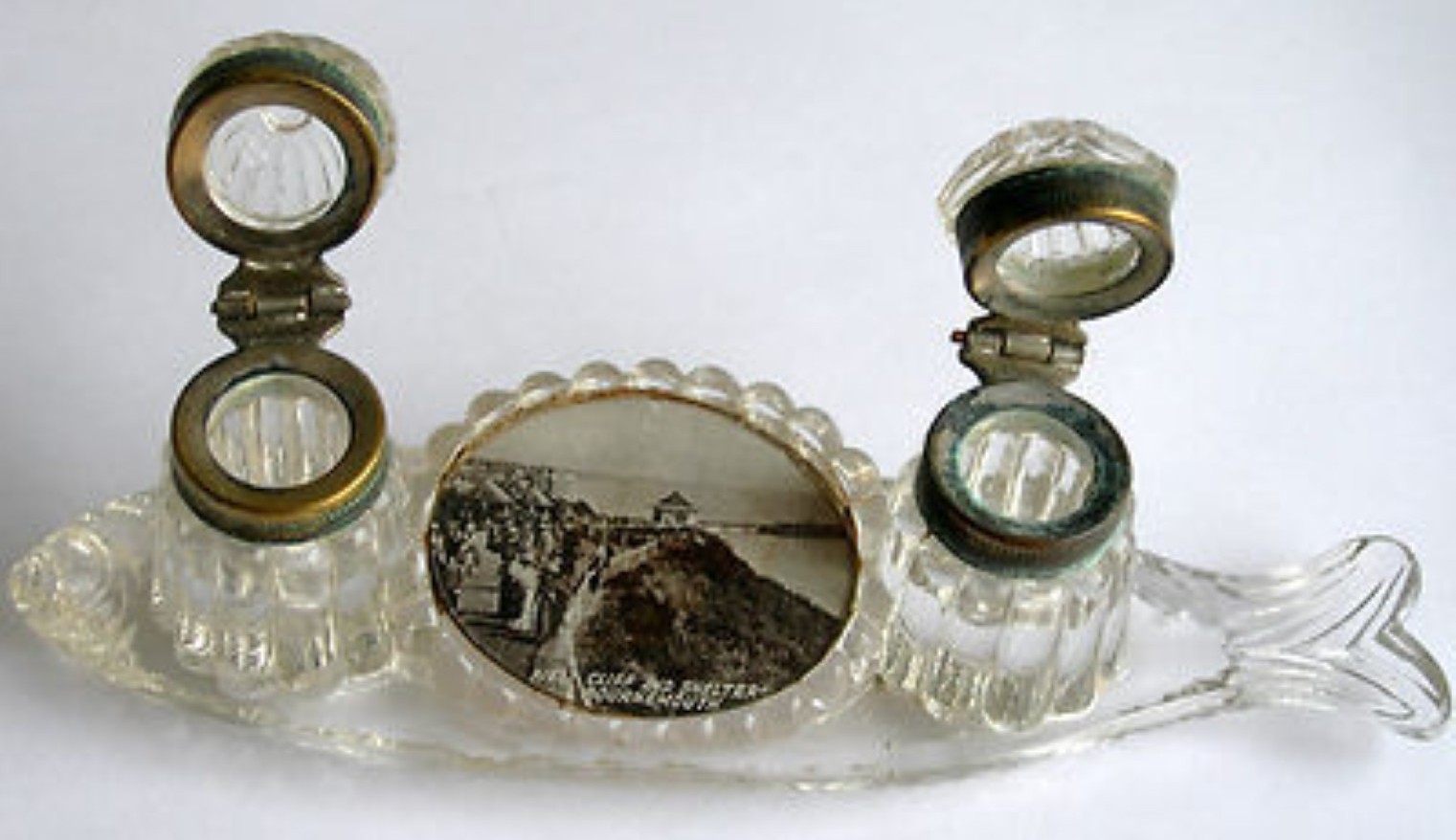
Unlike the previous rectangular example, this inkwell is a figural standish shaped like a fish.
- The Form: The clear pressed glass base is molded into the silhouette of a fish (possibly a trout or mackerel), with a rounded head at the left and a distinct, split “V” tail at the right.
- Texturing: The “body” of the fish features molded scales or ribbing along the edges, giving it a tactile, shimmering quality that would have mimicked water on a Victorian desk.
- The Double Inkwell: This is a “double” set, featuring two identical ink reservoirs.
West Cliff and the Shelters
The central focal point is an oval photographic print under a glass cabochon, framed by a scalloped or beaded border.
- The Landmark: The caption reads “West Cliff and Shelters, Bournemouth.” While the East Cliff was known for its grand hotels, the West Cliff was famous for its high-elevation views and these “Shelters.”
- Victorian Social Life: The figures in the photograph are in Victorian dress—women in long, bustled skirts and men in formal hats. These shelters were vital to the Bournemouth “cure,” allowing visitors to sit and breathe the salt air and pine fragrance for hours while remaining protected from the English wind and sun.
- The View: The image captures the rugged coastline and the architectural charm of the public shelters that once lined the promenade.
Technical Details
- The Reservoirs: The two glass pots feature vertical fluting identical to the first inkwell, suggesting they may have been produced by the same manufacturer or were part of a coordinated series of souvenirs.
- The Lids: Each reservoir has a hinged metal collar and a domed, sunburst-molded glass lid.
- Date: Like the first, this piece firmly belongs to the 1890–1905 period. The combination of the figural fish shape and the “West Cliff” imagery makes it a prime example of the high-Victorian taste for decorative, themed functional objects.
Having these two side-by-side—one representing the East Cliff and one the West Cliff—effectively gives you a complete “map” of Bournemouth’s coastal identity at the turn of the century.
Estimated value: $25 each
Content disclaimer. The information posted is the owner’s best knowledge and may not have been vetted by the SOIC. We welcome comments, corrections, and additions, working to make our website information comprehensive and accurate.
Join the Society of Inkwell Collectors (SOIC) – it’s free!
Founded in 1981 as a non-profit organization,
we are documenting inkwells (and accessories).
We’re here to help and inform!