




Souvenir Inkstand – Strasbourg Cathedral
| Categories | Souvenir |
| Material | Spelter |
| Markings | See Narrative |
| Manufacturer | Undetermined |
| Origin | France |
| Date or Era | circa 1890 |
Description of the Inkstand
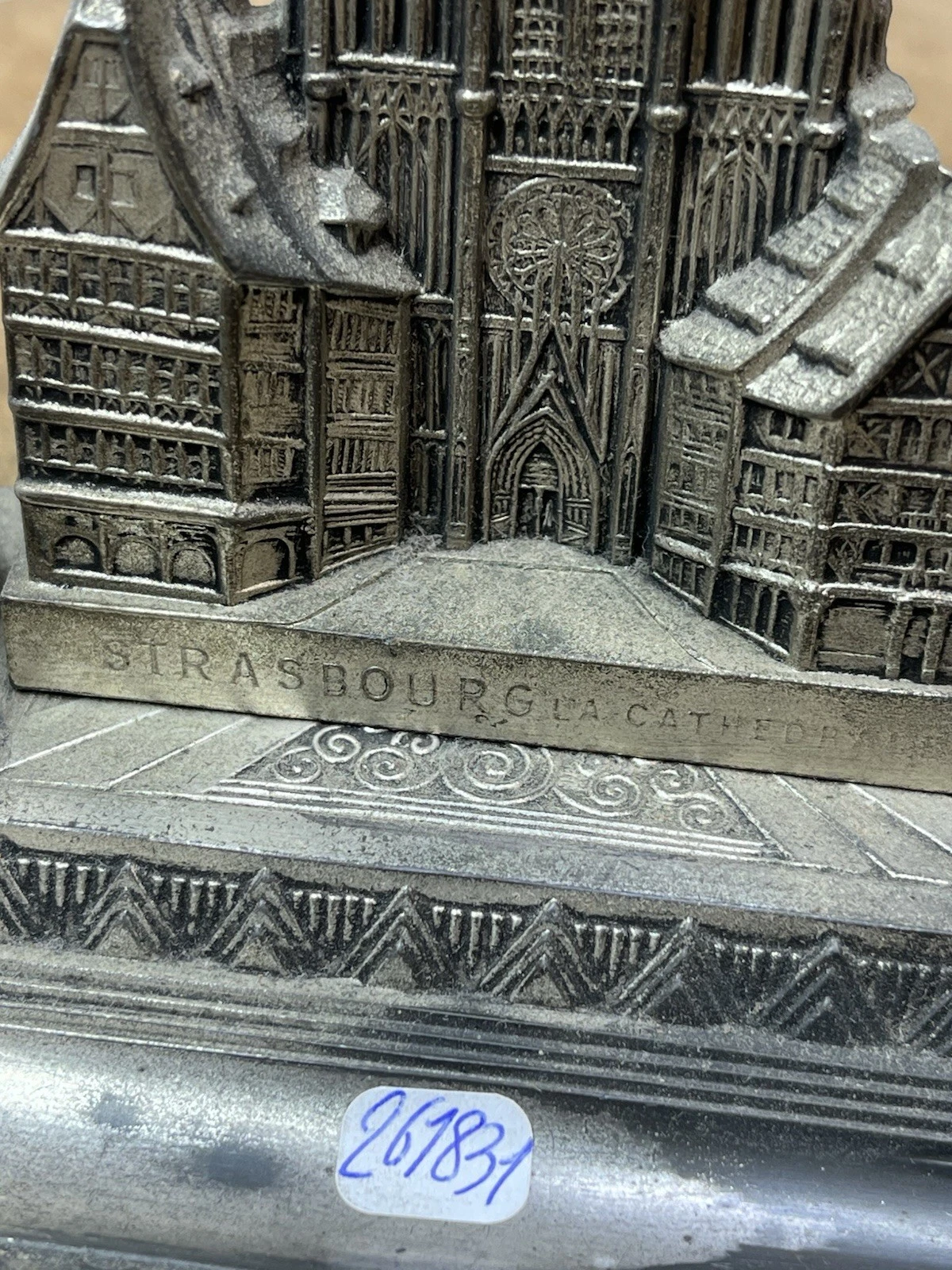
This piece is a detailed miniature of the Strasbourg Cathedral (Cathédrale Notre-Dame-de-Strasbourg), cast in spelter (a zinc-based alloy often called régule in France).
- Central Feature: The cathedral model occupies the center, showcasing its iconic single-tower facade. It is flanked by two charming half-timbered houses, which are characteristic of the historic “Petite France” district in Strasbourg.
- The Inkwells: On either side of the cathedral are two lidded inkwells. The lids are octagonal and faceted, opening to reveal black inserts.
- The Base & Pen Tray: The wide, architectural base features a long, recessed pen tray in the front. It is decorated with intricate scrollwork, floral motifs at the center, and a repeating geometric “zigzag” or “sawtooth” pattern along the elevated platform.
- Inscriptions: The base of the cathedral model is clearly embossed with the words “STRASBOURG LA CATHÉDRALE.” The underside shows a hollow-cast construction with a central bolt and the number “5352,” likely a factory model or catalog number.
Age and Origin
This inkstand most likely dates to circa 1890–1915.
Spelter was the “bronze of the people” – it allowed for the mass production of highly detailed decorative arts at a lower cost than traditional bronze. The production of these monumental souvenirs peaked during the height of 19th-century European tourism, particularly after the Franco-Prussian War (1870), when Strasbourg’s status as a border city made it a site of significant national and cultural interest.
History of the Strasbourg Cathedral
The Strasbourg Cathedral is considered one of the finest examples of High Gothic architecture in the world.
- Construction: Building began in 1015 in the Romanesque style, but by the 1200s, the style shifted to the newly popular Gothic aesthetic. It was finally completed in 1439.
- The World’s Tallest: From 1647 to 1874, the cathedral’s 142-meter (466 ft) spire made it the tallest building in the world. It held this title for 227 years until it was surpassed by St. Nikolai’s Church in Hamburg.
- The Single Spire: One of its most famous features is its asymmetrical appearance. Though two towers were planned, only the north tower was ever finished with a spire. This unique silhouette became the defining symbol of the city.
Why It Became a Souvenir
By the 1800s, the cathedral was much more than just a place of worship; it was a “must-see” marvel of the Western world. It became worthy of such elaborate souvenirs for several reasons:
- Engineering Marvel: Visitors were awestruck by the “lace-like” stonework of the facade. Victor Hugo famously described it as a “gigantic and delicate marvel.”
- The Romantic Movement: Writers like Goethe and Hugo championed Gothic architecture in the 19th century, leading to a massive surge in “architectural tourism.”
- National Symbolism: Because Strasbourg was frequently contested between France and Germany, owning a model of the cathedral was often a statement of regional pride and cultural heritage.
- The Rise of the Desk Set: In the 19th century, the desk was the center of home life. Souvenir inkwells allowed travelers to bring a piece of “the world” home, serving as a functional reminder of their journey every time they dipped their pen.
Sold for $25 in April 2026
Content disclaimer. The information posted is the owner’s best knowledge and may not have been vetted by the SOIC. We welcome comments, corrections, and additions, working to make our website information comprehensive and accurate.
Join the Society of Inkwell Collectors (SOIC) – it’s free!
Founded in 1981 as a non-profit organization,
we are documenting inkwells (and accessories).
We’re here to help and inform!