

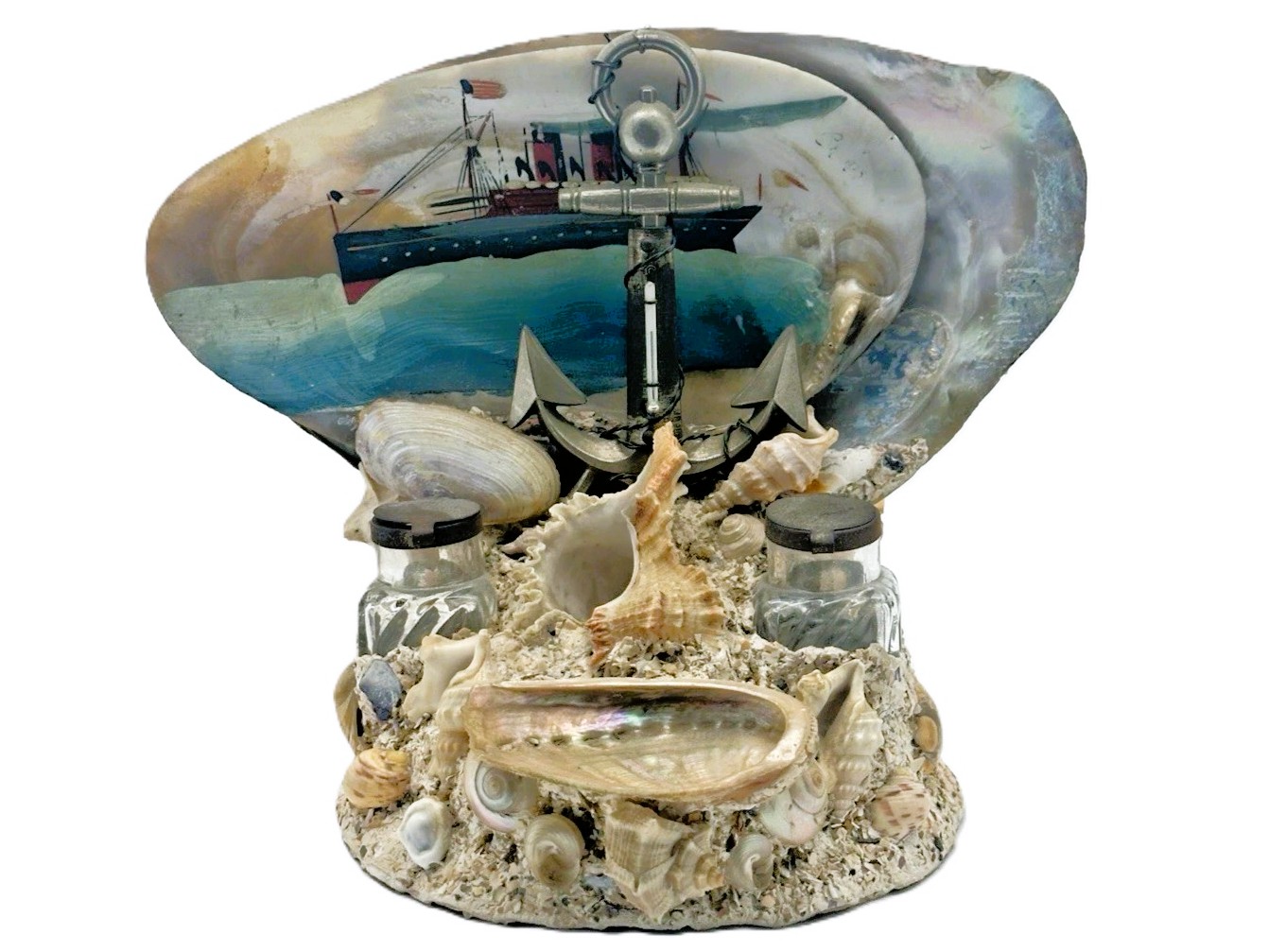


Souvenir Seashell Inkstand
| Categories | Souvenir |
| Type | Nautical |
| Material | Shell |
| Markings | Unmarked |
| Manufacturer | Undetermined |
| Origin | Undetermined |
| Date or Era | circa 1900 |
| Measuring | 8 ½” x 6” x 7” high |
This nautical souvenir inkstand and desk thermometer is typical of the “shell work” or “sailor’s valentines” and resort souvenirs popular during the late 19th and early 20th centuries.
The Temperature Scales & Origin
Looking closely at the thermometer attached to the metal anchor:
- Left Side: The scale shows 40, 30, 20, 10, 0.
- Right Side: The scale shows 40, 30, 20, 10, 0 (aligned slightly differently or representing a matching scale for a specific system).
Given the context of European souvenir manufacturing for the export market, these markings represent the Celsius (°C) and Réaumur (°R) scales. The Réaumur scale (where water freezes at 0° and boils at 80°) was widely used in Europe, particularly in Germany, France, and Russia, alongside Celsius during the 19th century.
Where was it made?
While it features a hand-painted steamship flying an American flag, indicating it was customized for the American market, the physical components tell a different story:
- Germany / Central Europe: Germany was the powerhouse of the global souvenir trade from the 1880s through the 1910s. German manufacturers mass-produced metal components (like the cast metal anchor), glass inkwells, and thermometer inserts, often combining them with local or imported shells to sell to seaside resorts across Great Britain and America.
- The use of European temperature scales on the cast metal backplate strongly points to a German or French manufacturer who exported the blank metal hardware or the finished novelty piece to the United States.
Shell Identification
The piece is a wonderful collage of natural marine materials.
- Large Backing Shells: The two massive, iridescent shells forming the backdrop and letter-holder space are Mussel shells—specifically, large marine species like the Mytilus californianus or a similar pearlescent saltwater mussel that has been polished down to reveal the shiny, colorful nacre (mother-of-pearl) layer.
- The Small Dish: The front dish meant for paper clips or pen nibs is a juvenile Abalone shell (Haliotis), identifiable by its signature iridescent rainbow colors and the row of respiratory pores along the edge.
- Prominent Center Shell: Nestled between the two inkwells is a Frog Shell (Tutufa bubo) or a type of Murex / Whelk, showing distinct spiky, rugged ridges.
- Left Side (Near Inkwell): A smooth, rounded Clam / Venus shell with prominent growth rings.
- Base Decorations (Rear & Sides):
- There is a large, flat, beautifully ribbed Lion’s Paw Scallop or Pecten shell holding up the back structure.
- The very bottom base is stabilized by a large Scallop shell (Pectinidae).
- Scattered throughout the crushed shell grout matrix are various small Turbo shells (the spiral, pearlescent green-and-white snails), Nerites, and small Top shells.
When Was It Made?
This souvenir can be confidently dated to roughly between 1890 and 1910.
Clues for Dating:
- The Steamship Design: The hand-painted ship features a black hull, a red lower waterline, and two prominent red funnels (smokestacks) with black tops. This specific silhouette closely mirrors the great transatlantic ocean liners of the late 1890s and early 1900s (such as early Cunard or White Star vessels).
- The Inkwell Style: The two glass inkwells feature swirling, molded glass bodies with simple hinged, base-metal flip lids. This specific style of utilitarian, double-inkwell desk set was standard for home and hotel writing desks around 1900.
- The Craze for Shell Work: The turn of the 20th century was the absolute peak era for “resort novelties.” Tourists visiting American coastal destinations like Atlantic City, Cape May, or New England ports frequently bought these exotic, shell-encrusted mainland imports as functional mementos.
Sold for $250 in May 2026
Content disclaimer. The information posted is the owner’s best knowledge and may not have been vetted by the SOIC. We welcome comments, corrections, and additions, working to make our website information comprehensive and accurate.
Join the Society of Inkwell Collectors (SOIC) – it’s free!
Founded in 1981 as a non-profit organization,
we are documenting inkwells (and accessories).
We’re here to help and inform!