




1904 St. Louis World’s Fair Souvenir
| Categories | Figural - Inanimate, Souvenir |
| Type | Buildings / Structures |
| Material | Gold Gilt Finish |
| Markings | See Narrative |
| Manufacturer | Undetermined |
| Origin | United States |
| Date or Era | circa 1904 |
| Measuring | 4 ¾” x 3 ¾” x 3 ½” high |
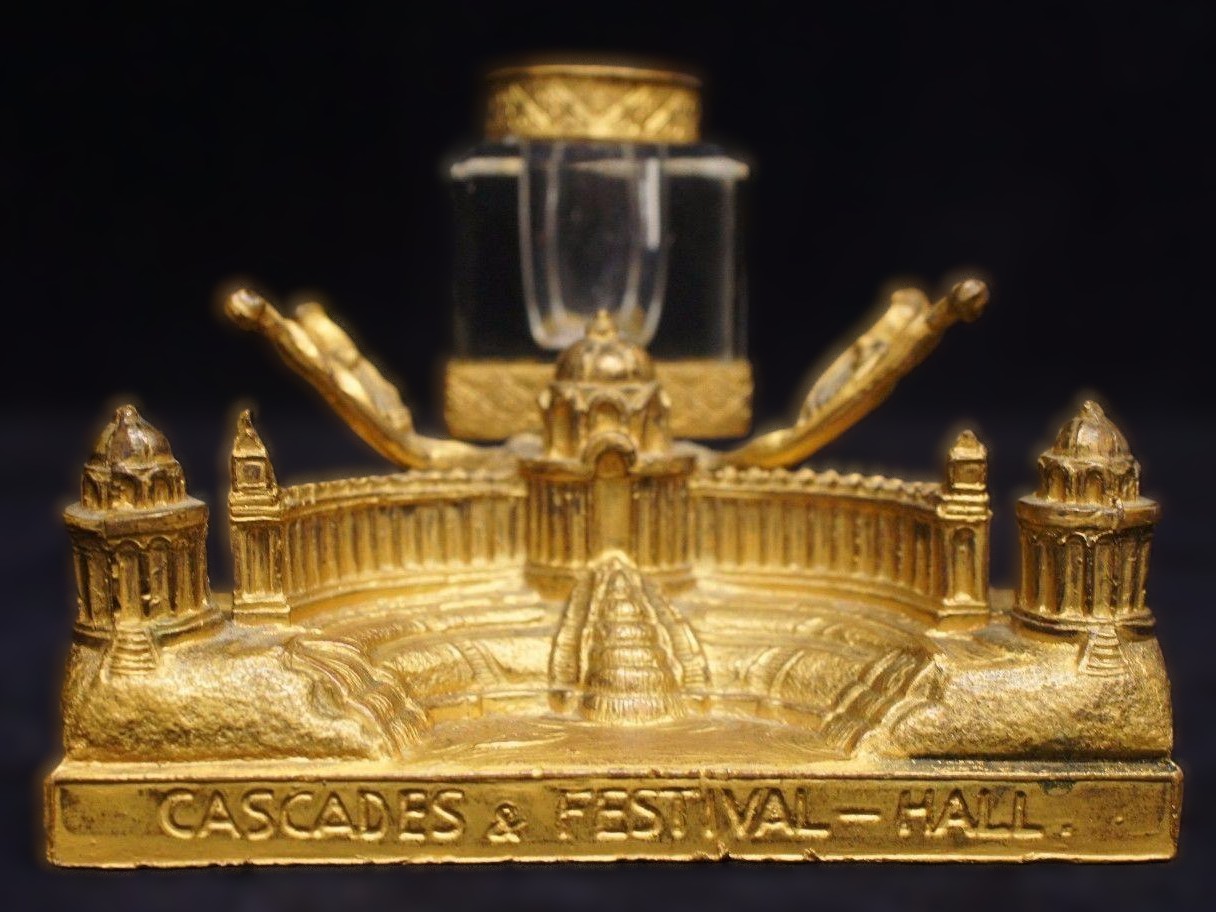
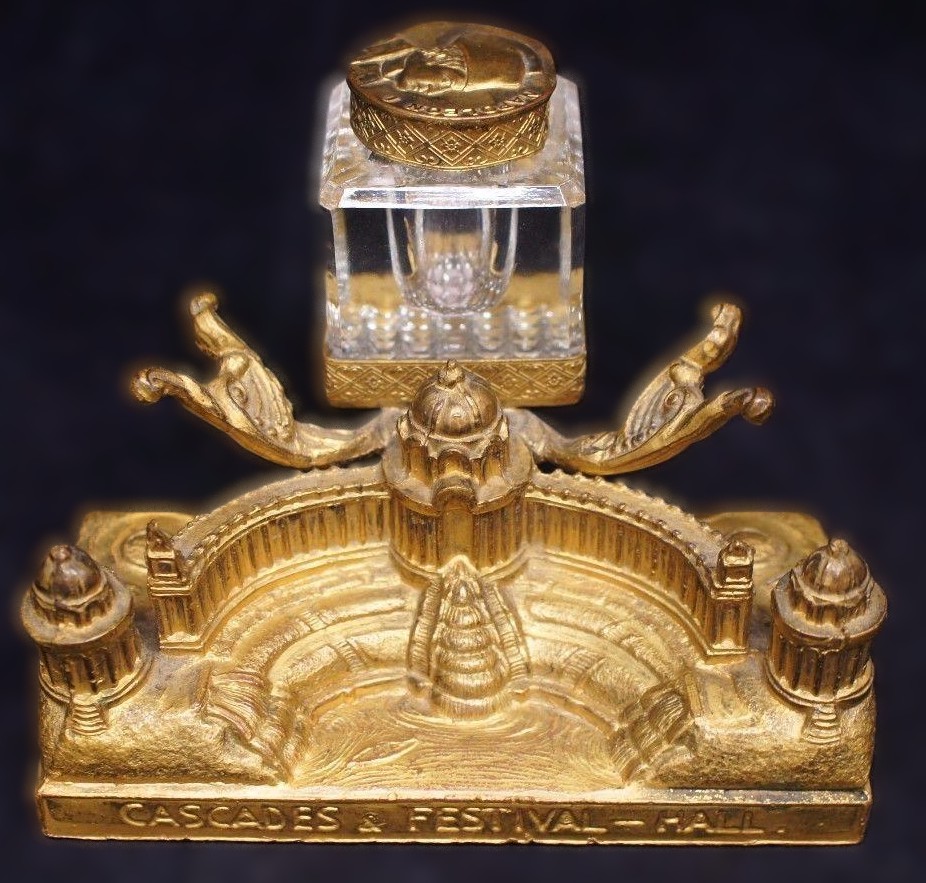
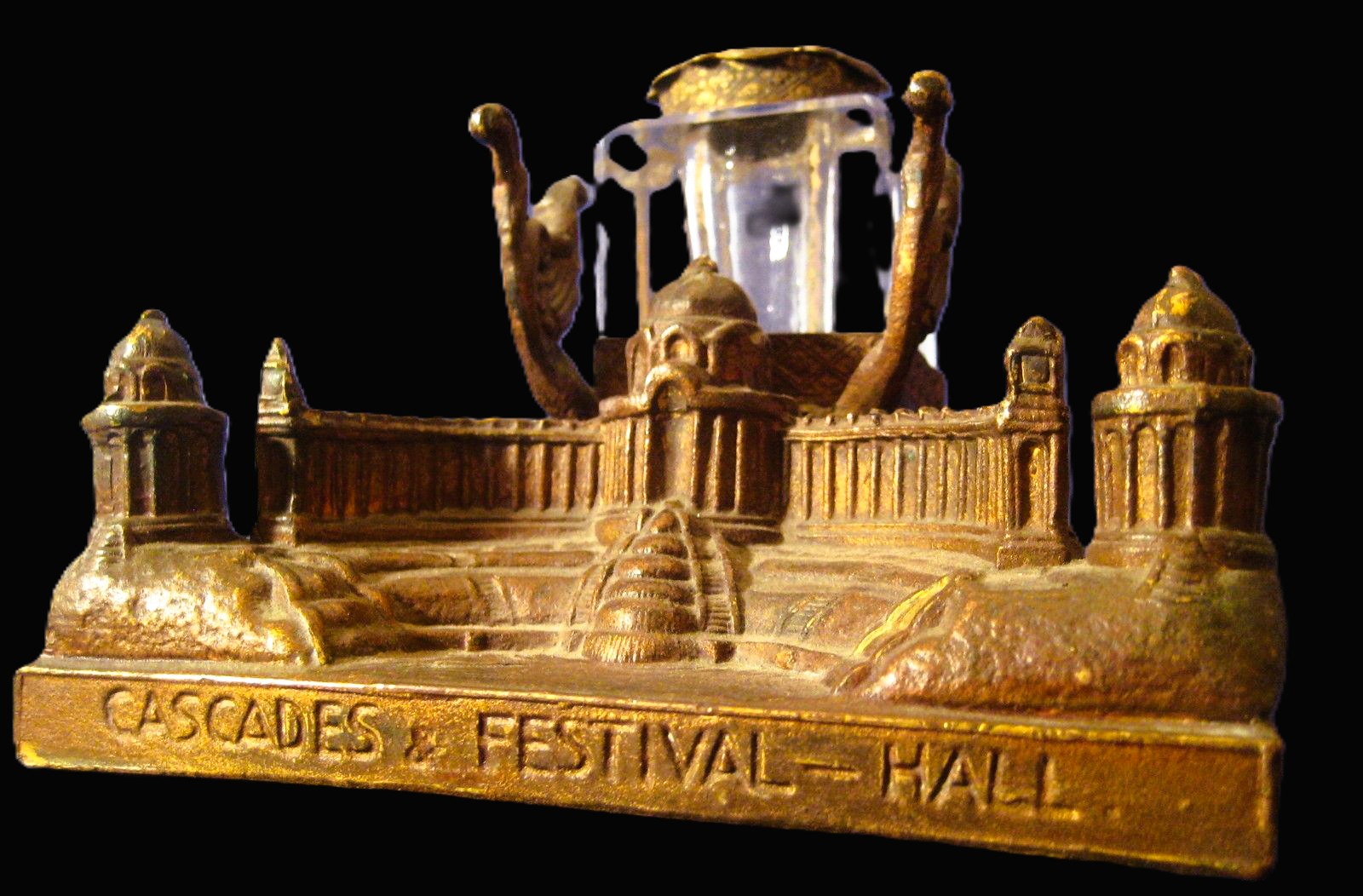
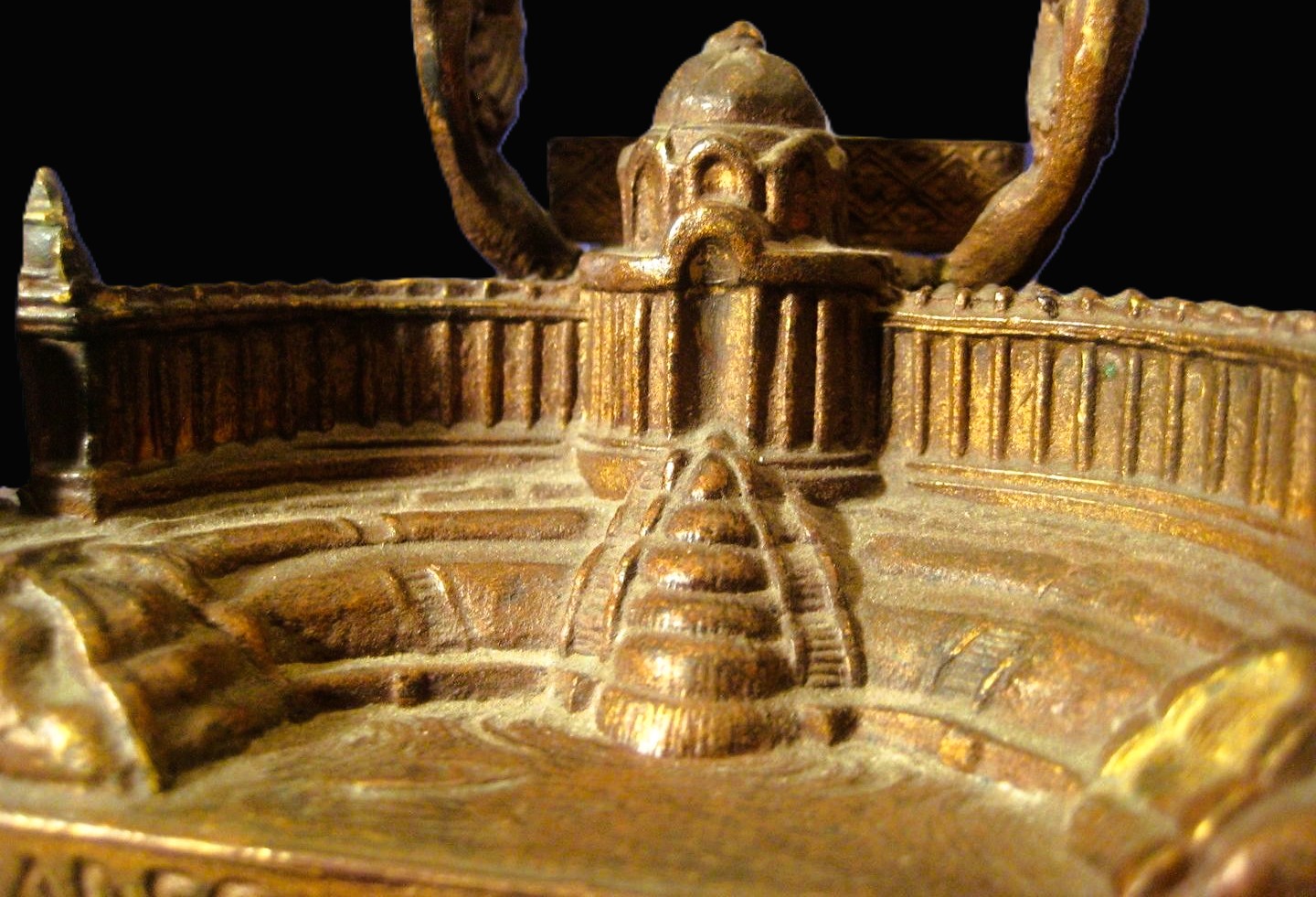
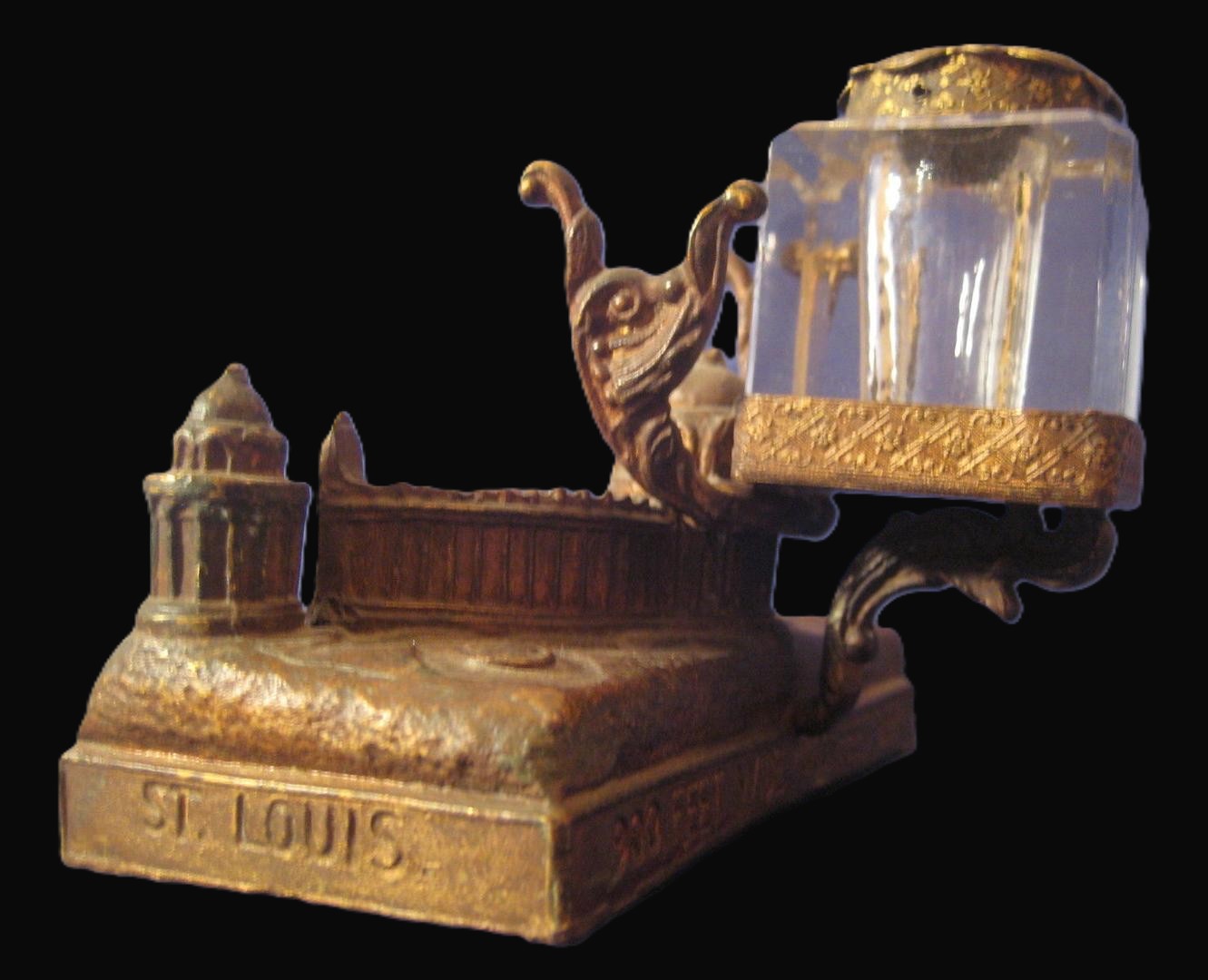
This souvenir inkstand is a detailed, three-dimensional scale miniature commemorating the 1904 St. Louis World’s Fair. Cast in a gold-plated spelter, it replicates the grand architectural heart of the exposition.
Description
The inkstand is structured as follows:
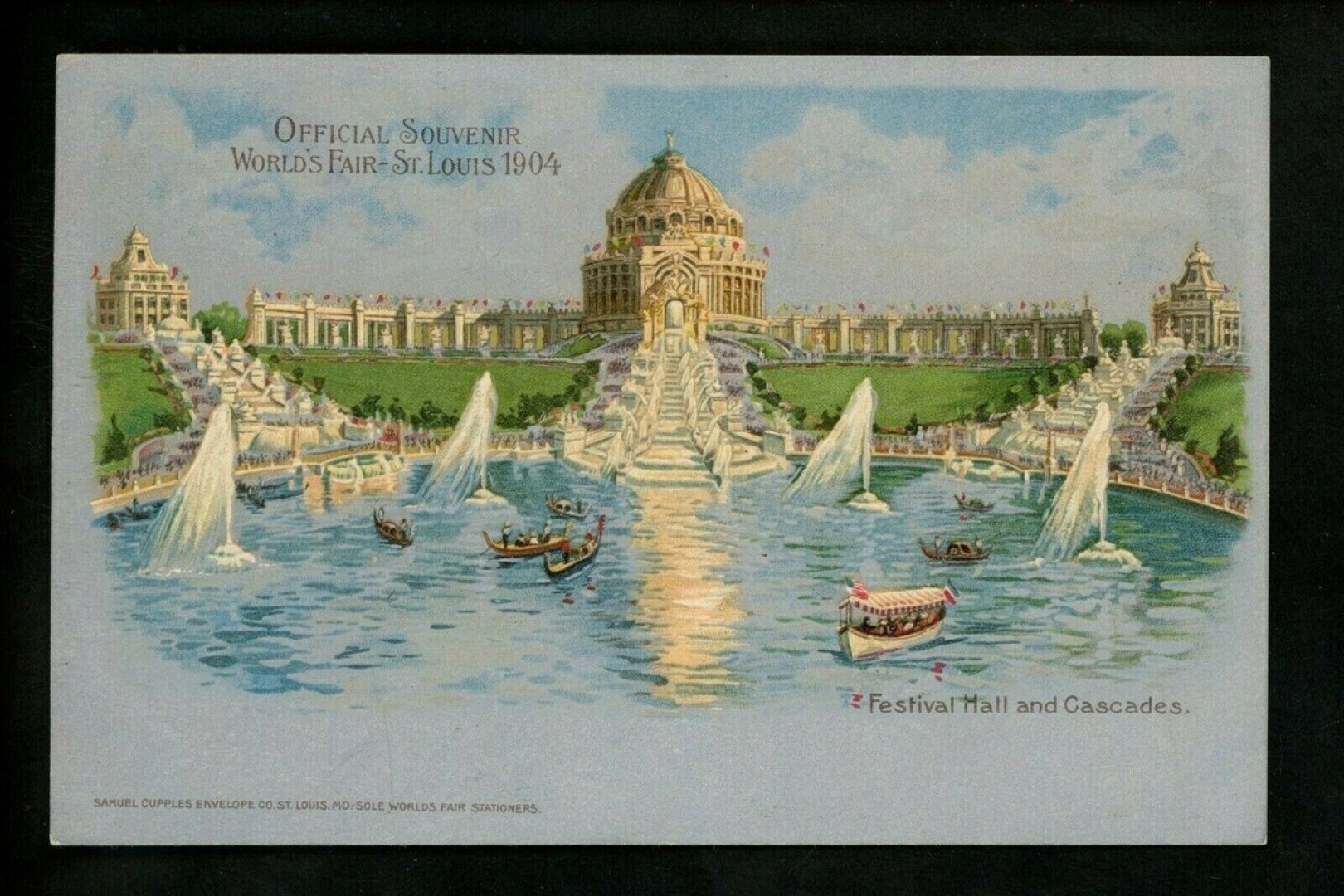
- The Base and Architecture: The front and center of the inkstand depicts Festival Hall perched atop Art Hill, flanked by the sweeping, curved Colonnade of States. Below the hall, the monumental, stepped Cascades flow downward into the Grand Basin. The textured detailing meticulously captures the ornate architectural columns, domes, and the tiers of the waterfall.
- The Markings:
- The front rim is stamped in raised capital lettering: CASCADES & FESTIVAL – HALL.
- The left side reads ST. LOUIS.
- The right side reads 1904.
- The reverse edge of the base is stamped with the operational dimensions of the monumental water feature: 900 FEET WIDE 1100 FEET DEEP.
- The Inkwell & Pen Holder: Suspended at the back of the structure, elevated by a decorative bracket, sits a removable, square-cut clear glass cube inkwell. The glass features a decorative pattern pressed into its bottom. Twin scrolled metal hooks extend forward from the brackets to act as an integrated pen cradle or holder to rest a fountain pen.
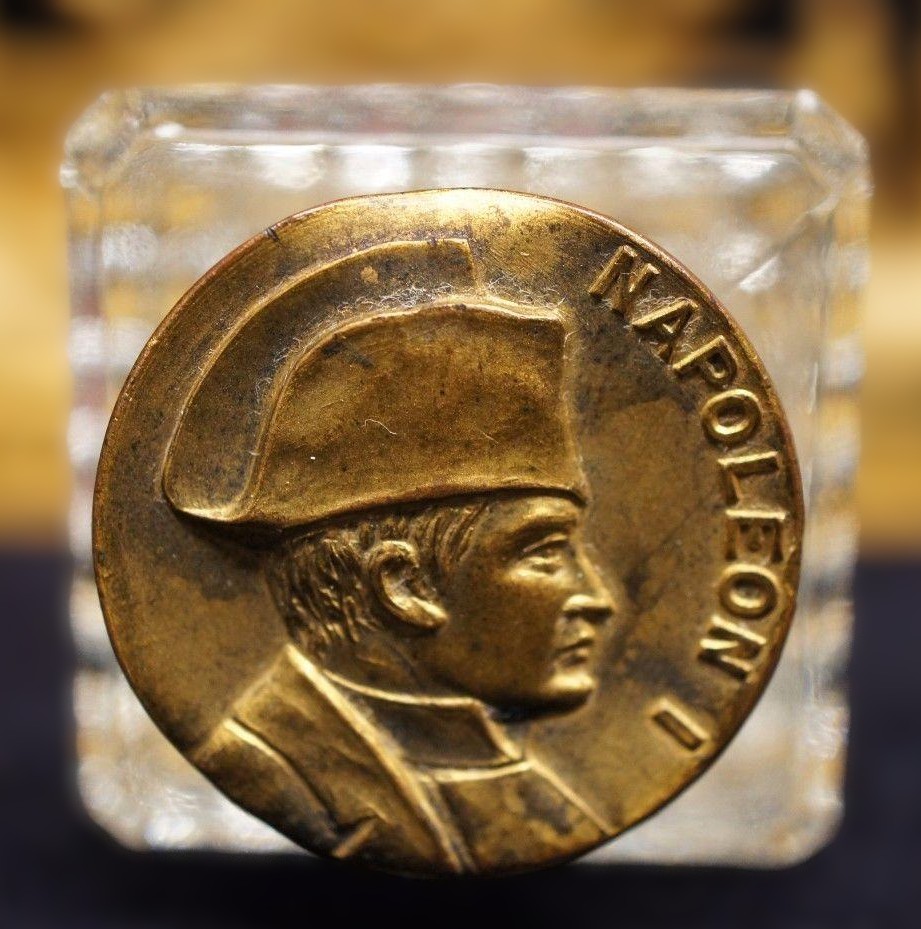
- The Lid: The inkwell features a circular gold metal cap. Embossed on the top of the lid is a profile portrait of Napoleon I wearing his signature bicorne hat, accompanied by the text NAPOLEON I.
Manufacturer Identification
While these specific souvenir items rarely featured a prominent manufacturer’s mark on the outer facing mold, mass-produced metal souvenirs for the 1904 World’s Fair were predominantly commissioned by official fair concessionaires and manufactured by major American metalwork and novelty companies of the era, such as The Sydenham Glass Co. (for glass components) and prominent metal foundries like the S.G. Adams Stamp & Seal Co. of St. Louis or The Ansonia Brass & Copper Co.
Historical Context: The 1904 St. Louis World’s Fair
The Louisiana Purchase Exposition, informally known as the 1904 St. Louis World’s Fair, was held from April 30 to December 1, 1904, to celebrate the centennial of the 1904 Louisiana Purchase. It was a massive undertaking covering over 1,200 acres in Forest Park, making it one of the largest international expositions ever held. It featured exhibits from over 60 countries and nearly every U.S. state, showcasing the dawn of 20th-century technology, agriculture, art, and culture.
The Inclusion of Napoleon I
Napoleon’s likeness on the lid is a direct nod to the historical purpose of the fair. In 1803, Napoleon Bonaparte sold the vast Louisiana Territory to the United States under Thomas Jefferson’s presidency. Because the fair was specifically celebrating this historic real estate deal, Napoleon (alongside Jefferson) was heavily featured on official medals, coinage, and souvenirs throughout the exposition.
About Festival Hall and the Cascades
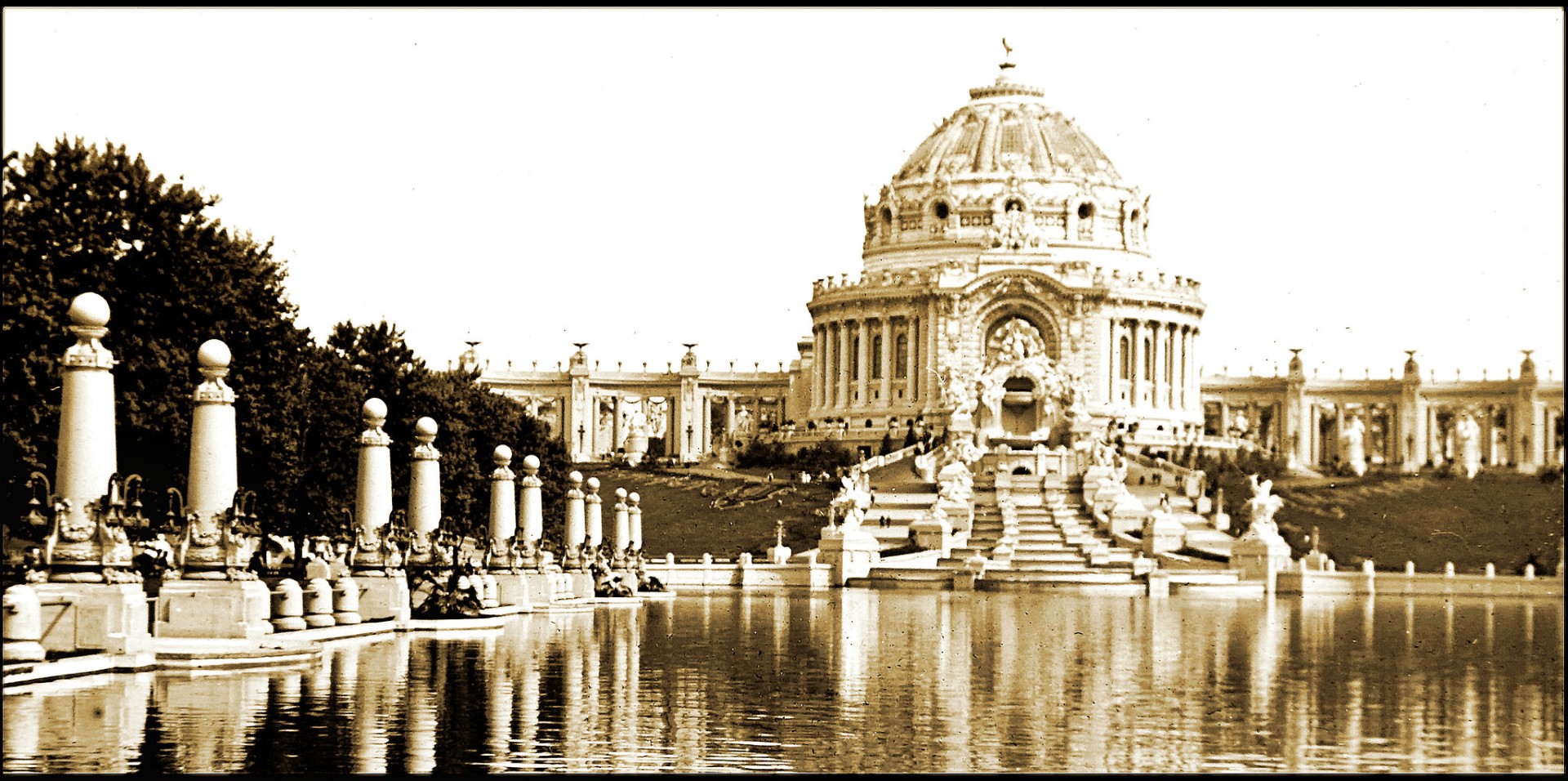
Festival Hall was designed by architect Cass Gilbert and served as the grand architectural centerpiece and “crown jewel” of the entire fair.
- Design & Purpose: Built atop Art Hill, the majestic Beaux-Arts building featured a massive dome larger than that of the U.S. Capitol. It housed a 4,500-seat auditorium designed primarily for musical performances, religious services, and ceremonies.
- The World’s Largest Organ: Festival Hall famously housed what was at the time the largest pipe organ in the world—a massive instrument built by the Murray M. Harris Organ Co. featuring more than 10,000 pipes. (After the fair, this legendary organ was purchased and expanded to become the famous Wanamaker Organ in Philadelphia).
- The Cascades: The dimensions on the back of the inkstand (900 Feet Wide 1100 Feet Deep) refer to the sprawling footprint of the Grand Cascades. This series of artificial waterfalls surged out from below Festival Hall and the adjacent Colonnade of States, pumping an astonishing 90,000 gallons of water per minute down into the Grand Basin. At night, the entire feature was illuminated by thousands of colored electric bulbs, creating a breathtaking visual spectacle that became the most photographed view of the fair.
Like most of the main exhibition palaces, Festival Hall was constructed out of “staff” – a temporary mixture of plaster of Paris, hemp fiber, and cement. Consequently, despite its breathtaking beauty, the building was entirely dismantled after the fair concluded, leaving objects like this inkstand as tangible reminders of its existence.
Sold for $282 in October 2021
Content disclaimer. The information posted is the owner’s best knowledge and may not have been vetted by the SOIC. We welcome comments, corrections, and additions, working to make our website information comprehensive and accurate.
Join the Society of Inkwell Collectors (SOIC) – it’s free!
Founded in 1981 as a non-profit organization,
we are documenting inkwells (and accessories).
We’re here to help and inform!