


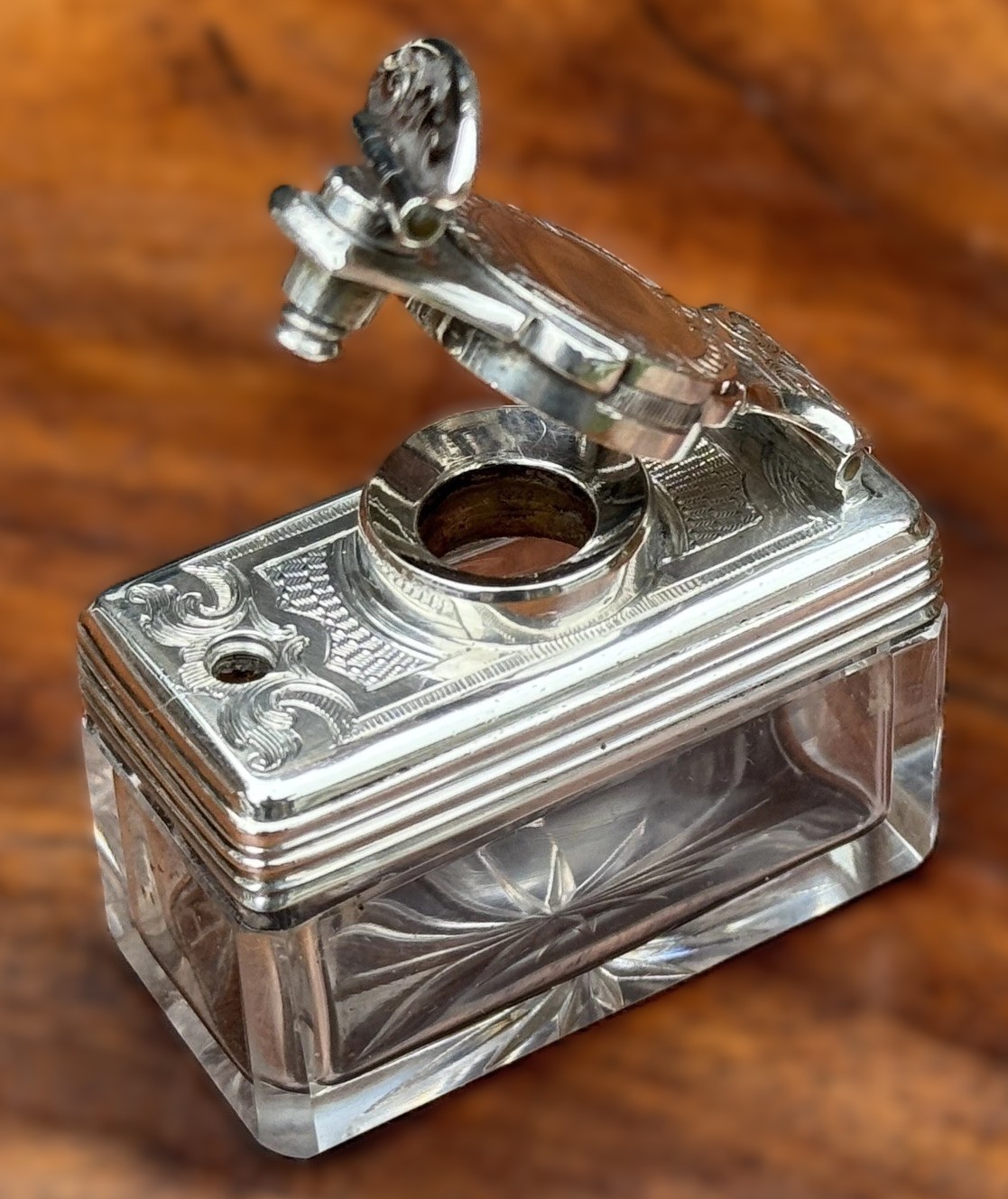


Silver Lock-Down Traveling Inkwell
| Categories | Travel |
| Material | Glass, Silver |
| Markings | See Narrative |
| Manufacturer | Thomas Diller |
| Origin | England |
| Date or Era | circa 1845 |
| Measuring | 1 ⅞” x ⅞” x 1 ½” high |
This Victorian solid silver traveling inkwell, manufactured by Thomas Diller in 1845, is a premier example of mid-19th-century portable writing equipment. These pieces were engineered to be entirely leak-proof, allowing Victorian travelers to carry liquid ink safely inside a writing slope or trunk.
Manufacturer & Hallmarks
The silver frame and lid are extensively hallmarked, providing precise details about its origin:
- Maker’s Mark: “T.D” identifies the silversmith as Thomas Diller, a well-known London specialist in high-end small silver wares and desk accessories.
- Purity Mark: The Lion Passant confirms it is crafted from .925 sterling silver.
- City & Date: The Leopard’s Head indicates it was assayed in London, and the lowercase Gothic “k” dates the piece specifically to 1845.
- Duty Mark: Features the profile of Queen Victoria, signifying the duty tax paid on the silver.
The “Lock-Down” Mechanism
The inkwell utilizes a sophisticated three-part sealing system designed to withstand the rigors of travel:
- The Hinged Screw: At the front of the lid is a large, decorative screw with a scalloped, easy-to-grip head. This screw is attached to the lid by its own small hinge.
- Mechanical Compression: When the lid is closed, the user flips the screw downward and threads it into a matching hole on the silver base frame. As the screw is tightened, it applies downward pressure, physically clamping the lid onto the glass body.
- The Internal Seal: The underside of the silver lid contains its original cork stopper, which is held in place by a small silver plate. The pressure from the screw forces this stopper into the neck of the glass well, creating an airtight, vacuum-tight seal that prevents ink from escaping even if the well is turned upside down.
Artistry & Design
- Silverwork: The lid and frame are decorated with dense Victorian scrollwork and engine-turned patterns, featuring a central vacant circular cartouche on the lid.
- Glass Body: The thick, clear glass base is finished with deep star-cut faceting on the underside to add brilliance.
Sold for $200 in December 2025
Content disclaimer. The information posted is the owner’s best knowledge and may not have been vetted by the SOIC. We welcome comments, corrections, and additions, working to make our website information comprehensive and accurate.
Join the Society of Inkwell Collectors (SOIC) – it’s free!
Founded in 1981 as a non-profit organization,
we are documenting inkwells (and accessories).
We’re here to help and inform!