






Sèvres-Style Desk Set
| Categories | Ceramics/Porcelain "Named" Makers |
| Material | Porcelain |
| Markings | See Narrative |
| Manufacturer | Sèvres |
| Origin | France |
| Date or Era | circa 1890 |
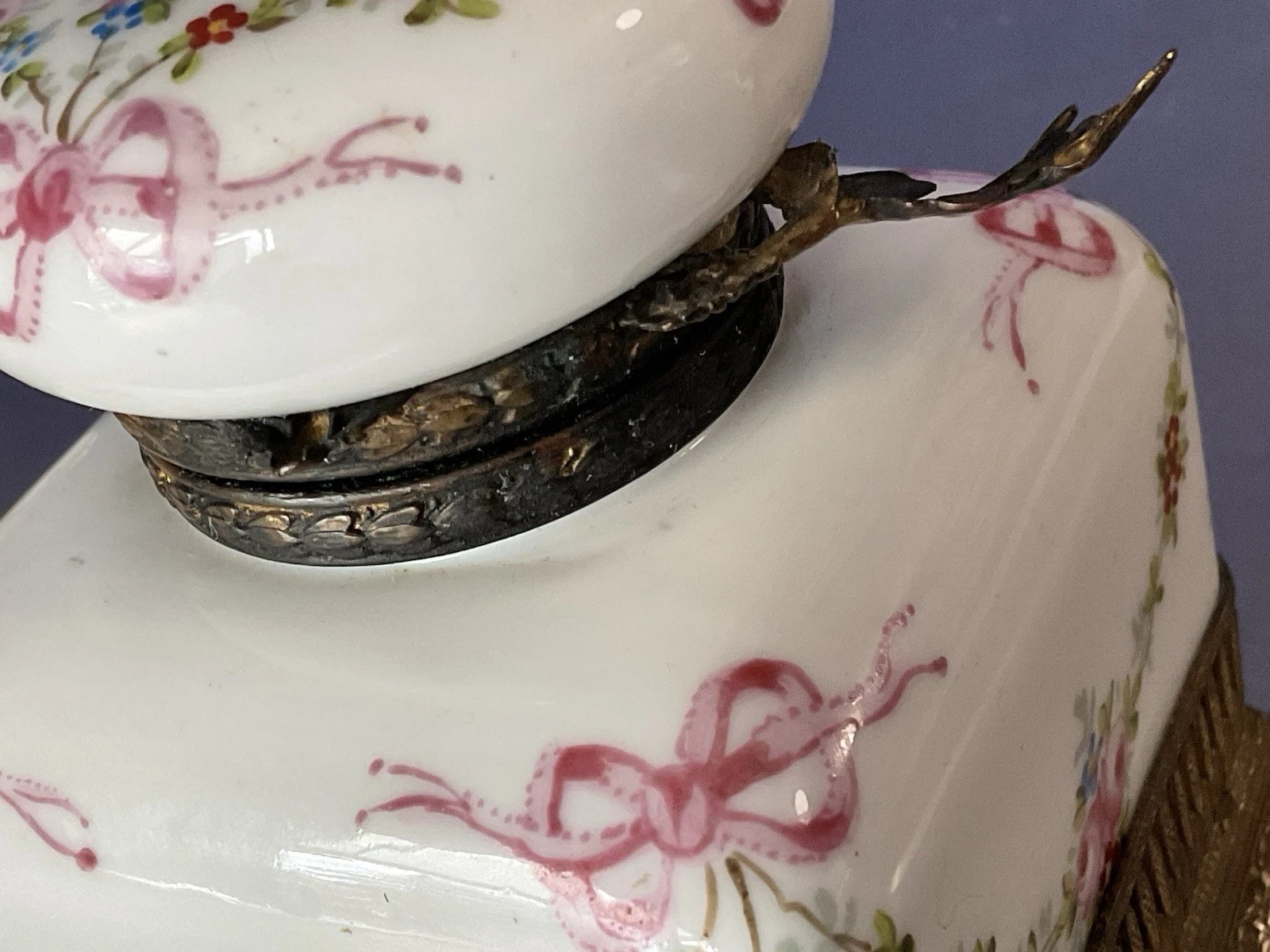
This is an elegant French-style porcelain and gilt-bronze (ormolu) desk set comprising a tiered letter holder and a matching square inkwell. While the decoration is heavily inspired by 18th-century Sèvres aesthetics, the marks and construction suggest a 19th-century origin.
Description
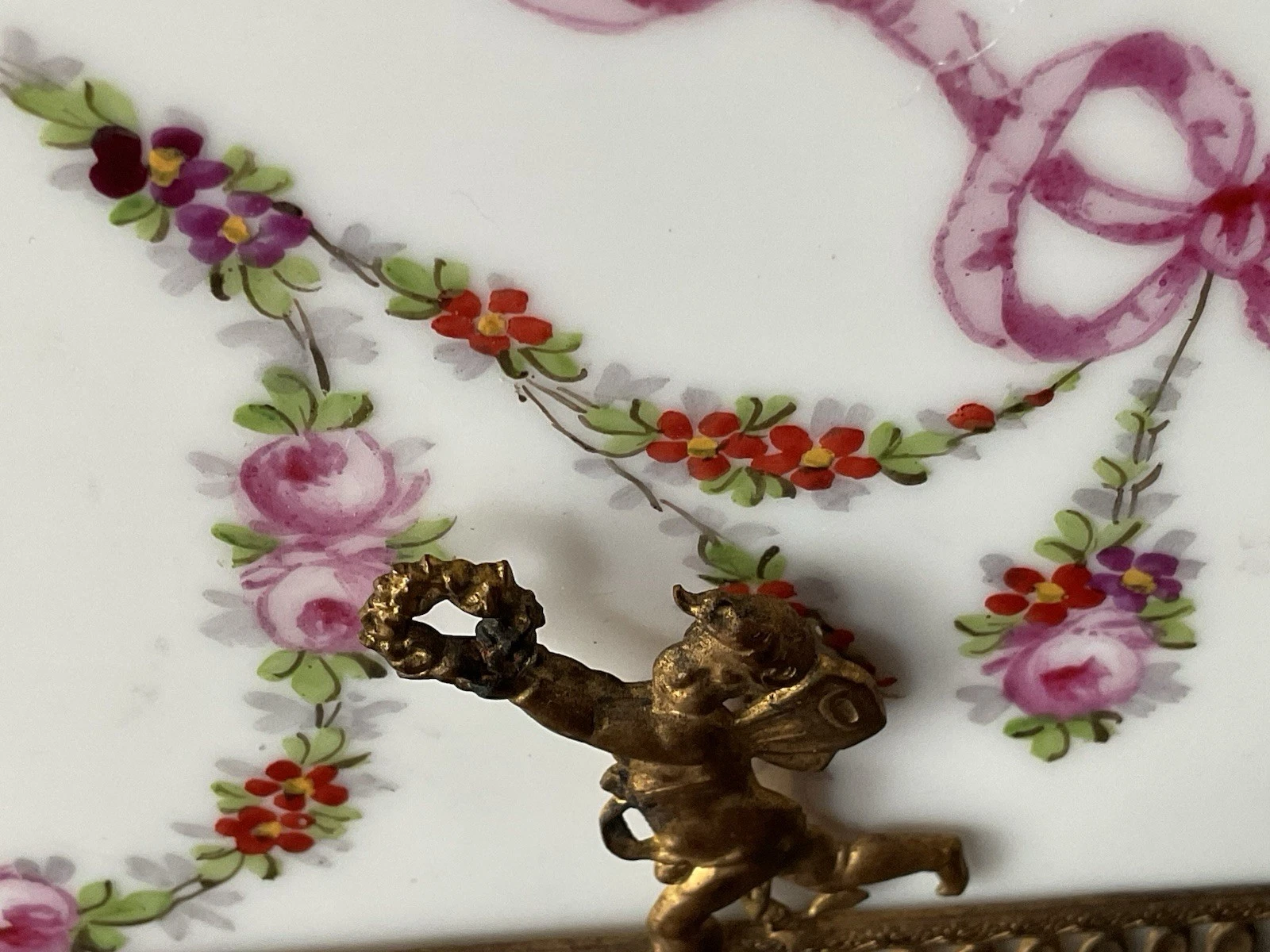
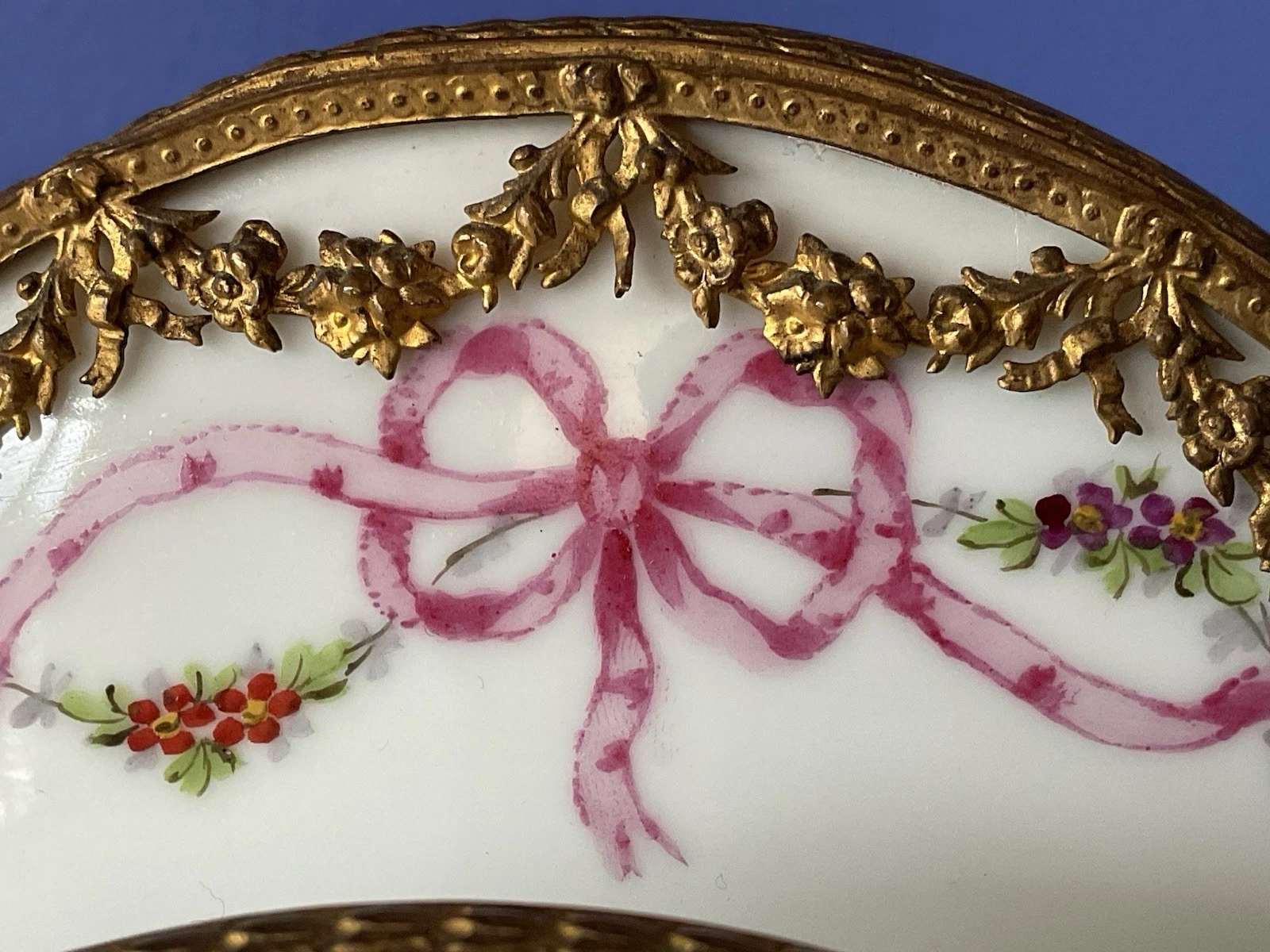
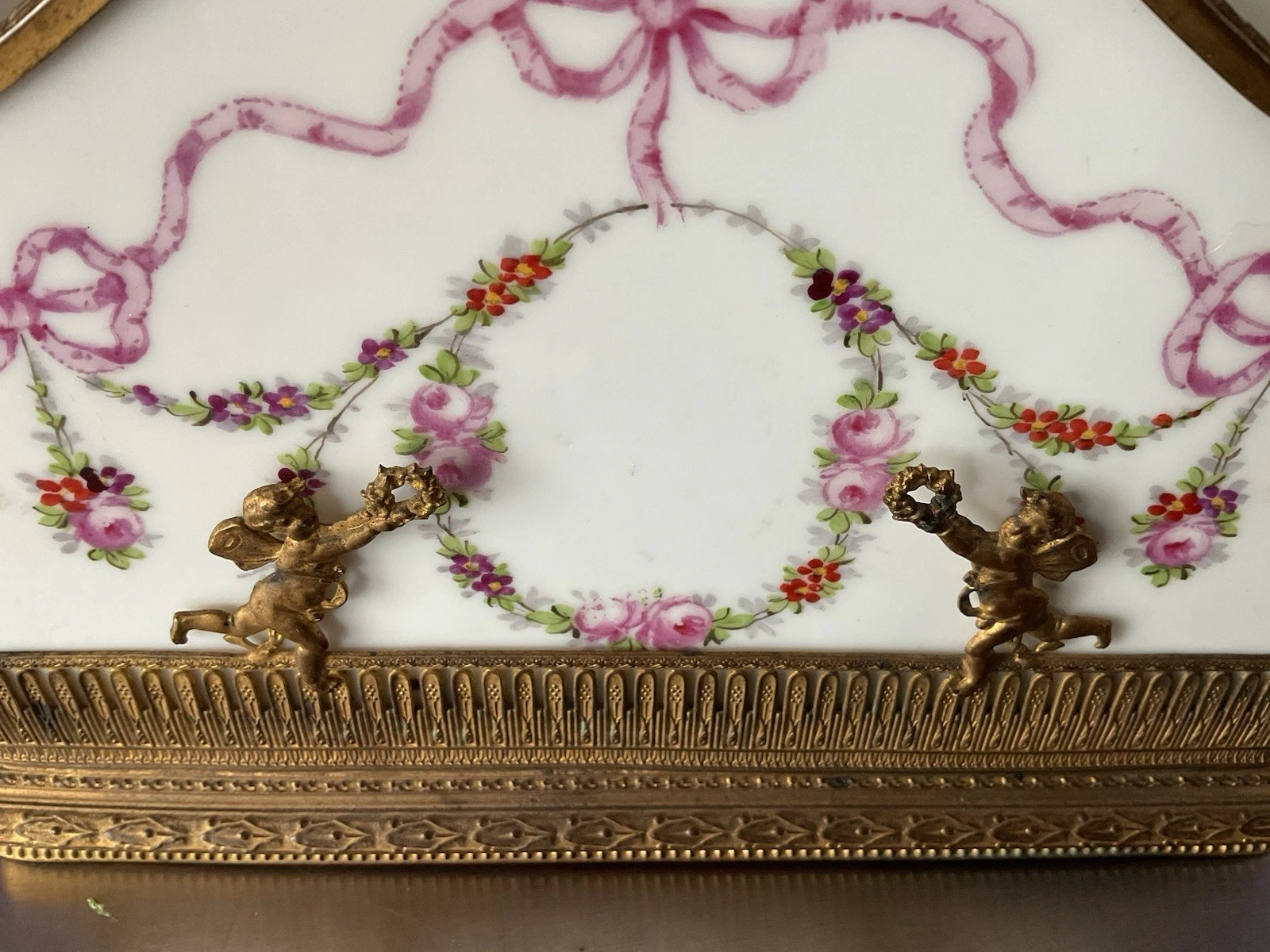
The Letter Holder The piece features a two-tiered “vaugirard” style porcelain body with a scalloped top edge. It is decorated with hand-painted floral swags (roses and cornflowers) suspended from delicate pink ribbons and bows.
- Ormolu Accents: The top rim is encased in a beaded and floral-cast gilt-bronze mount.
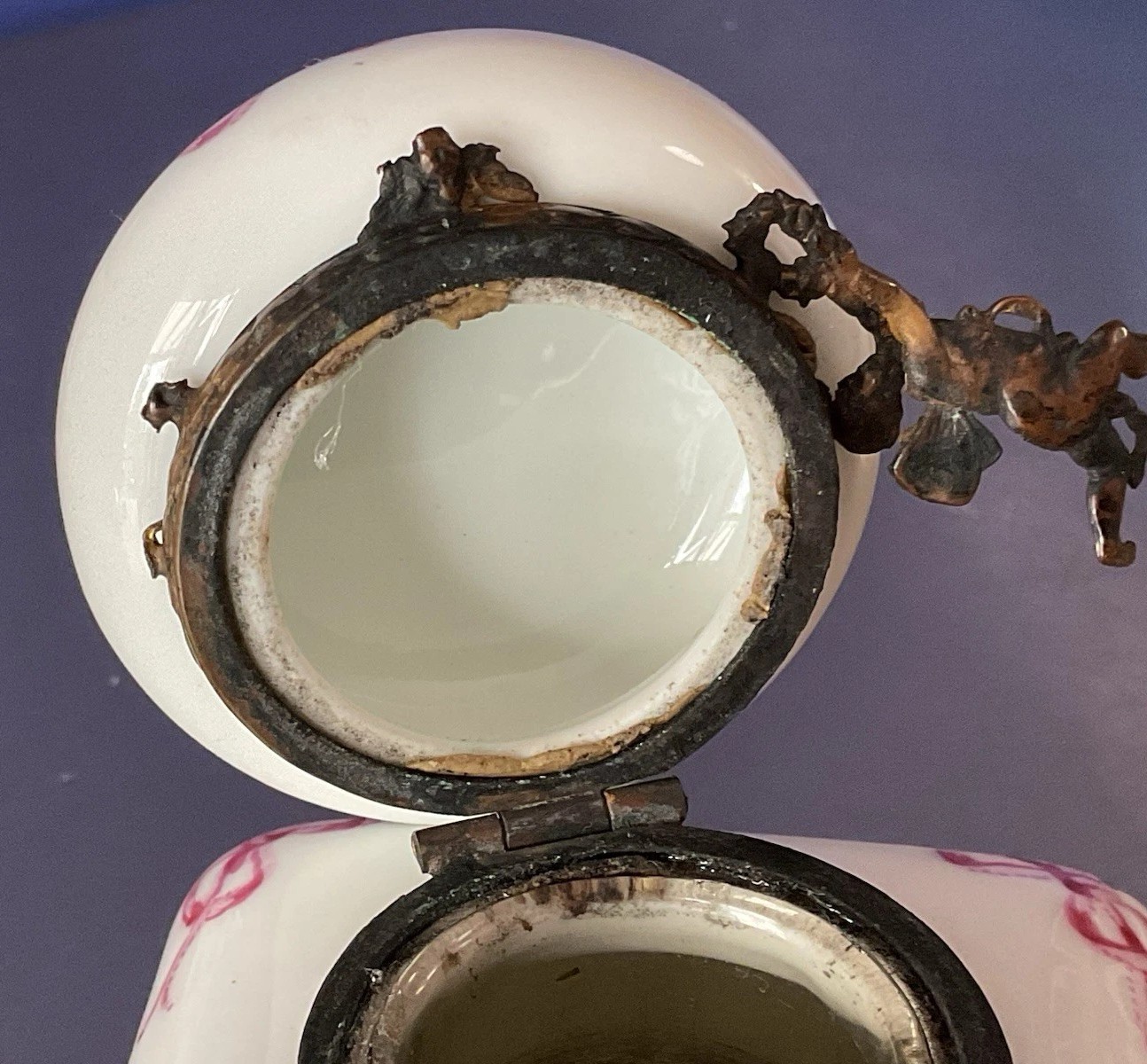
- Figural Details: Most notably, the front is adorned with two small bronze putti (cherubs). Each is captured in a dynamic pose, holding up circular floral wreaths that frame the central painted garland.
- The Base: Both pieces sit on substantial, ornate ormolu bases featuring a vertical “pierced” gallery design and a repeating leaf-and-dart pattern at the bottom.
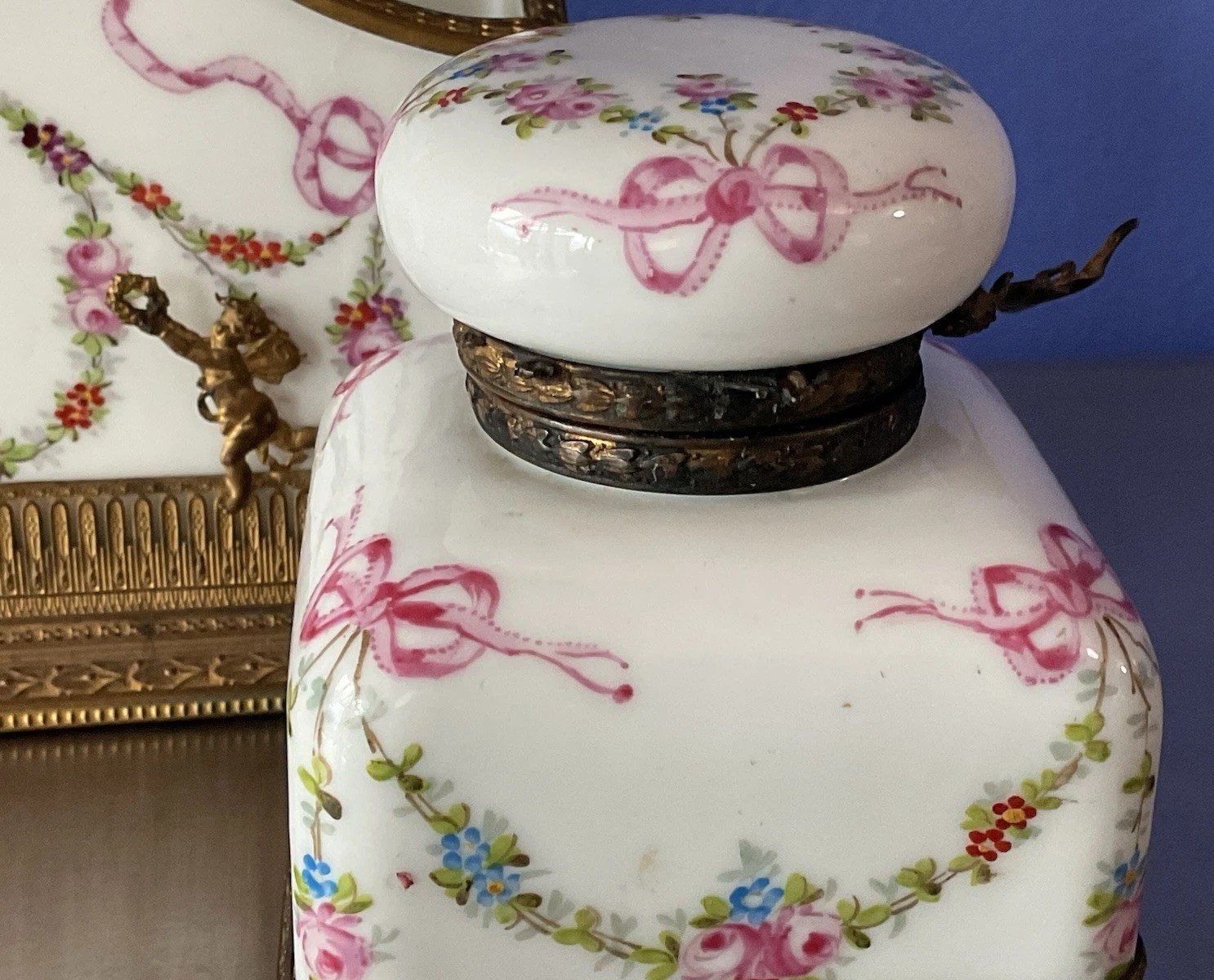
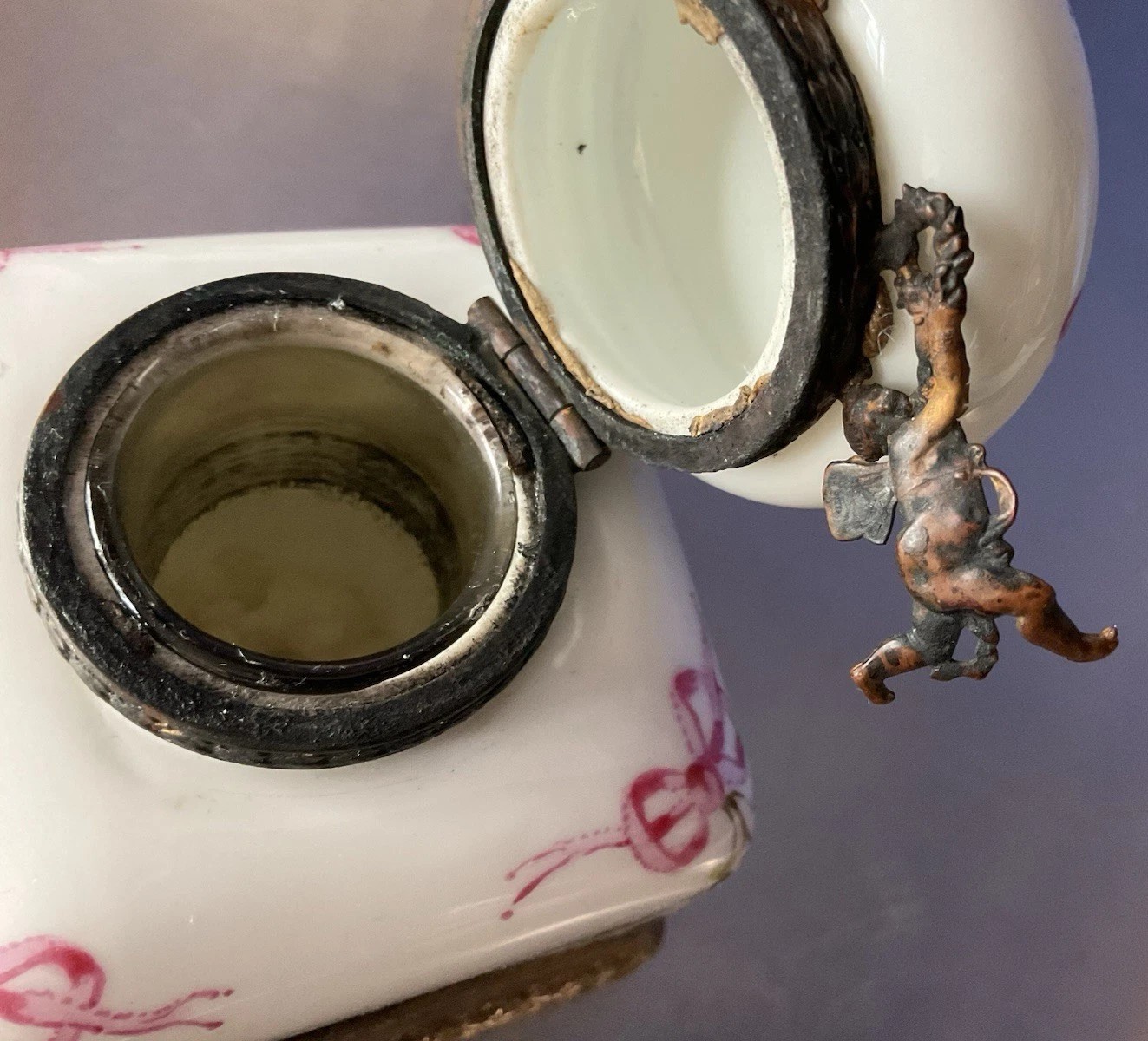
The Inkwell The matching inkwell is a square, cuboid vessel with a hinged, domed porcelain lid.
- Design: It carries the same motif of pink ribbons and floral swags.
- Mechanism: The lid opens on a gilt-metal hinge to reveal a recessed porcelain ink pot. A small bronze cherub is also attached to the lid’s rim.
Interpretation of the Marks
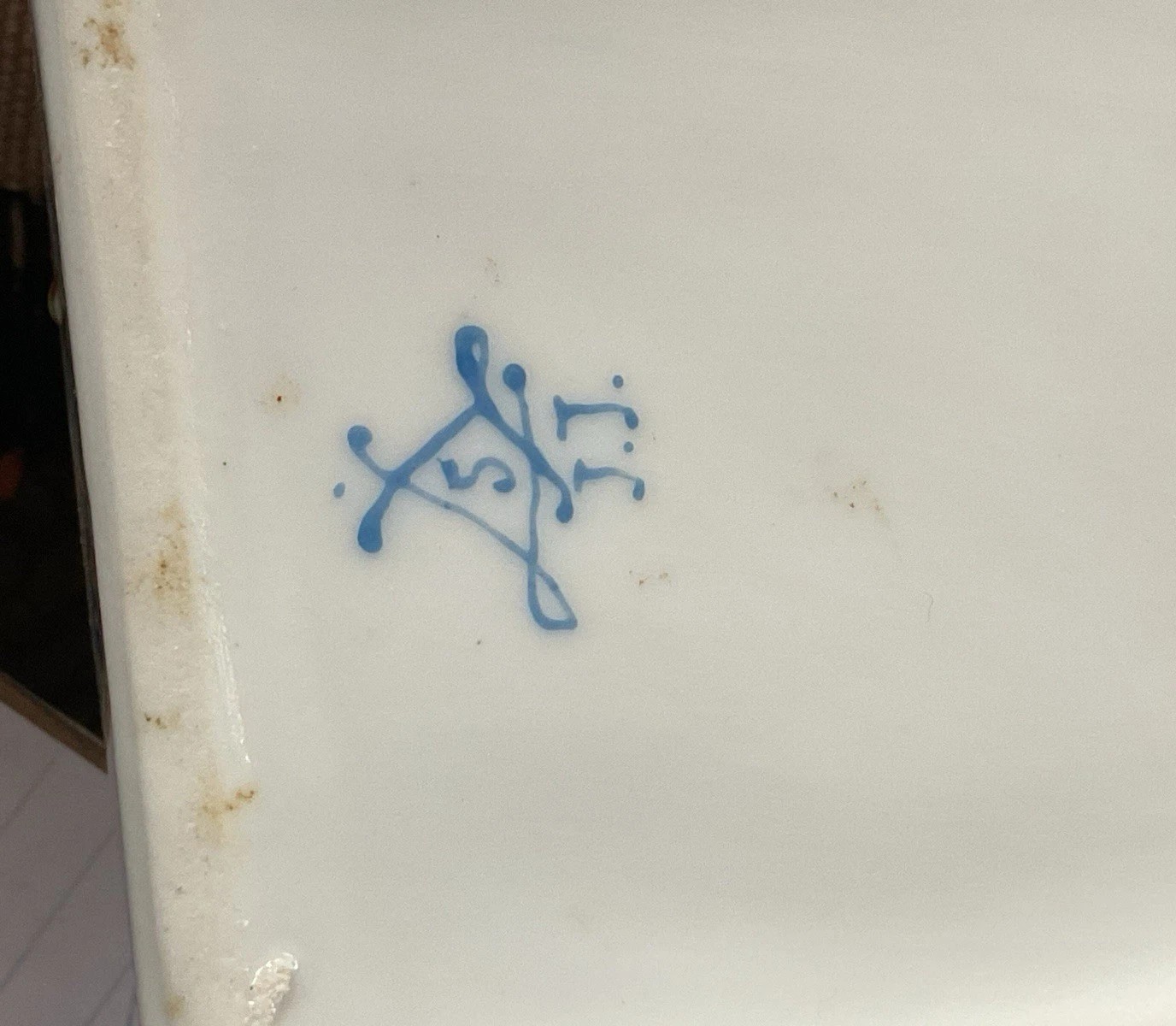
The underside of both pieces shows a blue overglaze mark consisting of interlaced L’s (the royal cipher of King Louis XV) with a letter “S” in the center and the initials “J.J.” below.
- The “S” Mark: In original 18th-century Sèvres porcelain, letters inside the interlaced L’s were date codes. An “S” would traditionally indicate the year 1771.
- The “J.J.” Initials: The “J.J.” mark on this desk set provides a fascinating clue that bridges the gap between 18th-century royal porcelain and the 19th-century revival movement.
- The “Dual Identity” of the Mark
The markings on these pieces are intentionally ambiguous, designed to mimic the 18th-century royal Sèvres factory while actually identifying a 19th-century workshop.
- The 18th-Century Pretense: In the original Sèvres dating system used between 1753 and 1793, letters were used as year codes. A single “S” indicated the year 1771, while a double “JJ” indicated 1786.
- Why this is a “Pseudo” Mark: By placing the “S” inside the L’s and the “J.J.” below them, the maker was “borrowing” the prestige of these dates without strictly following the factory’s historical protocol. A real 18th-century piece would not typically mix a single-letter date code with a double-letter one in this specific way.
- The 19th-Century Reality: The “J.J.” is most likely the signature of a Parisian decorating studio or an independent artist active during the late 19th century (c. 1870–1890). Many high-quality workshops in Paris purchased “blanks” (white, undecorated porcelain) from factories like Sèvres or Limoges and decorated them in the opulent Louis XV style.
- Potential Candidates for “J.J.”
While there were hundreds of small studios in the late 19th century, “J.J.” is frequently associated with a few specific high-end sources in the “Sèvres Style” market:
- Independent Paris Decorators: It was common for master painters in the Petit Feu (enamel) workshops of Paris to sign with their initials. High-quality pieces like this—featuring precise floral garlands and intricate ribbons—were the specialty of these studios.
- The “Jules Jarry” Connection: Some scholars link certain “J.J.” marks to Jules Jarry, a notable figure in French ceramics during the late 19th century. However, Jarry is more frequently associated with the Lille factory and majolica, making a Paris-based “studio painter” a more likely origin for these specific porcelain pieces.
- Conclusion on Age and Value
- Authenticity: These are “Sèvres-style” (also called Spurious Sèvres), not 18th-century royal Sèvres.
- Age: They were almost certainly produced during the Belle Époque (c. 1880–1900).
- Quality: Despite not being 18th-century, the quality is exceptional. The fact that the marks are underglaze (or high-fired overglaze) and the ormolu mounts are so finely cast suggests these were expensive, luxury items made for wealthy European or American households during the Victorian era.
Sold for $340 in February 2026
Content disclaimer. The information posted is the owner’s best knowledge and may not have been vetted by the SOIC. We welcome comments, corrections, and additions, working to make our website information comprehensive and accurate.
Join the Society of Inkwell Collectors (SOIC) – it’s free!
Founded in 1981 as a non-profit organization,
we are documenting inkwells (and accessories).
We’re here to help and inform!