








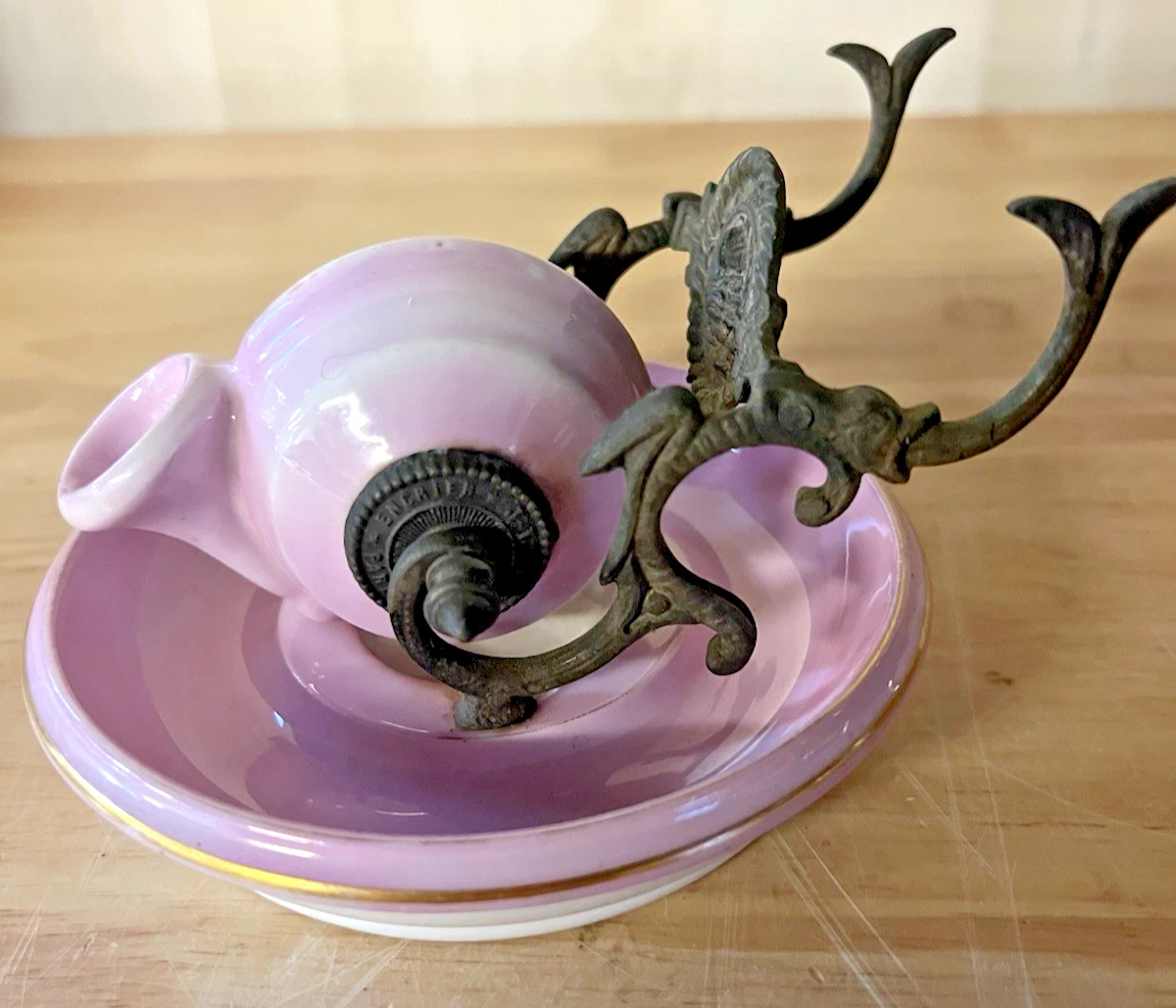
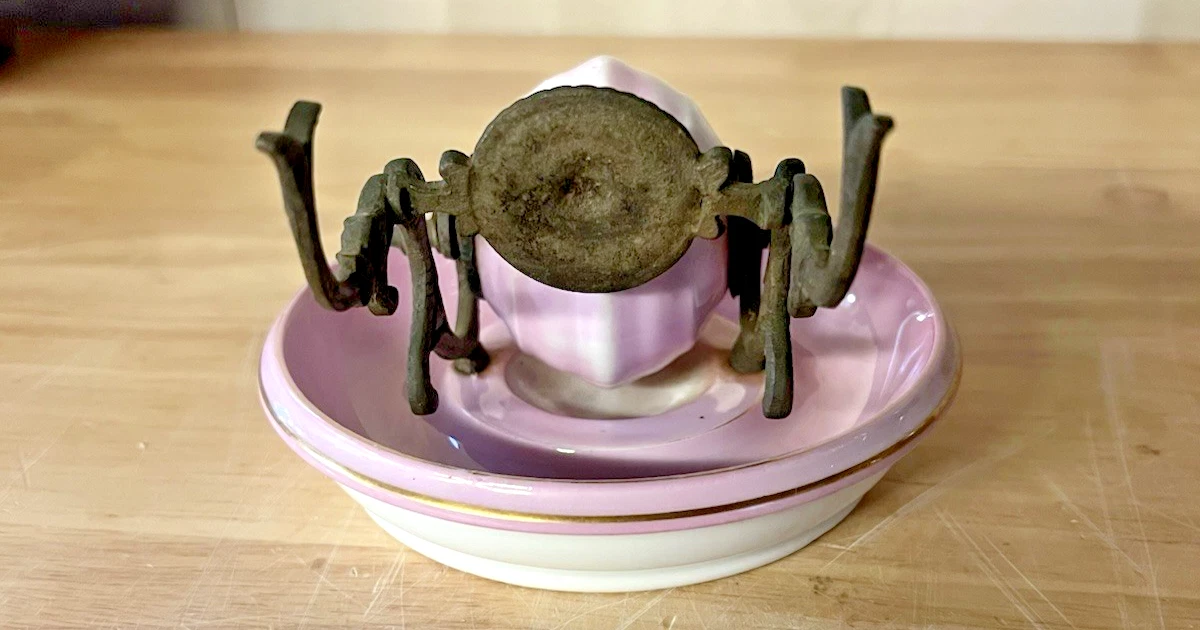
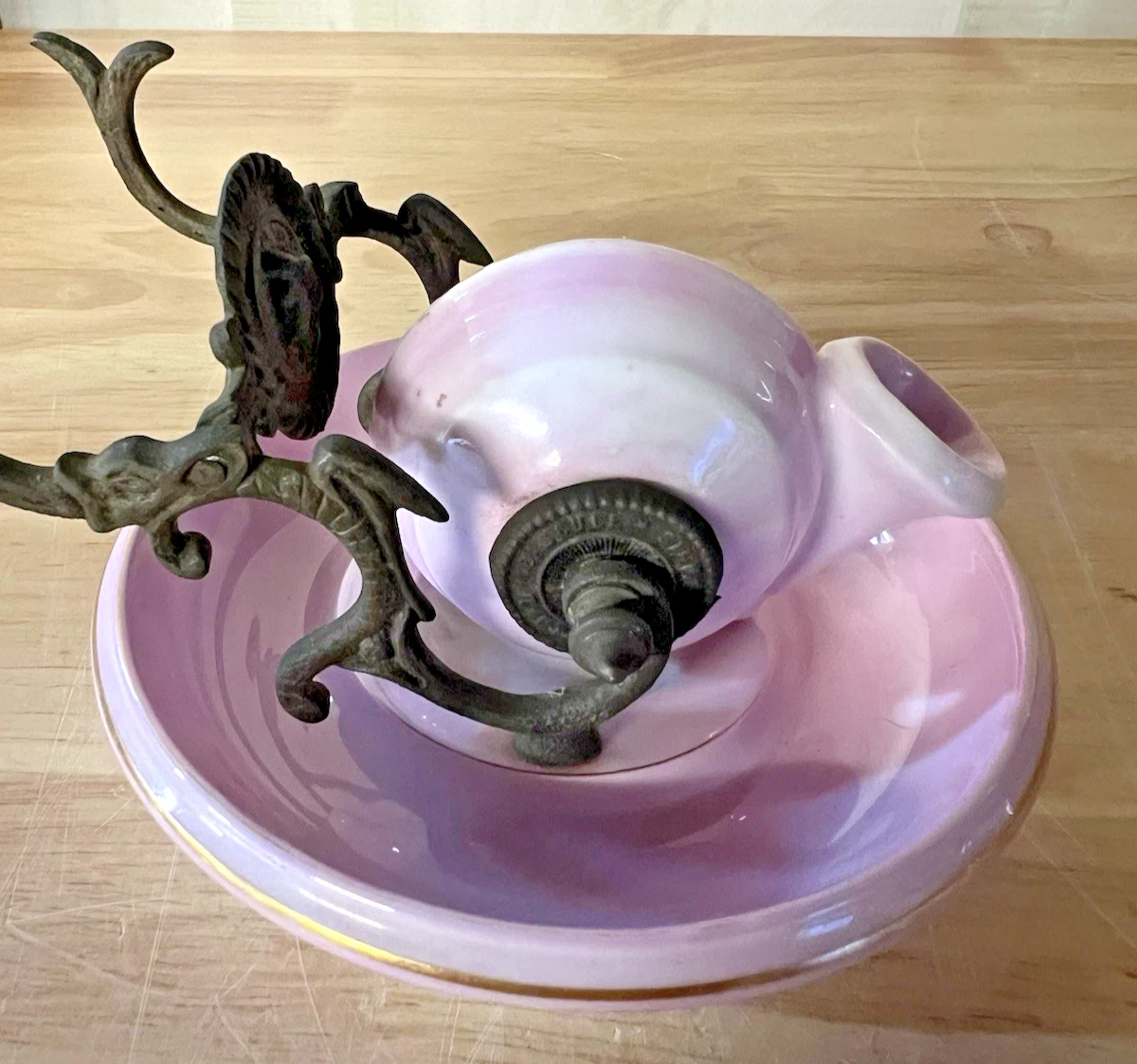
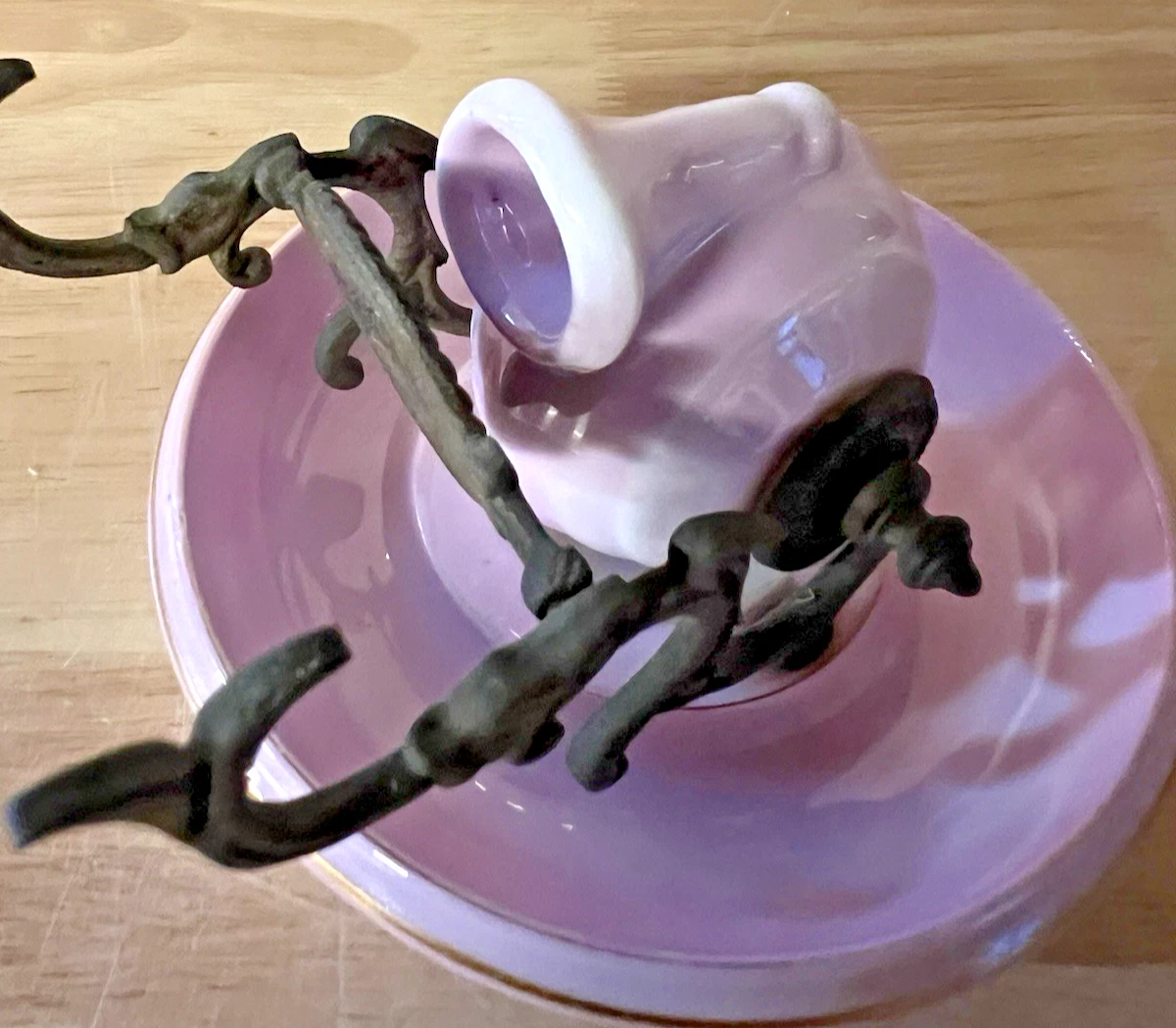
Revolving “Snail” Inkstand – J.L. Bascule Paris
| Categories | Mechanical - Snail / Pivoting |
| Type | Snail |
| Material | Porcelain |
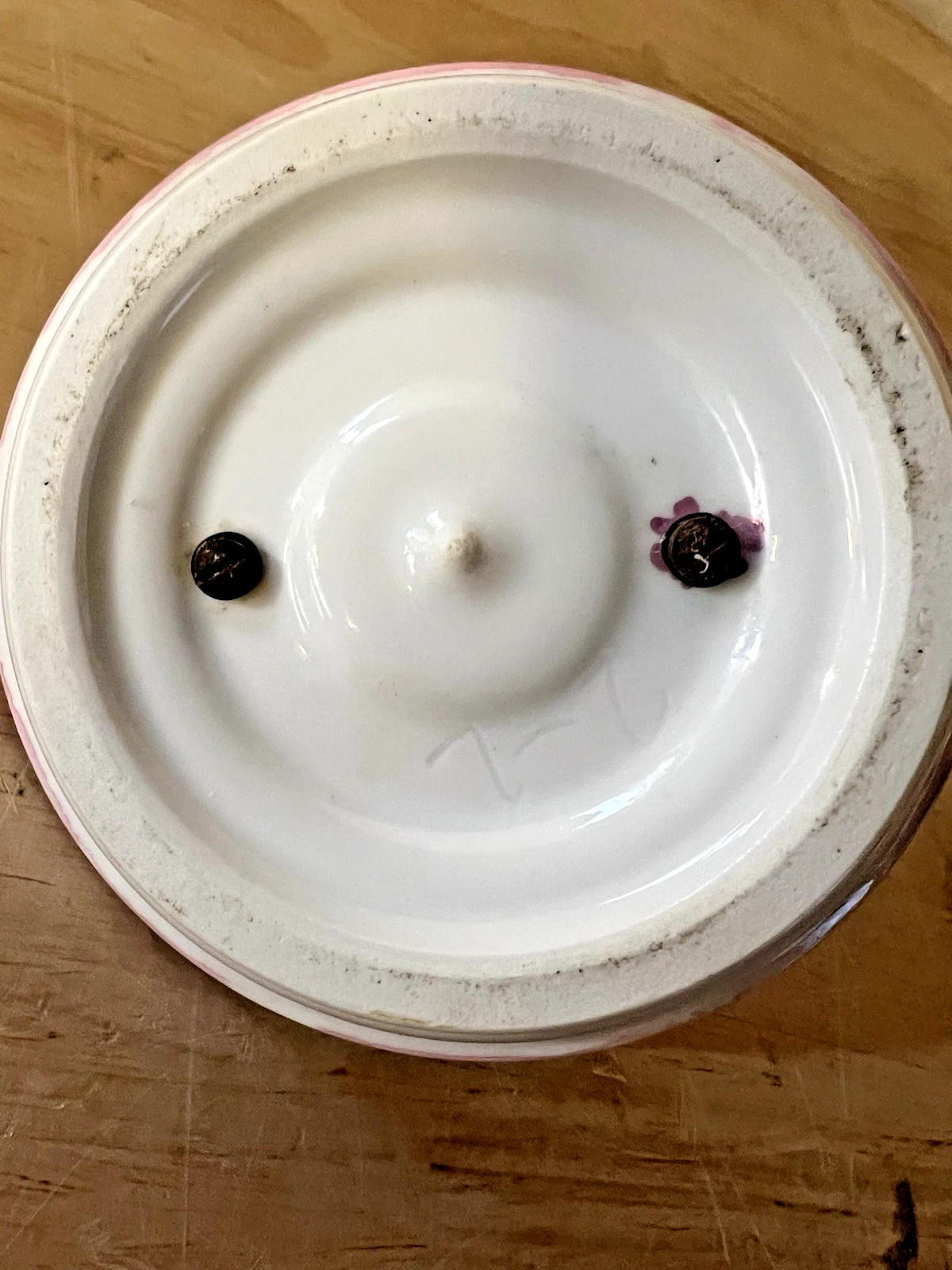
| Markings | See Narrative |
| Manufacturer | J. L. Bascule |
| Origin | France |
| Date or Era | circa 1870 |
| Measuring | 5 ½” diameter; 3 ½” high |
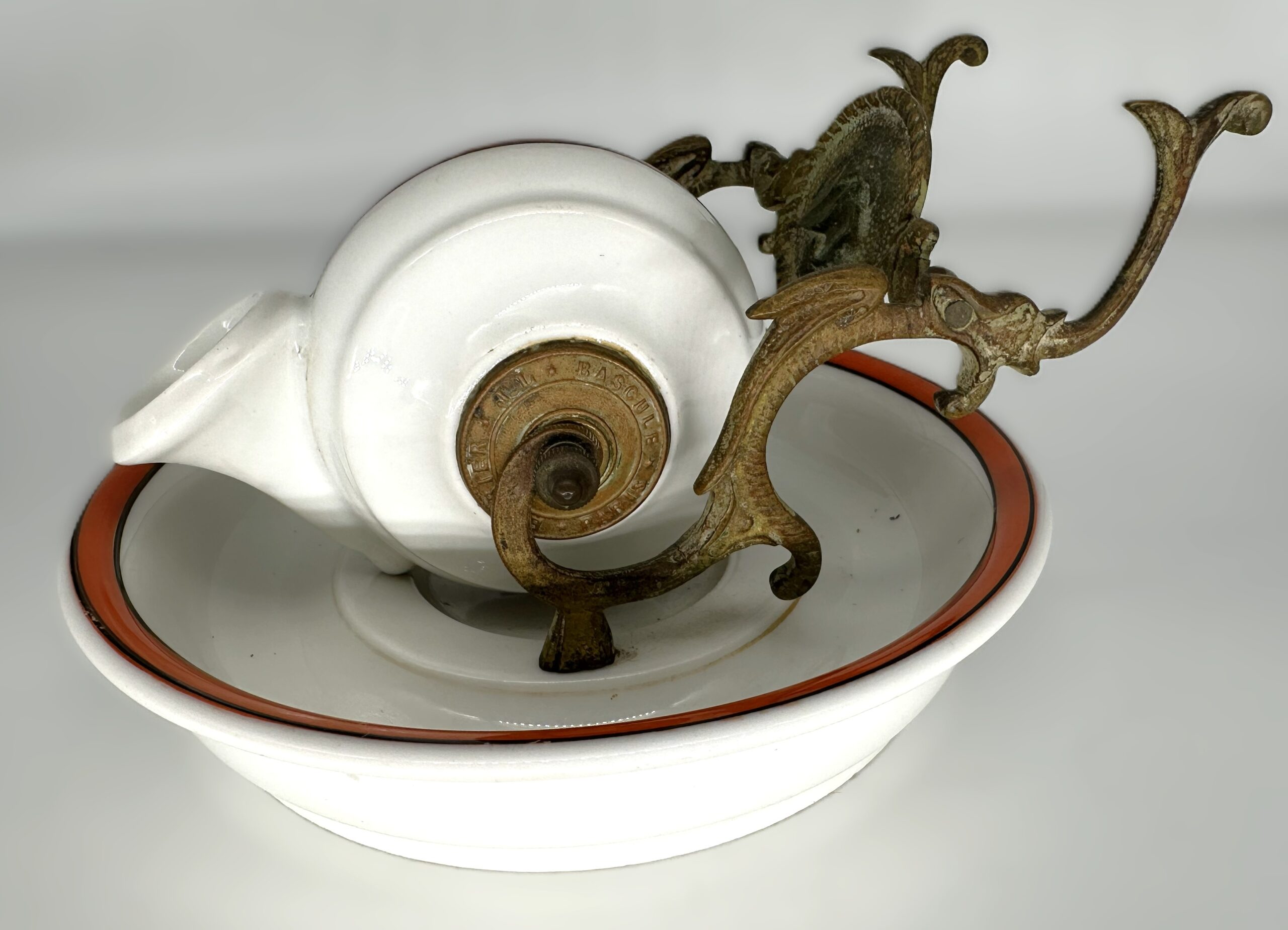
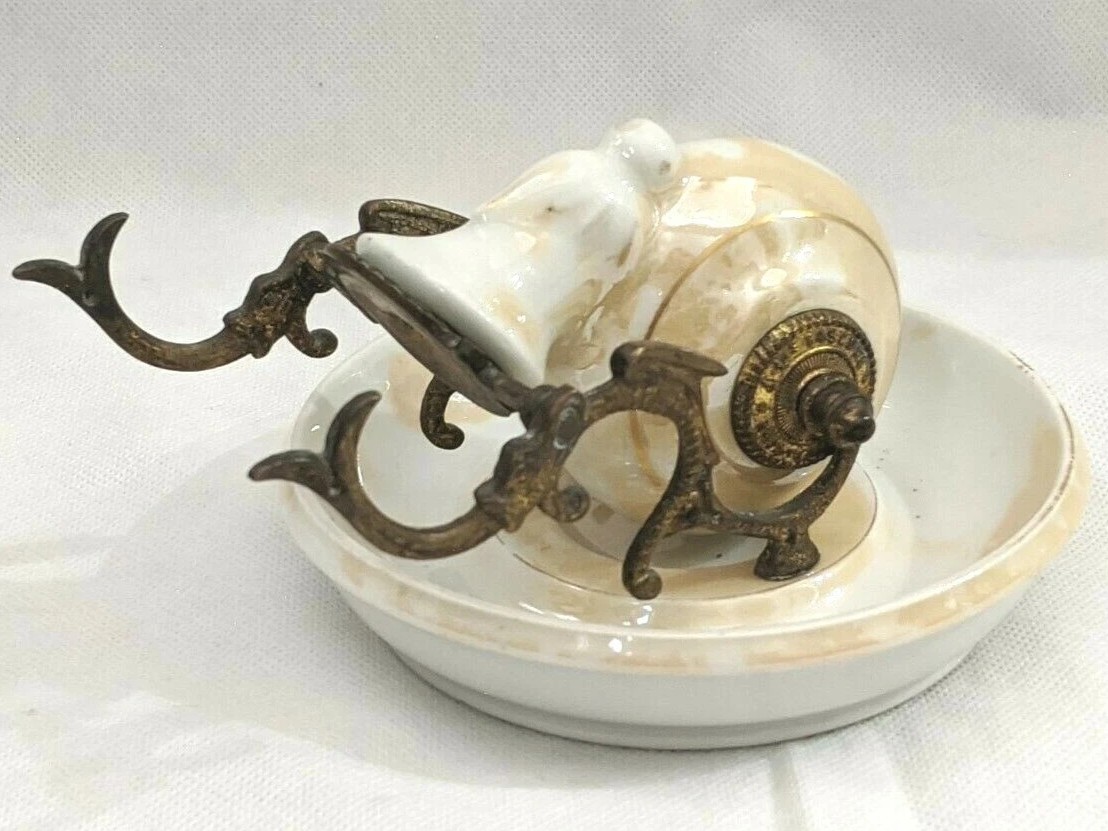
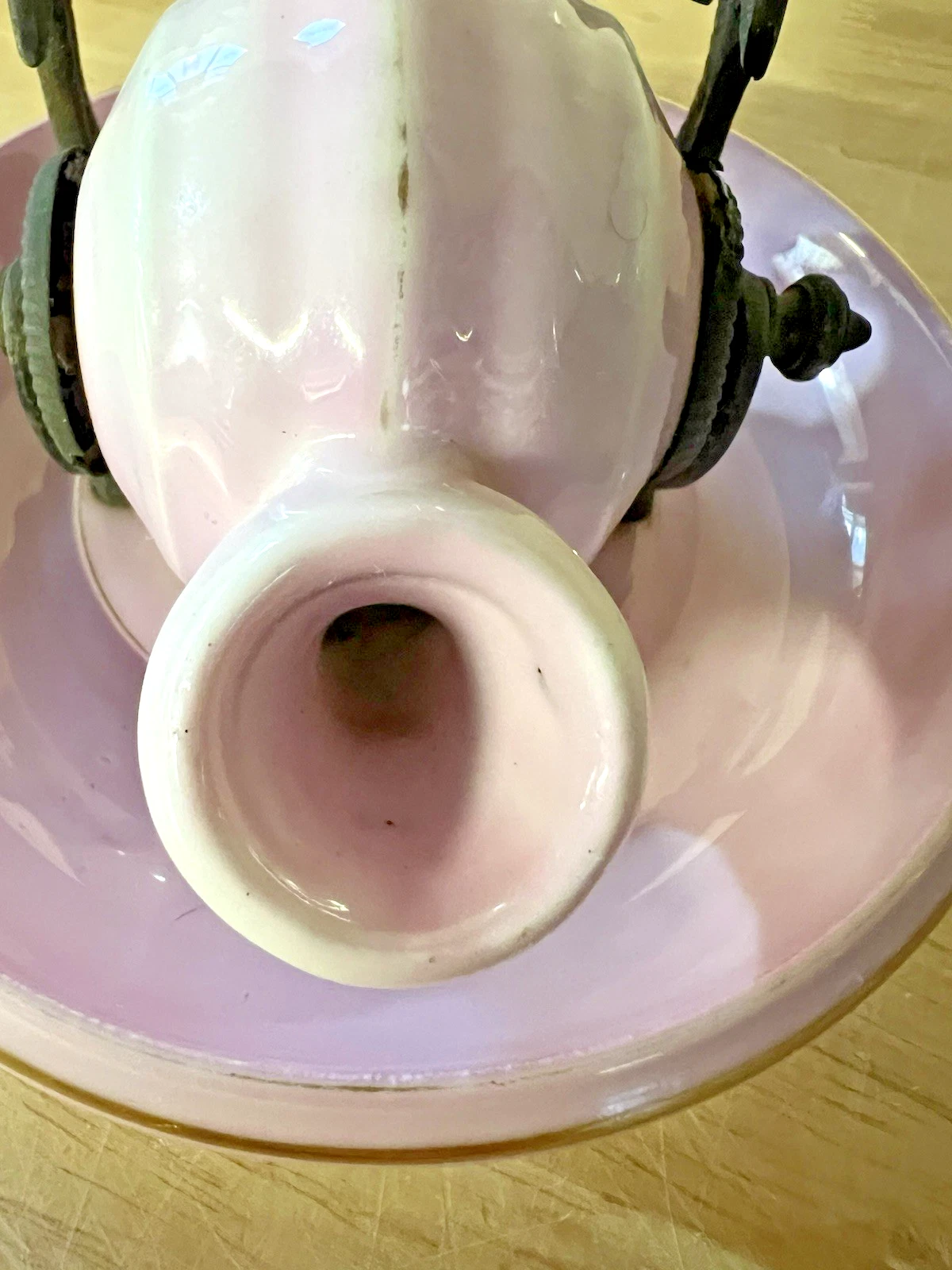
These two revolving “snail” inkstands, identified by its specialized hardware as a product of J.L. Bascule Paris, are fine examples of 19th-century French mechanical design.
Mechanism and Function
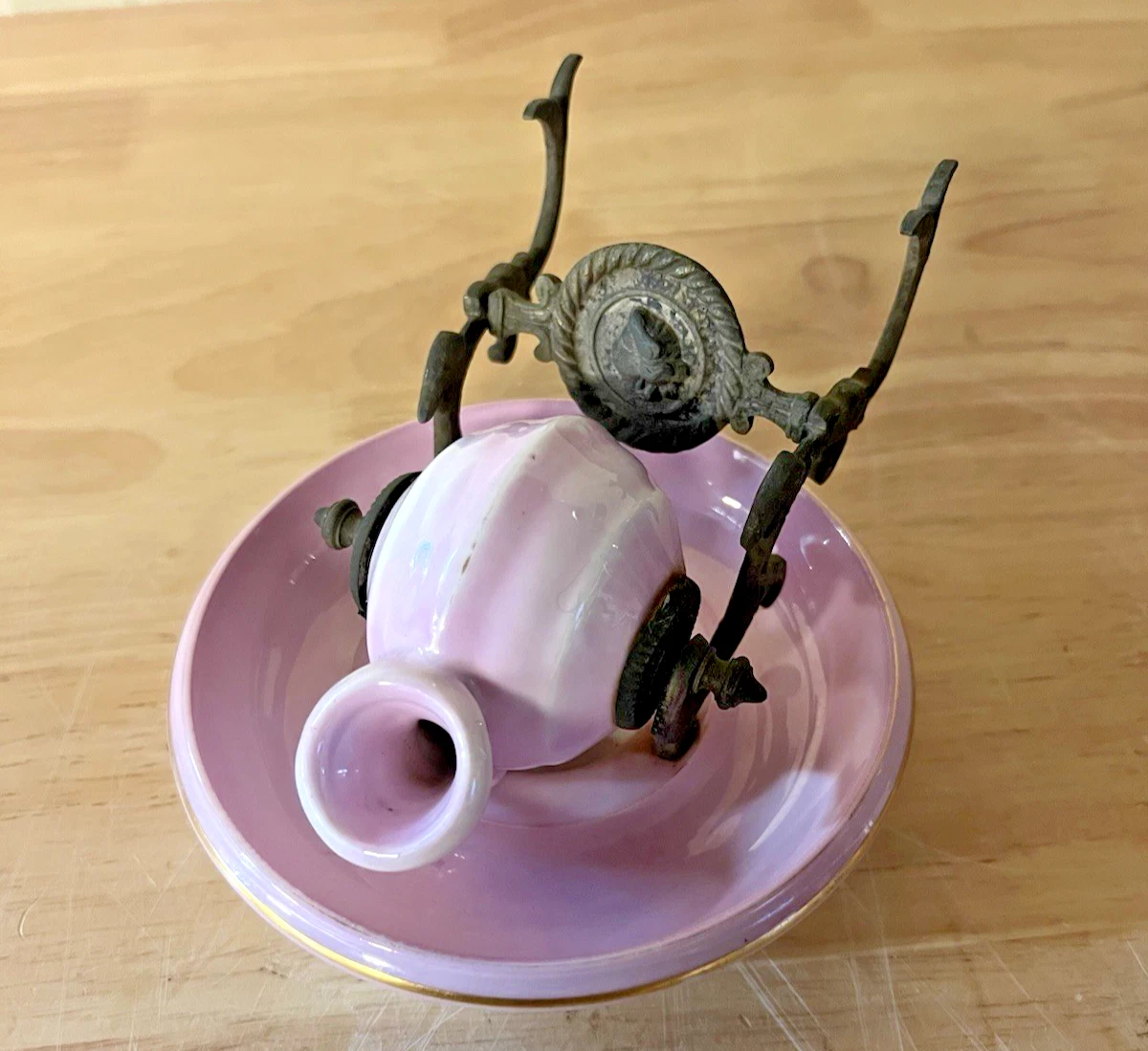
This is a bascule (rocking/tilting) inkstand, named for the way the porcelain shell swivels on a horizontal axis.
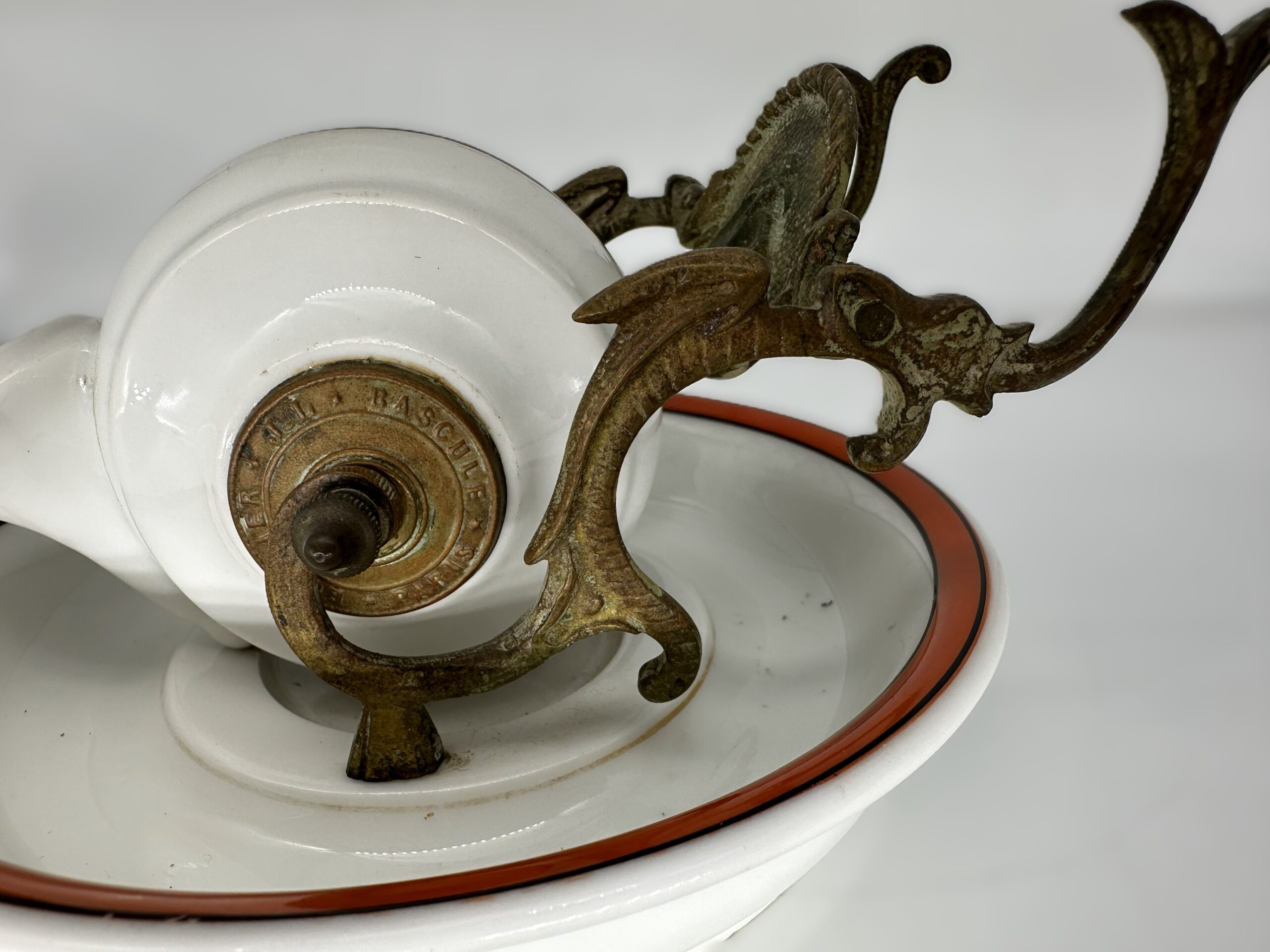
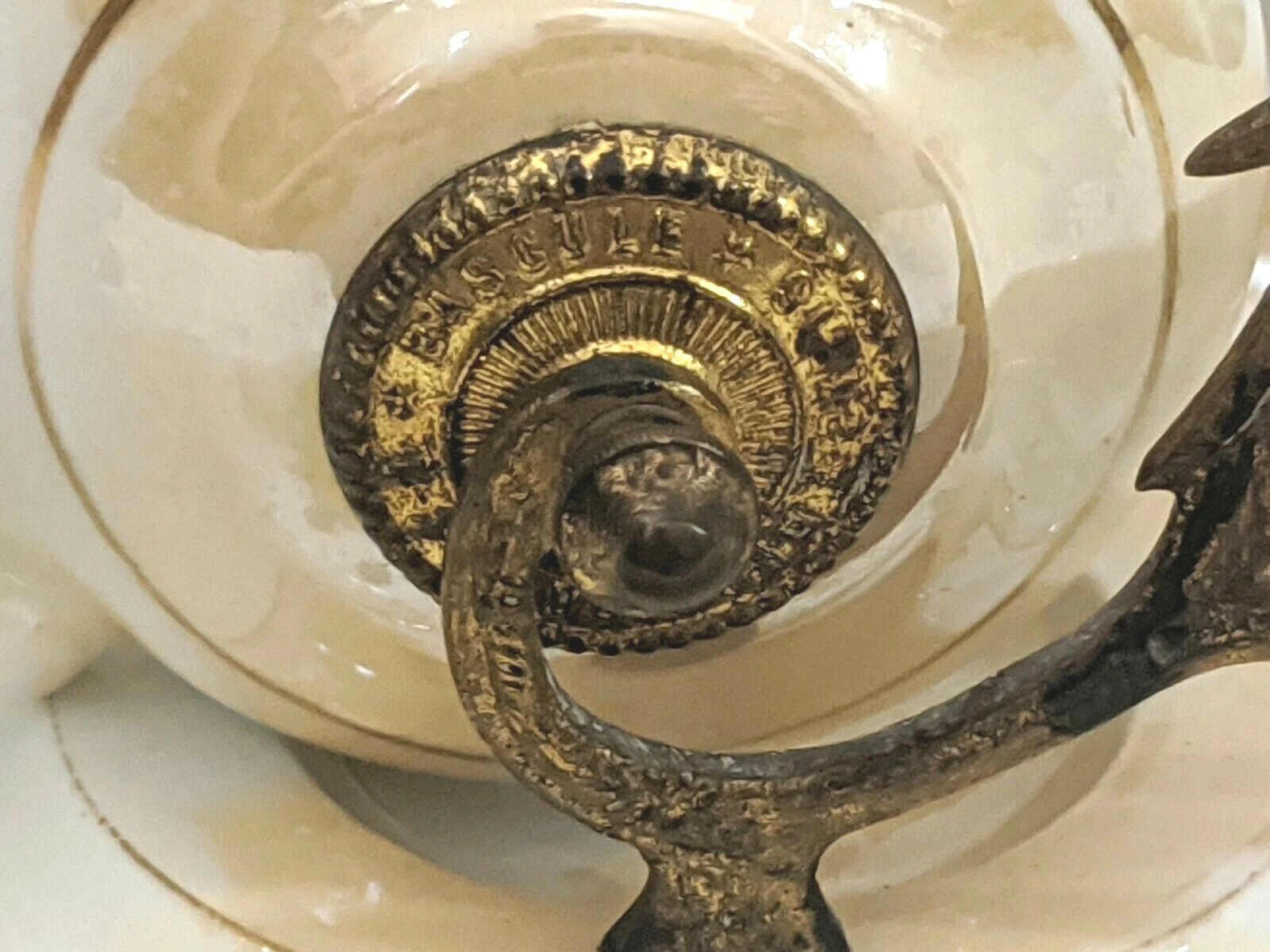
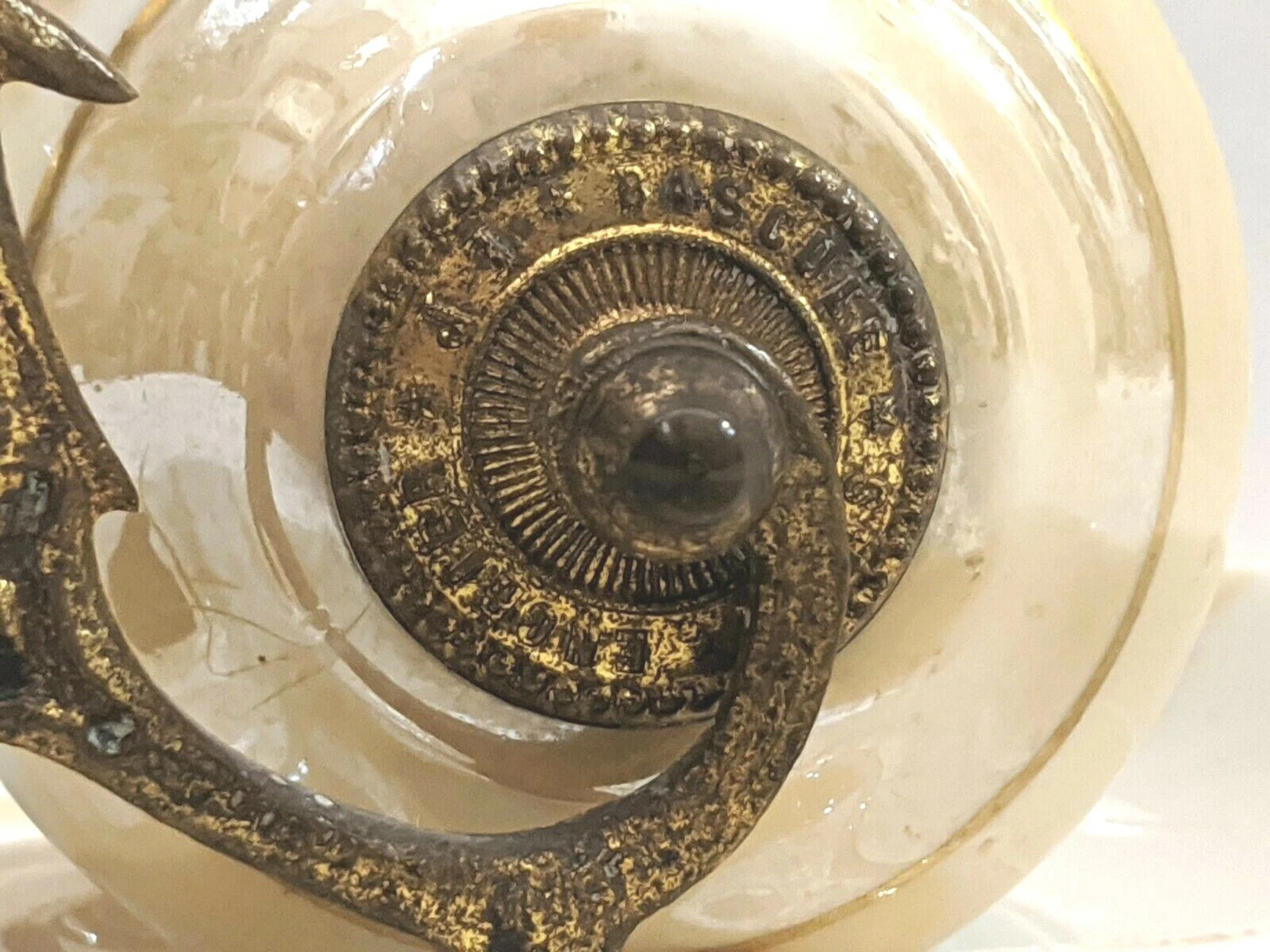
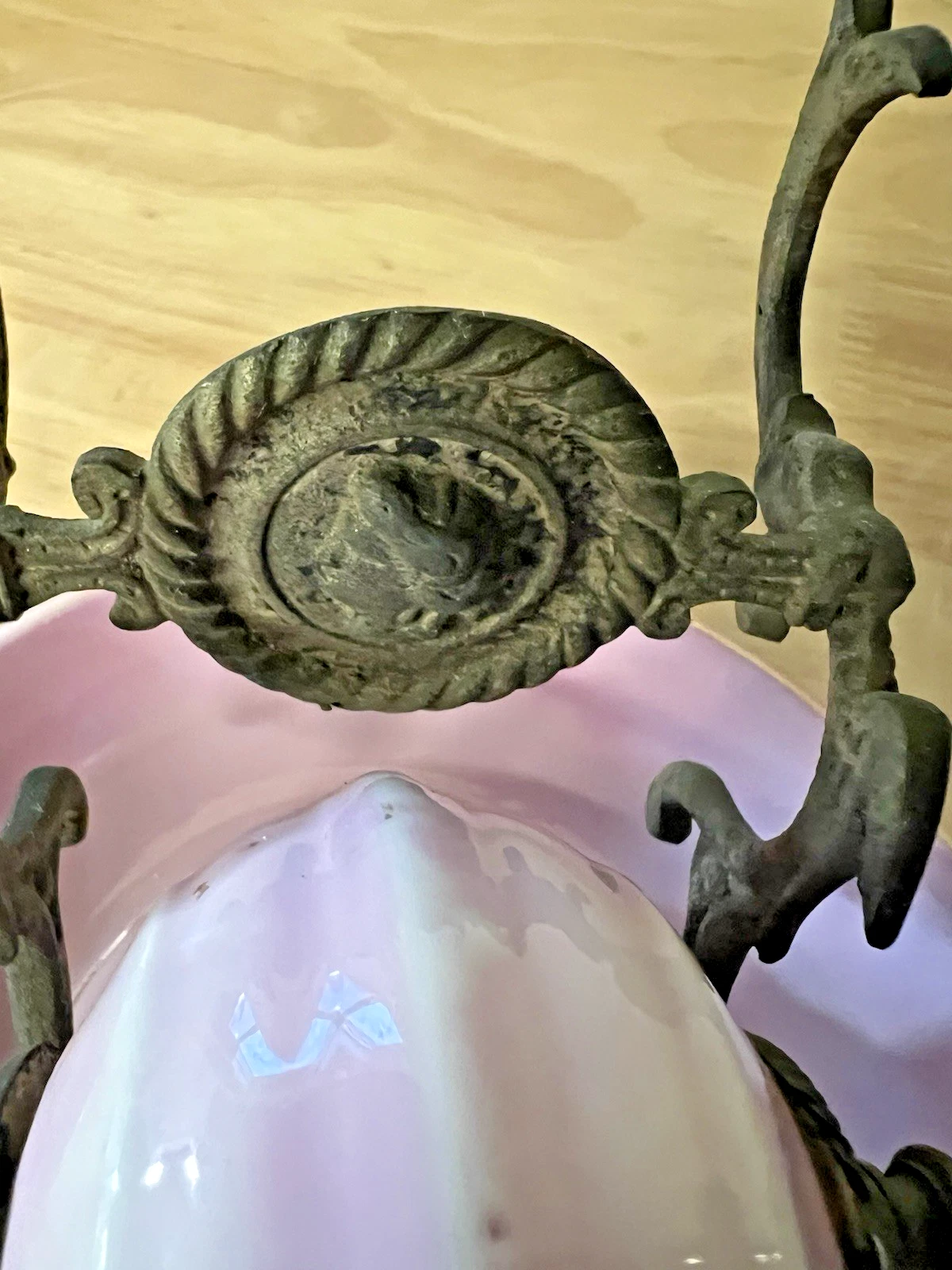
- The Pivot: The shell is mounted on a central brass rod that passes through two circular pivot discs.
- Opening: To write, the user tilts the “snail” forward within its frame. This reveals the mouth of the ink reservoir at the top.
- Closing: When rotated back, the mouth of the inkwell is pressed against an internal stoppel (stopper) plate, creating a seal that prevents the ink from evaporating or spilling.
Detailed Parts and Nomenclature
- The Pivot Discs: These are the circular brass plates at the center of the rotation. They are stamped with the maker’s identification: “ENCRIER J.L. BASCULE PARIS”.
- The Pen Rack: The brass frame features two highly ornate side supports designed to hold a single pen horizontally. These are cast in the form of mythological creatures, specifically stylized dragons or sea-serpents, characterized by their scrolled tails and open-mouthed, crested heads.
- The Stoppel Plate: Positioned at the back of the mechanism, this ornamental brass plate acts as the “stop” for the revolving shell. It is decorated with a low-relief design of three large leaves or petals arranged in a circular cluster.
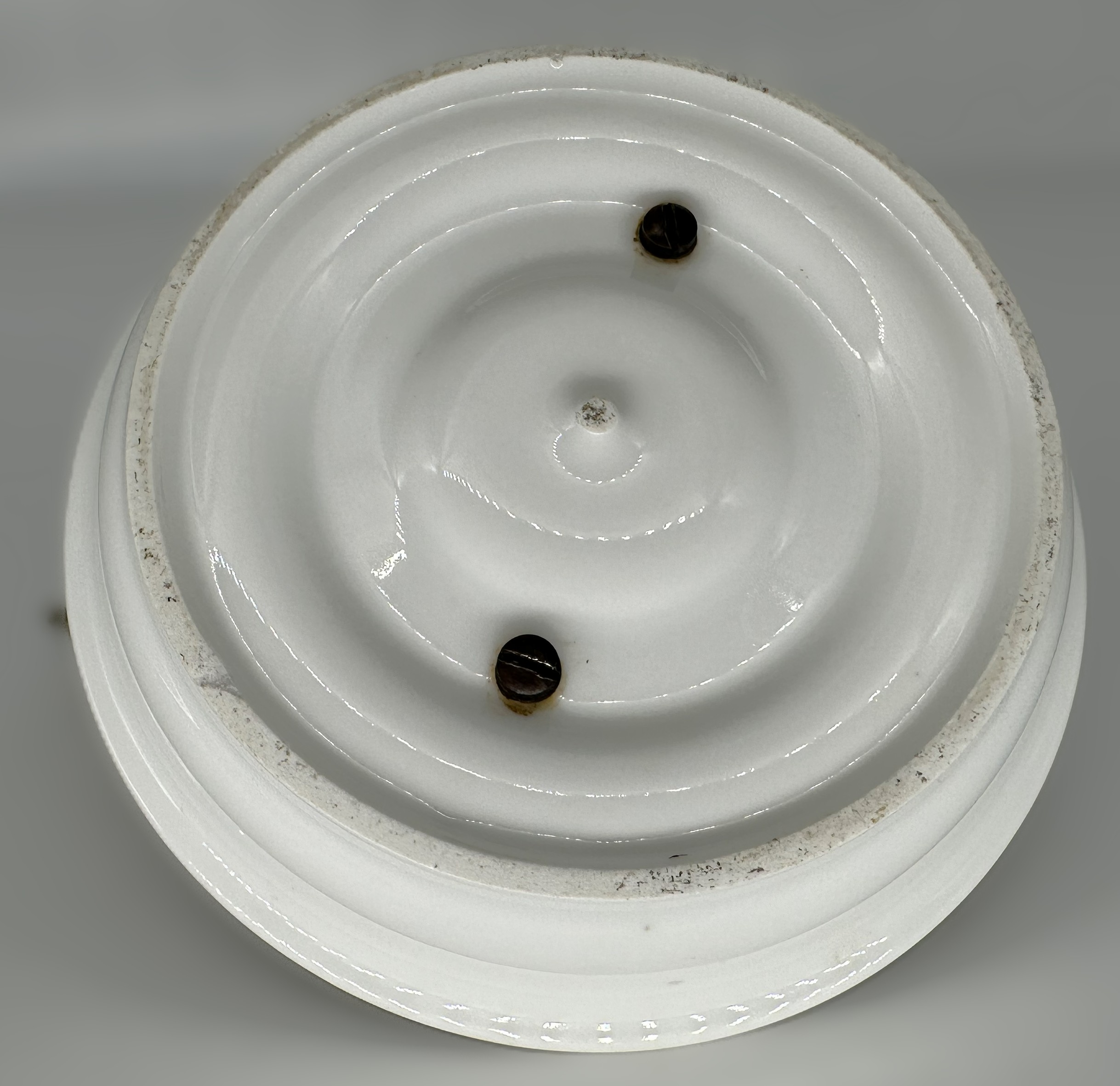
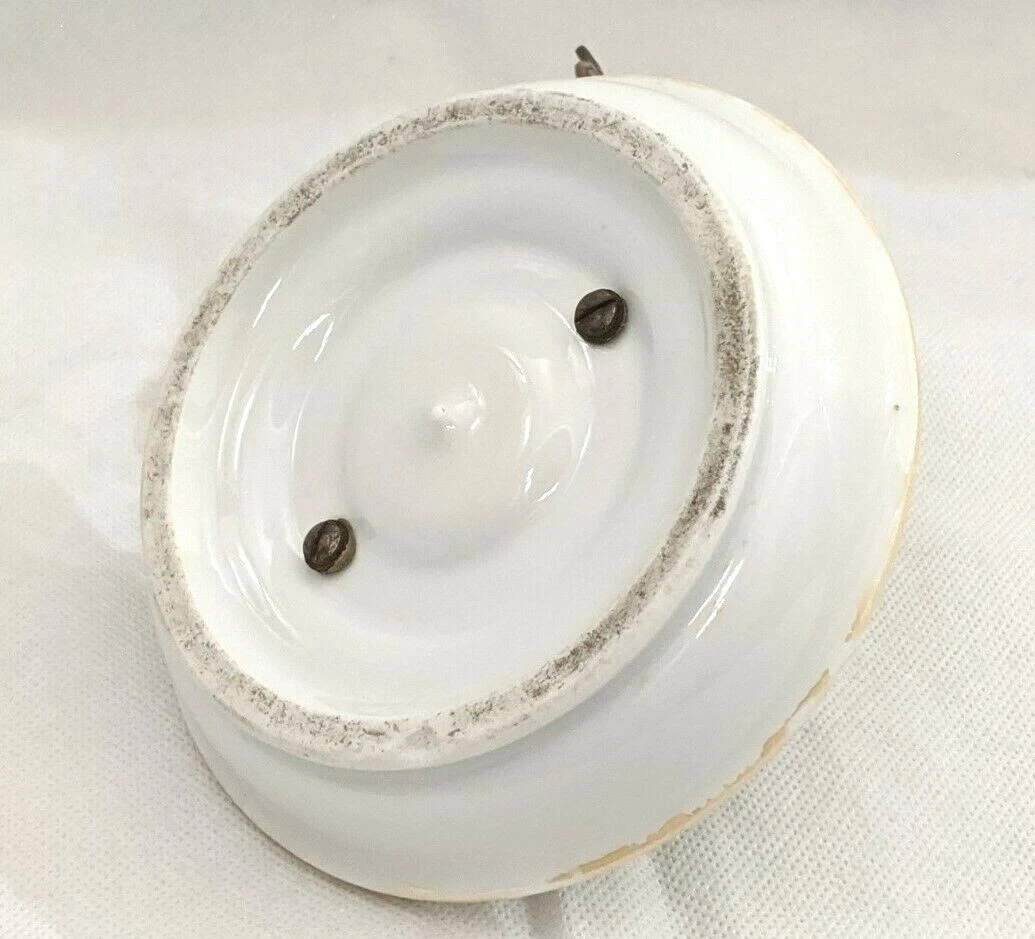
- The Saucer: The entire mechanism is mounted onto a wide, circular porcelain saucer with a raised rim, intended to catch any incidental drips of ink.
- Decoration: This specific model features a minimalist empire-style aesthetic, with a simple hand-painted orange or terracotta-colored band and thin black line detailing against a crisp white porcelain body.
Maker’s Mark
While J.L. Bascule might look like a name, it is actually a descriptive mark for the type of mechanical device.
What the Stamp Means
The mark “Encrier J.L. Bascule Paris” is a combination of a maker’s initials and a description of the mechanical movement:
- Encrier: The French word for “inkwell”.
- J.L.: These are the initials of the specific Parisian manufacturer or workshop. While many antique listings attribute these pieces simply to “J.L. Bascule,” historical research points to a workshop that produced these high-quality “siphoïde” (siphon-style) shells and mechanical frames.
- Bascule: This is the technical term for a rocking or tilting mechanism. In French mechanics, a bascule is anything that operates on a pivot, like a see-saw or a rocking chair.
- Paris: This confirms the piece was manufactured in the French capital, a hub for luxury desk accessories in the 19th century.
Clarifying the Design
- The “Dragon” Pen Holder: The side brackets on this inkstand are cast as mythological dragons or sea-serpents. This “Gargoyle” or “Grotesque” aesthetic was a hallmark of French Second Empire design (circa 1850–1870), intended to look both ancient and luxurious.
- The Stoppel Plate: The three-leaf or petal design on the stopper plate is a Fleur-de-Lis variant or a stylized clover, serving to create a secure seal when the porcelain shell is tilted back into its “closed” position.
Age and Context
This inkstand likely dates to circa 1850–1880. These “Snail” inkwells were specifically popular during the mid-to-late 19th century because they successfully addressed a major problem for writers: ink drying out. The “siphoïde” shape of the shell ensured that only a small amount of ink was exposed to air at any given time.
The Maker: Jean-Louis Journet
Journet was a Parisian manufacturer specializing in “encriers mécaniques” (mechanical inkwells). He registered several patents in the 1860s and 1870s for bascule (tilting) and siphoïde (siphon) mechanisms.
- The “J.L.” Connection: In French commercial records from the era, he is often listed as Journet (J.-L.).
- The Brand Name: The stamp “Encrier J.L. Bascule” served as a “Marque de Fabrique” (trademark), combining his initials with the patented rocking action.
How the “J.L.” Mechanism Evolved
Journet’s workshop was part of a larger movement in Paris toward “Office Novelties” that used physics to solve common problems.
- The “Bascule” Patent: The goal of the pivot system was to create a self-sealing environment. When the shell is in the “down” position, the ink is concentrated at the back; when tilted forward, a small amount flows into the mouth.
- The Hardware: Journet didn’t just make the porcelain; he was primarily a brass founder and engineer. He would buy the porcelain shells—often from high-quality factories like those in Limoges or the outskirts of Paris—and then fit them with his patented brass “dragon” frames and stoppel plates.
Summary of This “Snail” Inkstand
- Maker: Jean-Louis Journet (Paris)
- Estimated Date: Circa 1865–1880
- Style: Second Empire / Neo-Gothic (indicated by the dragon/gargoyle pen rests)
- Rarity: While “bascule” inkwells were produced by several makers, the Journet-marked pieces with the mythological dragon supports are considered the “deluxe” versions of this design.
For a more thorough and accurate description of revolving inkstands, use the link below to access an article from The Stained Finger (Volume XXX number 4):
Estimated Value: $200
Second example (mother-of-pearl finish) sold for $338 in February 2026
Pink example sold for $207 in June 2026
Content disclaimer. The information posted is the owner’s best knowledge and may not have been vetted by the SOIC. We welcome comments, corrections, and additions, working to make our website information comprehensive and accurate.
Join the Society of Inkwell Collectors (SOIC) – it’s free!
Founded in 1981 as a non-profit organization,
we are documenting inkwells (and accessories).
We’re here to help and inform!