


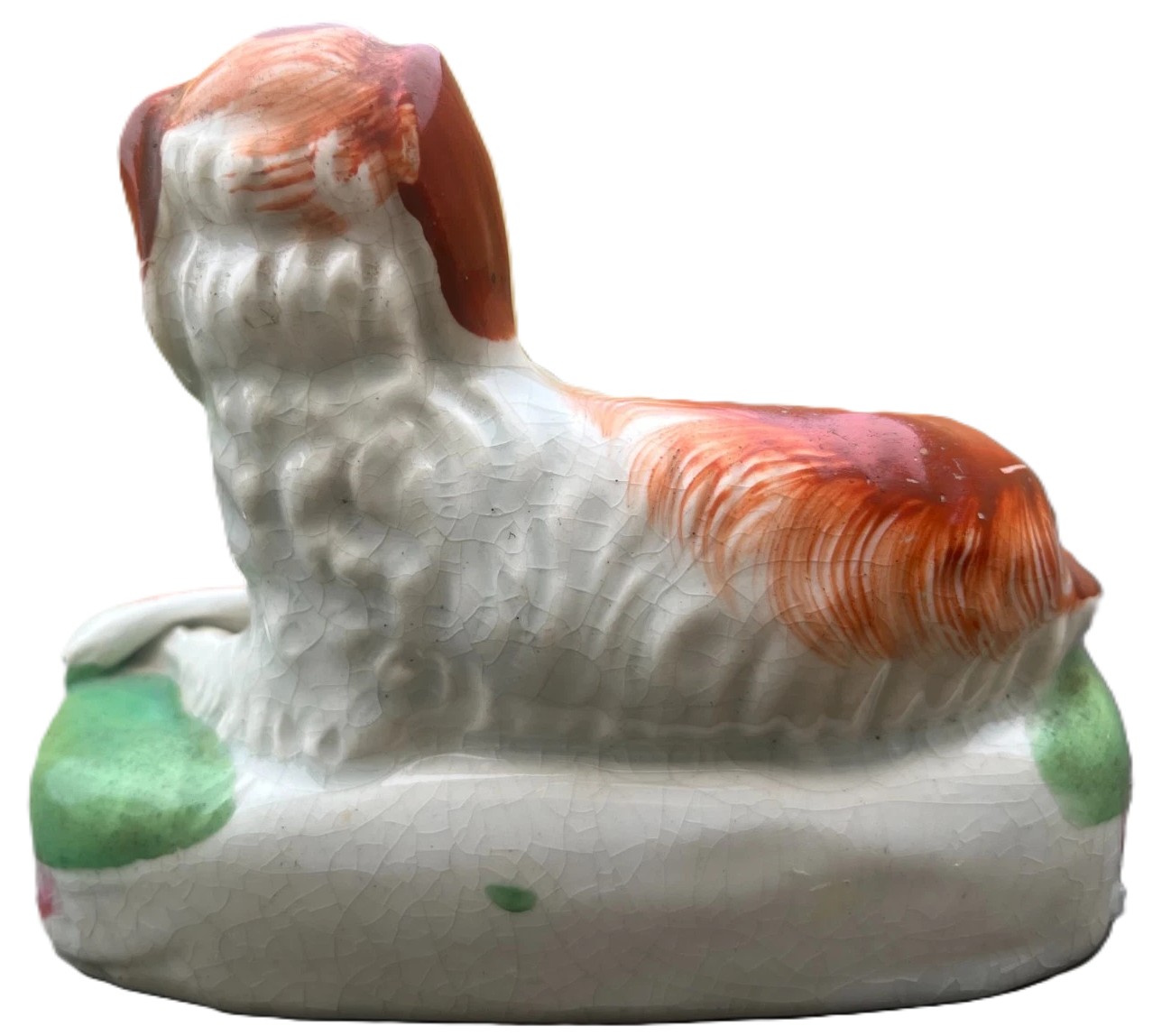
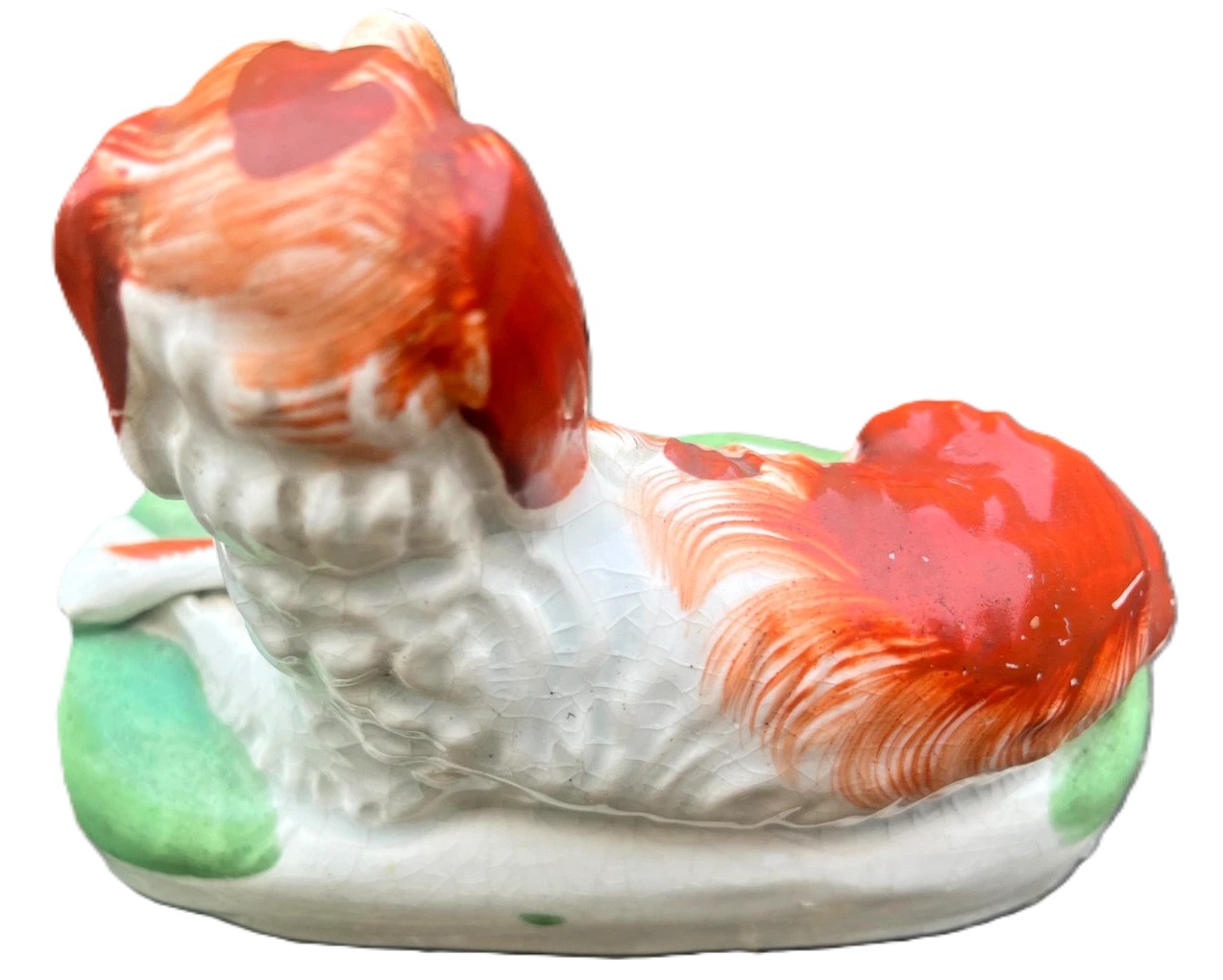
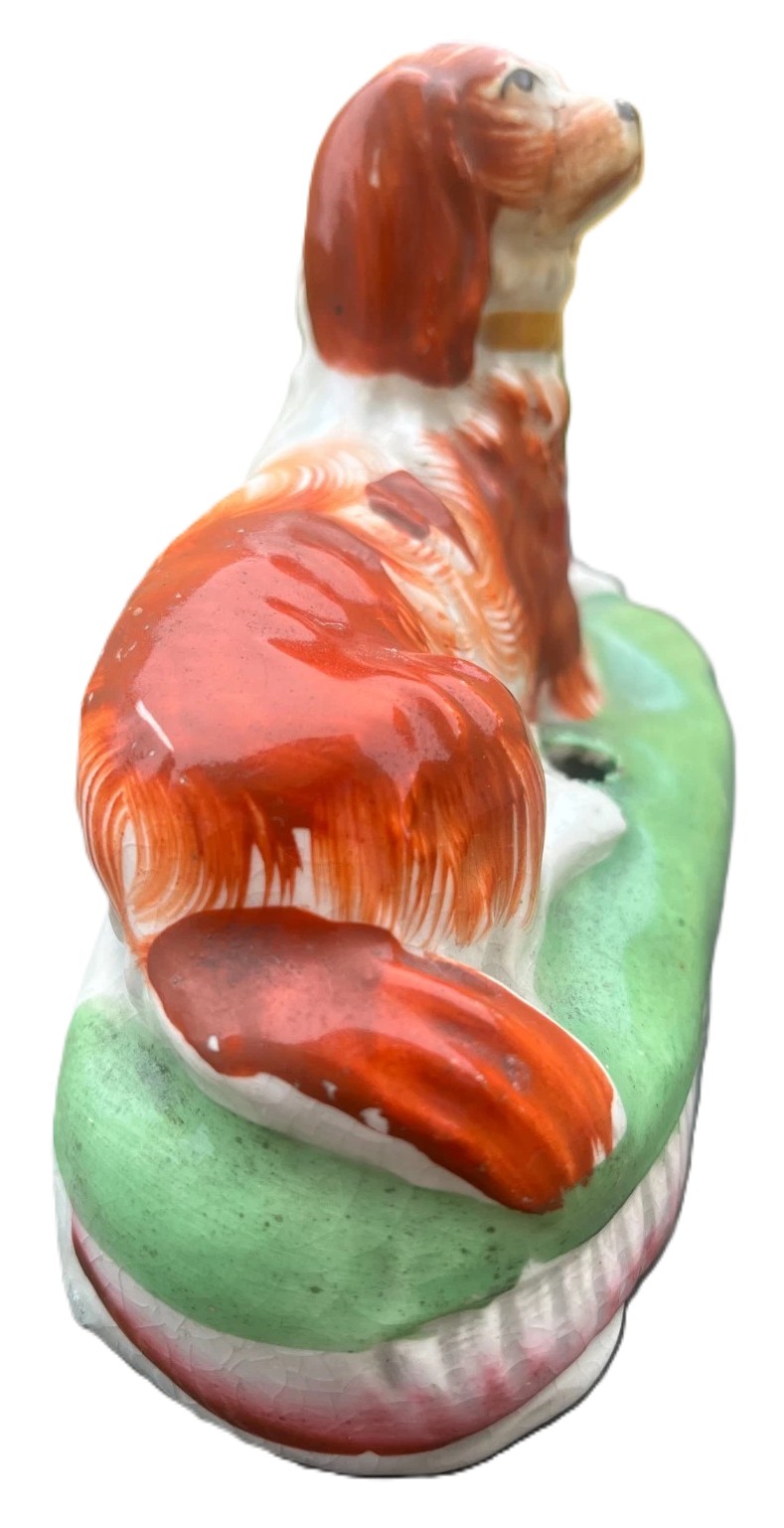


Recumbent King Charles Spaniel
| Categories | Ceramics/Porcelain Figural |
| Type | dog |
| Material | Earthenware |
| Markings | Unmarked |
| Manufacturer | Staffordshire |
| Origin | England |
| Date or Era | circa 1850 |
| Measuring | 5 ¾” x 3” x 4 ¾” high |
Description
- Subject: A molded, recumbent King Charles Spaniel—a style popularized during the Victorian era due to Queen Victoria’s deep affection for her own spaniel, Dash.
- Details & Coloring: The dog features rich russet-red painted patches over a creamy-white slip background, with stylized black painted claws and an ochre-yellow or gilt collar. It has molded, wavy fur detailing along its chest and ears, and its front paws are crossed gracefully.
- The Base: The dog rests atop a molded, oval-shaped plush cushion. The top of the cushion is glazed in a vibrant green, while the lower skirt is detailed with pink vertical stripes meant to replicate fabric pleats or textile fringe.
- Condition Notes: The entire piece exhibits a fine, pronounced network of glaze crazing. This web-like crackle is entirely characteristic of 19th-century lead-glazed Staffordshire earthenware.
Function: Inkwell vs. Pen Holder
Despite often being labeled as “inkwells” in the antiques trade, this piece is strictly a quill or pen holder. It was not designed to hold liquid ink.
Here is why it wouldn’t function as an inkwell:
- No Reservoir or Lid: A proper inkwell requires either a wide, deep opening to hold a glass/pottery liner or a built-in reservoir with a lid to slow down evaporation and prevent spilling. Liquid ink poured directly inside this hollow figurine would simply pool loosely in the wide base, dry out rapidly, and ruin the unglazed interior.
- The Aperture: The single small hole positioned right in front of the spaniel’s paws is too narrow and shallow for a writer to cleanly dip a pen nib into an internal supply of ink.
How It Was Used
This figurine was a decorative and functional accessory for a Victorian writing desk. It sat alongside a separate, dedicated inkwell. When a writer paused mid-letter, they would slide the shaft of their quill or dip pen into the small hole. The hole stabilized the pen upright or at an angle, keeping the wet nib suspended safely off the tabletop to protect the desk from ink blots.
Establishing the Date
While Staffordshire mantle spaniels were produced well into the late 19th and early 20th centuries, these smaller, utilitarian desk accessories (like quill holders, spill vases, and sanders) hit the peak of their production and quality between 1840 and 1860. The specific modeling of the crossed paws, the soft style of the russet painting, and the press-molded cushion base point directly to a mid-19th century Victorian attribution.
Sold for $81 in April 2026
Content disclaimer. The information posted is the owner’s best knowledge and may not have been vetted by the SOIC. We welcome comments, corrections, and additions, working to make our website information comprehensive and accurate.
Join the Society of Inkwell Collectors (SOIC) – it’s free!
Founded in 1981 as a non-profit organization,
we are documenting inkwells (and accessories).
We’re here to help and inform!