

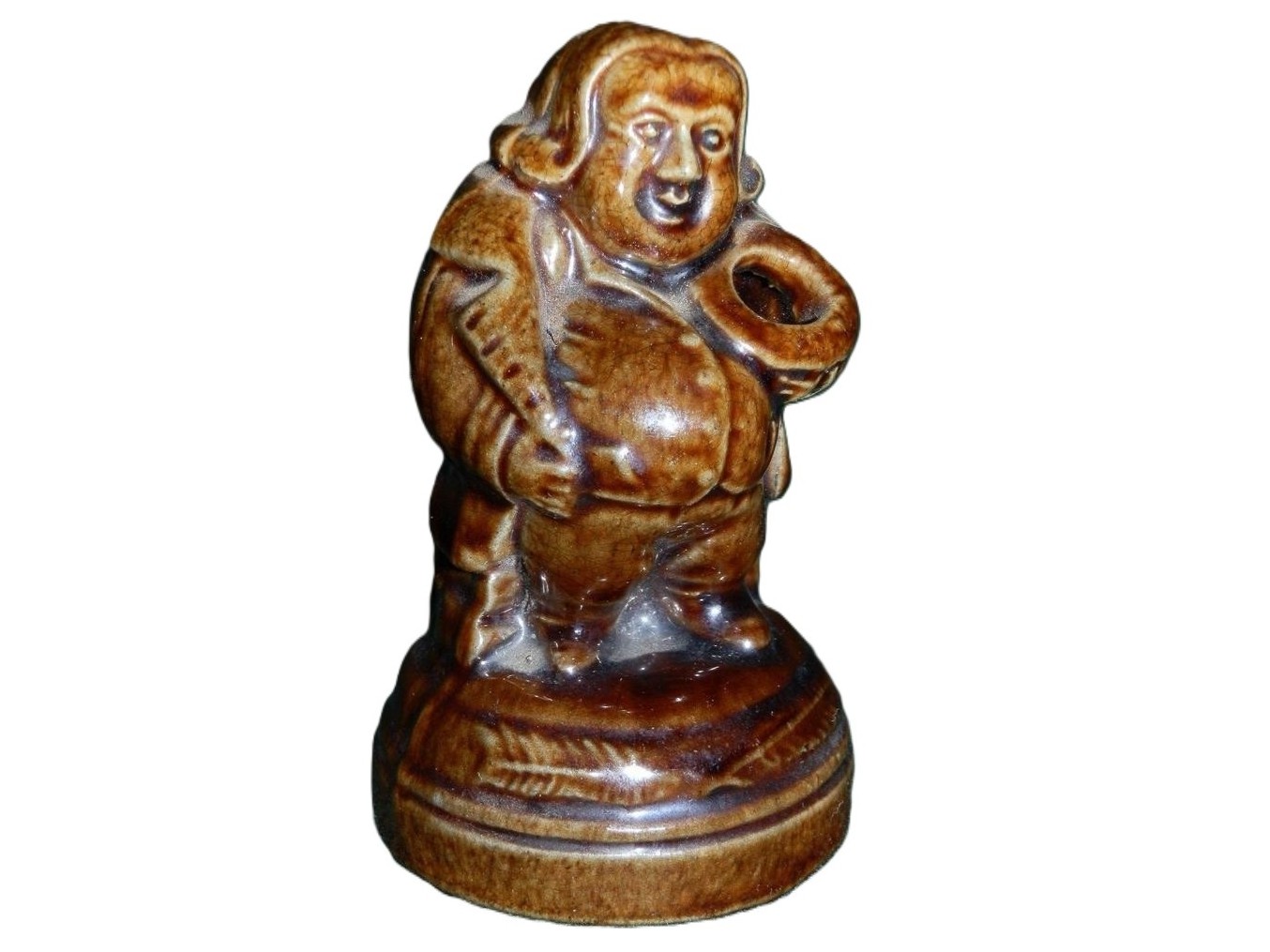


Corpulent Gentleman – Rockingham Glaze
| Categories | Ceramics/Porcelain Figural |
| Type | Man |
| Material | Pottery |
| Markings | Unmarked |
| Manufacturer | Undetermined |
| Origin | England |
| Date or Era | circa 1850 |
| Measuring | 3 ⅜” high |
This inkwell is documented in William E. Covill Jr.’s definitive work, “Ink Bottles and Inkwells” on page 379, figure 1600. The description reads: “Rockingham glaze, 3 ⅜ H., English, C1840-1850”.
Description of the Inkwell
This mid-19th-century figural inkwell is a charming example of English molded yellowware or creamware. Standing at 3 ⅜ inches tall, it exhibits excellent depth of molding designed to be both decorative and highly stable on a writing desk.
- The Front: It features a jovial, corpulent gentleman dressed in classic mid-to-late 18th-century attire, including knee breeches, stockings, a buttoned waistcoat, and a heavy frock coat. His face is molded with a wide smile, a double chin, and a prominent, curly, shoulder-length wig.
- The Writing Motifs: In his right hand, he tightly clutches a rolled document or parchment scroll. The circular pedestal base features a prominent feather quill pen molded in relief across the front face, serving as a clever thematic advertisement for the object’s purpose.
- The Ink Reservoir: His left arm cradles a wide, heavy, ring-like circular opening that serves as the mouth of the ink reservoir. This opening is integrated into the design, appearing to be the crown of a wide-brimmed or tricorn hat held against his side.
- The Back: The reverse side shows the gentleman leaning against (or sitting upon) a low brick wall or well structure. This brickwork is both a narrative detail and a clever engineering trick by the potter, providing essential structural support to prevent the heavy, solid clay form from warping or collapsing during firing.
The Character: Who is Depicted?
While this piece draws inspiration from the classic, hard-drinking “Toby Philpot” figures that inspired generations of Toby jugs, the specific combination of elements tells a different story.
Given his formal 18th-century legal/clerical wig, the rolled parchment, and the prominent quill pen, this character is almost certainly a satirical caricature of a Parish Clerk, Town Scribe, or a Village Magistrate.
In 18th and 19th-century English popular culture, local parish and town clerks were frequent targets of lighthearted satire. They were routinely depicted in literature and print as cheerful, well-fed, and slightly pompous officials who took great pride in their records and legal decrees (hence the scroll and pen) while enjoying the comforts of the local tavern. The rustic brick wall behind him further reinforces this local, village-official setting rather than a high-court London judge.
Understanding Rockingham Glaze
In the United Kingdom, this finish is frequently referred to as “treacle glaze” due to its striking resemblance to dark British molasses, though it is globally recognized by collectors as Rockingham glaze.
- The Origin: The glaze gets its name from the Rockingham Pottery estate in Swinton, Yorkshire, England, operating under the patronage of the Marquess of Rockingham. While popularized there in the late 1700s and early 1800s, the formula was quickly adopted by potters throughout the Staffordshire region and eventually exported to American pottery hubs like Bennington, Vermont, and East Liverpool, Ohio.
- The Coloration: It is a lead-based glaze heavily enriched with manganese and iron oxide. The characteristic “mottled” or “tortoiseshell” look is achieved because of how the glaze flows when intense kiln heat melts it. It naturally runs thin on high-relief areas (like the man’s nose, cheekbones, and waistcoat buttons) and pools deeply in the recessed crevices (like the brickwork and coat folds).
- The Effect: This pooling creates a beautiful, variegated spectrum of color on a single object—ranging from warm, translucent amber and golden-tan highlights to deep, nearly black espresso lowlights. The glassy, highly reflective finish adds visual texture, making it a good choice for intricate, character-filled figural molds like this clerk.
Estimated value: $125
Content disclaimer. The information posted is the owner’s best knowledge and may not have been vetted by the SOIC. We welcome comments, corrections, and additions, working to make our website information comprehensive and accurate.
Join the Society of Inkwell Collectors (SOIC) – it’s free!
Founded in 1981 as a non-profit organization,
we are documenting inkwells (and accessories).
We’re here to help and inform!