

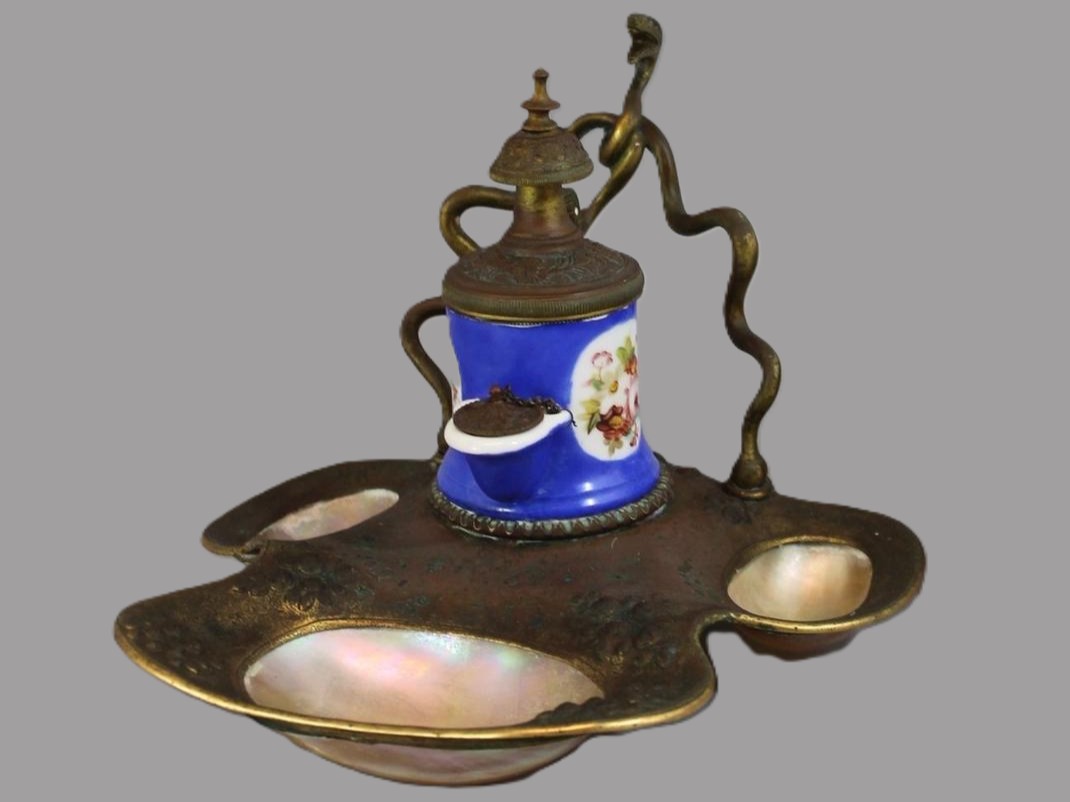
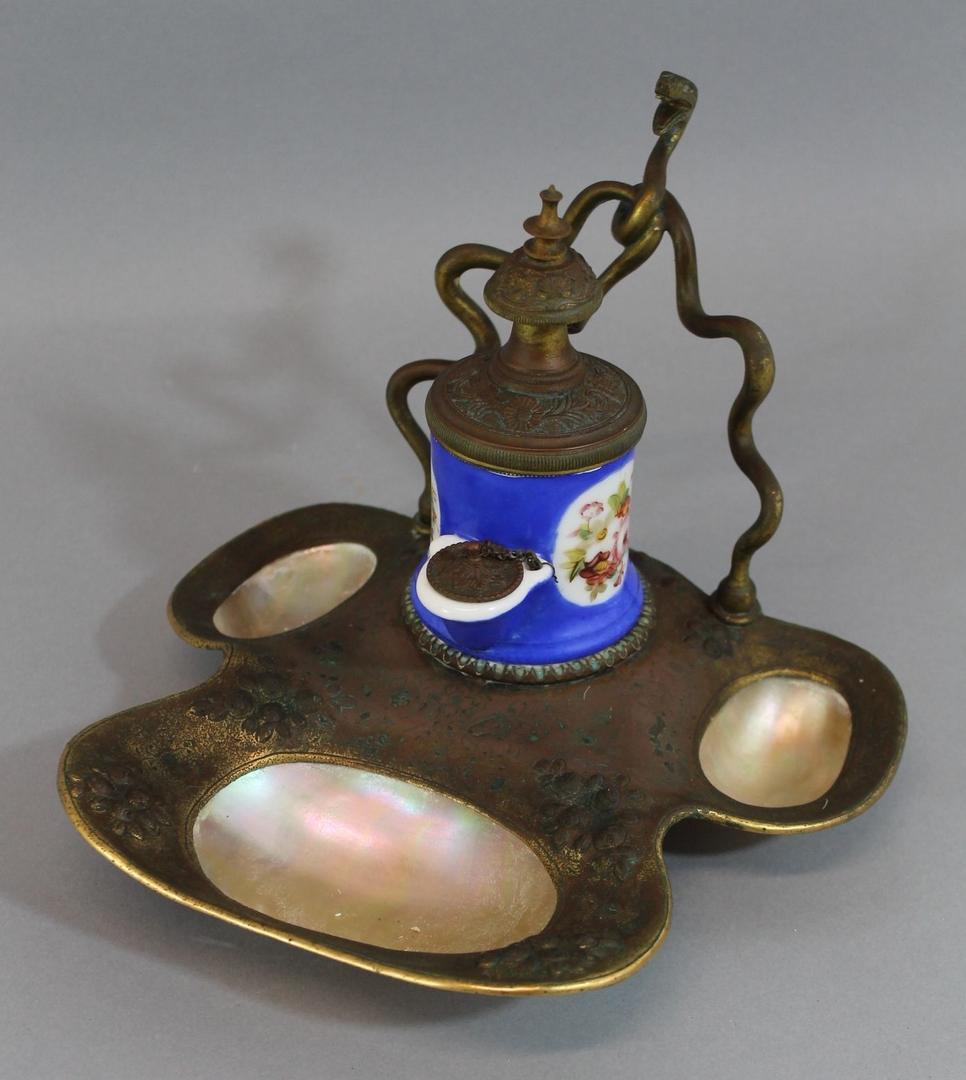
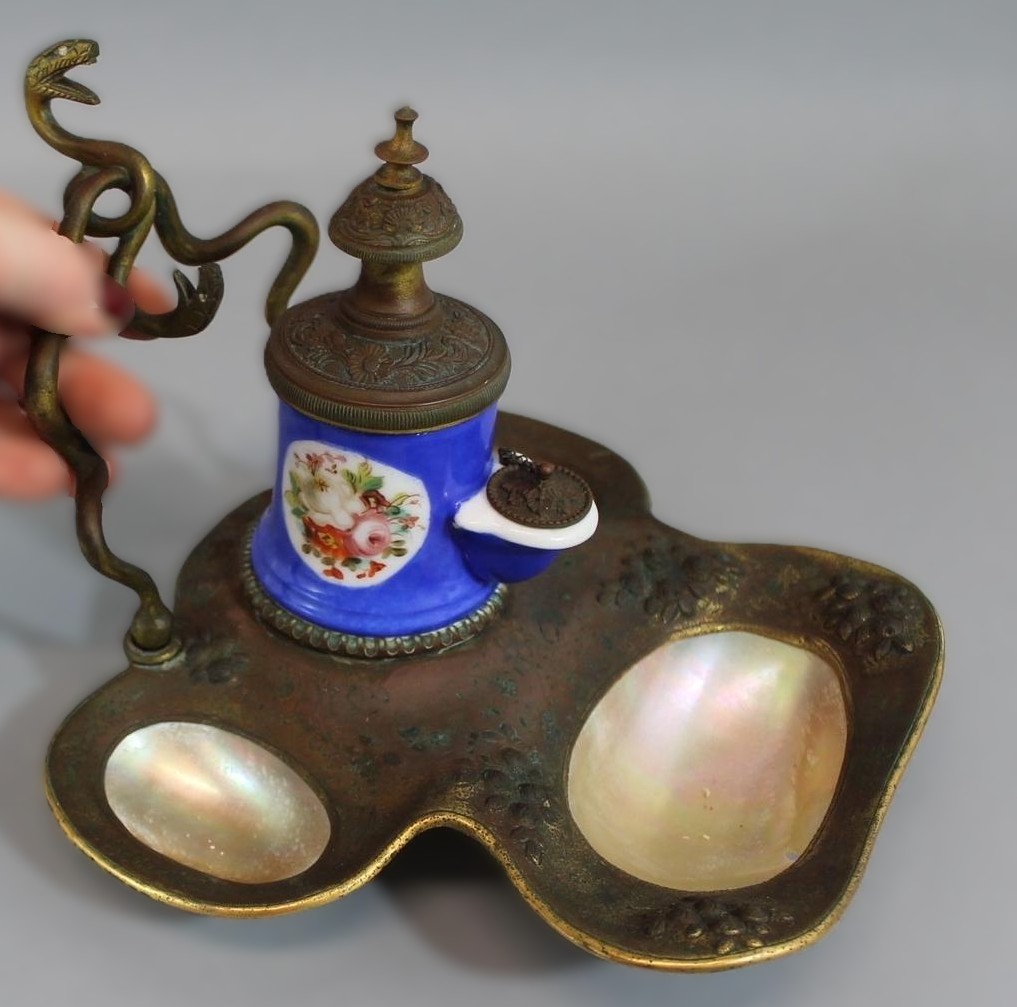
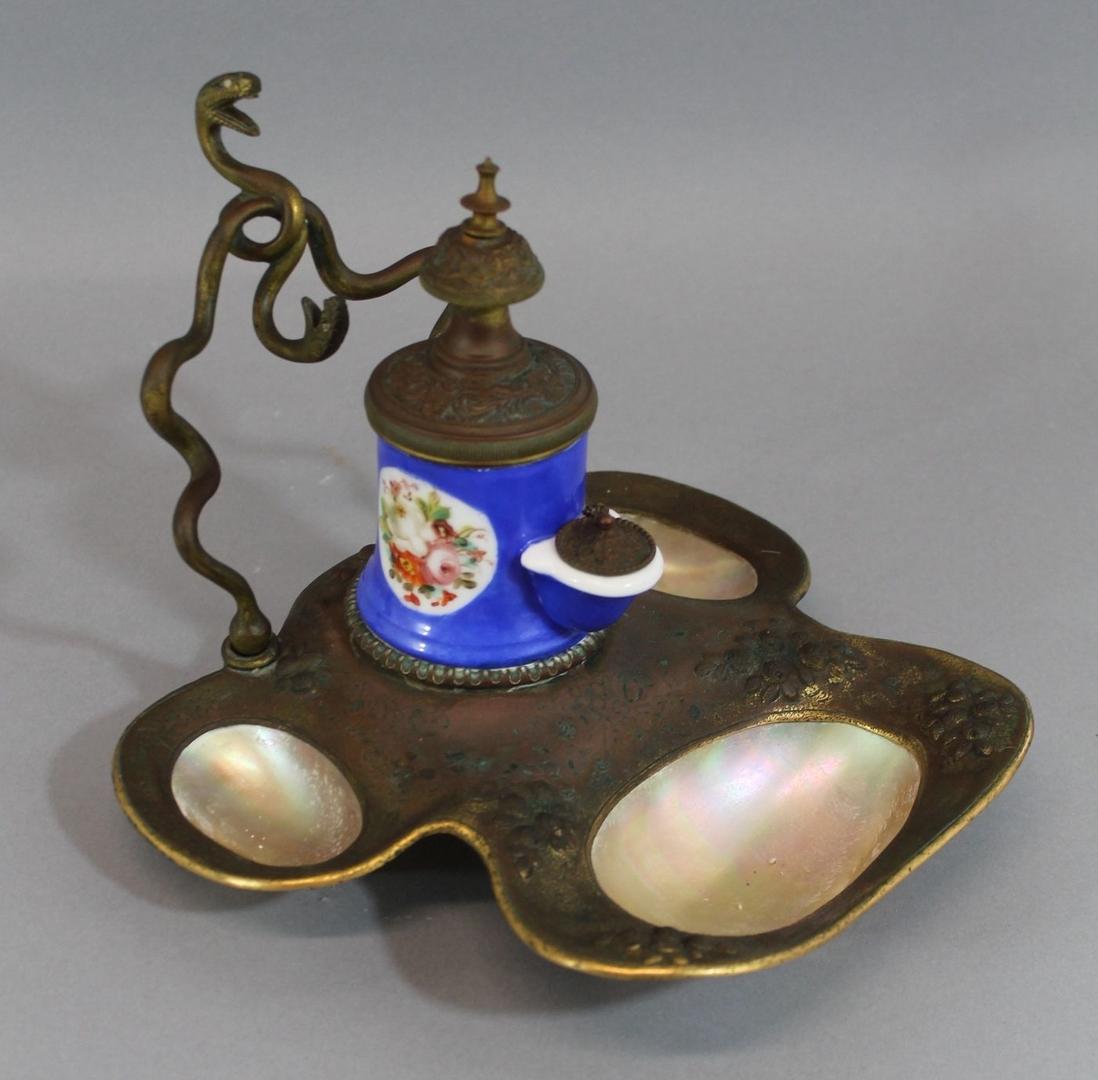
Pump-Style Inkstand with MOP Shells
| Categories | Mechanical - Pump / Siphon |
| Type | Snake / Serpent |
| Material | Bronze, Porcelain |
| Markings | Unmarked |
| Manufacturer | Undetermined |
| Origin | France |
| Date or Era | circa 1860 |
Overview
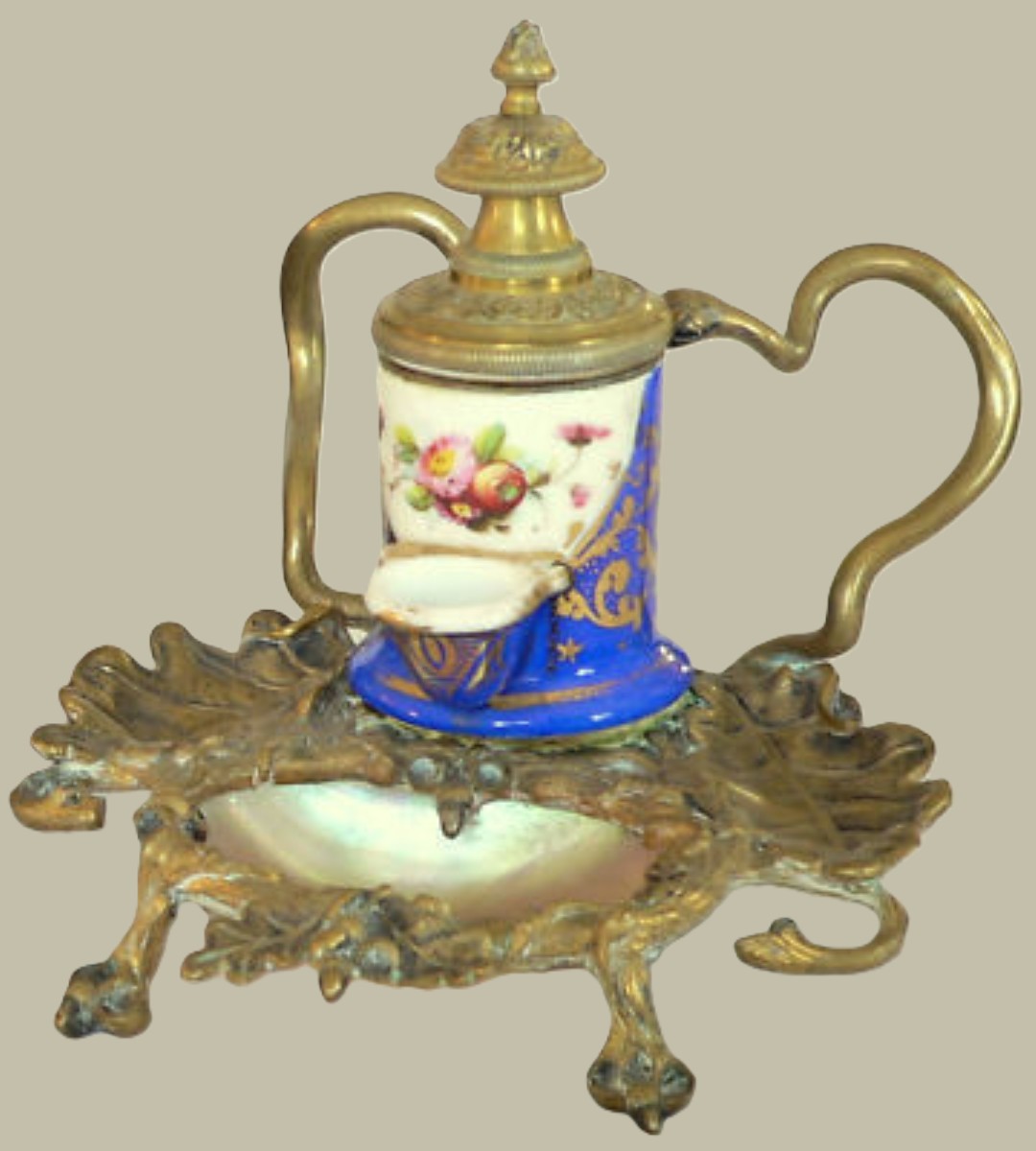
This mechanically sophisticated desk accessory is a French mechanical pump-style inkstand (pompe inkwell).
- The Base & Frame: The asymmetrical, clover- or trefoil-inspired footed tray is cast in brass or bronze (originally exhibiting a rich fire-gilt or gold ormolu finish, now largely softened to a warm, dark, aged patina with highlights of residual gilding). The tray is embellished with low-relief repoussé or chased floral and foliate motifs.
- The Mother-of-Pearl Inserts: The tray features three distinct, iridescent concave sections crafted from natural mother-of-pearl (nacre) shells. These depressions served dual purposes as functional compartments: either for resting dipping pens or holding small desk items (such as nibs or wax seals).
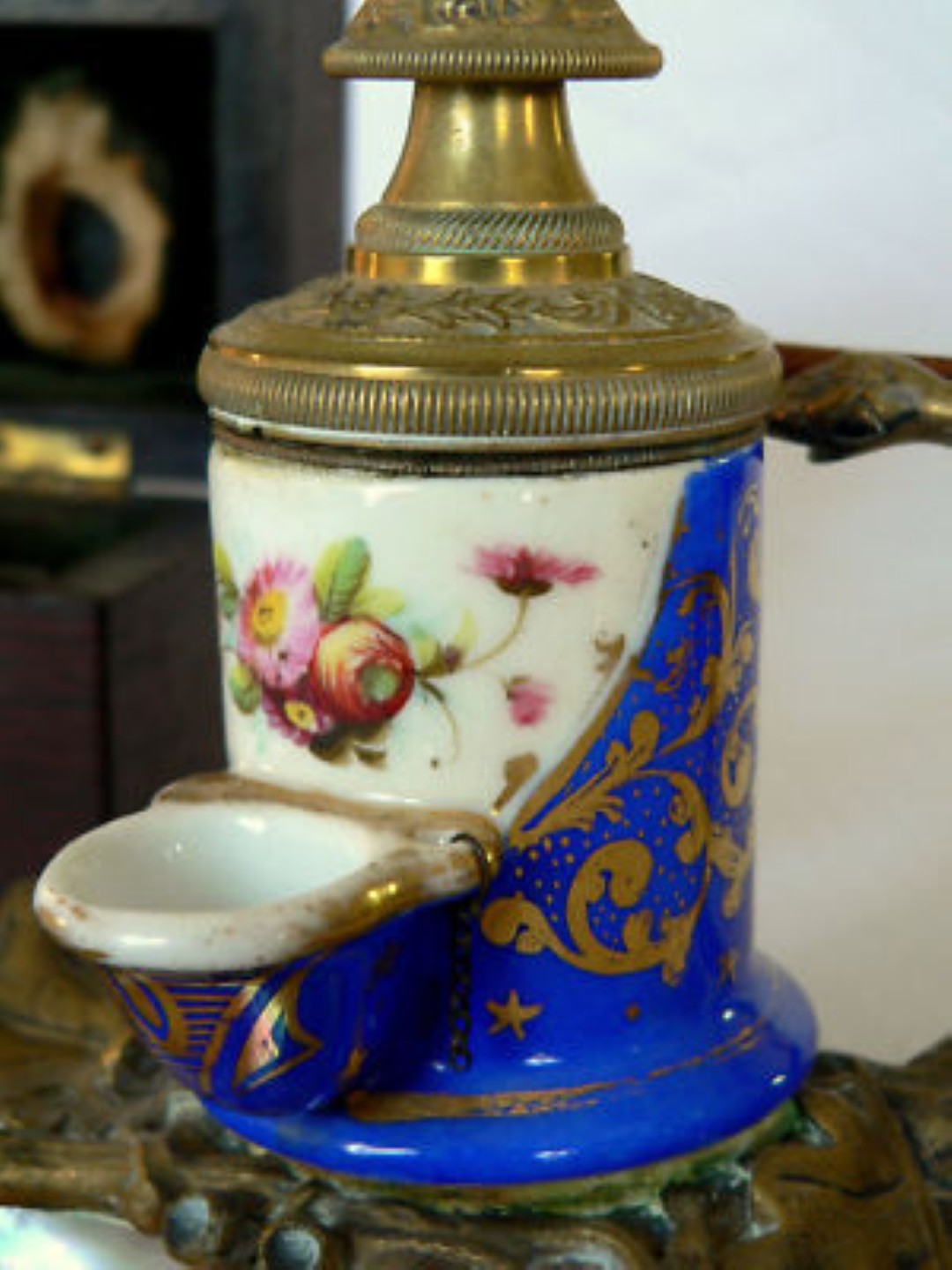
- The Ink Reservoir: Centered on the platform is a cylindrical porcelain reservoir featuring a vibrant cobalt blue ground accented with a finely hand-painted polychrome floral cartouche. The porcelain is mounted with chased brass collars, a matching domed lid topped with a decorative finial, and an exterior dipping well (font) with a small lid.
- The Serpent Pen Holder: Rising dramatically from the rear of the brass frame is an ornate structural pen rack formed by two entwined, undulating serpents (snakes). Their sinuous bodies create natural rests designed to hold a quill or pen.
Mechanical Operation
This piece belongs to a clever class of 19th-century mechanical inkstands designed to prevent ink from evaporating, gathering dust, or spilling.
- Inside the central cobalt porcelain cylinder sits a precision-fitted porcelain float attached to an internal reverse screw mechanism.
- When the user turns the control knob or top finial, the internal screw raises or lowers the float within the bore of the main reservoir.
- Lowering the float displaces the ink, forcing it upward into the small exterior dipping font for immediate access.
- Raising the float creates a partial vacuum or recession, cleanly drawing the remaining ink back down into the sealed main reservoir, keeping the ink fresh and secure when not in use.
Maker and Attribution
- Maker / Patent: Mechanical pump inkwells of this specific construction and mechanism were pioneered and patented in France during the mid-19th century. Similar proprietary pump mechanisms are frequently associated with French makers and inventors such as Bocquet (or Boquet), who registered patents for anti-evaporation mechanical inkwells.
- The Serpent Motif: The use of entwined snakes or serpents as structural handles and pen rests was a popular motif in European decorative arts, bridging late Neoclassical, Romantic, and Victorian design vocabularies where serpents symbolized eternity, wisdom, and guardianship. While French desk-set manufacturers frequently utilized cast-bronze mounts and Old Paris or Sèvres-style porcelain bodies, these pieces were often retailed through luxury boutiques in Paris (such as Palais Royal retailers) without a prominent maker’s hallmark.
Dating
- Period: Mid-19th Century (circa 1840–1870).
- Stylistic Context: The combination of natural mother-of-pearl shell insets, cobalt-blue hand-painted porcelain (reflecting the enduring influence of Sèvres and Old Paris factories), and high-relief botanical gilt-bronze mounts places this inkstand firmly in the Napoleon III / Second Empire era of French decorative arts, when mechanical novelties for executive writing desks reached their artistic and engineering peak.
Second Example
This second example is a closely related mid-19th-century French mechanical pump inkstand (circa 1840–1870), sharing the same anti-evaporation pumping engineering as the first, but featuring distinct design variations:
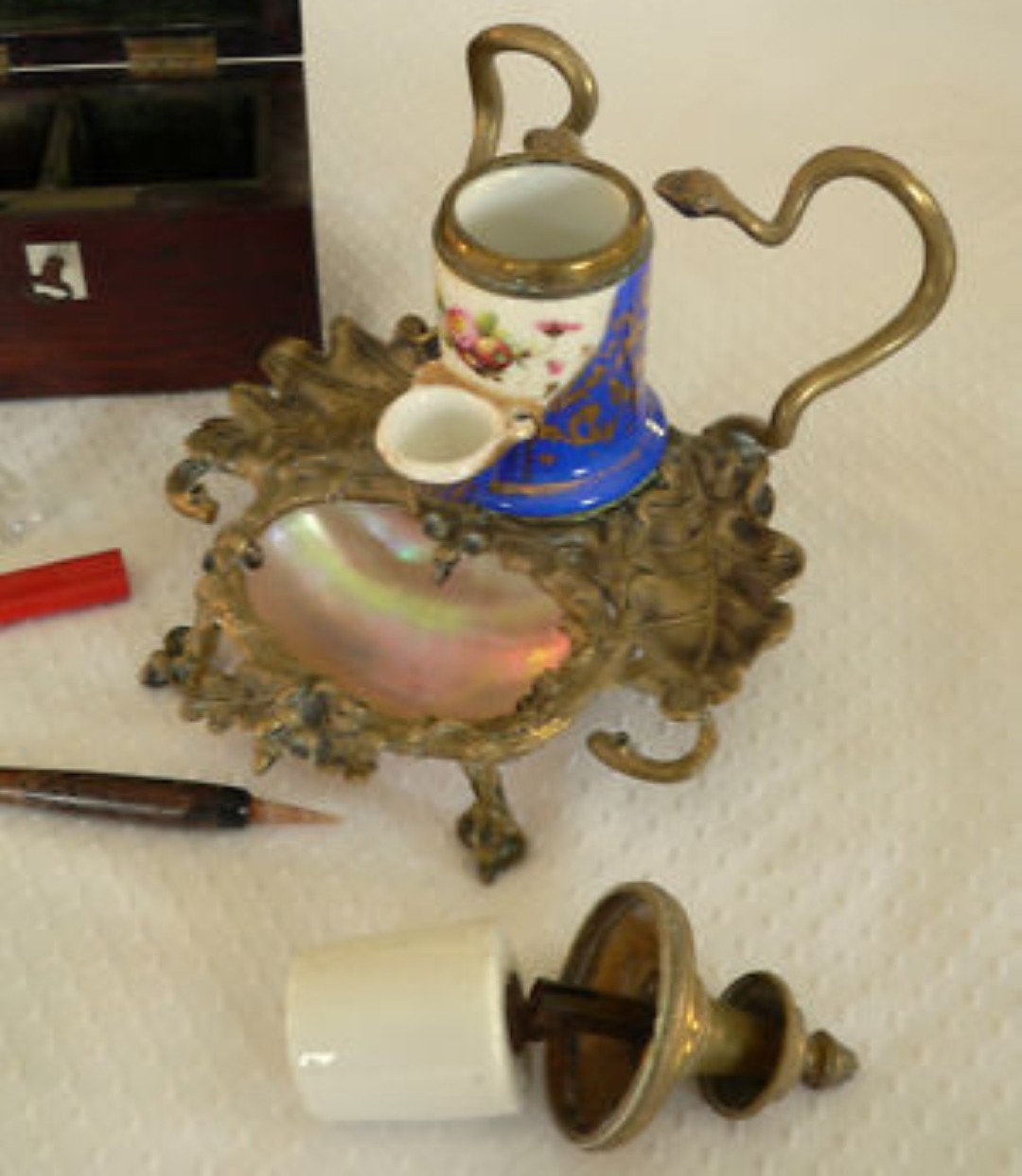
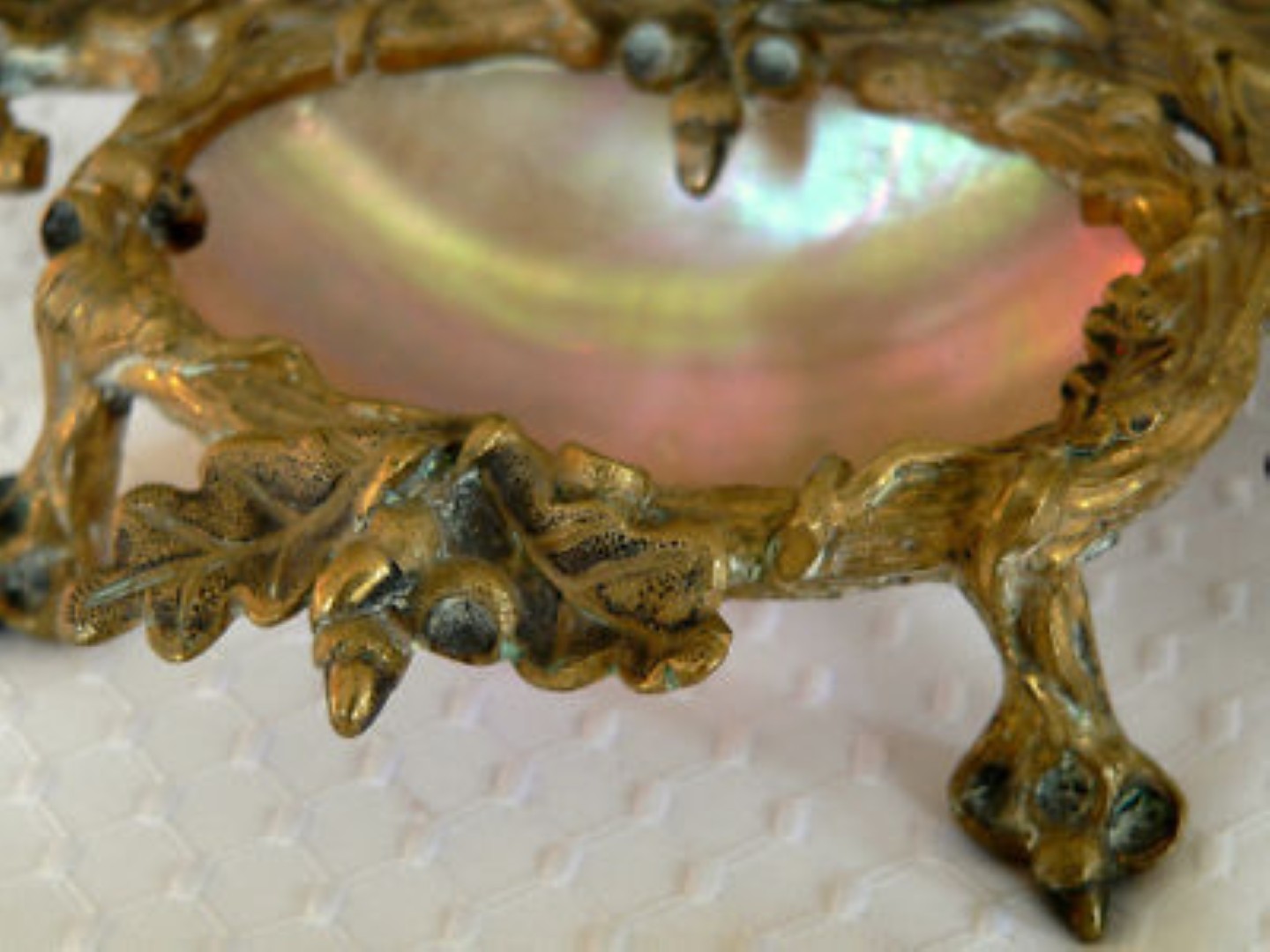
- The Frame & Base: Unlike the trefoil, multi-trayed tray of the first piece, this stand features a compact, single-basin design centered around one large, iridescent mother-of-pearl (nacre) shell. The cast brass or bronze frame is meticulously detailed with an oak leaf and acorn motif, standing on four ornate, claw-foot supports.
- The Pump Mechanism & Reservoir: It utilizes the same mechanical principle—a cylindrical porcelain reservoir with a vibrant cobalt blue ground, hand-painted floral cartouches, gold-gilded scrollwork, and star accents. It shares the same interior mechanics removed from the bore: a precision-fitted cylindrical porcelain float attached via a threaded metal shaft to the screw-top control knob, designed to displace and raise ink into the exterior dipping font when turned.
- The Pen Rest: Rising from the rear of the leafy bronze frame is a single sinuous serpent pen holder, whose curved body and sculpted head form a rest for a dipping pen.
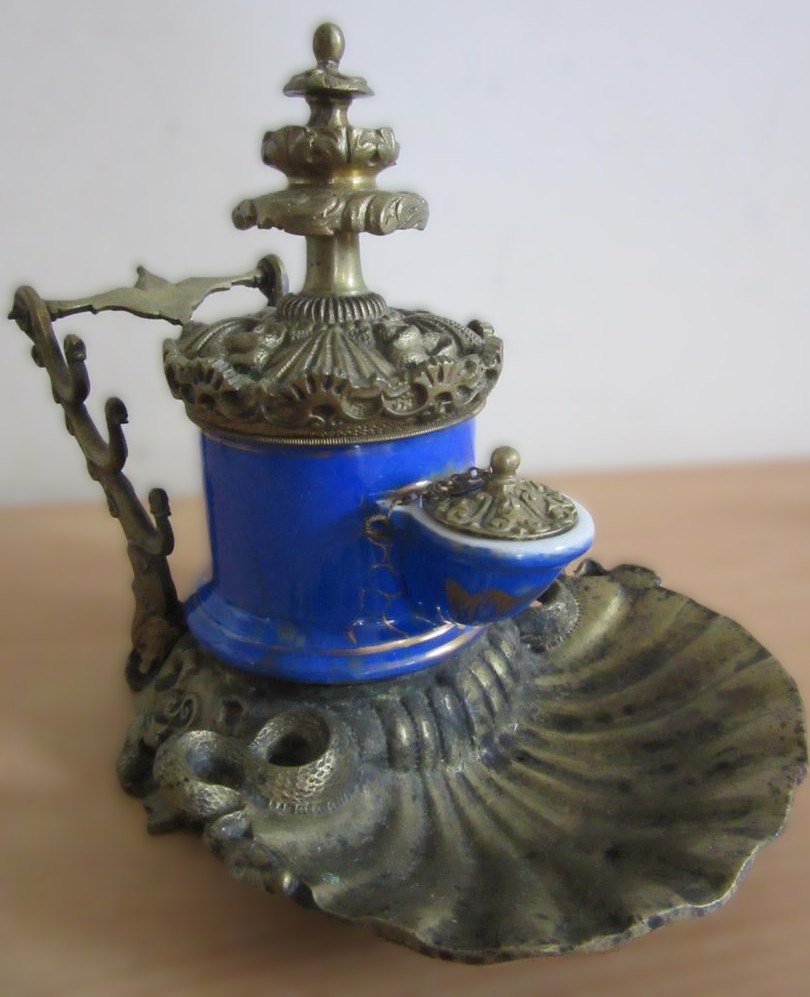
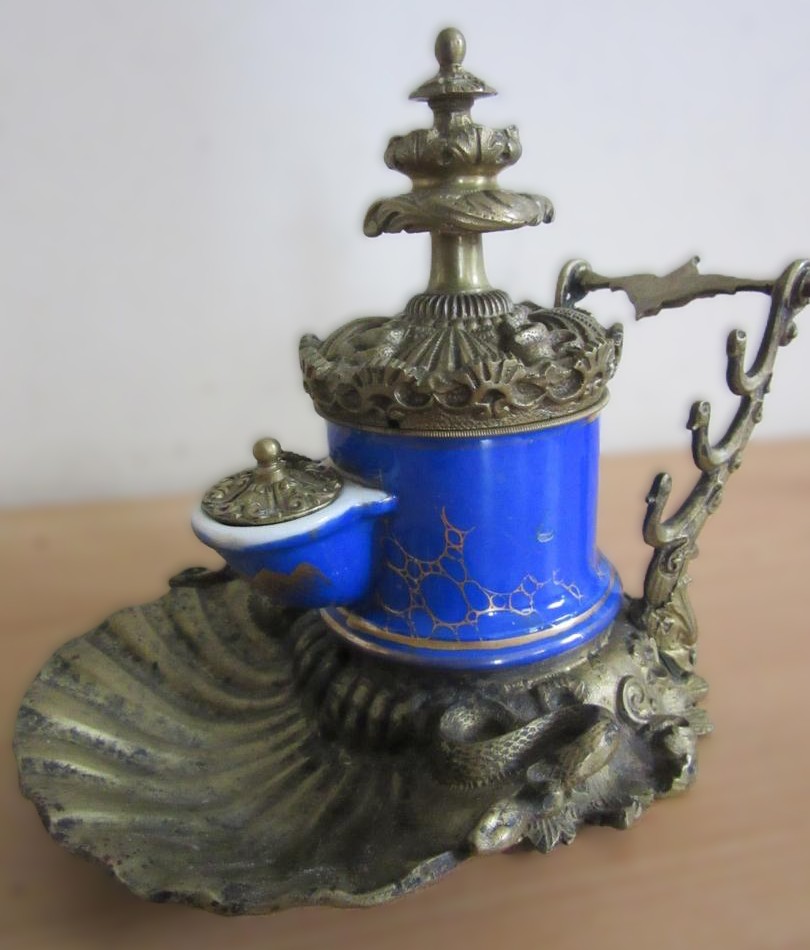
Third Example: Pump-Style Inkstand
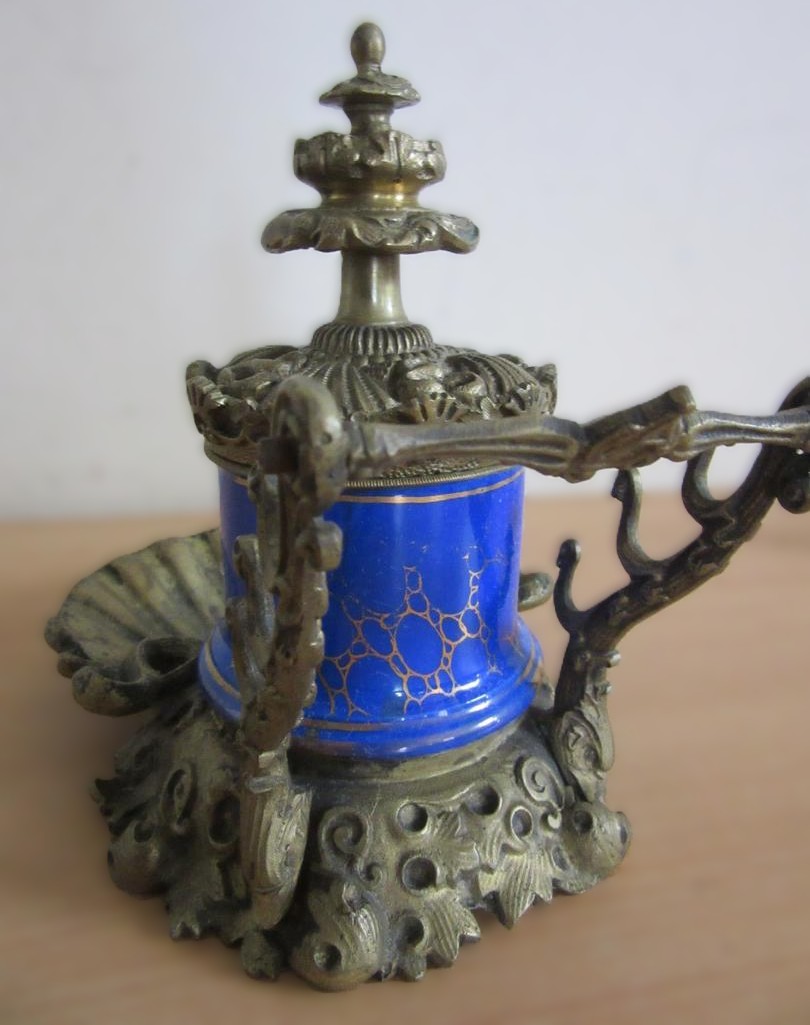
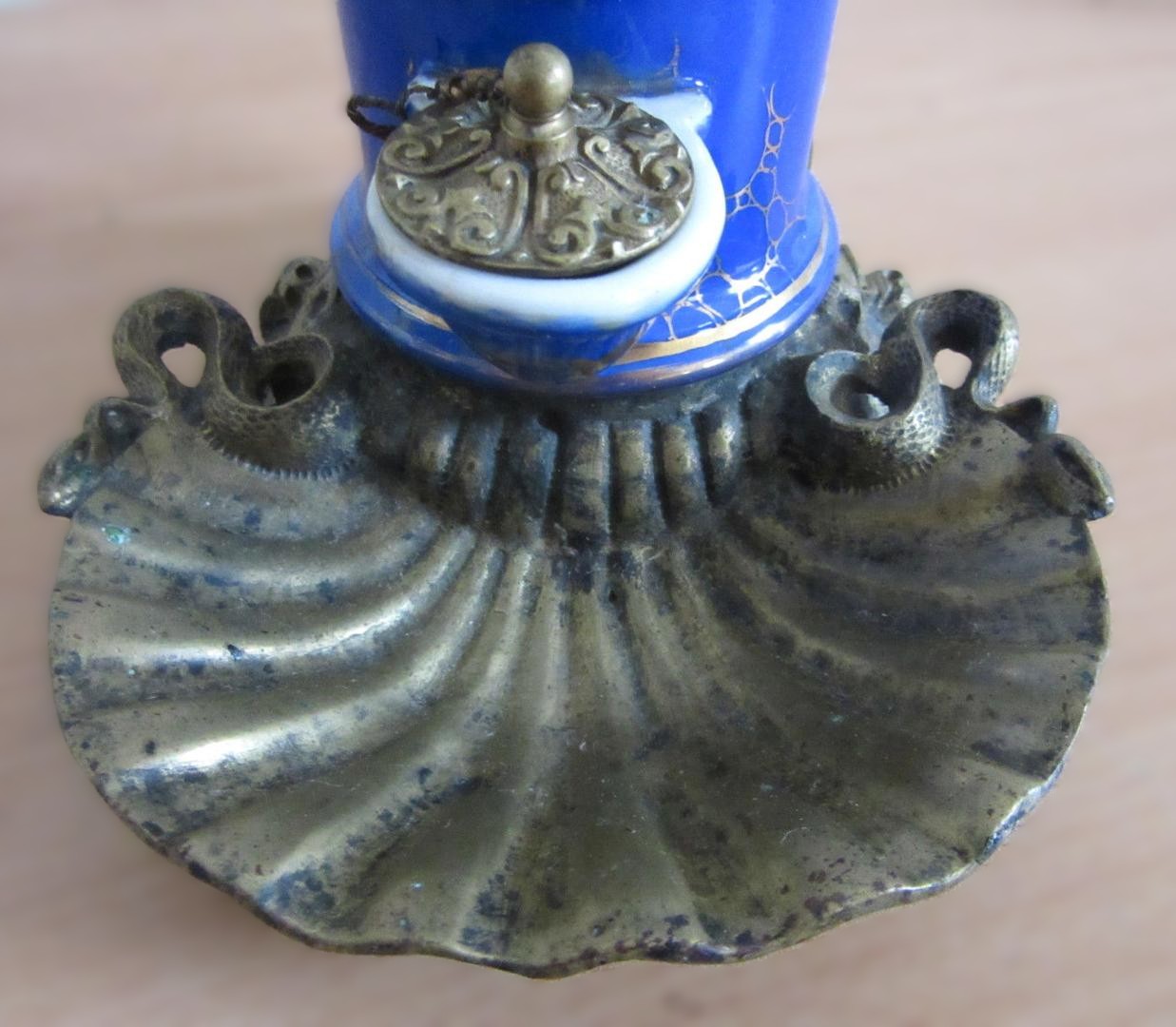
This third example is another fine mid-19th-century French mechanical pump inkstand (circa 1840–1870), exhibiting a cohesive thematic design distinct from the previous two:
- The Shell Tray & Base: The cast brass or bronze tray is sculpted directly in the shape of a fluted scallop shell (replacing the separate mother-of-pearl inserts of the earlier models). The junction where the shell meets the central reservoir is flanked by detailed, coiled serpents resting along the rim.
- The Pump Reservoir & Mounts: It features the characteristic cobalt blue porcelain cylinder, here decorated with an intricate gilded crackle or web-like surface pattern rather than floral cartouches. The top cap and multi-tiered finial are heavily chased with ornate foliate scrollwork and crown-like relief motifs. A matching small lid with delicate pierced chasing covers the exterior dipping font.
- The Pen Rest / Rack: Rising from the rear is a stylized structural pen rack, incorporating branching or coral-like vertical supports designed to neatly hold pens.
Estimated value: $200 to $300
Content disclaimer. The information posted is the owner’s best knowledge and may not have been vetted by the SOIC. We welcome comments, corrections, and additions, working to make our website information comprehensive and accurate.
Join the Society of Inkwell Collectors (SOIC) – it’s free!
Founded in 1981 as a non-profit organization,
we are documenting inkwells (and accessories).
We’re here to help and inform!