

Post-Bottom Ink Bottle Mold
| Categories | Ink Bottle |
| Material | Cast iron |
| Origin | United States |
| Date or Era | circa 1890 |
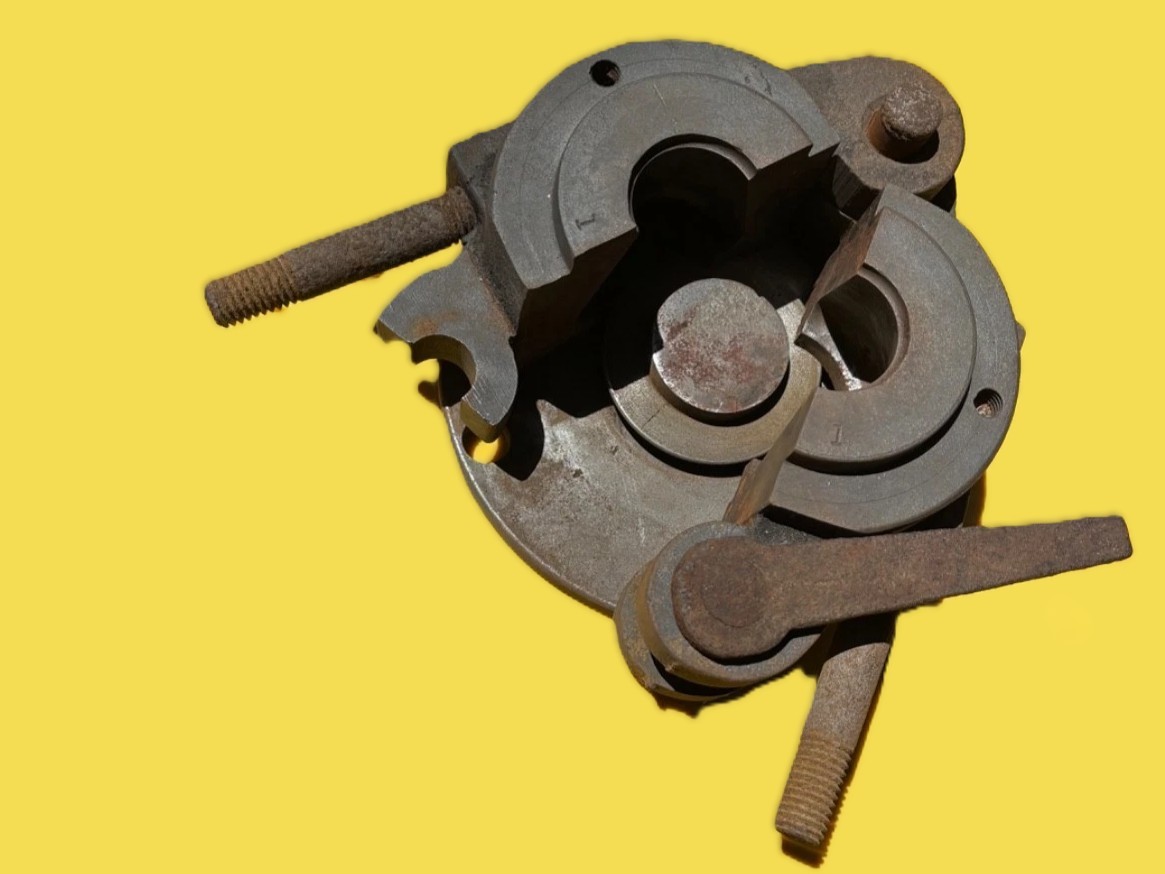
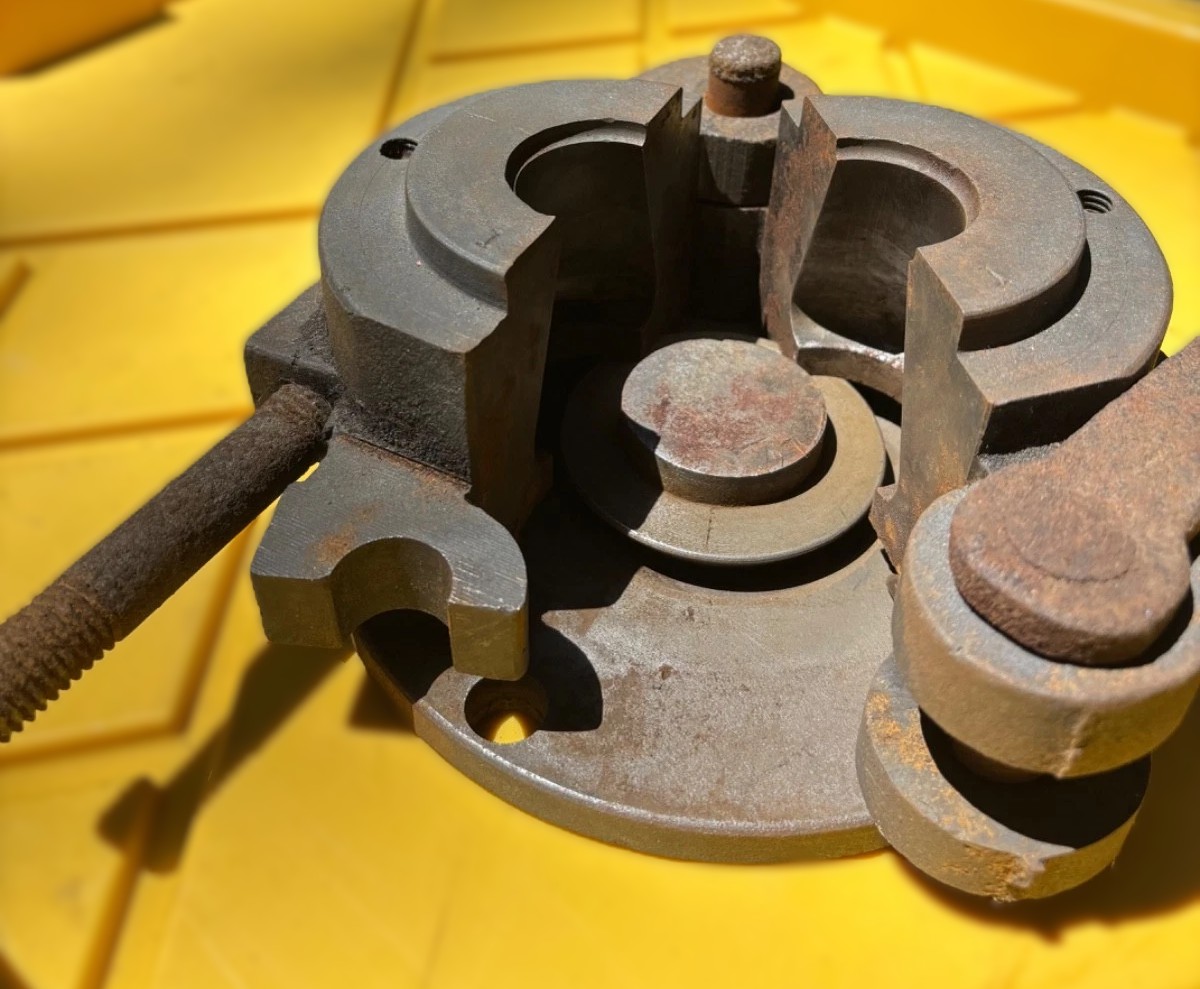
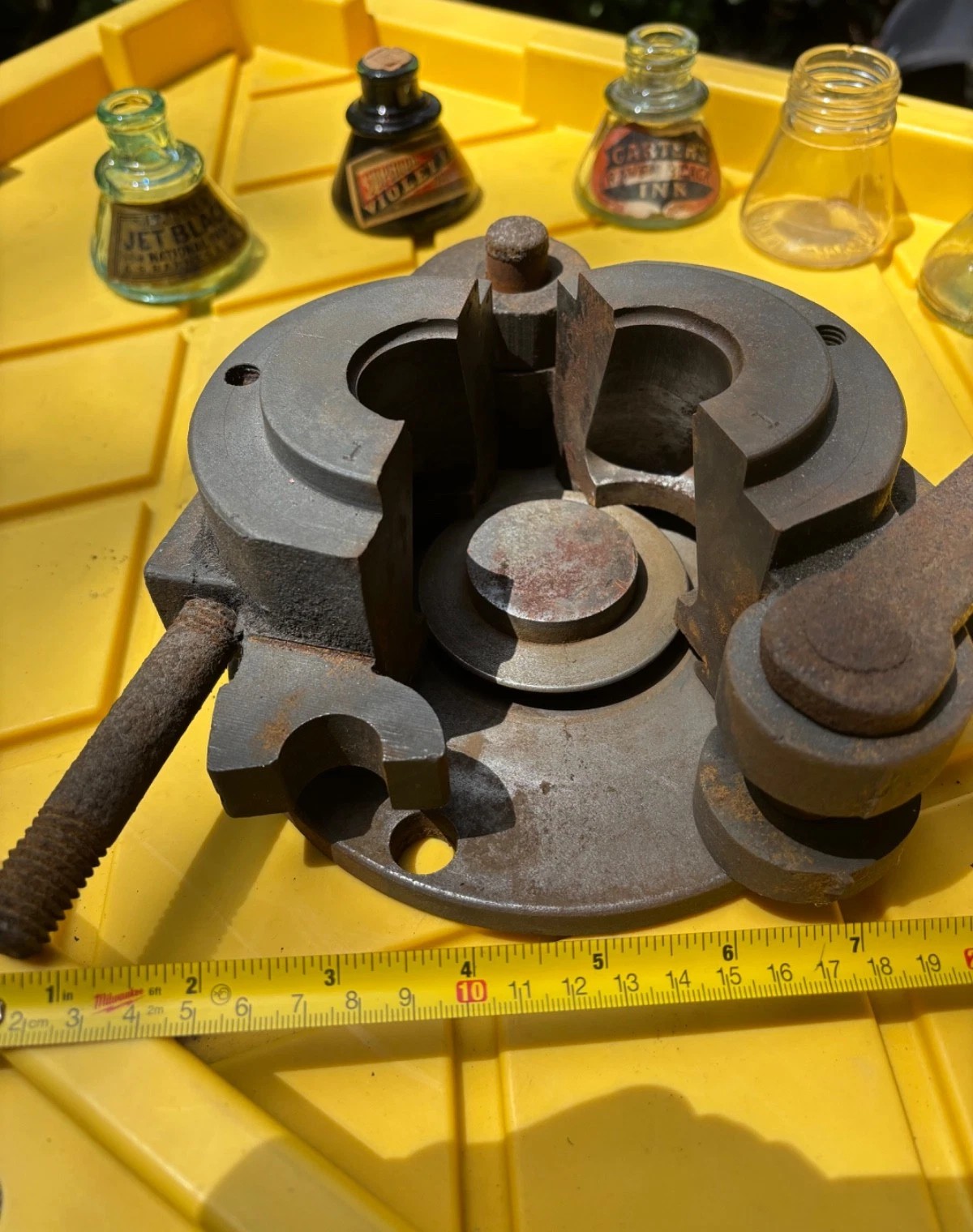
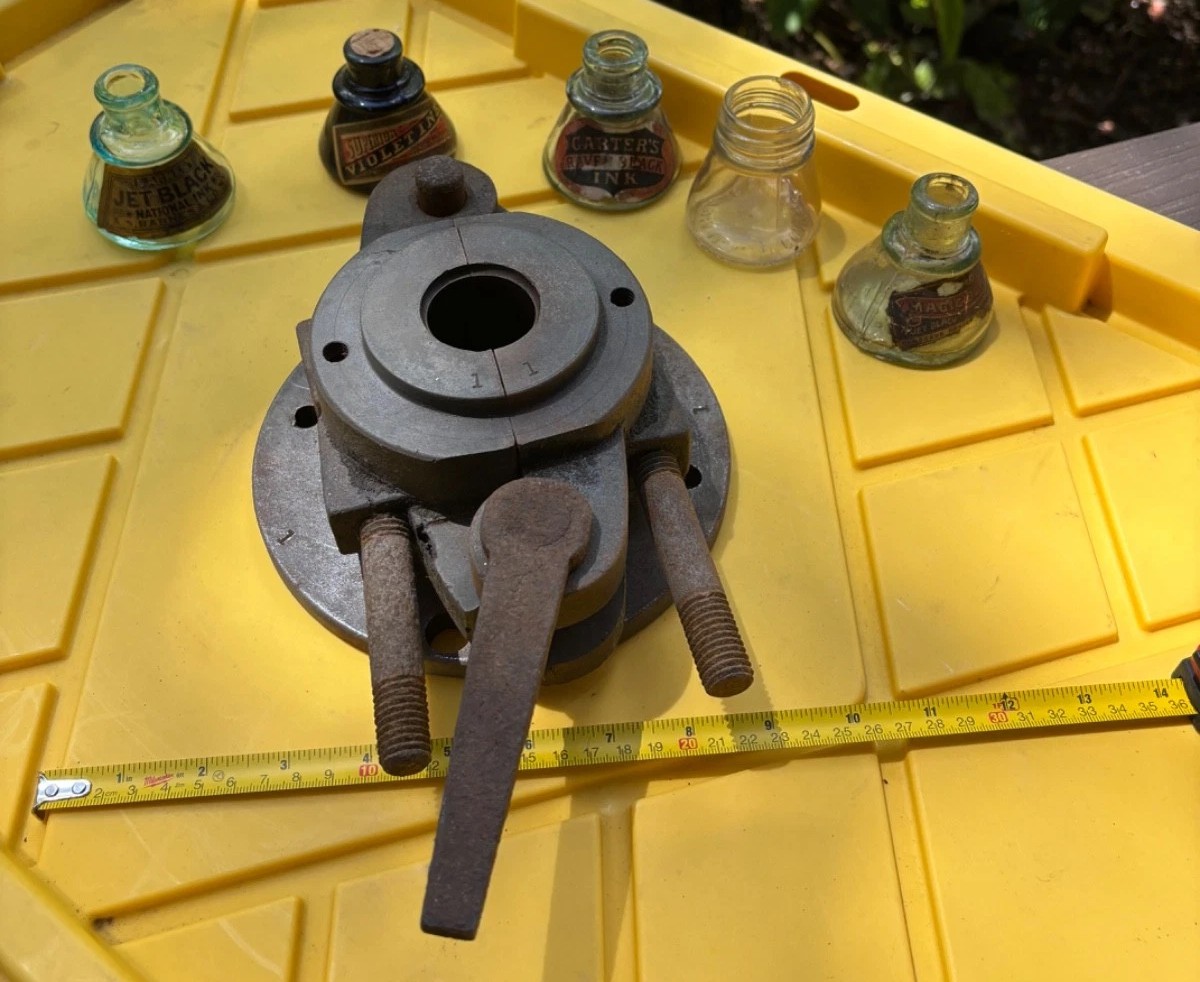
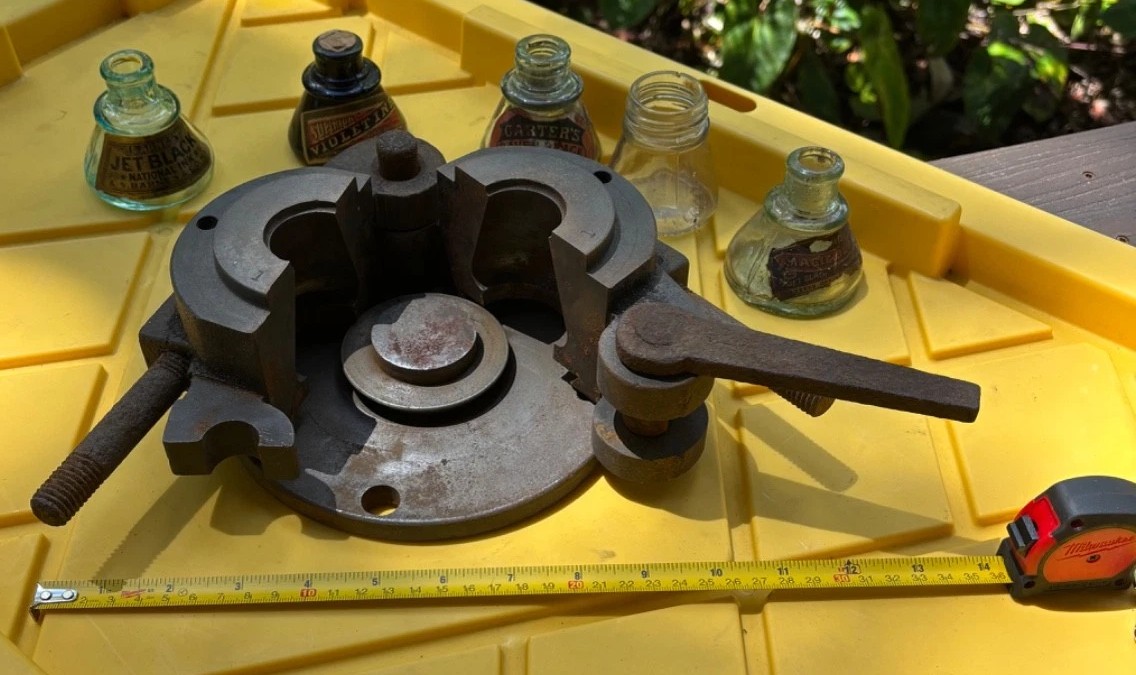
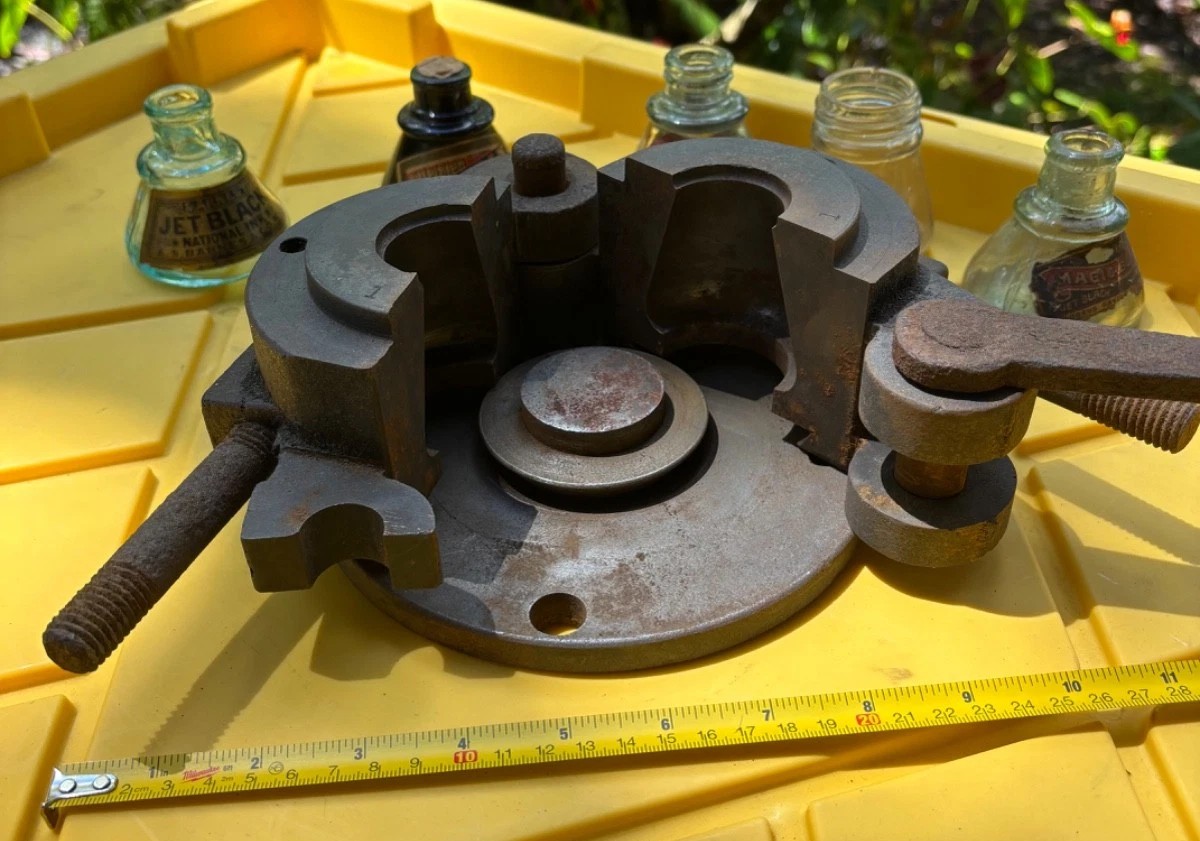
This piece is an antique heavy cast iron post-bottom bottle mold used to blow small cone/pyramid ink bottles by hand during the late 19th and early 20th centuries (circa 1880s–1900s).
Characteristics & Dimensions
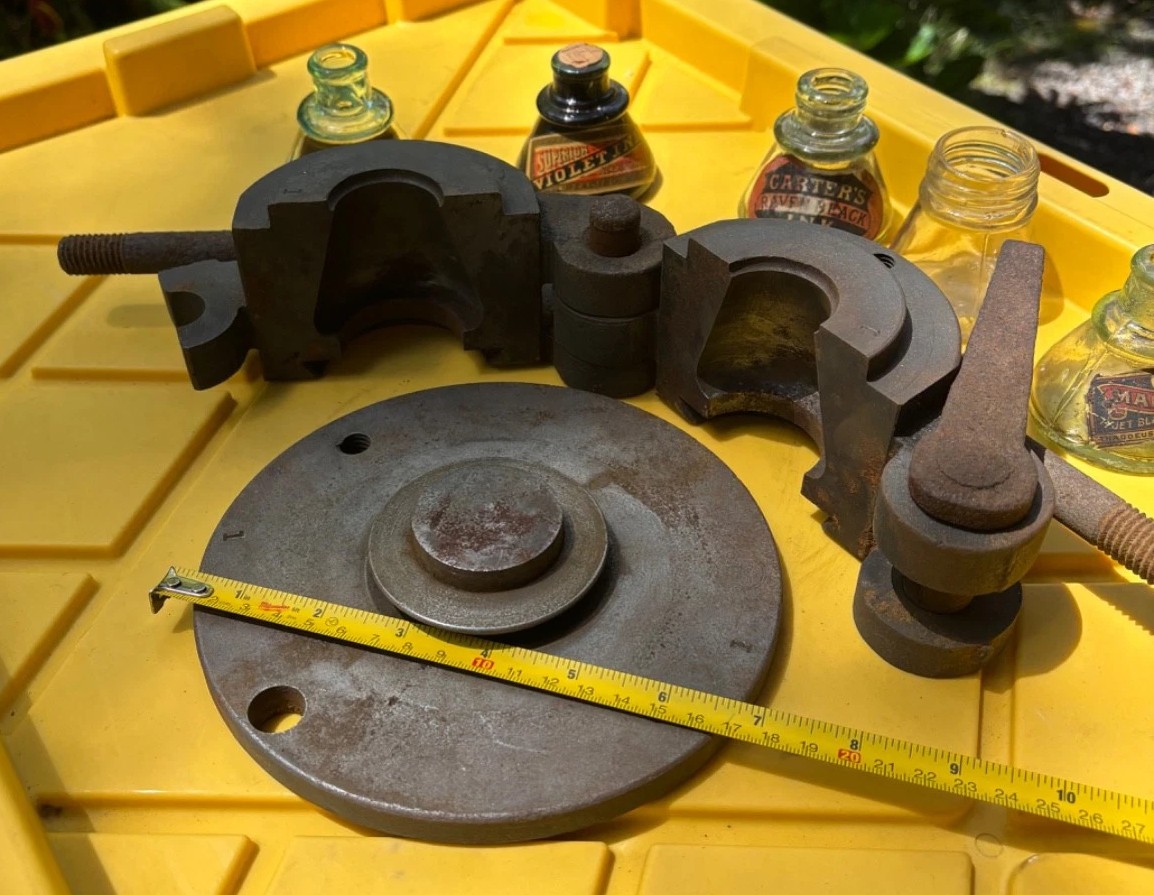
- Base Plate Diameter: The flat circular base plate measures 8 inches across.
- Overall Span / Handles: With the threaded handles and locking mechanism extended, the total width spans roughly 13.5 to 14 inches.
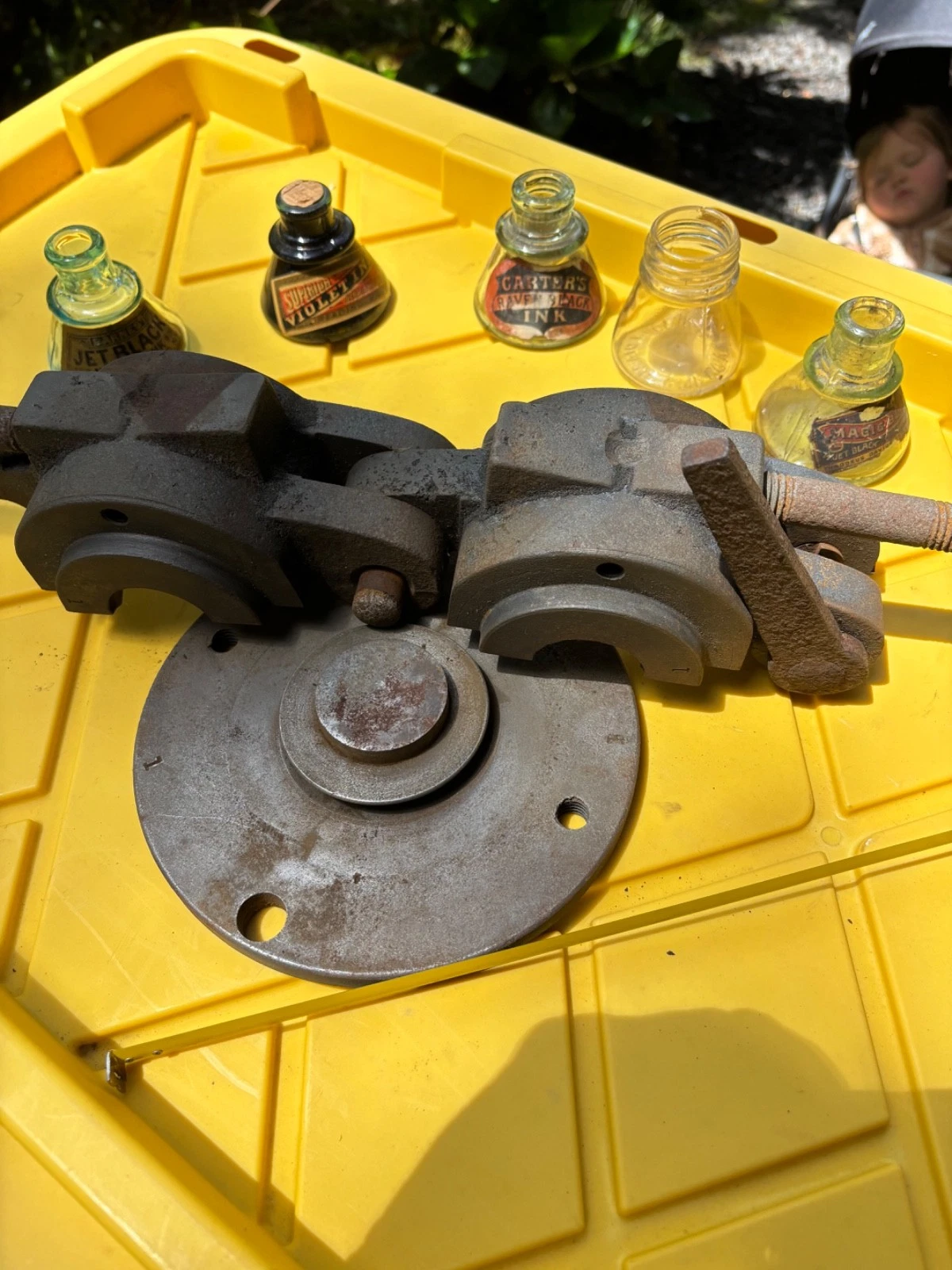
- Internal Cavity: Designed to produce small conical/pyramid-shaped inkwells with a flared shoulder and short neck—virtually identical to the finished 19th-century cone ink bottles sitting behind the mold in the background (such as the Carter’s, Sanford’s, and Thaddeus Davids ink bottles).
How the Mold Worked (Step-by-Step Operation)
During the hand-blown manufacturing era prior to Michael Owens’ invention of the Automatic Bottle Machine (ABM) in 1903–1904, glasshouses operated on a team system (a “shop”) relying on high speed and precise coordination:
- Preparing the Mold: The heavy circular base plate was mounted to a workstation floor or frame. The two hinged side-halves hinged around the central post plate, which formed the circular base (bottom) of the ink bottle.
- Gathering & Pre-Forming: The master glassblower (the gaffer) inserted a hollow iron blowpipe into the furnace to collect a small gather (catch) of molten glass. He rolled the molten glass on a flat metal table (marver) to shape a preliminary hollow bubble called a parison.
- Placing into the Mold: The gaffer lowered the hot parison vertically into the center of the open mold, resting the base of the molten glass directly onto the raised central post plate.
- Closing the Mold: A young assistant (traditionally called a mold boy or servitor) swung the heavy hinged halves shut around the molten glass and secured the locking lever to hold the halves tightly closed.
- Blowing the Bottle: The gaffer blew firmly through the blowpipe, expanding the hot glass inside the cavity until it pressed tightly against the cast iron walls, acquiring the exact conical body shape and base contours.
- Opening & Removal: Once the glass chilled enough to hold its form (a matter of seconds), the mold boy pulled the lever, opened the halves, and the gaffer lifted the newly formed bottle out on the end of his blowpipe.
- Detaching & Finishing: The bottle was cracked or sheared off the blowpipe at the neck. A finishing tool was then used by hand to tool or apply the lip before the bottle was sent to the annealing lehr (cooling oven).
Sold for $221 in July 2026
Content disclaimer. The information posted is the owner’s best knowledge and may not have been vetted by the SOIC. We welcome comments, corrections, and additions, working to make our website information comprehensive and accurate.
Join the Society of Inkwell Collectors (SOIC) – it’s free!
Founded in 1981 as a non-profit organization,
we are documenting inkwells (and accessories).
We’re here to help and inform!