


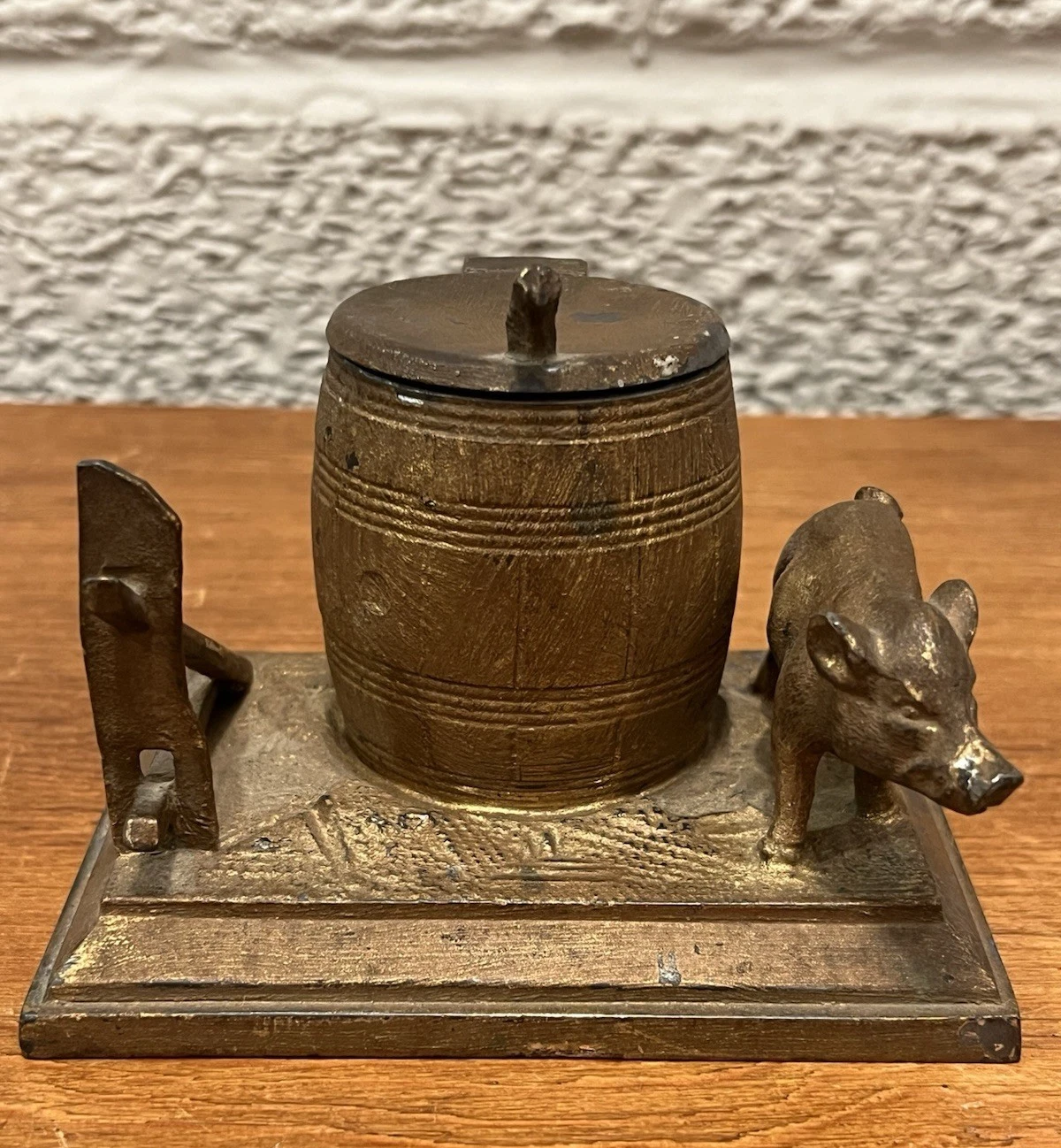


Pig Next to a Barrel
| Categories | Figural - Animals & Living Creatures |
| Type | Pig, Barnyard |
| Material | White metal |
| Markings | See Narrative |
| Manufacturer | Pairpoint |
| Origin | United States |
| Date or Era | circa 1890 |
This figural inkstand depicts a rural farmyard scene.
- Subject: A realistic pig stands next to a large barrel. The barrel itself serves as the inkwell; the lid is hinged to reveal the ink reservoir (the insert is missing).
- Pen Rest: To the left of the barrel, there is a rustic split-rail fence. This is designed functionally as a pen rest to hold your dip pen when not in use.
- Material: It is made of spelter (a zinc alloy) or a white metal base that was originally silver-plated or gilded. The inkstand now has a brassy/bronze tone, which suggests the original plating may have worn away to reveal the base metal, or it was originally finished with a “gold dore” lacquer, which was popular for novelty items in the late 19th century.
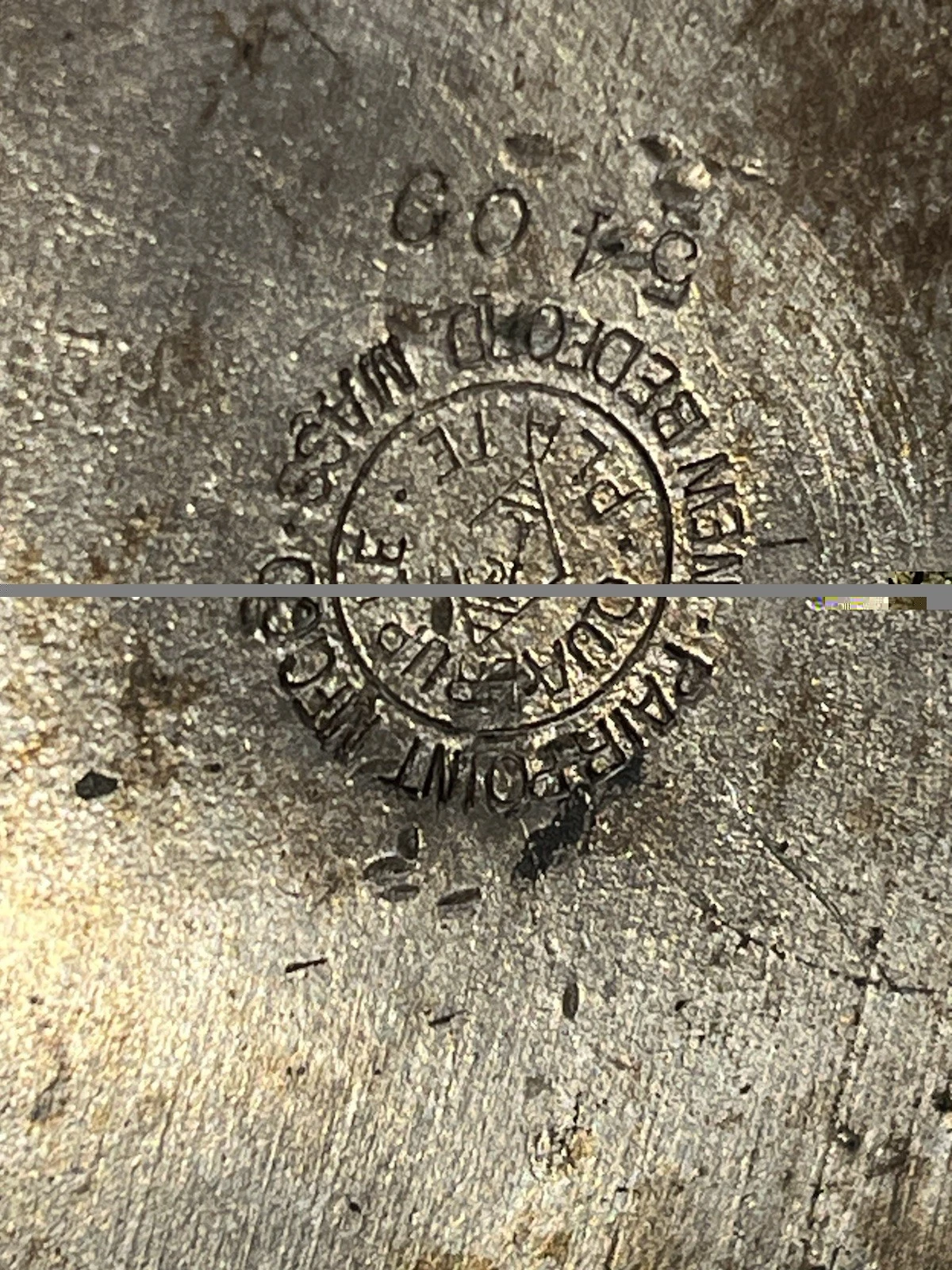
Deciphering the Mark
The mark on the underside is the standard seal for this company during the late 19th century. It reads:
PAIRPOINT MFG CO. NEW BEDFORD MASS 5409
- “P” in Diamond: In the center of the circle, you can see the letter “P” inside a diamond shape. This was the specific trademark for Pairpoint’s electroplated silver.
- 5409: This is the pattern number. Manufacturers used these four-digit codes to identify specific designs in their trade catalogs.
History of Pairpoint Manufacturing Co.
Pairpoint is one of the most storied names in American decorative arts, often mentioned in the same breath as Tiffany for their contributions to glass and metalwork.
- Founding (1880): The company was founded in 1880 in New Bedford, Massachusetts, by Thomas J. Pairpoint, a silversmith who had previously worked for the famous Meriden Britannia Company. It was initially established to manufacture silver-plated metal mounts (bases and lids) for the glass made by the neighboring Mount Washington Glass Company.
- Merger: The two companies (Pairpoint and Mt. Washington) had a close relationship and eventually merged in 1894, though they continued to operate under their own names for several years.
- Reorganization: The company is famous for its “Puffy” lamps (reverse-painted glass shades) and rich cut glass, but these largely came later. In 1900, the company was reorganized and renamed The Pairpoint Corporation.
When was this made?
This inkstand can be dated to circa 1880–1900.
- The Clue is in the Name: The mark says “Pairpoint Mfg Co.” This specific company name was used from its founding in 1880 until the reorganization in 1900. After 1900, wares were typically marked “The Pairpoint Corp”.
- Style: The naturalistic “barnyard” novelty style was at the height of fashion during the 1880s and 1890s, catering to the Victorian love for whimsical, sentimental, or rural subjects on their writing desks.
Sold for $75 in November 2025
Content disclaimer. The information posted is the owner’s best knowledge and may not have been vetted by the SOIC. We welcome comments, corrections, and additions, working to make our website information comprehensive and accurate.
Join the Society of Inkwell Collectors (SOIC) – it’s free!
Founded in 1981 as a non-profit organization,
we are documenting inkwells (and accessories).
We’re here to help and inform!