


Peter Rabbit
| Categories | Figural - Animals & Living Creatures, Figural - Mythology; Literature; Religion; Fictional |
| Type | Fictional, Rabbit |
| Material | White metal |
| Manufacturer | Undetermined |
| Origin | Undetermined |
| Date or Era | circa 1900 |
| Measuring | 7 ½” x 7 ½” x 5 ½” |
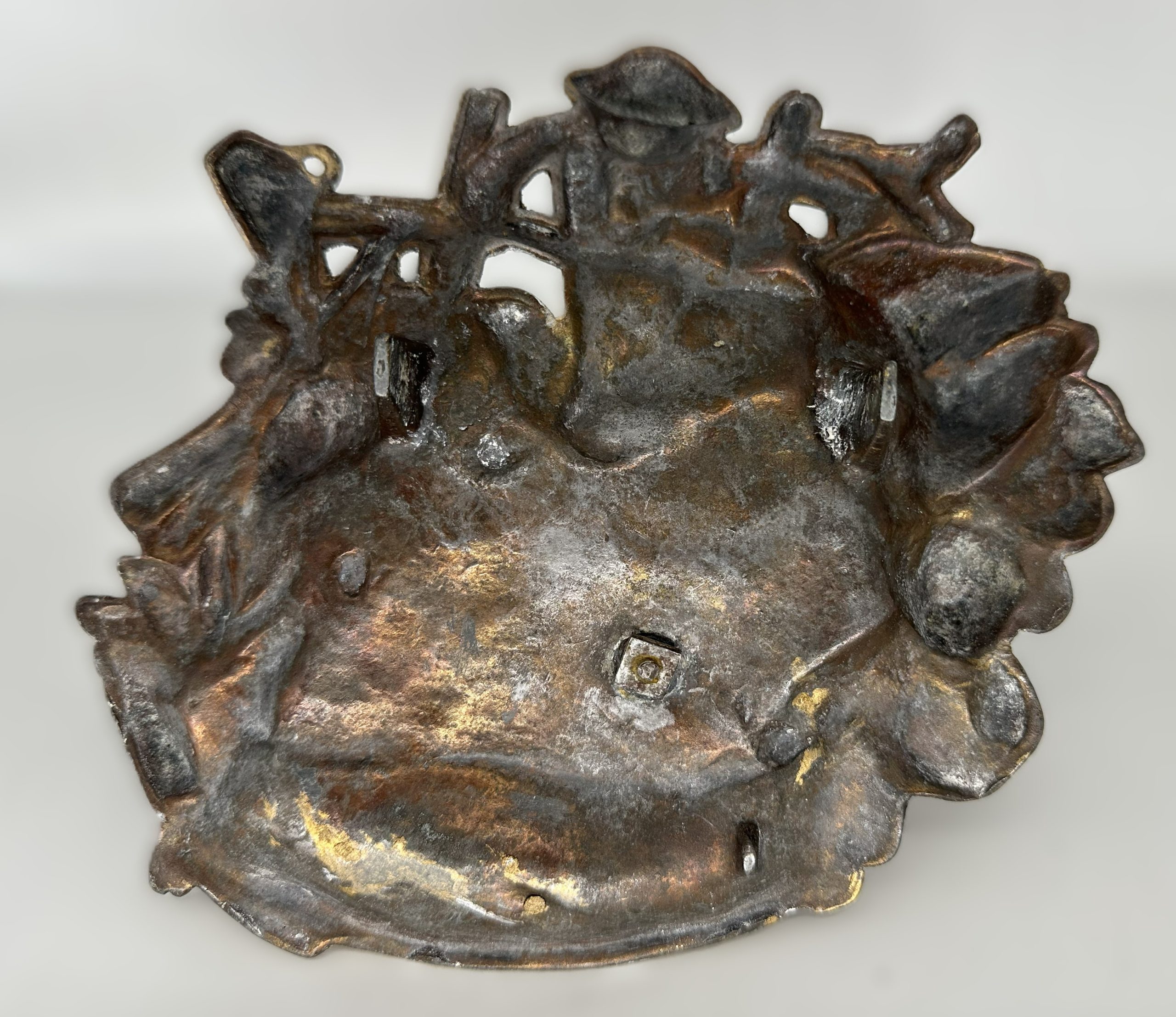
This figural desk inkstand depicts a charming, dynamic garden scene cast in relief:
- The Inkwell & Cover: A large hare/rabbit sits upright inside a woven basket on a leaf base; the rabbit’s upper body and basket rim form the hinged lid, opening to reveal a removable white ceramic inkwell insert.
- Garden Scene & Perimeter: At the rear, a wide-brimmed hat-wearing farmer/gardener peers over a rustic post-and-rail fence. Scattered around the textured ground and integrated into the pen tray base are garden elements including a doghouse/shed structure, a smaller companion rabbit, a pitchfork, an overturned watering can, a broom, and broad cabbage leaves forming the tray contours.
- Construction & Material: Cast white metal (spelter/pot metal) with an applied gilt or bronze-wash finish, showing characteristic dark gray metal core on the underside and hinge interior, secured with a square-nut assembly beneath.
Connection to The Tale of Peter Rabbit
While evocative of Beatrix Potter’s classic 1902 tale—specifically Peter raiding Mr. McGregor’s garden with its fence, watering can, and cabbages—this piece is not an authorized Beatrix Potter product, but rather part of the broader late 19th/early 20th-century European trend of anthropomorphic, narrative animal novelties:
- Potter closely guarded her copyright and licensed specific porcelain and pewter merchandise (beginning with the 1903 patented Peter Rabbit doll).
- The rustic, slightly mischievous “rabbit in the cabbage patch” motif was already a widely popular Victorian and Art Nouveau trope popularized across Continental decorative arts and storybook illustration prior to and alongside Potter’s work.
Origin, Maker, and Date
- Origin / Region: Most likely Germany, Austria (Vienna), or France, which heavily produced elaborate spelter (régule) and cold-painted or gilt-washed zinc-alloy desk sets. Similar models were also produced by English novelty metalware foundries, though the style and underside casting strongly mirror Continental spelter novelties.
- Maker: Unmarked, which is standard for mass-produced Continental zinc/spelter novelties of this era (often sold via export catalogs or retailers without foundry marks).
- Period of Manufacture: Circa 1895–1915
Estimated value: $150
Content disclaimer. The information posted is the owner’s best knowledge and may not have been vetted by the SOIC. We welcome comments, corrections, and additions, working to make our website information comprehensive and accurate.
Join the Society of Inkwell Collectors (SOIC) – it’s free!
Founded in 1981 as a non-profit organization,
we are documenting inkwells (and accessories).
We’re here to help and inform!