




Ottoman Divit
| Categories | Middle East / Africa |
| Type | Qalamdan / Divit |
| Material | Brass |
| Markings | Unmarked |
| Manufacturer | Undetermined |
| Origin | Undetermined |
| Date or Era | circa 1820 |
| Measuring | 8 ¾” x 2 ¼” x 1 ½” high |
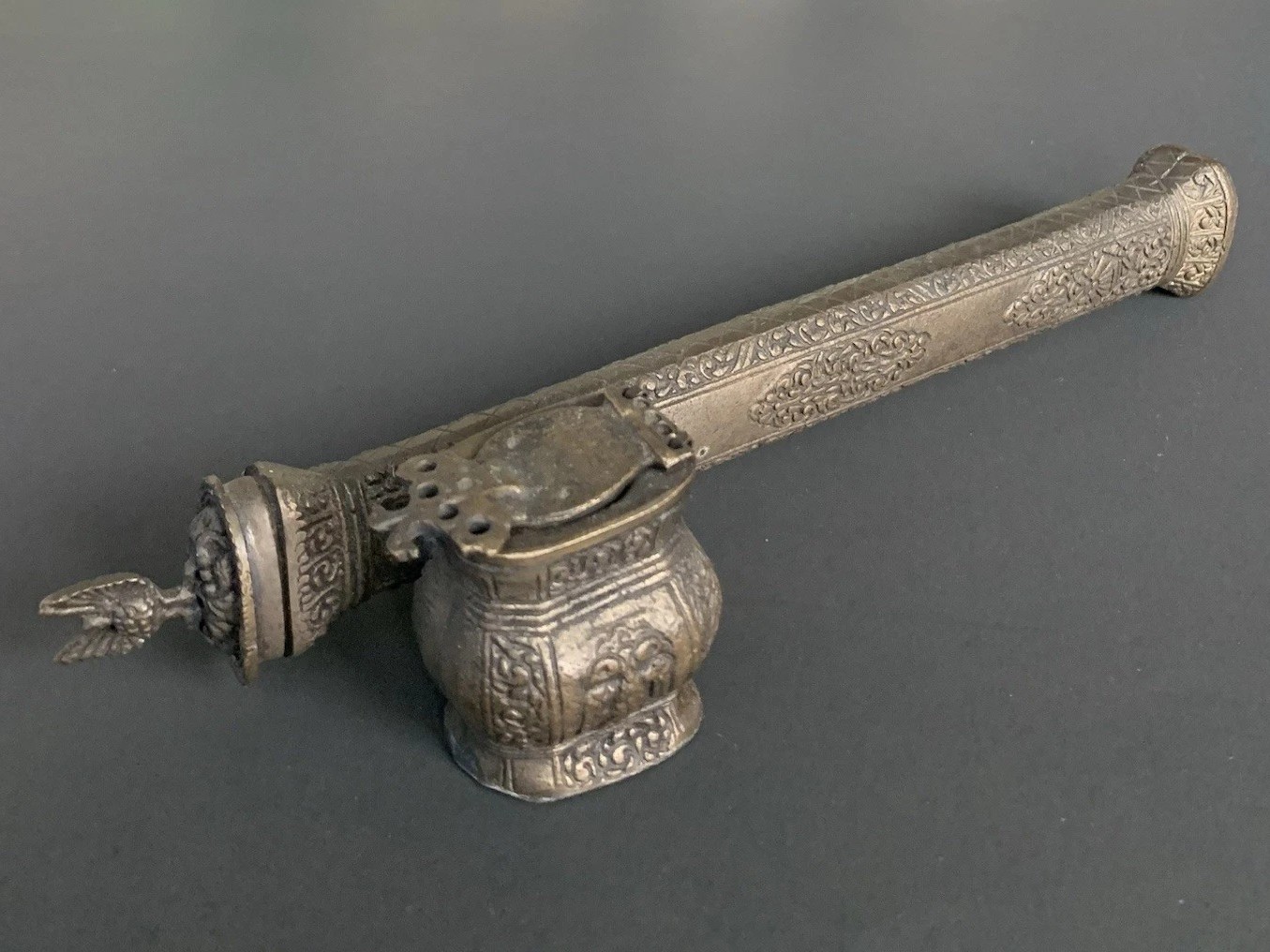
This is a nice example of a portable scribe’s case, historically known as a qalamdan (in Persian/Arabic contexts) or more specifically an Ottoman divit (the Turkish term for this specific combined pencase and inkwell design).
- Description, Origin, and Date
- What it is: A portable brass writer’s set designed to be slipped into a sash or belt by a traveling merchant, scribe, clerk, or government official.
- Where it was made: While built in the distinct Ottoman structural style, the prominent design motifs strongly point toward the Ottoman Balkans (regions such as modern-day Greece, Bulgaria, Serbia, or Albania).
- When it was made: This style was widely manufactured and used throughout the 18th century and 19th century. This example dates to the early 19th century.
- The Anatomy of a Divit: Parts & Usage
The object is engineered to be entirely self-contained and spill-proof for travel:
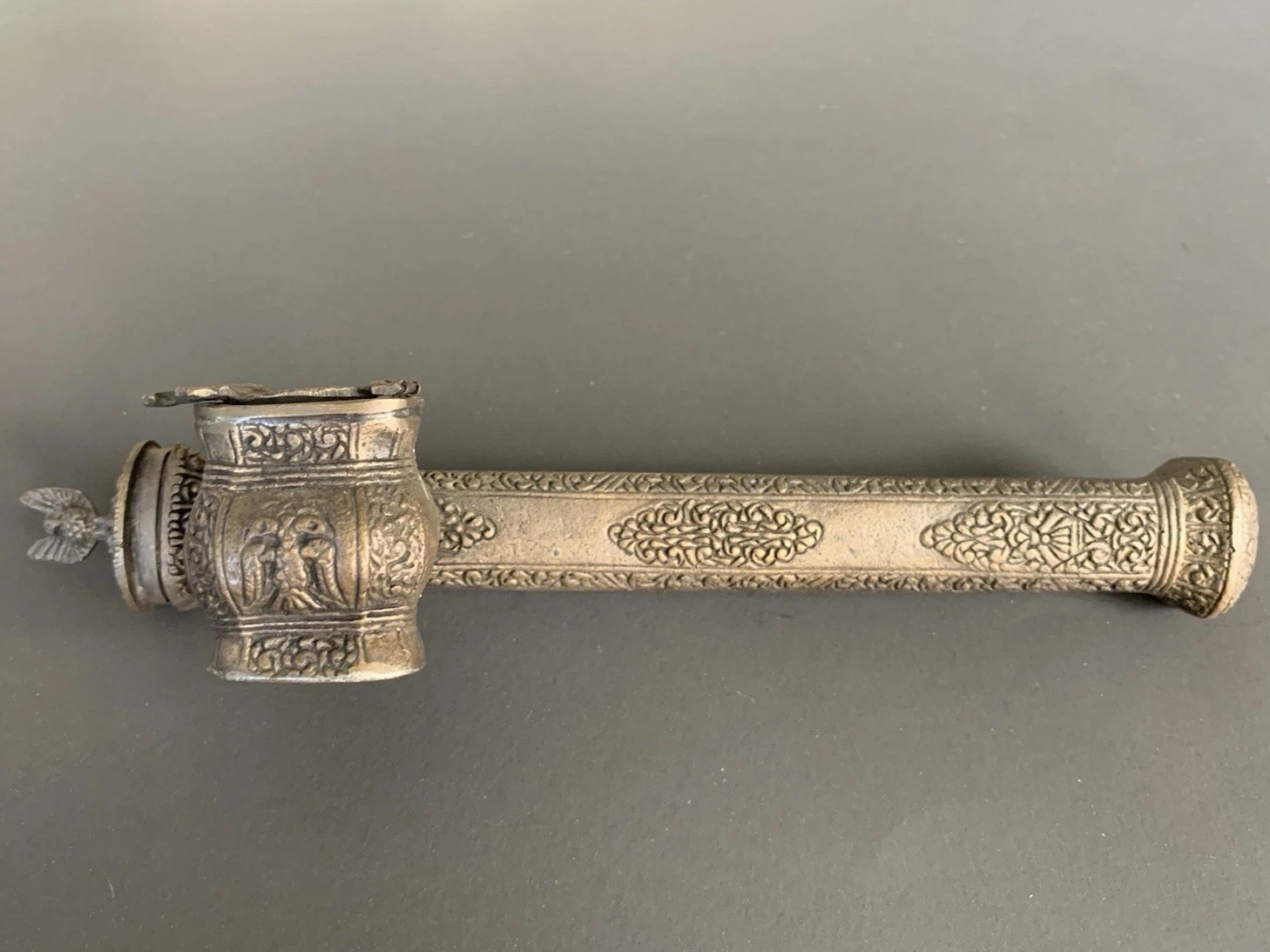
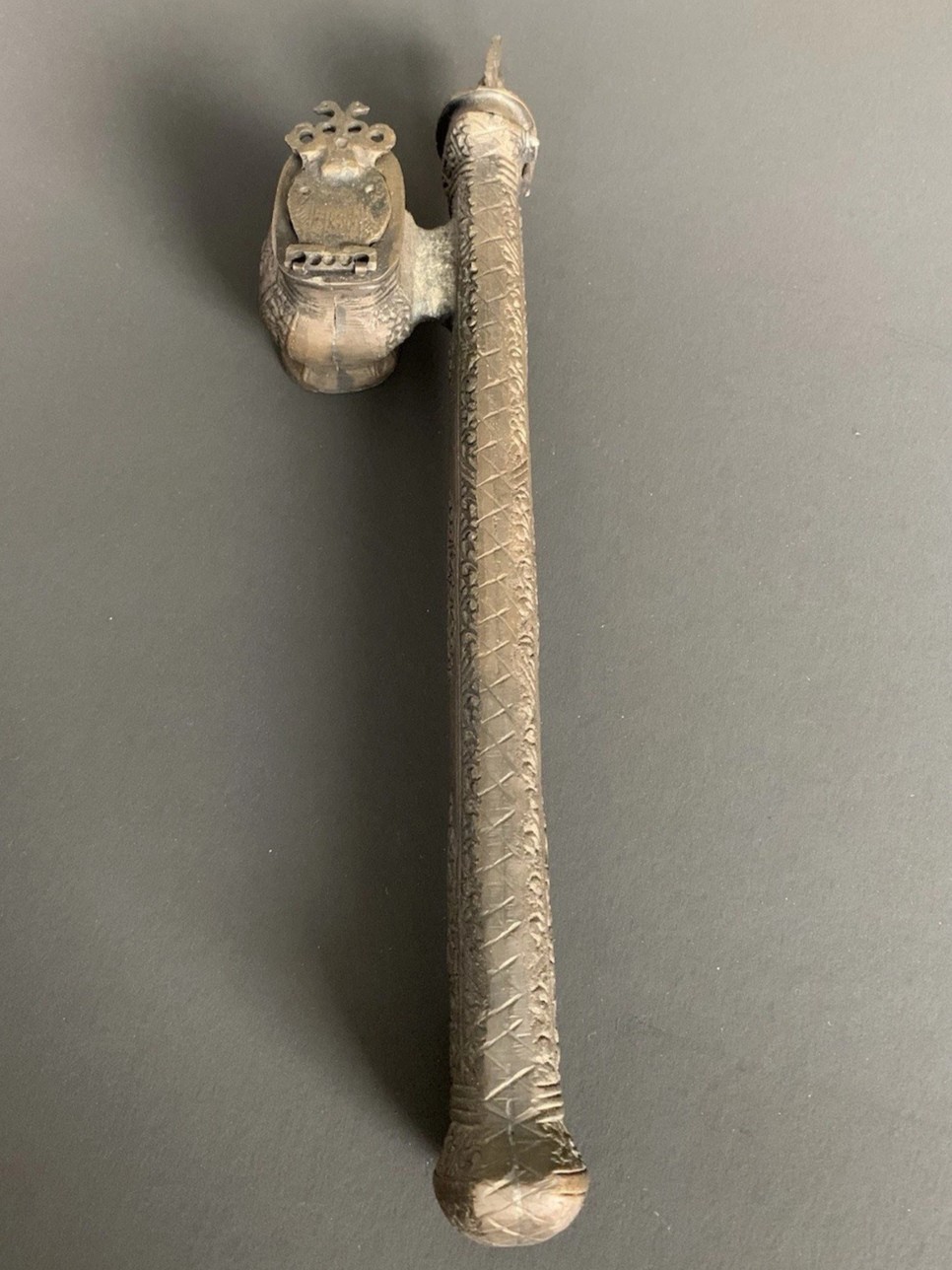
- The Pen Barrel (Kubur): The long, slender, rectangular-to-cylindrical tube houses reed pens (qalam) or early metal dip pens. Writing instruments were carefully slipped inside to protect their delicate split-nib tips from breaking.
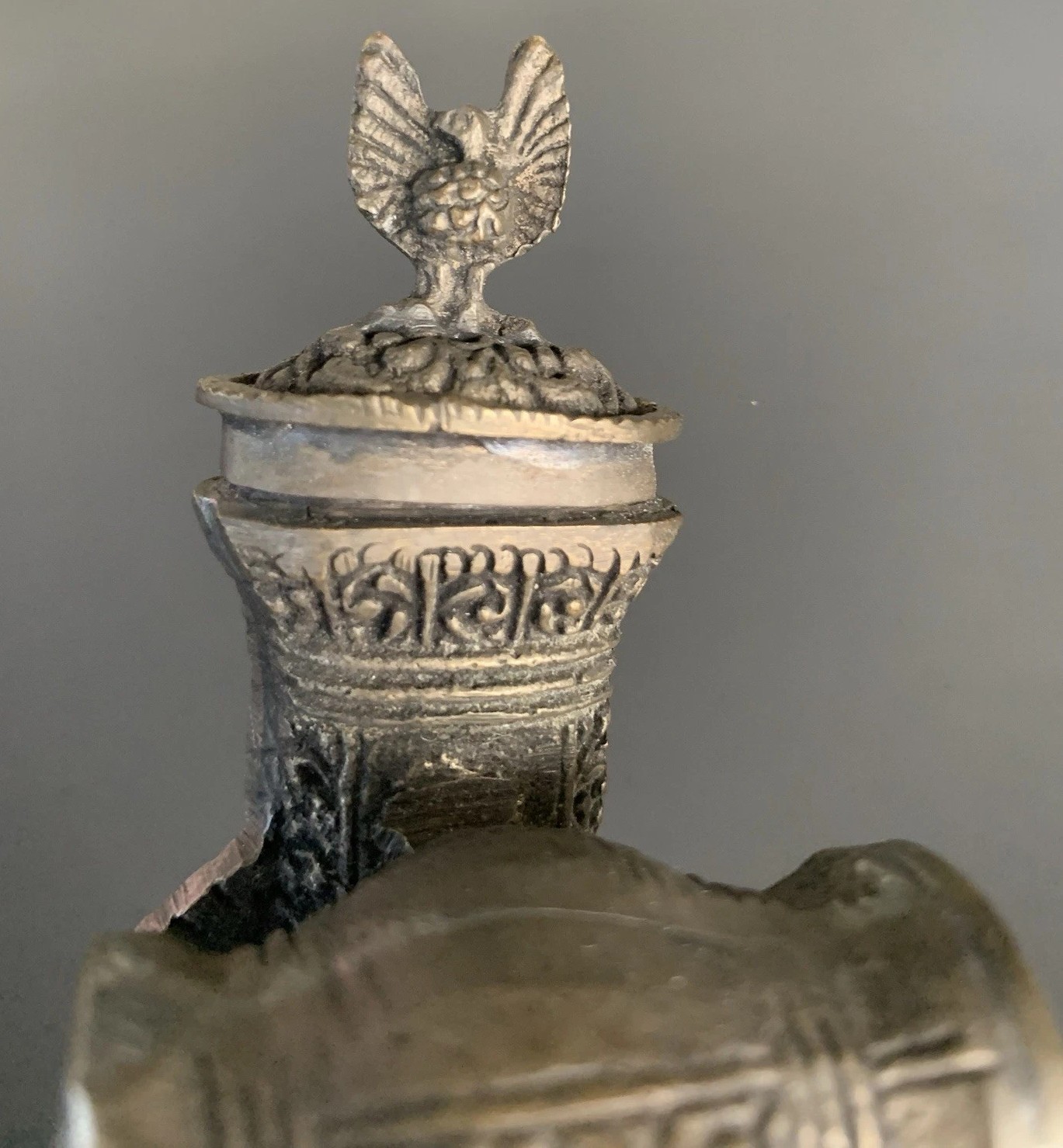
- The End Cap: The barrel is sealed by a hinged cap at the top. On this piece, the lid is secured and adorned with a sculptural bird/eagle finial that pulls double duty as a decorative handle to open the case.
- The Inkwell (Hokka or Divit proper): The bulbous, pot-like vessel welded to the side of the barrel holds the ink.
- How it was used without spilling: In the Ottoman tradition, the inkwell wasn’t filled with ink only. Instead, scribes stuffed it with raw, unspun silk fibers (lika). The silk acted like a sponge, absorbing the ink and preventing it from sloshing out when the lid was opened or when the writer was walking. To write, the scribe simply pressed the tip of the reed pen into the saturated silk fibers to load just the right amount of ink without blotting.
- The Lid: The inkwell features a tightly fitted hinged lid with a decorative, pierced pull-tab to keep the ink from drying out.
- Markings
There are no official maker’s marks, signatures, silver/metal assay stamps (such as an Ottoman tughra or provincial hallmarking). This is common for brass or bronze utilitarian provincial wares of the era, which were hand-cast and chased in local bazaars rather than stamped by imperial court goldsmiths.
- Significance of the Design Elements
The Double-Headed Eagle
The most telling feature of this piece is the relief of the double-headed eagle on the front facing of the inkwell, paired with a similar stylized double-headed silhouette on the lid’s thumbpiece.
- Cultural Context: While the single-headed eagle appears occasionally in Seljuk and early Islamic art, the distinct double-headed eagle is fundamentally a Byzantine imperial symbol. Following the fall of Byzantium, it remained deeply embedded in the identity of Balkan Christian populations (Greeks, Serbs, Albanians, and Bulgarians) and the Eastern Orthodox Church.
- Scribal Significance: The presence of this icon suggests the piece was likely made by or for a Christian merchant, cleric, or local administrator living within the multi-ethnic Ottoman Empire.
The Scrollwork and Geometric Patterns
The rest of the barrel and inkwell are covered in chased foliate scrolls, stylized palmettes, and a cross-hatched geometric pattern down the spine of the pen tube. This blend of traditional Islamic-style floral scrollwork (rumi or arabesque) alongside local Balkan iconography is typical of the cross-cultural metalwork found in late Ottoman-era regional trading hubs.
More Information About Dating the Piece
While pinning down an exact calendar year on provincial brassware without a dated inscription or maker’s mark is impossible, we can look at the stylistic execution and historic production trends to arrive at a much tighter window: circa 1780–1840.
Here is the reasoning behind why this piece sits firmly at the turn of the 19th century:
- The Proportions and Design Evolution
Earlier Ottoman divits from the 16th and 17th centuries tend to have incredibly long, ultra-slender, very sharp-edged rectangular barrels, often with tiny, compact inkwells. By the late 18th century and moving into the 19th century, the barrels became somewhat thicker and heavier, and the inkwells grew larger and more rounded to facilitate longer writing sessions between refills. The bulbous, lobed, melon-like shape of this inkwell is classic for the late 18th and early 19th centuries.
- The Chasing and Casting Style
The relief decoration on this piece—particularly the stylized floral panels on the side of the inkwell and the cross-hatched geometric pattern down the top spine of the barrel—is characteristic of Balkan metalwork from the late Ottoman Baroque period. During this era, traditional Islamic arabesques began to merge with stylized European floral motifs. The cast-brass hinge work, the specific openwork (pierced) layout of the inkwell thumbpiece, and the cast finial all point to regional workshop techniques common between 1780 and 1840.
- The Iconographic Context
The integration of the prominent double-headed eagle cast directly into the body panel suggests this piece was made during a period of rising regional identity in the Balkans (such as Greece, Serbia, or Bulgaria) under late Ottoman rule. During the late 18th and early 19th centuries, wealthy Christian merchants, clergy, and administrative scribes increasingly commissioned fine brass everyday objects that proudly displayed these cultural and religious emblems.
Summary
This piece accurately be described as late 18th to early 19th century, likely dating to the late Georgian or early Victorian era (c. 1780–1840). It represents the height of the portable scribe’s kit before mass-produced Western European stationery and fountain pens began flooding the Mediterranean markets in the mid-to-late 19th century.
Sold for $232 in May 2026
Content disclaimer. The information posted is the owner’s best knowledge and may not have been vetted by the SOIC. We welcome comments, corrections, and additions, working to make our website information comprehensive and accurate.
Join the Society of Inkwell Collectors (SOIC) – it’s free!
Founded in 1981 as a non-profit organization,
we are documenting inkwells (and accessories).
We’re here to help and inform!