





Orientalist Desk Stand – Bedouin Warrior on Camel
| Categories | Middle East / Africa |
| Type | Arab |
| Material | Bronze, Marble |
| Markings | Unmarked |
| Manufacturer | Undetermined |
| Origin | Austria |
| Date or Era | circa 1900 |
| Measuring | 13 ½” x 8 ⅝” x 7 ½” high |
- The Marble Base: Portoro
The base is made of Portoro marble (also known as Black and Gold marble or Nero Portoro).
- Characteristics: This is a high-end Italian marble extracted from the Gulf of Poets in La Spezia. It is famous for its deep, jet-black color with intense, jagged veins of gold or orange-yellow.
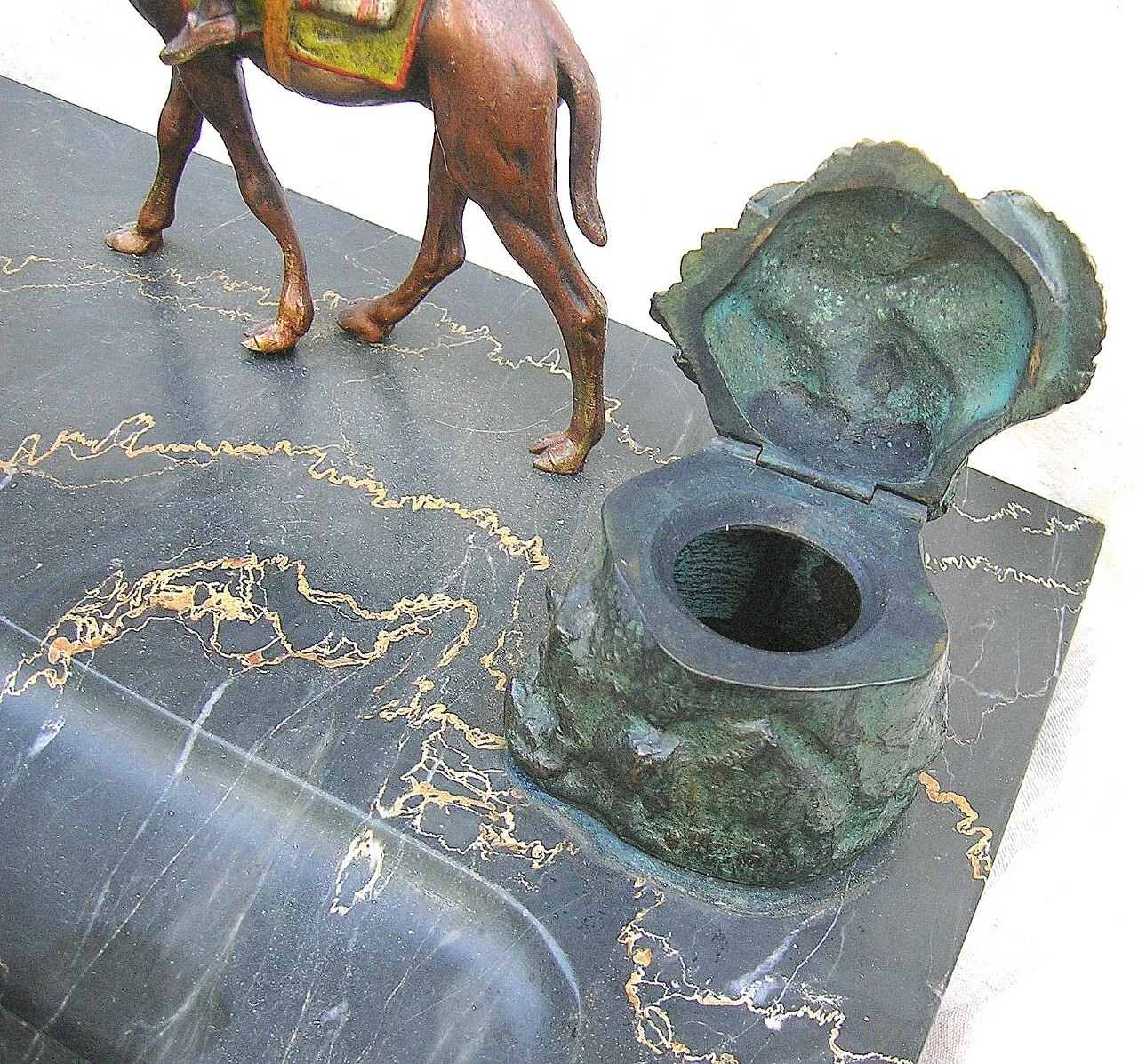
- Function: The stone has been carved with a shallow groove across the front to serve as a pen tray.
- The Figure: Arab Warrior on Camel
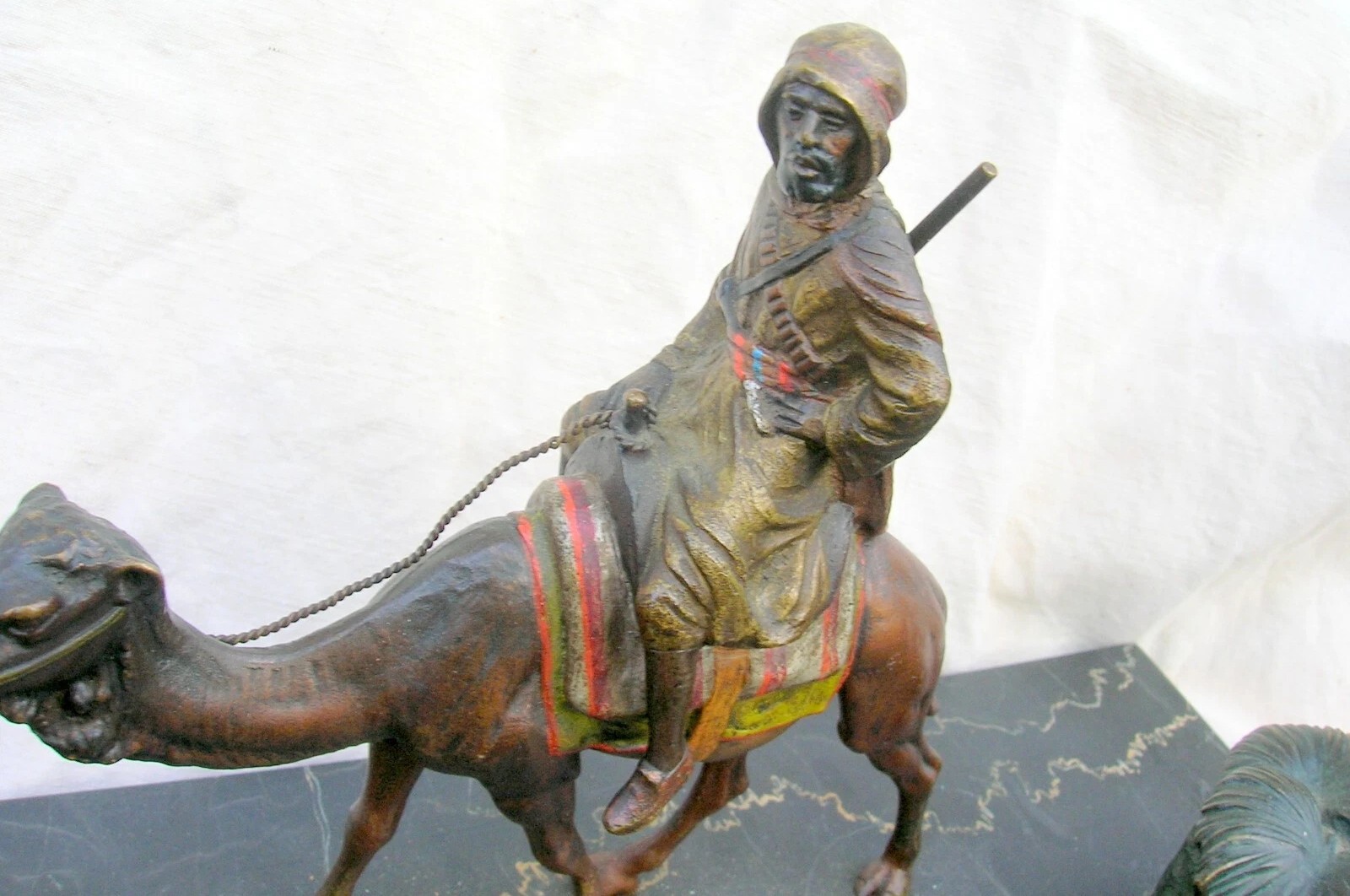
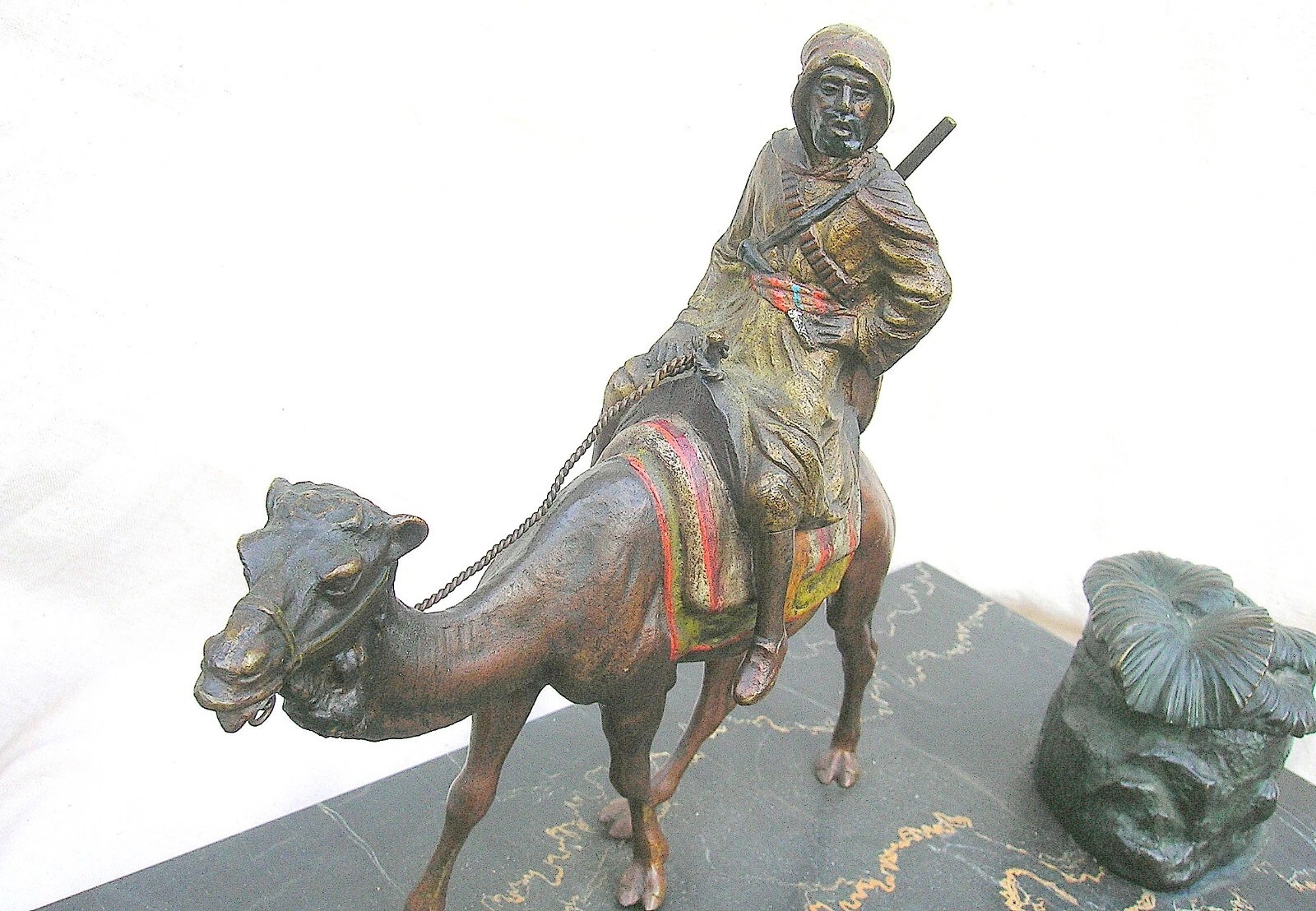
- Subject: The central sculpture depicts a Bedouin or Arab warrior riding a camel. He is dressed in traditional desert robes and a turban, carrying a long, curved stock musket or rifle (often called a moukhala) slung across his back.
- Technique (Vienna Bronze): The figure is cold-painted, meaning the color was applied after the metal was cast, rather than using fired enamels. You can still see the original red and green stripes on the saddle blanket, which is a hallmark of Viennese production (e.g., Franz Bergman).
- The Inkwells: Palm Fronds
- Design: The two inkwells are modeled to look like low clumps of Fan Palms or Palmetto bushes growing out of a rocky mound.
- The Lids: The “fronds” are the hinged lids. The leaves are cast with detailed ribbing to mimic the texture of the palm leaf. When lifted, they reveal the reservoir for the ink. The glass or ceramic liners that would have sat inside these metal wells are missing.
- Historical Context: Orientalism
This piece is a classic example of the Orientalist movement in decorative arts. In the late 19th and early 20th centuries (c.1890-1920), there was a massive fascination in Europe and America with the cultures of North Africa and the Middle East. Desk sets featuring camels, warriors, tents, and carpets were extremely fashionable status symbols for well-traveled gentlemen.
Note: The use of Portoro marble typically indicates a higher quality of production than the standard slate or onyx bases often found on similar sets. The preservation of the cold paint on the saddle is a significant plus for its value.
Sold for $600 in November 2025
Content disclaimer. The information posted is the owner’s best knowledge and may not have been vetted by the SOIC. We welcome comments, corrections, and additions, working to make our website information comprehensive and accurate.
Join the Society of Inkwell Collectors (SOIC) – it’s free!
Founded in 1981 as a non-profit organization,
we are documenting inkwells (and accessories).
We’re here to help and inform!