






Egyptian Revival Silverplate Inkstand
| Categories | Middle East / Africa |
| Type | Egyptian Revival |
| Material | Silverplate |
| Markings | See Narrative |
| Manufacturer | Meriden Silver Co. |
| Origin | United States |
| Date or Era | circa 1870 |
| Measuring | Base: 12” x 8” |
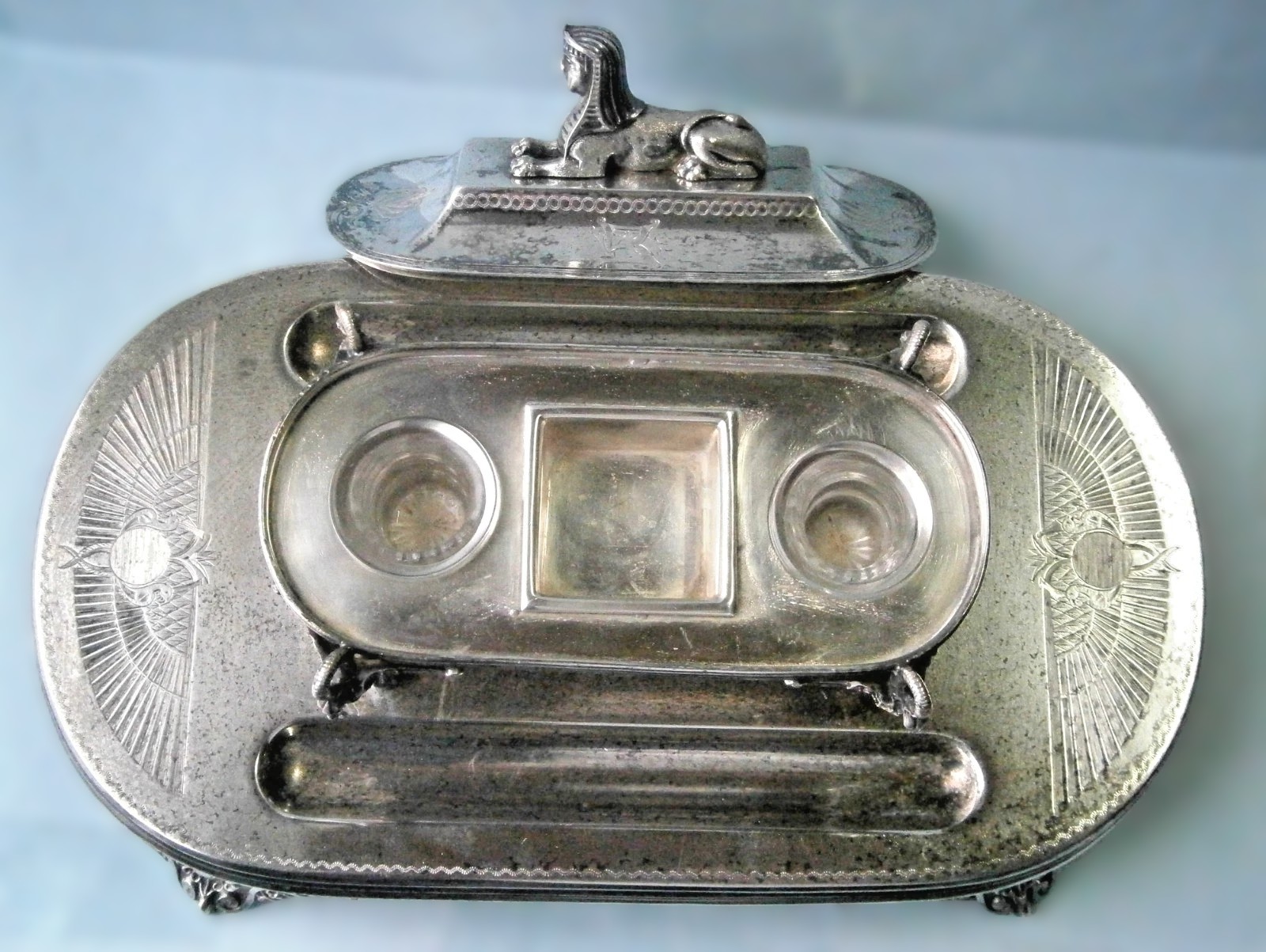
This Egyptian Revival silverplate inkstand (No. 3748) is an example of the “Egyptomania” that swept through American decorative arts in the 1860s and 1870s. While many inkstands use general motifs, the Meriden Britannia Company model 3748 is celebrated for its specific architectural and symbolic details.
Sphinx & Central Architecture
- The Sphinx Finial: The most striking feature is the central recumbent Sphinx that serves as the handle for the middle lid. Note the precision of the nemes headdress (the striped headcloth of the pharaohs) and the calm, stoic facial expression. Unlike later mass-produced versions, these early Meriden figures were modeled with individualistic, serene features.
- The Pedestal Base: The Sphinx sits atop a raised rectangular platform. The vertical sides of this platform are decorated with engraved hieroglyphs or stylized “false door” motifs reminiscent of ancient Egyptian mastaba tombs.
The Flanking Elements
- The Glass Wells: The inkstand features two inkwell inserts made of heavy-cut crystal with a “starburst” base.
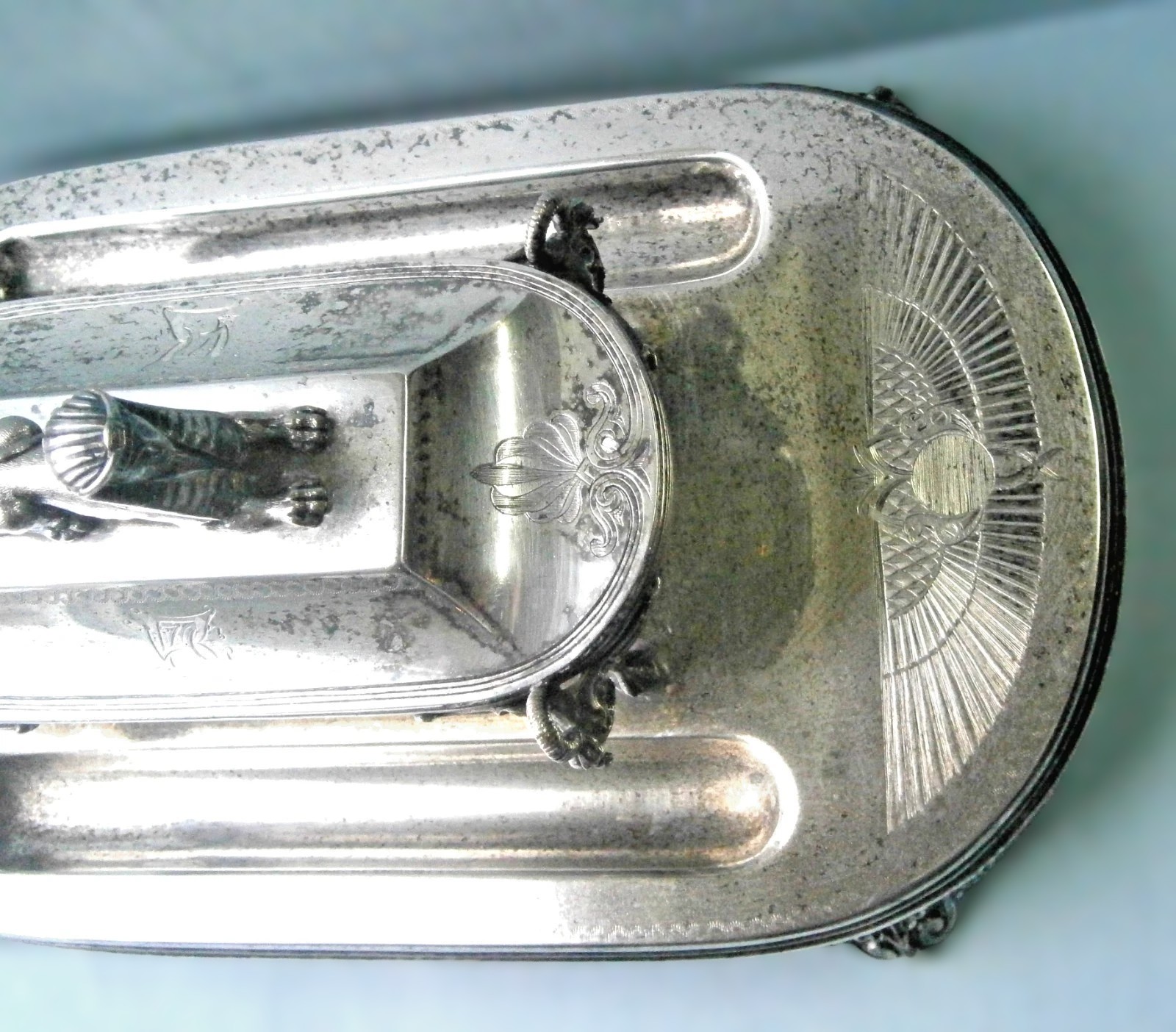
- The Pen Cradle: Running along the front and rear is a deep, curved channel designed to hold a dip pen.
The “Winged” Symbolism
- Winged Sun Disks: The flat surface of the tray features an etched Winged Sun Disk (Behedeti). This was one of the most powerful symbols in ancient Egypt, representing divine protection. The wings are rendered with individual feather details, accompanied by two uraeus serpents (cobras) flanking the central sun.
- Vulture Motifs: The feet of the inkstand are not simple scrolls; they are modeled as vultures with outstretched wings. In Egyptian mythology, the vulture (Nekhbet) was a symbol of sovereignty and protection, making it a fitting choice for the “foundation” of the piece.
Manufacturing Context – Catalog Information
Based on historical trade catalogs from the Meriden Britannia Company, pattern No. 3748 refers to a premier Egyptian Revival Double Inkstand, first introduced in the early 1870s (circa 1869–1874).
Catalog Information & Specifications
In the company’s 1871 and 1878 illustrated catalogs, as well as the comprehensive 1886-7 “Treasury” reprint, this model is officially categorized under “Inkstands and Desk Sets.”
- Official Title: Typically listed as “Double Inkstand, No. 3748, Egyptian Pattern.”
- Original Retail Price: In the 1870s, an inkstand of this size and complexity retailed for approximately $18.00 to $26.00, depending on whether it was ordered in “Plain Silver” or with “Gold Gilt” accents. Adjusted for today’s value, this was a significant luxury purchase, equivalent to roughly $450–$650.
- Dimensions: The base tray for this pattern typically measures roughly 12 inches in length by 8 inches in width, making it one of the company’s larger “Cabinet” models.
Specific Catalog Features for No. 3748
The catalog description highlights the “Fine Quadruple Plate” finish and the precision of its architectural casting.
- The Sphinx Finial: The central box (originally designed for stamps or nibs) is topped with a Sphinx finial. In the catalog illustrations, this Sphinx is noted for its “serene and classical expression,” distinguishing the high-end Meriden version from cheaper competitors.
- Symbolic Engraving: The flat surface of the tray is noted for its “Fine Etching,” which typically includes the Winged Sun Disk.
- The 3748 Series: This pattern was often part of a larger “Mantel and Desk Set” that included matching candlesticks (No. 3740) and a calling card receiver (No. 3742), allowing the 19th-century owner to maintain a consistent Egyptian theme throughout their study.
Historical Dating
The “3748” number fits perfectly into Meriden’s production surge following the Suez Canal opening in 1869, which ignited the American “Egyptomania” trend. The pattern was replaced by the “Aesthetic Movement” styles (featuring birds and flowers) by the mid-1880s, making this inkstand a quintessential artifact of the High Victorian Egyptian Revival period.
Sold for $314 in December 2025
Content disclaimer. The information posted is the owner’s best knowledge and may not have been vetted by the SOIC. We welcome comments, corrections, and additions, working to make our website information comprehensive and accurate.
Join the Society of Inkwell Collectors (SOIC) – it’s free!
Founded in 1981 as a non-profit organization,
we are documenting inkwells (and accessories).
We’re here to help and inform!