

Nippon with Hand Painted Owl
| Categories | Far East / Oriental |
| Material | Porcelain |
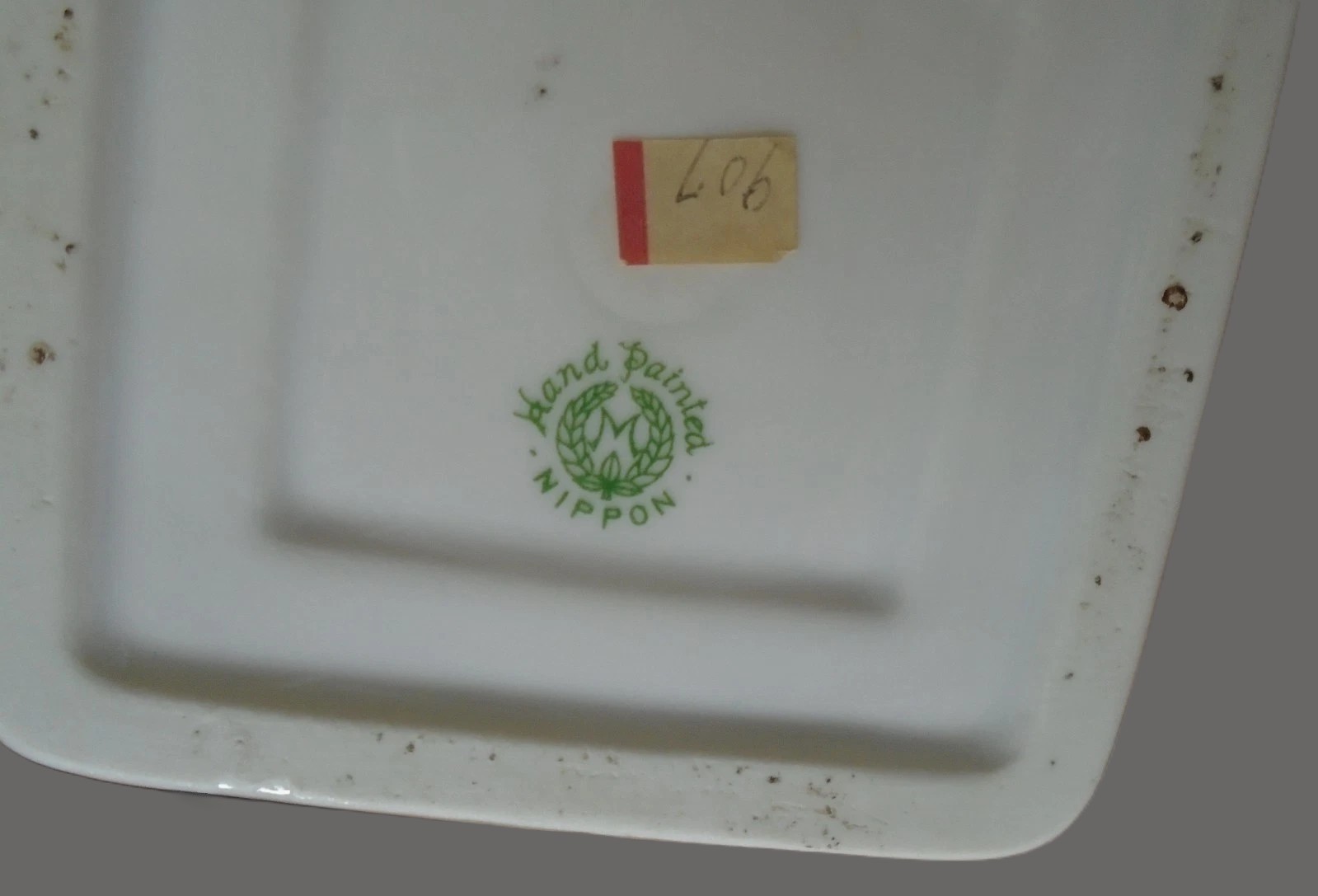
| Markings | See narrative |
| Manufacturer | Nippon |
| Origin | Japan |
| Date or Era | circa 1918 |
| Measuring | 3 ½” x 3 ½” x 3 ¾” high |
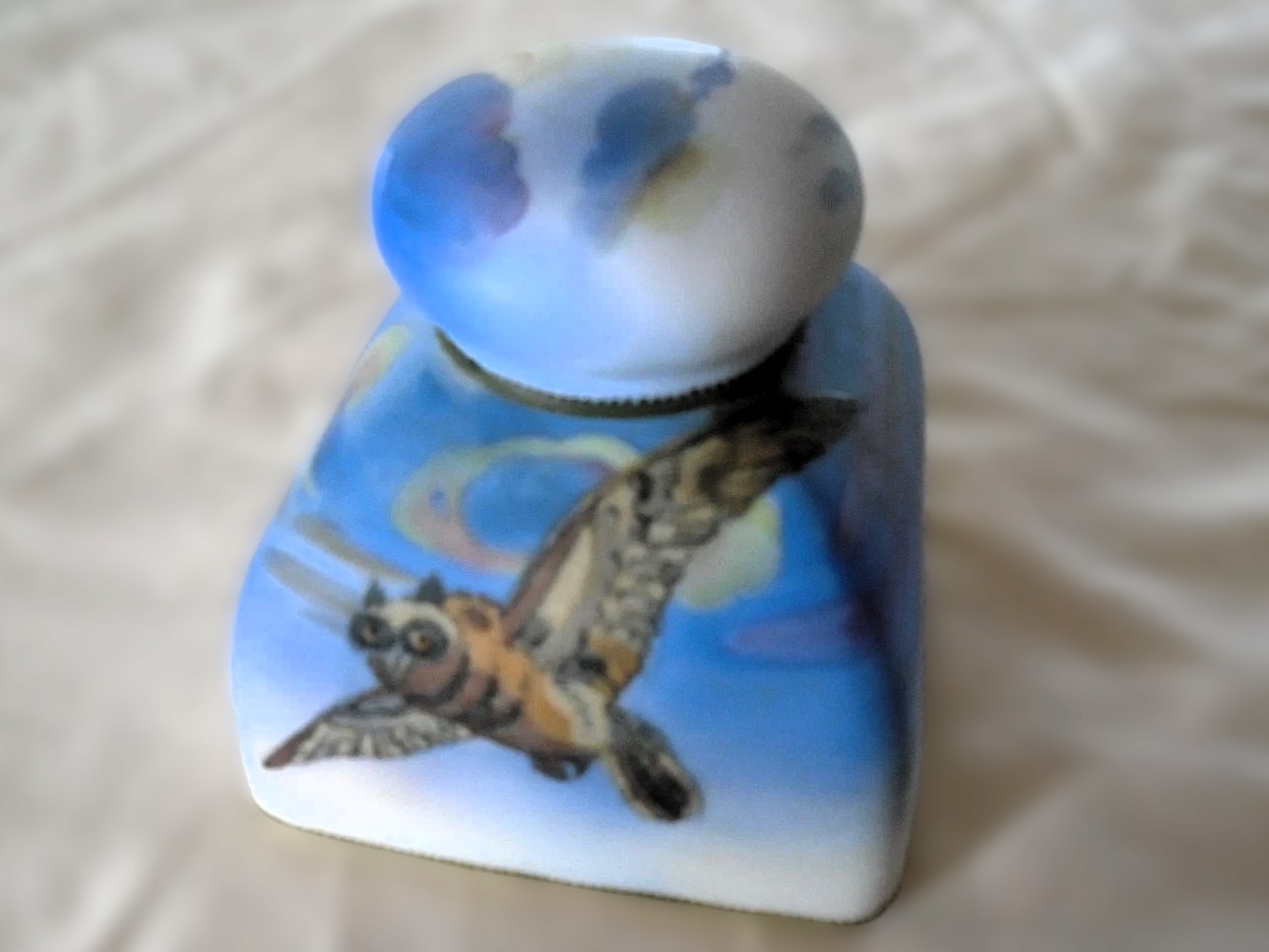
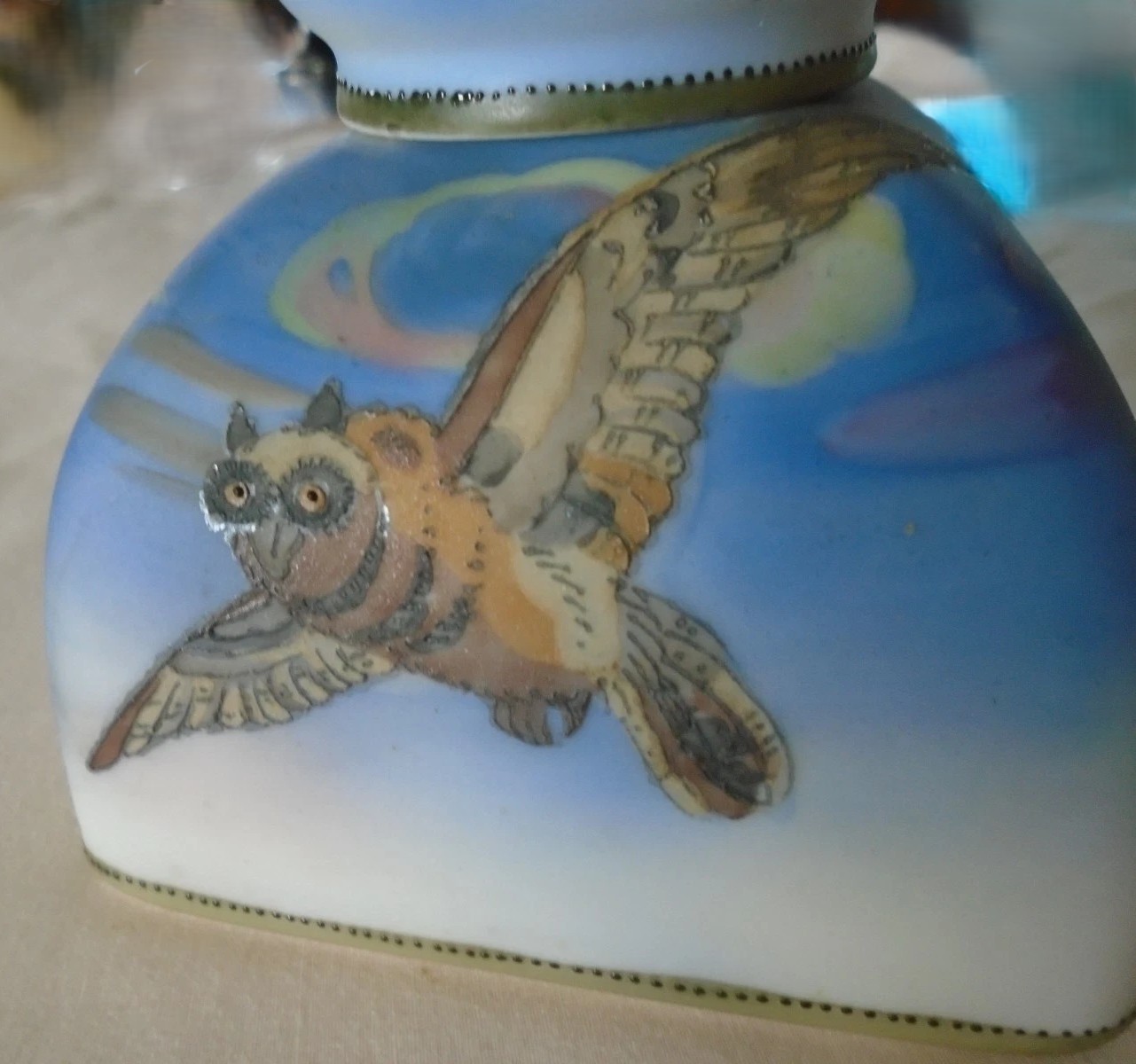
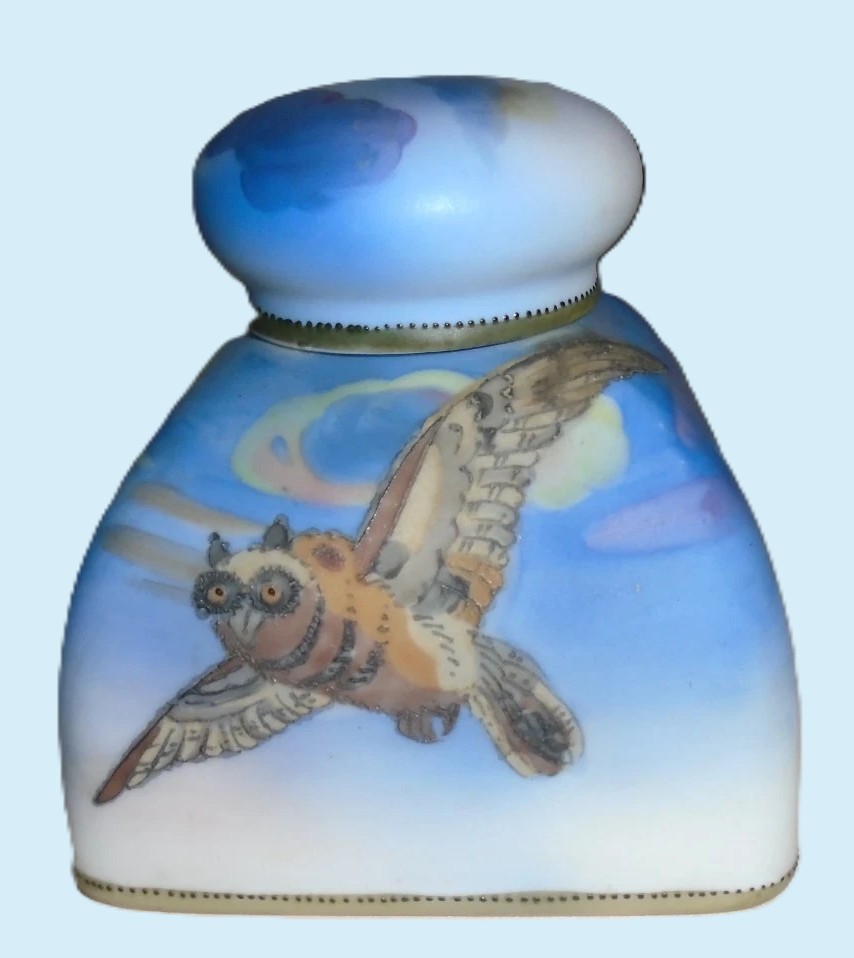
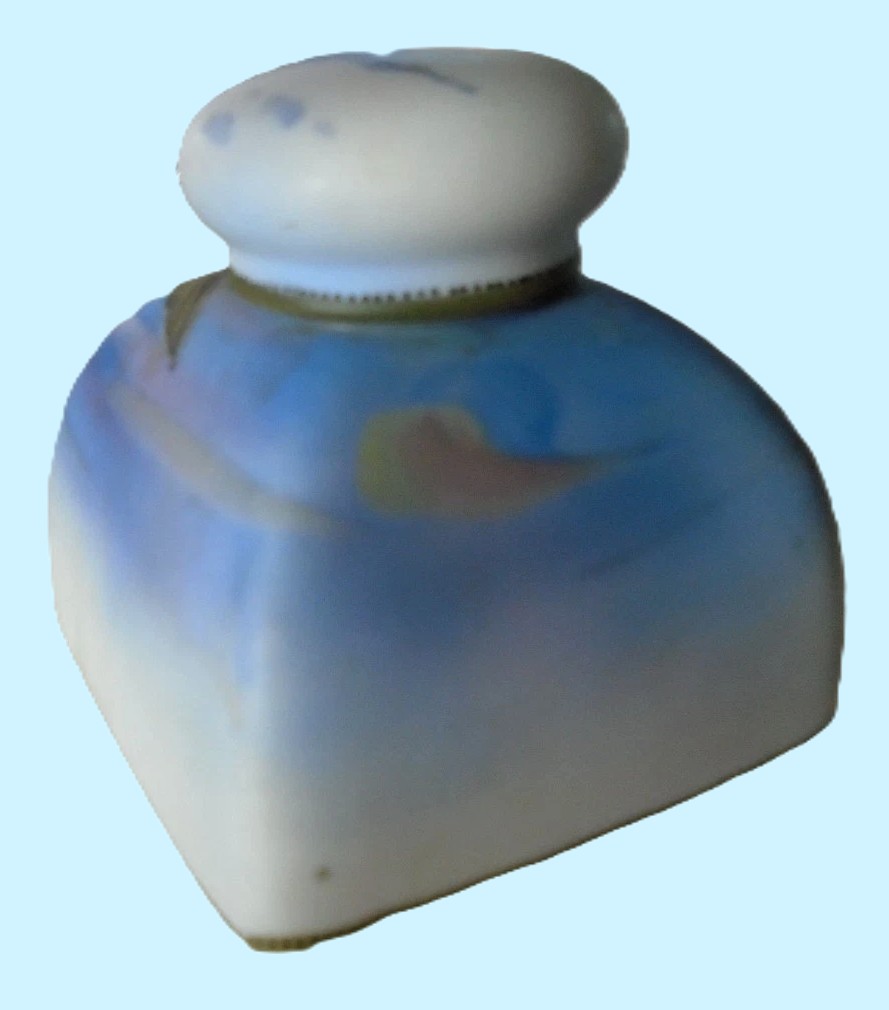
This hand-painted Nippon porcelain produced by Morimura Brothers features a full-scene depiction of a long-eared owl in mid-flight.
Description
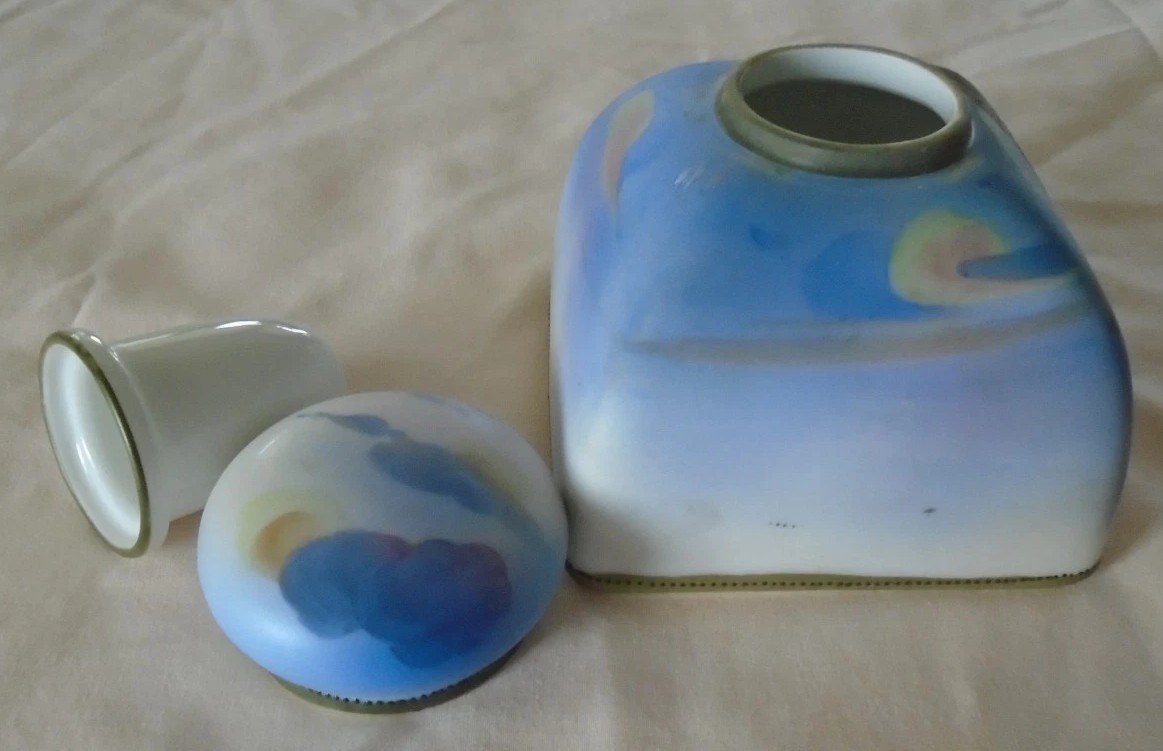
- Form & Structure: The inkwell consists of a four-sided, pyramidally tapered (or sloping square) body resting on a flat base. It features a separate, fitted porcelain dome lid and a porcelain cylindrical ink liner insert, making it a complete three-piece set.
- The Painting Technique: This piece is fully hand-painted. The soft, atmospheric background uses a subtle airbrushed or blended sky-blue gradient interspersed with clouds and stylized aura-like rings. Over this soft glaze, the owl is painted with sharp, crisp line work and detailed enameling.
- Details & Beading: The owl itself shows distinct raised enamel detail along its feather outlines, beak, and large yellow eyes, giving it a three-dimensional quality. The collar rim and the bottom square border are decorated with beaded dotting (a classic Nippon technique often referred to as moriage or jeweled work) in a soft, muted sage-green or olive tone.
Manufacturer Information: Morimura Bros.
The green backstamp—featuring the letter “M” encircled by a laurel wreath and crowned by the curved words “Hand Painted” over “NIPPON”—is the signature mark of Morimura Bros. (Van Patten #47).
- Who They Were: Morimura Brothers was an influential Japanese import-export firm founded by Ichitaro and Toyo Morimura. They commissioned white porcelain blanks from local Japanese kilns, had skilled Japanese artists paint them specifically tailored for the Western export market, and distributed them across North America.
- The Evolution to Noritake: This very company, Morimura Bros., eventually evolved into the world-famous Noritake China company. The “M” inside the wreath stands directly for Morimura.
Narrowing the Date of Manufacture
While the general timeframe for Van Patten Mark #47 spans 1911 to 1921, we can narrow the date further based on design context and U.S. tariff laws:
- Approximate Production Window: Circa 1912–1918
- Why Not Later Than 1921? Under the U.S. McKinley Tariff Act revisions implemented in 1921, items exported from Japan had to be marked with the country’s English name (“JAPAN” or “MADE IN JAPAN”) rather than the native name “NIPPON”. Therefore, 1921 serves as a hard cutoff date for this piece.
- Stylistic Clues: The soft, dreamy blue background combined with the stylized, nature-focused subject matter reflects the transition from Late Art Nouveau into early 1910s Japanese export pictorial art. Owls are among the most sought-after and collectible motifs in Nippon wares, as bird and animal scenes were produced in far fewer quantities compared to standard floral, landscape, or scenic patterns.
Sold for $69 in July 2026
Content disclaimer. The information posted is the owner’s best knowledge and may not have been vetted by the SOIC. We welcome comments, corrections, and additions, working to make our website information comprehensive and accurate.
Join the Society of Inkwell Collectors (SOIC) – it’s free!
Founded in 1981 as a non-profit organization,
we are documenting inkwells (and accessories).
We’re here to help and inform!