


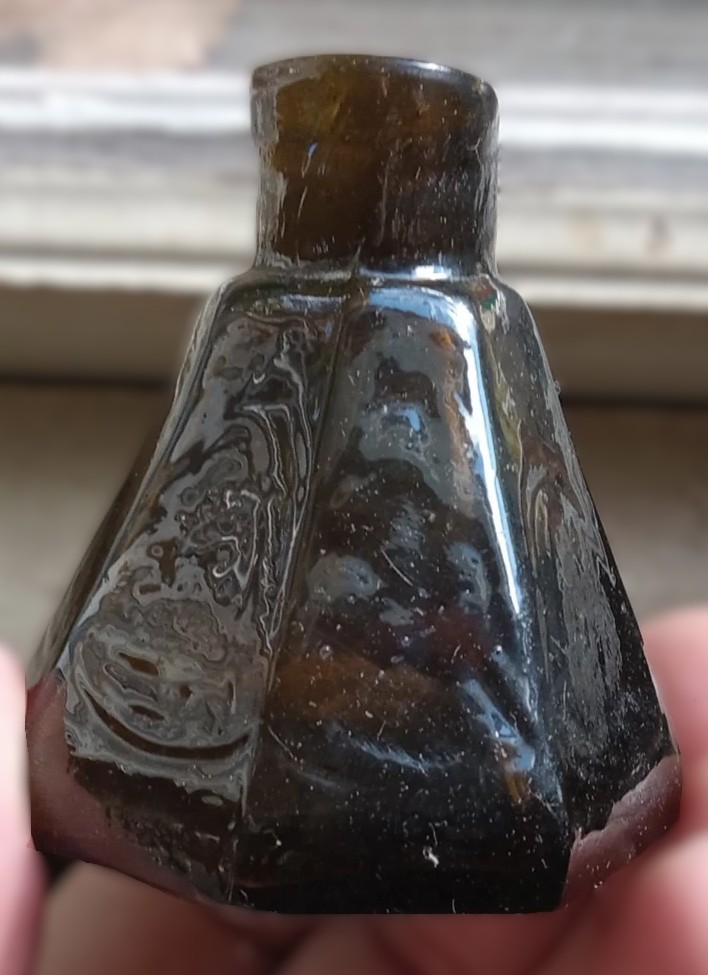


New England Umbrella Ink Bottle – Olive Amber
| Categories | Ink Bottle |
| Type | Umbrella |
| Material | Glass |
| Markings | Unmmarked |
| Manufacturer | Undetermined |
| Origin | United States |
| Date or Era | circa 1850 |
| Measuring | 2 ⅜” across the base; 2 ⅜” high |
Antique New England Umbrella Ink Bottle
- Period and Origin: Circa 1850s (Pre-Civil War era), attributed to New England glass houses like the ones in Stoddard, New Hampshire, or Keene, New Hampshire.
- Color: Deep Olive Amber (sometimes referred to as “black glass” due to the dark color caused by impurities or excess iron in the sand). This rich, darker color is generally more desirable than the common aqua glass.
- Shape and Body: The bottle has a squat, stable, and distinctive shape—known as an “umbrella” ink—designed to prevent tipping and spillage. The body is formed by eight prominent, sloping panels (or facets) that give it a conical or fluted shape, which is the most common configuration for this type.
- Base Feature: A defining characteristic is the open pontil scar on the base. This is a rough, jagged, or heavily scarred area left where the pontil rod (or “punty”) used by the glassblower to hold the base during the finishing of the lip was broken off. The presence of an open pontil confirms it is a hand-blown bottle from the period before the widespread use of smoother snap-case tools (c. 1860s).
- Lip/Finish: The bottle features a crude, smooth sheared lip. This refers to a basic, utilitarian finish where the blowpipe was simply sheared off, and the rim was minimally reheated and smoothed without being finished with a rolled or applied lip. This is typical of cheap, mass-produced “penny inks” of the era.
- Decoration: It is not embossed, meaning it would have originally been sold with a paper label indicating the ink’s manufacturer or merchant, a common practice to save on the cost of mold-making.
- Lower Body Detail: The base is further characterized by eight small vertical panels encircling the lowest part of the body, just above the heel, which is a common base molding detail for the 8-sided umbrella style.
This bottle is a fine example of American utilitarian glass from the mid-19th century, prized by collectors for its rich color, hand-blown nature, and key diagnostic features like the open pontil and crude sheared lip.
History of Umbrella Ink Bottles
The umbrella ink bottle (also known as a “dwarf” or “cone” inkwell) was one of the most common and utilitarian bottle styles of the mid-19th century.
- Dates: They were most popular from the 1820s to the 1880s. The presence of a pontil mark, as discussed below, helps date them to the earlier part of this range, typically before the late 1860s.
- Purpose & Design:
- Stability: The short, squat body with wide-angled facets (often 8- or 12-sided) gives the bottle exceptional stability, making it less likely to tip over and spill ink. This was particularly useful for individual use at home, in an office, or especially in a schoolroom, where they were sometimes referred to as “penny ink wells.”
- Functionality: They had a wide mouth to easily accommodate a quill or an early dip pen. The body would hold a practical amount of ink for a single user.
- Materials: They were often made from inexpensive, functional glass, commonly appearing in shades of aqua (light blue-green), various greens (olive, teal), and occasionally in more desirable colors like amber, blue, or amethyst.
- Manufacturing: The majority of the early umbrella inks were hand-blown into a mold, and they are rarely embossed with a company name, as paper labels were a cheaper method of branding.
Types of Pontil Marks (Pontil Scars)
A pontil mark is a scar or rough area left on the base of a hand-blown bottle where a pontil rod (a long iron rod) was temporarily attached. The rod held the hot bottle after the blowpipe was removed, allowing the glassblower (gaffer) to finish the lip or neck. The presence of a pontil mark indicates that a bottle was hand-blown and generally dates it to before the late 1860s (when snap case tools largely replaced the pontil rod).
Collectors categorize the scars into distinct types:
| Pontil Mark Type | Appearance & Characteristics | Dating Clues (Approximate) |
| Open Pontil (or Glass-Tipped Pontil) | A rough, jagged, and colorless scar, often in an irregular circle, with sharp edges or fragmented glass. This mark is where a solid iron rod tipped with molten glass was attached and then broken off. | Pre-1850s to Mid-1860s. Generally considered the earliest and crudest. |
| Blowpipe Pontil (or Tube Pontil) | A distinct, raised ring of glass on the base, which is usually smooth and hollow inside. This scar is left when the hollow blowpipe itself was used as the pontil rod. | Mid-1840s to Mid-1860s. Highly desirable to collectors. |
| Iron Pontil (or Improved Pontil) | A scratchy, dome-like mark or a gray/reddish-black metallic residue or “smear” at the center of the base. This resulted from a bare iron ball being directly attached to the hot glass. | Mid-1840s to Mid-1860s. Often a flatter base than the open pontil. |
| Sand/Disk Pontil | A diffuse scattering of tiny glass particles or sand grains, often with pitting, usually spread over a wider, circular area of the base. It was created by dipping the glass-tipped rod into unrefined sand before application. | Early to Mid-19th Century (less common on small inks). |
The rougher and more distinct the pontil mark, the older and often more desirable the bottle is to collectors, as it signifies a cruder, earlier production era.
Here is a breakdown of the major types of bottle finishes and the approximate time periods they indicate:
- Mouth-Blown Finishes (Pre-1880s to Early 1900s)
These finishes show evidence of being hand-worked after the bottle body was blown into a mold.
| Finish Type | Characteristics | Typical Date Range |
| Sheared or Cracked-Off Lip | Very simple, rough, or sharp rim. The glass was snapped or cracked from the blowpipe with no or minimal fire-polishing or tooling. | Prior to the 1870s (Common from 1700s to 1860s) |
| Applied Finish | The mold seam ends abruptly on the bottle’s neck, not extending into the finish. A separate ring or “string” of molten glass was applied to the neck and then shaped. Look for a visible line or ridge where the applied glass meets the neck. | 1835 to 1885 (Most common on older bottles) |
| Tooled Finish | The mold seam ends just below the top of the lip. The glass on the neck was reheated and shaped using a specialized “lipping tool” for a smoother, more symmetrical, and refined closure than an applied finish. | Mid-1870s to Early 1910s |
| Specialized Finishes | Blob Top: A thick, rounded lip used to hold stoppers or internal corks. Common on soda, beer, and mineral water bottles. | 1850s to Late 1800s (e.g., Hutchinson style) |
| Crown Cap Finish: Designed specifically for the crimped metal crown cap. | Post-1892 (when the crown cap was patented) |
- Machine-Made Finishes (Post-1900)
The invention of automatic bottle-making machines revolutionized the industry and left distinct markers on the bottle finish.
- Mold Seam Over the Lip: On machine-made bottles, the side mold seam typically extends all the way up to the very top edge of the finish and sometimes even across the top surface of the lip. This is a crucial indicator.
- Note: The transition wasn’t immediate; some hand-tooled bottles in the early 1900s may still have mold seams stopping below the lip.
- Valve Scars: Bottles made using the Owens Automatic Bottle Machine (post-1904) often have a distinct circular scar on the center of the base called a suction or valve mark. This, combined with the mold seam over the lip, firmly places the bottle in the automatic machine era.
- Threads (Screw Tops): While internal screw threads existed earlier, the widespread use of external screw threads on bottles for modern caps became standard with machine production.
Dating by Manufacturing Method Summary
- Free-Blown: (Prior to 1860s): No mold seams on the body or neck. Usually crude and asymmetrical.
- Mold-Blown with Applied or Tooled Finish: (Pre-Automatic Machine Era, 1840s – 1910s): Has mold seams on the body, but the finish was hand-worked (applied or tooled), meaning the seams stop somewhere below the top of the lip.
- Fully Automatic Machine-Made: (Post 1905): Mold seams run right over the top edge of the lip. Uniform in appearance.
Sold for $320 in October 2025
Content disclaimer. The information posted is the owner’s best knowledge and may not have been vetted by the SOIC. We welcome comments, corrections, and additions, working to make our website information comprehensive and accurate.
Join the Society of Inkwell Collectors (SOIC) – it’s free!
Founded in 1981 as a non-profit organization,
we are documenting inkwells (and accessories).
We’re here to help and inform!