

Keller’s Superior Writing Fluid Master Ink Bottle
| Categories | Ink Bottle |
| Material | Glass |
| Markings | See Narrative |
| Origin | United States |
| Date or Era | circa 1920 |
| Measuring | 6 inches tall (excluding the stopper) |
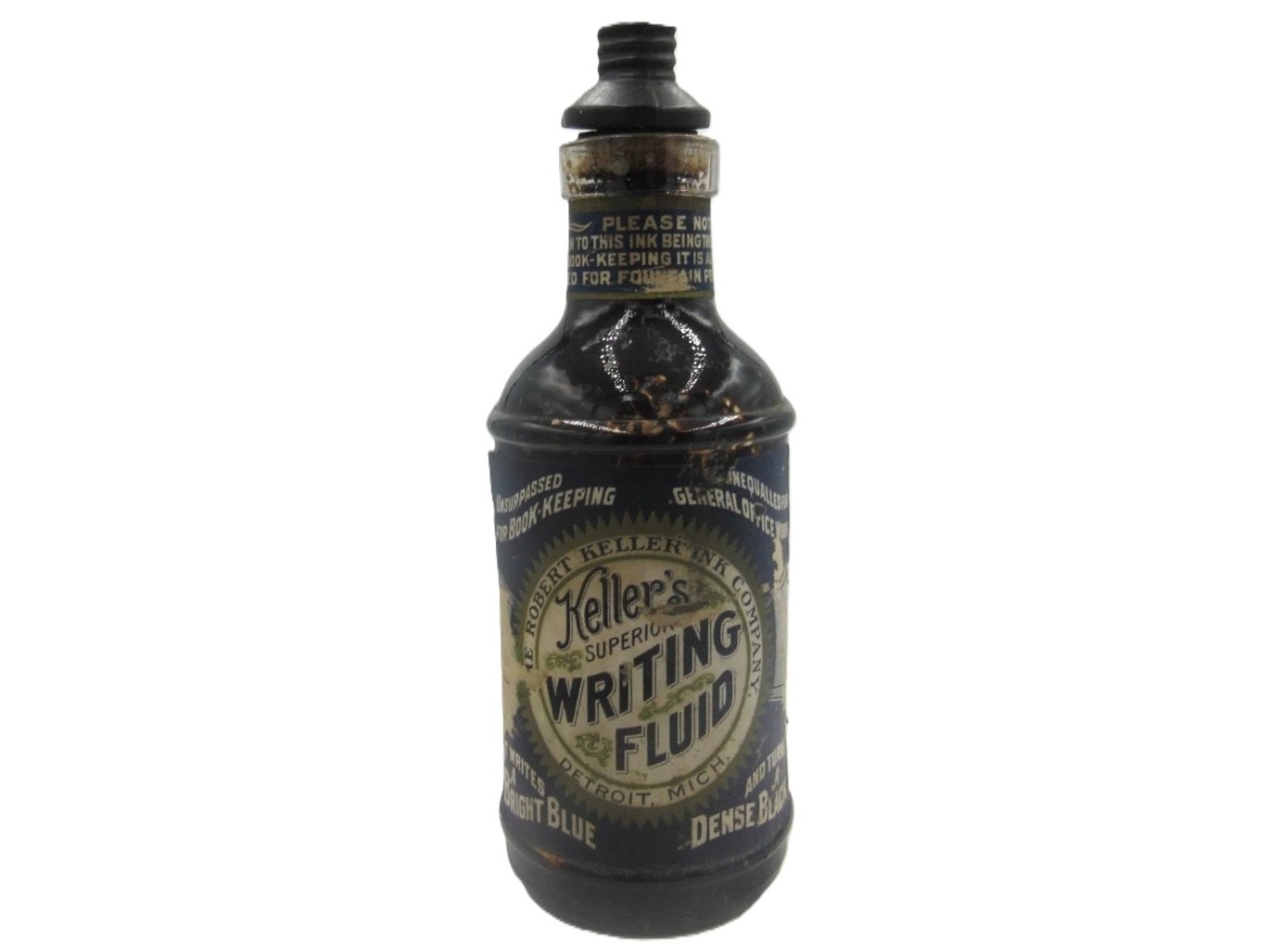
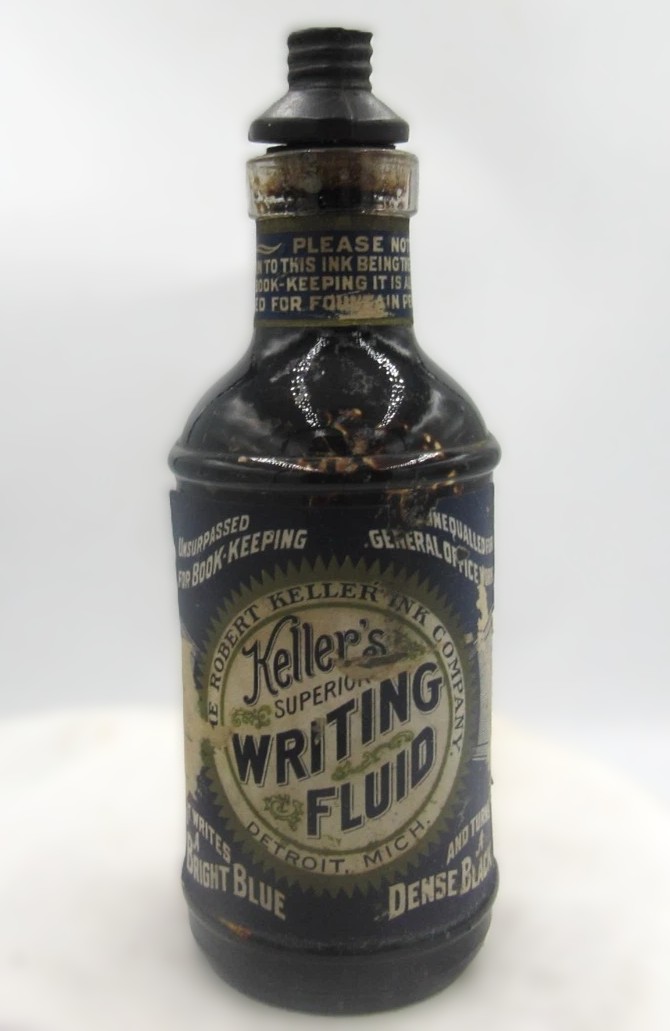
Keller’s Superior Writing Fluid Master Ink Bottle
- Origin & Manufacturer: The Robert Keller Ink Company, Detroit, Michigan.
- Dating: Circa 1914–1920s.
- Dimensions & Capacity: 6 inches tall (excluding the stopper); embossed capacity of 8 fluid ounces.
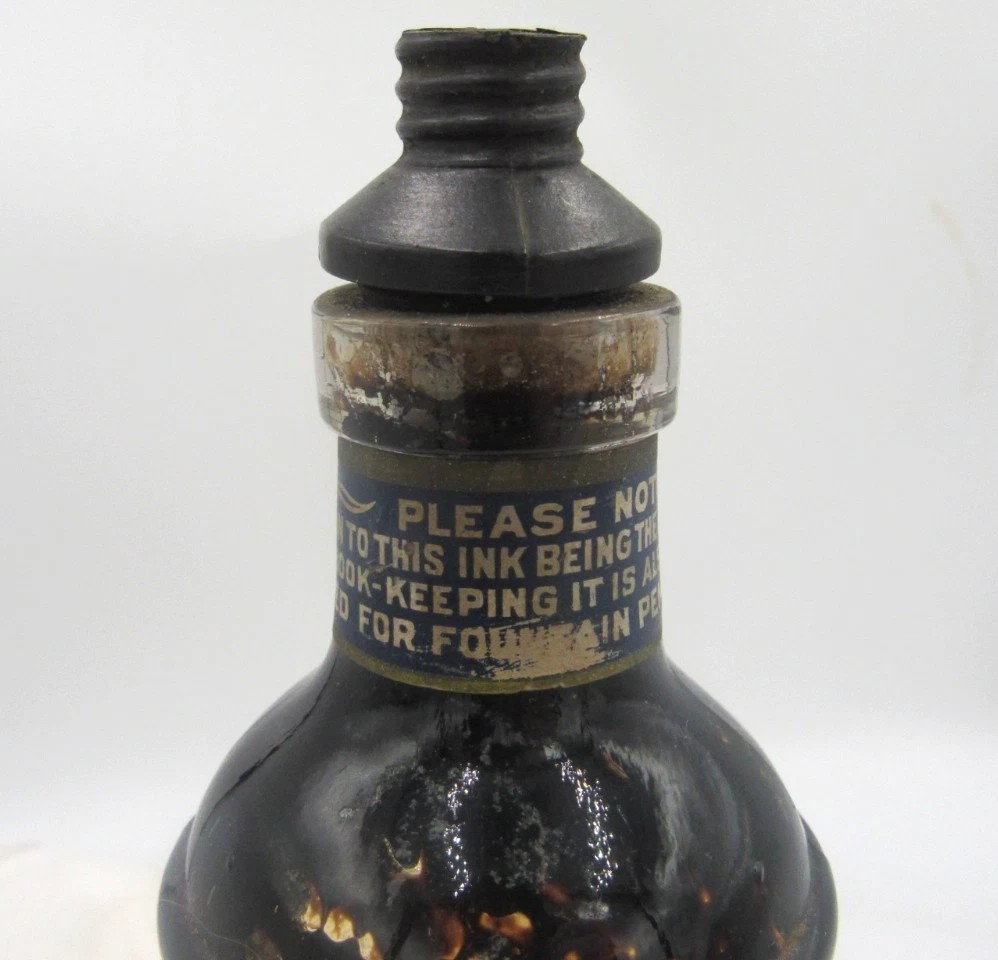
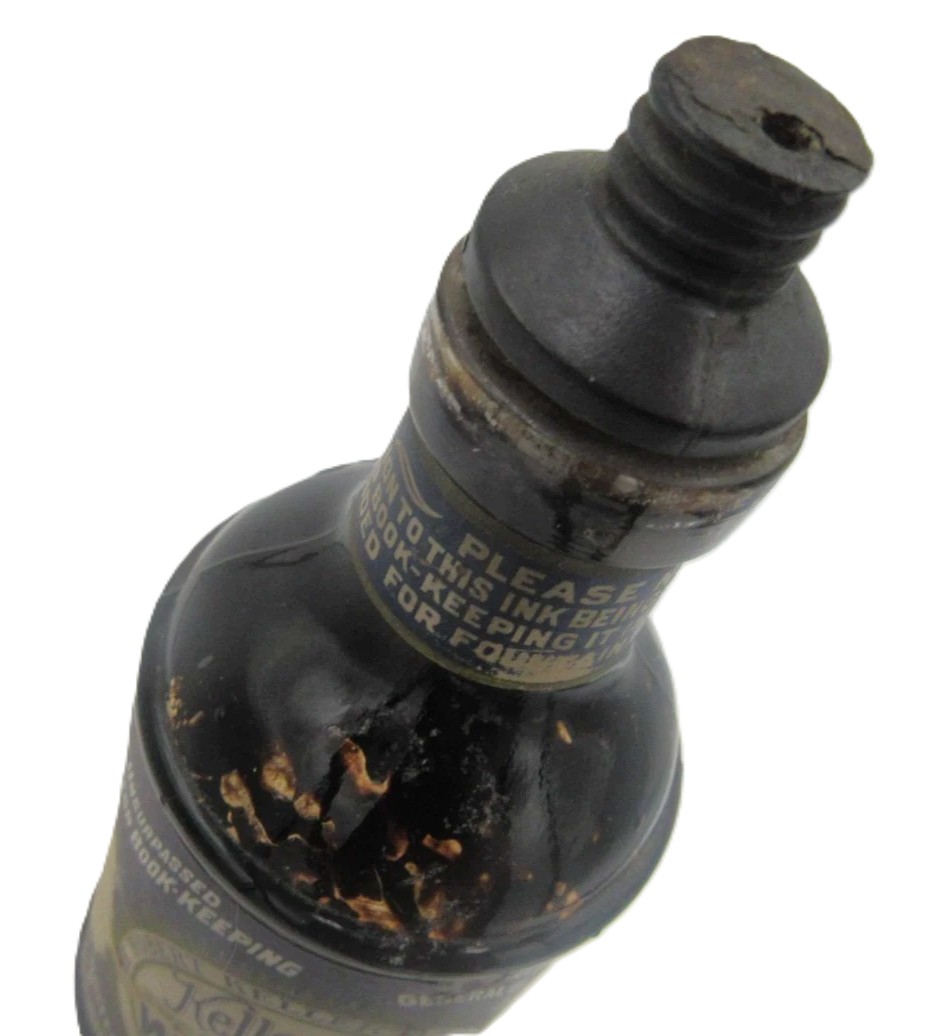
- Glass & Form: Clear cylinder master ink bottle with pronounced shoulder rings, an applied/tooled pour collar, and its original black hard-rubber (vulcanite) stepped pour-spout stopper insert intact. Heavy internal dried ink residue gives the body a dark, dramatic patina while preserving the original character of an active commercial inkwell bottle.
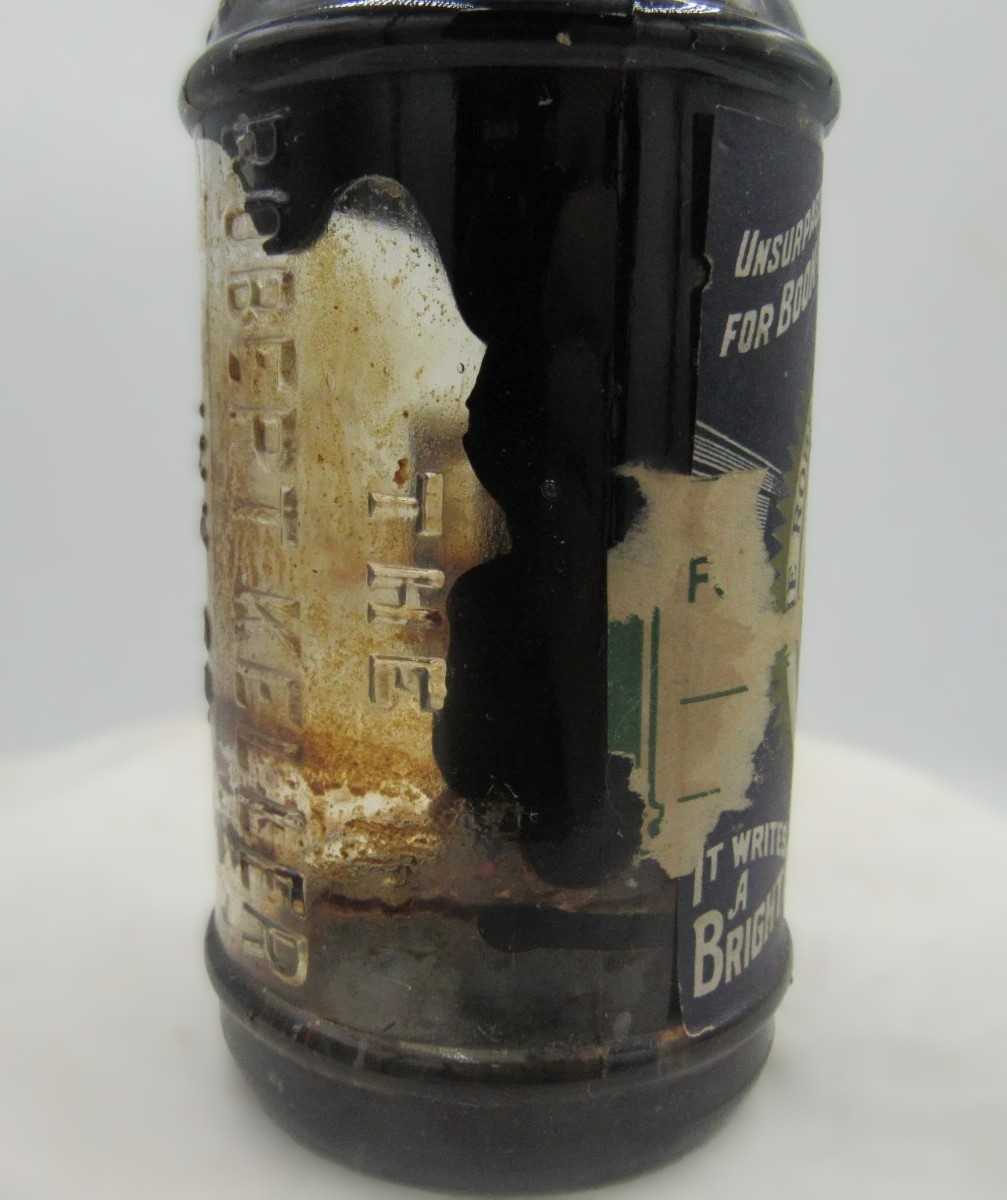
- Embossing:
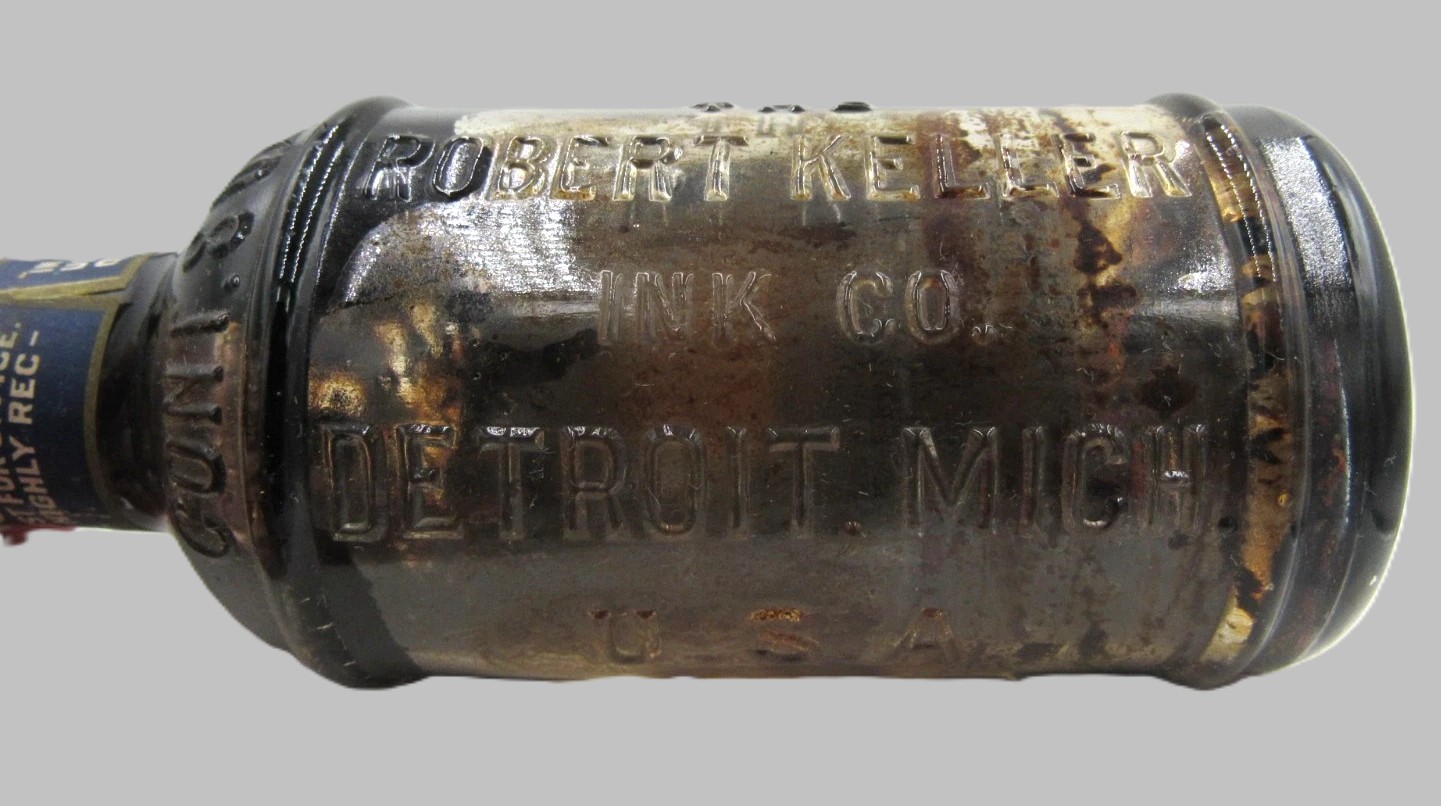
- Shoulder: CONT 8 oz
- Back Body: ROBERT KELLER INK CO. / DETROIT, MICH. / U.S.A.
- Labels & Typography:
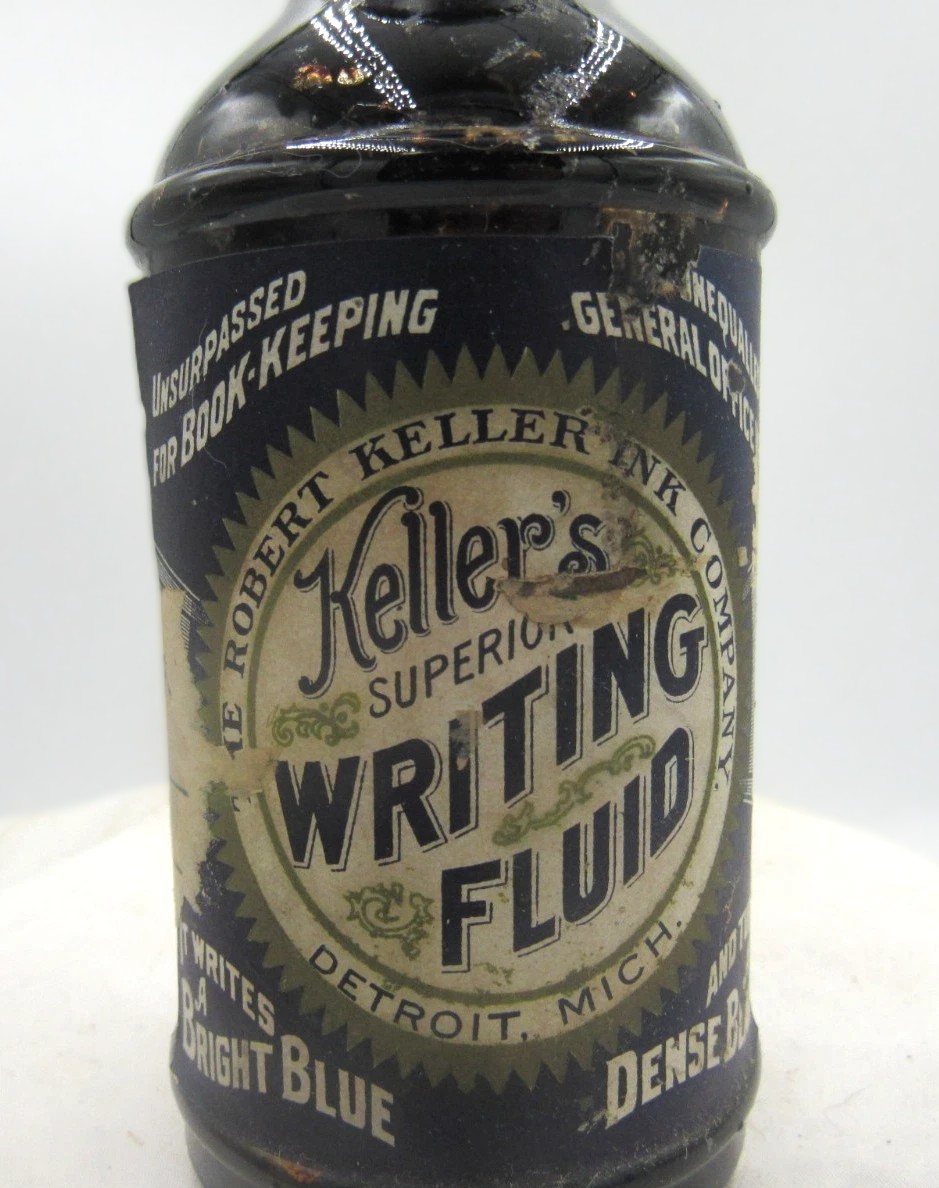
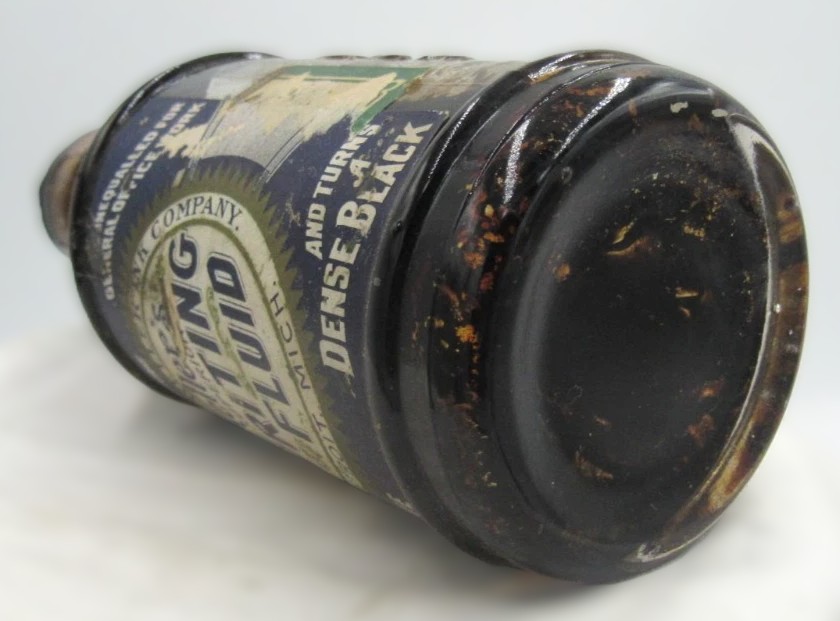
- Main Body Label: Multi-color paper lithograph displaying a central serrated medallion: “Keller’s Superior Writing Fluid – The Robert Keller Ink Company, Detroit, Mich.” Flanked by commercial claims: “Unsurpassed for Book-Keeping / Unequalled for General Office Work” and bottom tagline: “Writes a Bright Blue and Turns a Dense Black” (denoting an iron gall formulation). Shows edge loss, age toning, and remnant paper/adhesive ghosting across the center-right from a secondary retailer label applied long ago.
- Neck Label: Blue-and-white warning/instruction band stating: “PLEASE NOTICE… TO THIS INK BEING… BOOK-KEEPING IT IS ADAPTED FOR FOUNTAIN PENS.” Moderate scuffing and edge wear.
- Condition: Excellent structural condition with no chips, cracks, fissures, or lip bruises. Labels show honest workplace wear, surface soiling, and paper loss consistent with early 20th-century commercial office use.
Dating Clarification: Why It Dates to the 1910s–1920s
While antique listings often peg embossed Keller bottles to the 1890s, several diagnostic markers place this exact piece after 1913:
- The “CONT 8 oz” Embossing: The U.S. federal Gould Amendment of 1913 (an addition to the 1906 Pure Food and Drug Act) made net fluid and weight declarations mandatory on commercially packaged goods. Bottlers rarely embossed abbreviations like “CONT” before 1913.
- Incorporation Date: Keller operated locally as a druggist through the late 1880s and 1890s, but did not incorporate under the corporate name on the glass (The Robert Keller Ink Co.) until 1899.
- Fountain Pen Adaptability: While fountain pens gained popularity in the 1890s, neck labels assuring office managers that ledger-grade gall ink was specifically filtered and “Adapted for Fountain Pens” became widespread among major ink makers between 1910 and 1925 to compete with Waterman, Sheaffer, and Carter.
History of The Robert Keller Ink Company
- Founder Roots: Robert Keller was born in Germany in 1860, lived in Switzerland, and immigrated to the United States in 1881, settling in Detroit in 1883.
- Basement Beginnings: Keller worked as a pharmacist and opened a drugstore at the corner of Third Street and Warren Avenue. In 1886, experimenting in the basement of his pharmacy, he formulated his own formulas for writing fluids, sealing wax, and mucilage (glue).
- Expansion: Demand for his smooth-flowing iron gall inks grew rapidly among Detroit’s burgeoning industrial, railway, and municipal offices. By 1899, he left retail pharmacy behind to incorporate The Robert Keller Ink Company.
- The Corktown Factory: After outgrowing several facilities, Keller commissioned architectural firm Preston, Brown & Walker in 1917 to construct a modern, four-story brick factory at 1441 Brooklyn Street in Detroit’s Corktown neighborhood. Advertised as a “model factory,” it featured state-of-the-art laboratory testing rooms, mastic floors, and an electric elevator.
- Legacy: Keller Ink supplied commercial desks across the Midwest well into the mid-1930s before ceasing operations, after which the Brooklyn Street plant was acquired by the Kaul Glove & Manufacturing Co. Master bottles like this one served as the refill “jugs” from which clerks and bookkeepers replenished desk standishes and daily ink pots.Keller’s Superior Writing Fluid Master Ink Bottle
- Origin & Manufacturer: The Robert Keller Ink Company, Detroit, Michigan.
- Dating: Circa 1914–1920s.
- Dimensions & Capacity: 6 inches tall (excluding the stopper); embossed capacity of 8 fluid ounces.
- Glass & Form: Clear cylinder master ink bottle with pronounced shoulder rings, an applied/tooled pour collar, and its original black hard-rubber (vulcanite) stepped pour-spout stopper insert intact. Heavy internal dried ink residue gives the body a dark, dramatic patina while preserving the original character of an active commercial inkwell bottle.
- Embossing:
- Shoulder: CONT 8 oz
- Back Body: ROBERT KELLER INK CO. / DETROIT, MICH. / U.S.A.
- Labels & Typography:
- Main Body Label: Multi-color paper lithograph displaying a central serrated medallion: “Keller’s Superior Writing Fluid – The Robert Keller Ink Company, Detroit, Mich.” Flanked by commercial claims: “Unsurpassed for Book-Keeping / Unequalled for General Office Work” and bottom tagline: “Writes a Bright Blue and Turns a Dense Black” (denoting an iron gall formulation). Shows edge loss, age toning, and remnant paper/adhesive ghosting across the center-right from a secondary retailer label applied long ago.
- Neck Label: Blue-and-white warning/instruction band stating: “PLEASE NOTICE… TO THIS INK BEING… BOOK-KEEPING IT IS ADAPTED FOR FOUNTAIN PENS.” Moderate scuffing and edge wear.
- Condition: Excellent structural condition with no chips, cracks, fissures, or lip bruises. Labels show honest workplace wear, surface soiling, and paper loss consistent with early 20th-century commercial office use.
Dating Clarification: Why It Dates to the 1910s–1920s
While antique listings often peg embossed Keller bottles to the 1890s, several diagnostic markers place this exact piece after 1913:
- The “CONT 8 oz” Embossing: The U.S. federal Gould Amendment of 1913 (an addition to the 1906 Pure Food and Drug Act) made net fluid and weight declarations mandatory on commercially packaged goods. Bottlers rarely embossed abbreviations like “CONT” before 1913.
- Incorporation Date: Keller operated locally as a druggist through the late 1880s and 1890s, but did not incorporate under the corporate name on the glass (The Robert Keller Ink Co.) until 1899.
- Fountain Pen Adaptability: While fountain pens gained popularity in the 1890s, neck labels assuring office managers that ledger-grade gall ink was specifically filtered and “Adapted for Fountain Pens” became widespread among major ink makers between 1910 and 1925 to compete with Waterman, Sheaffer, and Carter.
History of The Robert Keller Ink Company
- Founder Roots: Robert Keller was born in Germany in 1860, lived in Switzerland, and immigrated to the United States in 1881, settling in Detroit in 1883.
- Basement Beginnings: Keller worked as a pharmacist and opened a drugstore at the corner of Third Street and Warren Avenue. In 1886, experimenting in the basement of his pharmacy, he formulated his own formulas for writing fluids, sealing wax, and mucilage (glue).
- Expansion: Demand for his smooth-flowing iron gall inks grew rapidly among Detroit’s burgeoning industrial, railway, and municipal offices. By 1899, he left retail pharmacy behind to incorporate The Robert Keller Ink Company.
- The Corktown Factory: After outgrowing several facilities, Keller commissioned architectural firm Preston, Brown & Walker in 1917 to construct a modern, four-story brick factory at 1441 Brooklyn Street in Detroit’s Corktown neighborhood. Advertised as a “model factory,” it featured state-of-the-art laboratory testing rooms, mastic floors, and an electric elevator.
- Legacy: Keller Ink supplied commercial desks across the Midwest well into the mid-1930s before ceasing operations, after which the Brooklyn Street plant was acquired by the Kaul Glove & Manufacturing Co. Master bottles like this one served as the refill “jugs” from which clerks and bookkeepers replenished desk standishes and daily ink pots.
Sold for $90 in August 2026
Content disclaimer. The information posted is the owner’s best knowledge and may not have been vetted by the SOIC. We welcome comments, corrections, and additions, working to make our website information comprehensive and accurate.
Join the Society of Inkwell Collectors (SOIC) – it’s free!
Founded in 1981 as a non-profit organization,
we are documenting inkwells (and accessories).
We’re here to help and inform!