


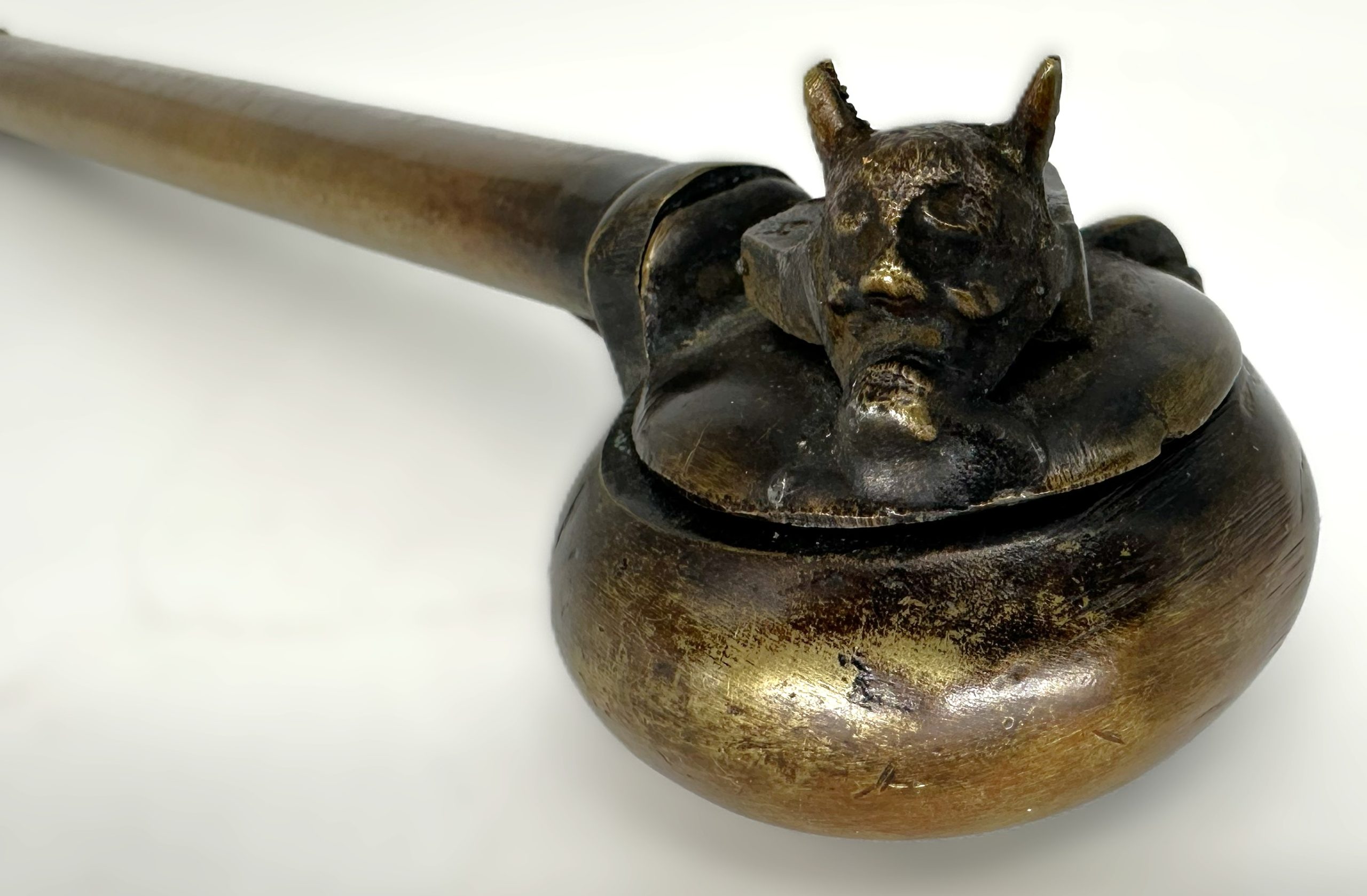
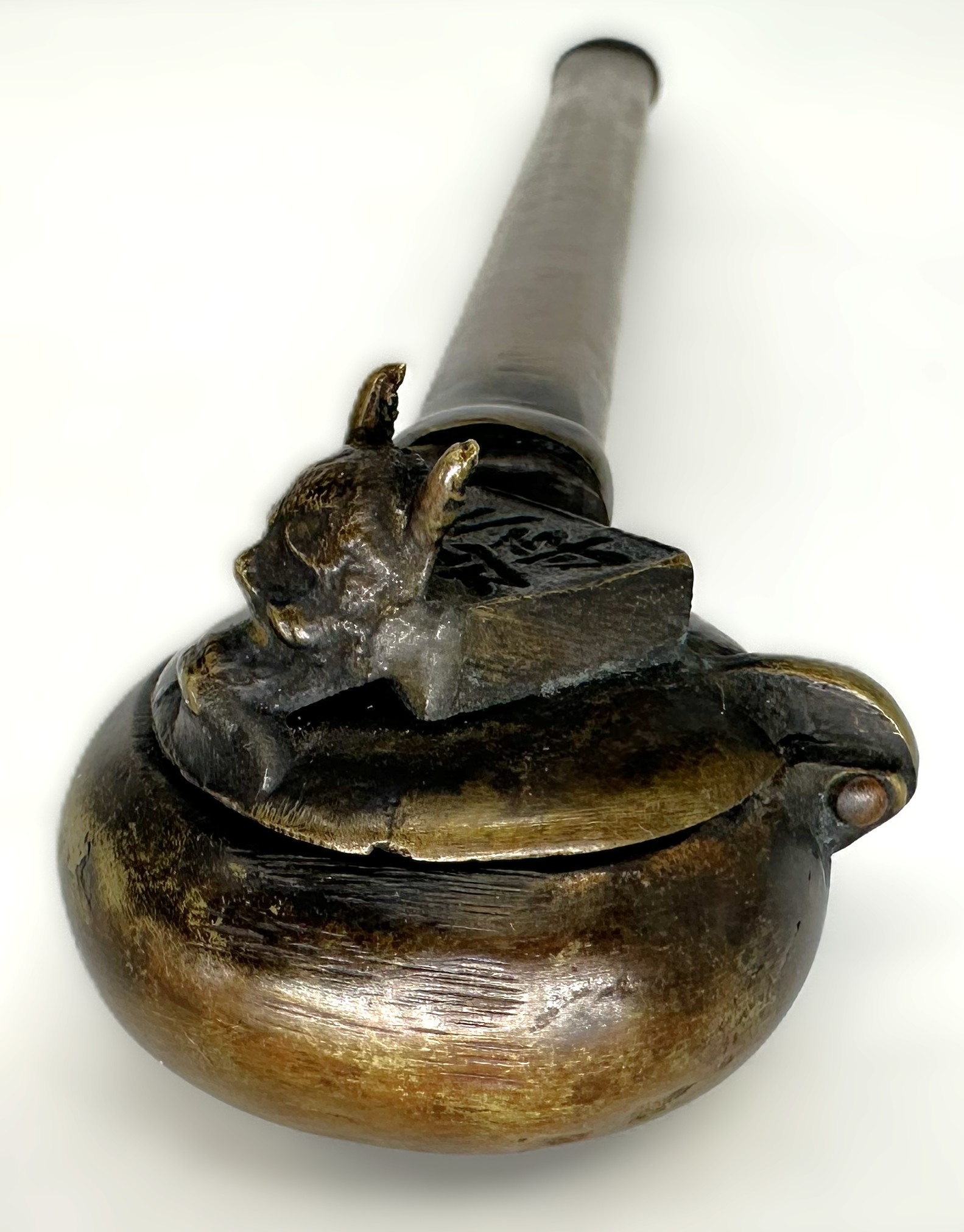

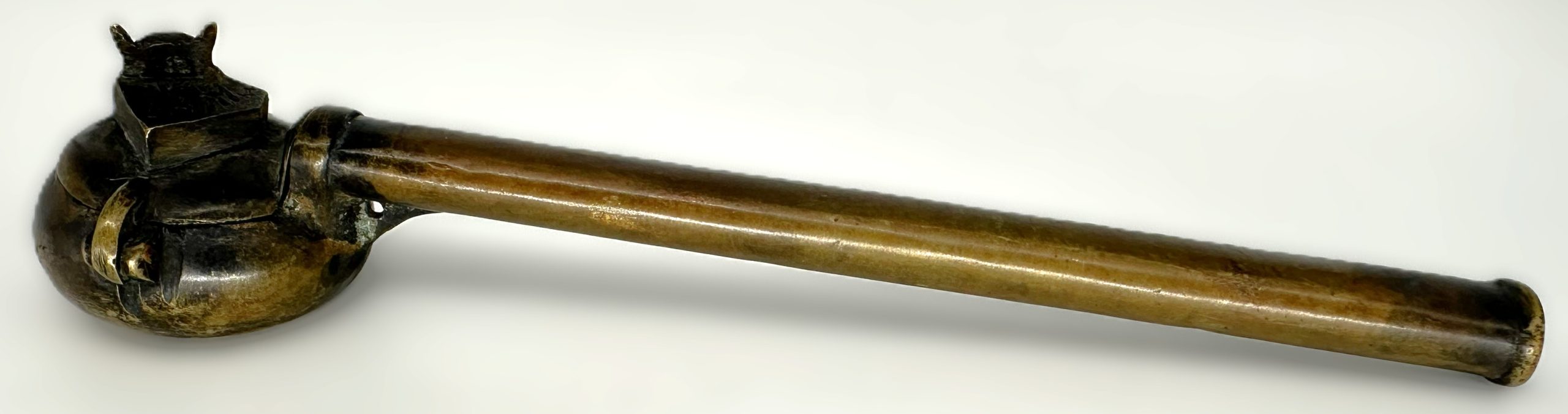
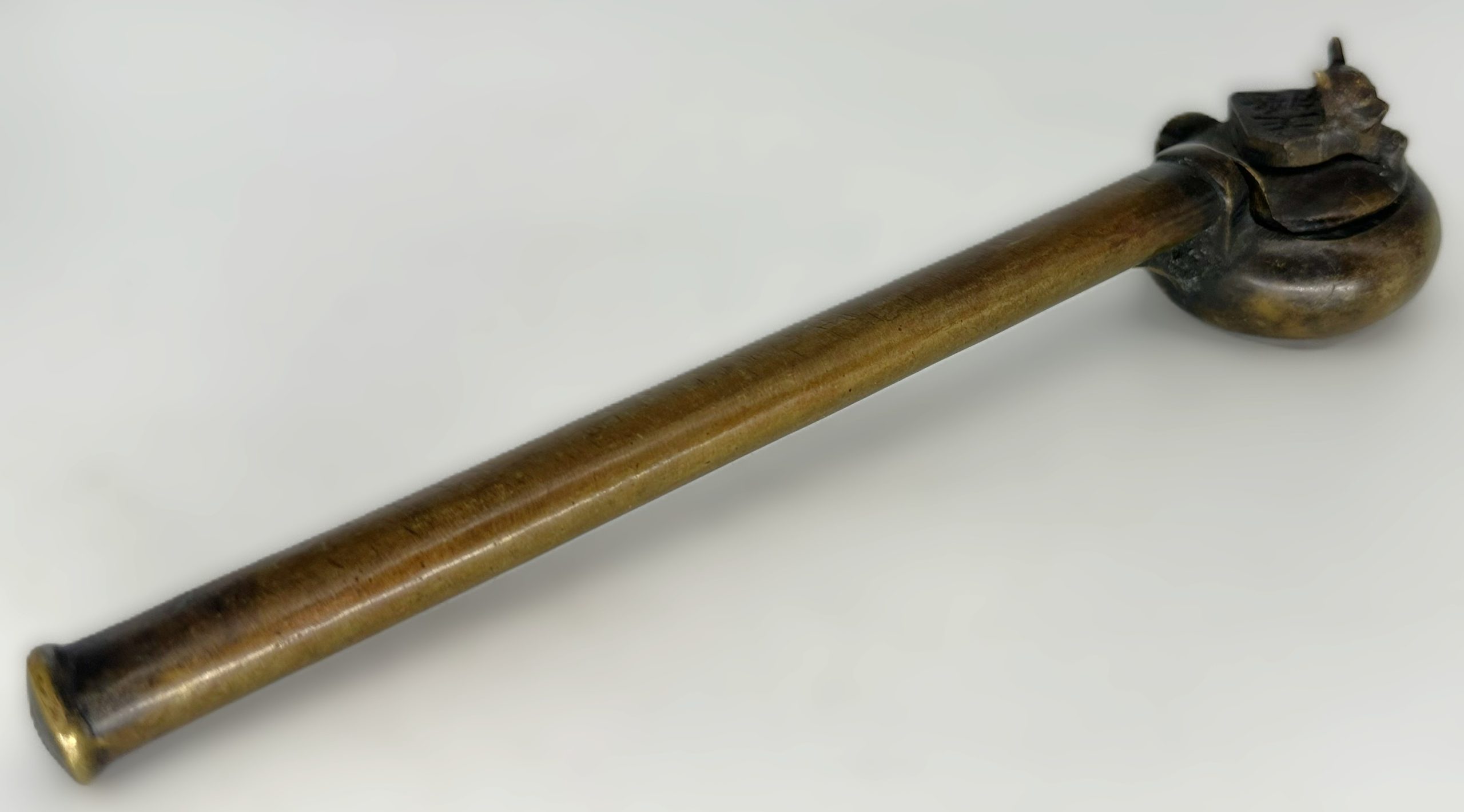
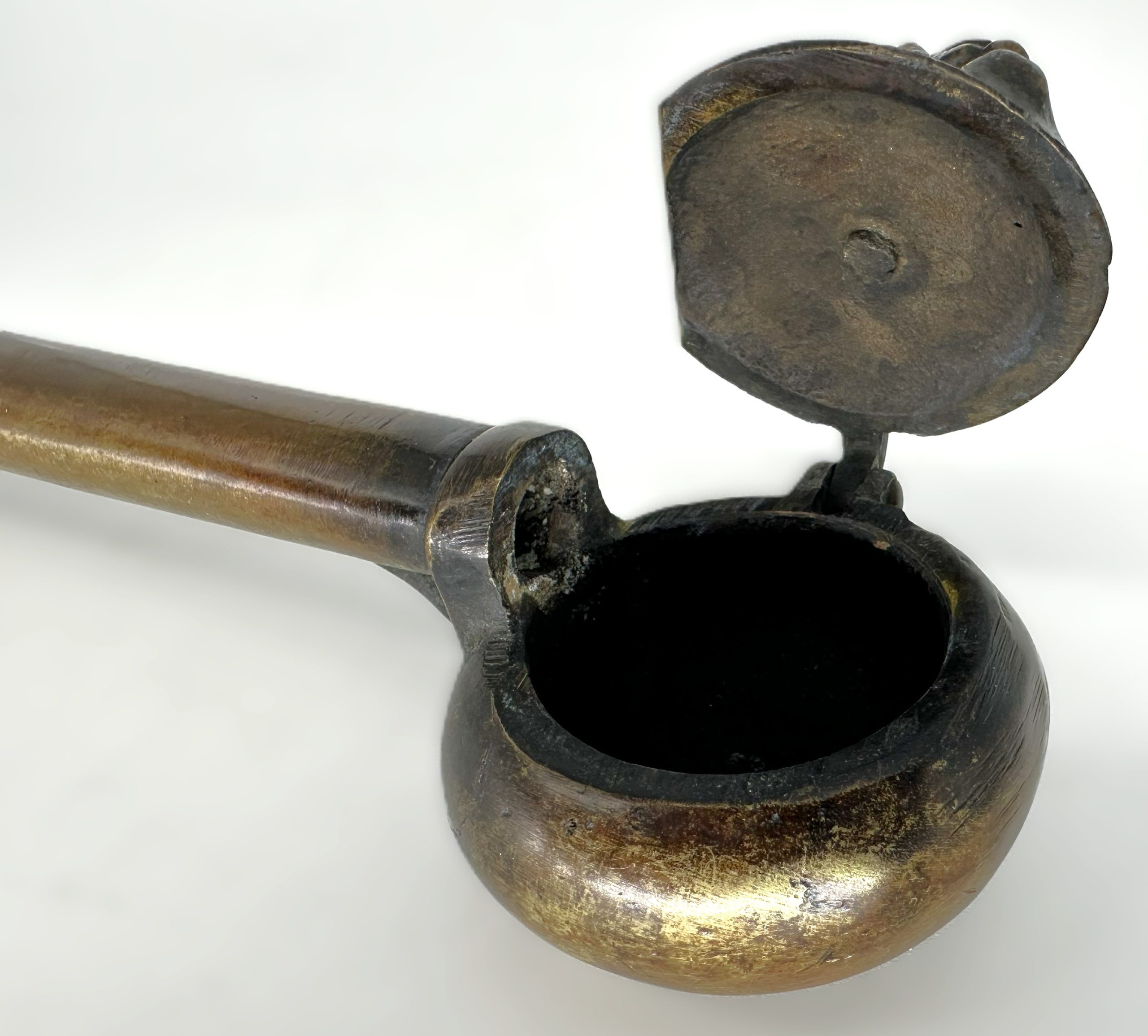
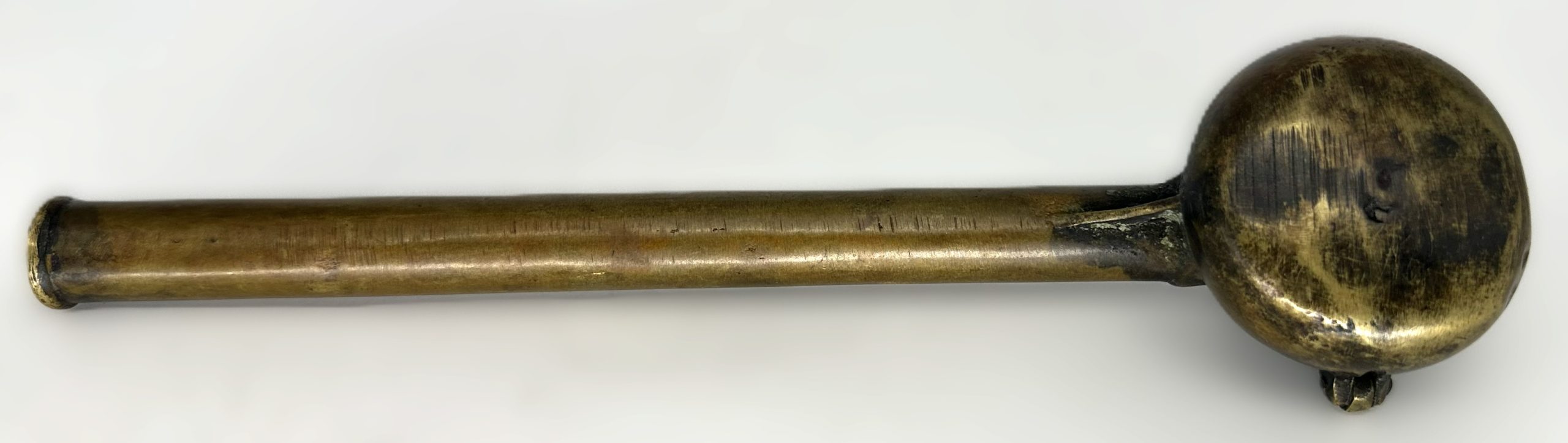
Japanese Yatate with Oni Figure
| Categories | Far East / Oriental |
| Type | Yatate |
| Material | Bronze |
| Markings | See Narrative |
| Manufacturer | Undetermined |
| Origin | Japan |
| Date or Era | circa 1890 |
| Measuring | 8 ¼” long; ink pot 1 ½” diameter |
This is a classic example of a Yatate (矢立), a portable writing set that allowed Japanese scholars, merchants, and samurai to carry their “four treasures of the study” (brush, ink, paper, and inkstone) on the go.
This piece is cast in bronze, likely from the late Edo period to the Meiji period (mid-to-late 19th century). Its design, featuring an Oni and a Shogi piece, makes it a charming “figural” example.
Anatomy of the Yatate
A Yatate generally consists of two primary sections:
- The Tube (Fude-zutsu): The long, hollow handle served as a protective case for a small bamboo writing brush (fude).
- The Ink Pot (Sumi-tsubo): The bulbous end is the “inkwell.” Rather than holding liquid ink, which would spill, it was stuffed with silk cotton saturated with liquid ink. To write, you simply pressed the brush into the damp cotton to “load” it.
- The Hinge and Lid: These were often the most decorative parts, designed to be airtight to prevent the ink from drying out.
The “Devil” on the Lid: The Japanese Oni
The devil-like figure on the lid is an Oni—a supernatural ogre or demon from Japanese folklore.
- Identification: You can see the classic hallmarks: the two short horns, the bulging eyes, and the wide, grimacing mouth.
- Symbolism: While Oni are often seen as villains in folk tales, they are also used as protective symbols (Onigawara). In the context of a personal item like this, the Oni often serves as a “ward” to frighten away bad luck or malevolent spirits.
- The Shogi Connection: The Oni is leaning against a Shogi piece (koma). Shogi is Japanese chess. The combination of an Oni and a Shogi piece suggests a playful or “clever” theme, perhaps implying the owner was a strategic thinker or a fan of the game.
The Characters
The characters on the Shogi piece are written in a stylized, archaic script.
- Interpretation: They appear to read 王将 (Ōshō), which translates to “King General.” This is the highest-ranking piece in Shogi, further reinforcing the prestige of the object.
Usage and Handling
In feudal Japan, the Yatate was carried by tucking the long tube through the Obi (the sash of a kimono). The ink pot acted as a “stopper” to prevent the set from sliding through the belt.
- Preparation: The user would pull the Yatate from their belt.
- Access: They would flip open the lid and slide the brush out of the tube.
- Writing: After dipping the brush into the ink-soaked cotton, they could write on a scroll or small pad of paper.
- Cleaning: Because the ink was held in cotton, there was no need to wash the brush immediately; it could slide back into the tube once the task was finished.
Historical Context
| Attribute | Details |
| Correct Terminology | It is a Yatate. While it contains an inkwell, the term “inkwell” usually refers to a stationary object. Calling it a “portable writing set” is also accurate. |
| Age | Most likely late 19th century (Meiji Era). The patina and the casting style are consistent with the “export” and “high-craft” period when Japanese artisans began creating more elaborate figural bronzes for a global market. |
| Origin | Japan. These were ubiquitous until the widespread adoption of the fountain pen in the early 20th century. |
Estimated value: $125
Content disclaimer. The information posted is the owner’s best knowledge and may not have been vetted by the SOIC. We welcome comments, corrections, and additions, working to make our website information comprehensive and accurate.
Join the Society of Inkwell Collectors (SOIC) – it’s free!
Founded in 1981 as a non-profit organization,
we are documenting inkwells (and accessories).
We’re here to help and inform!