

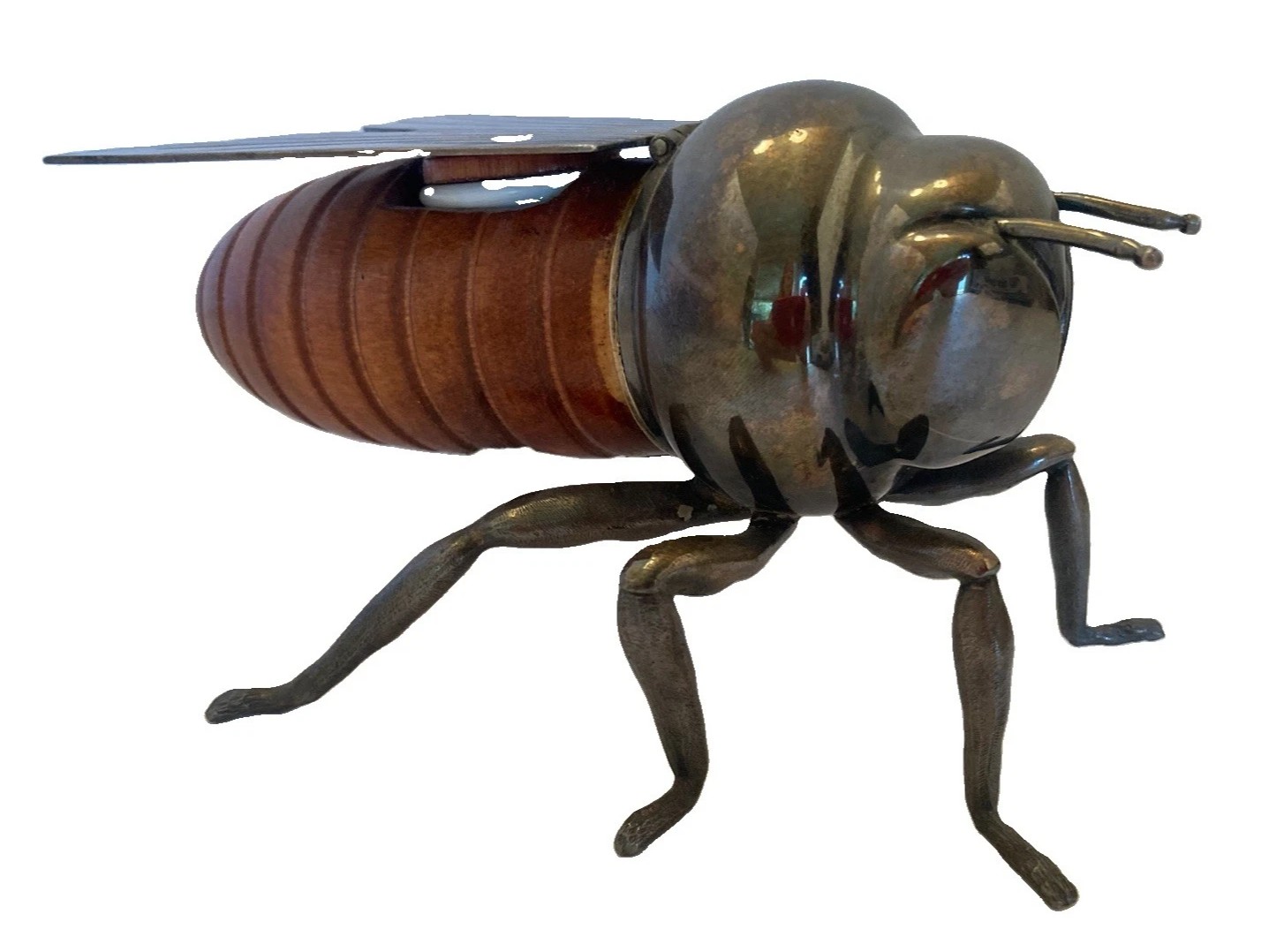
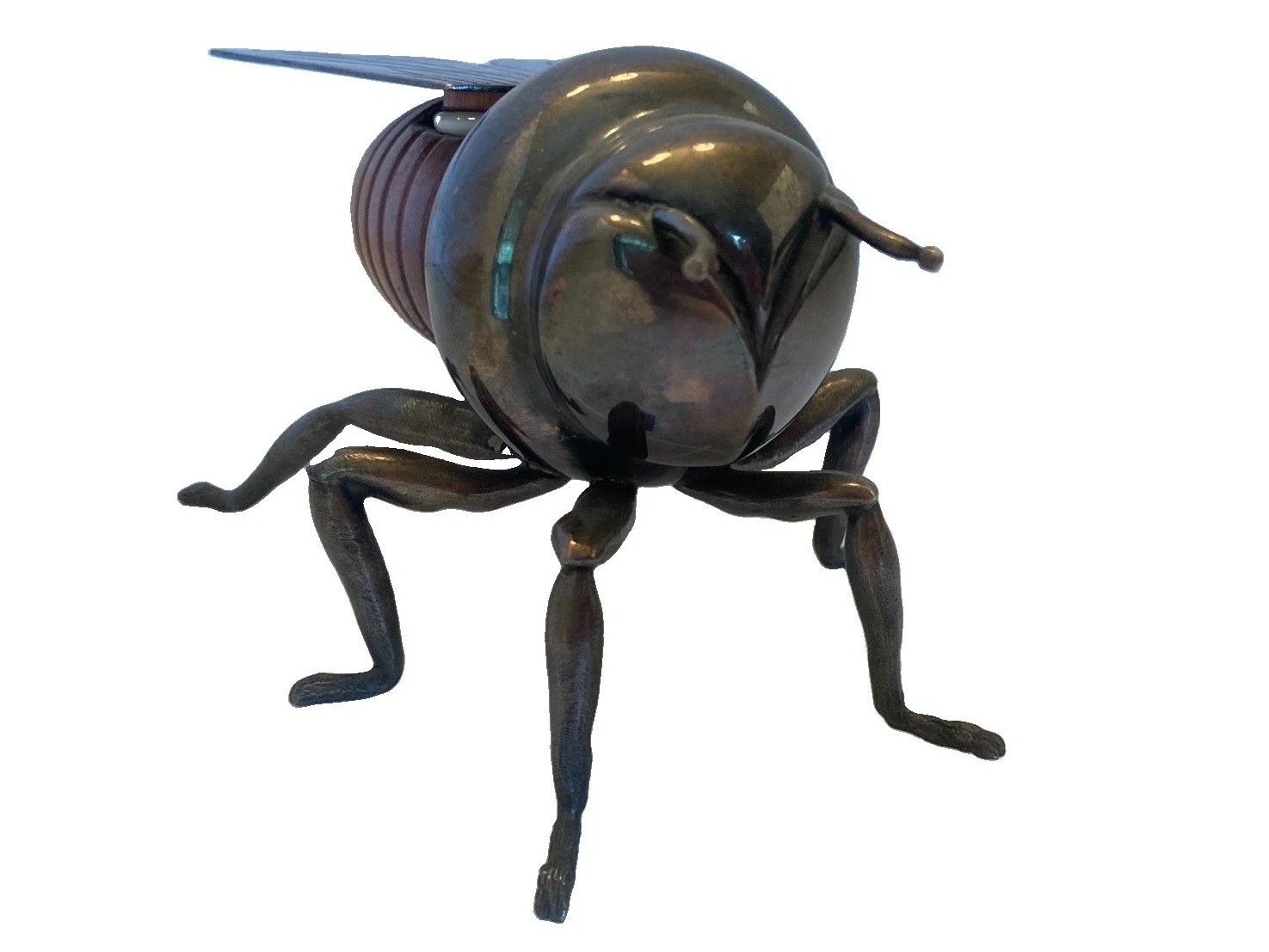
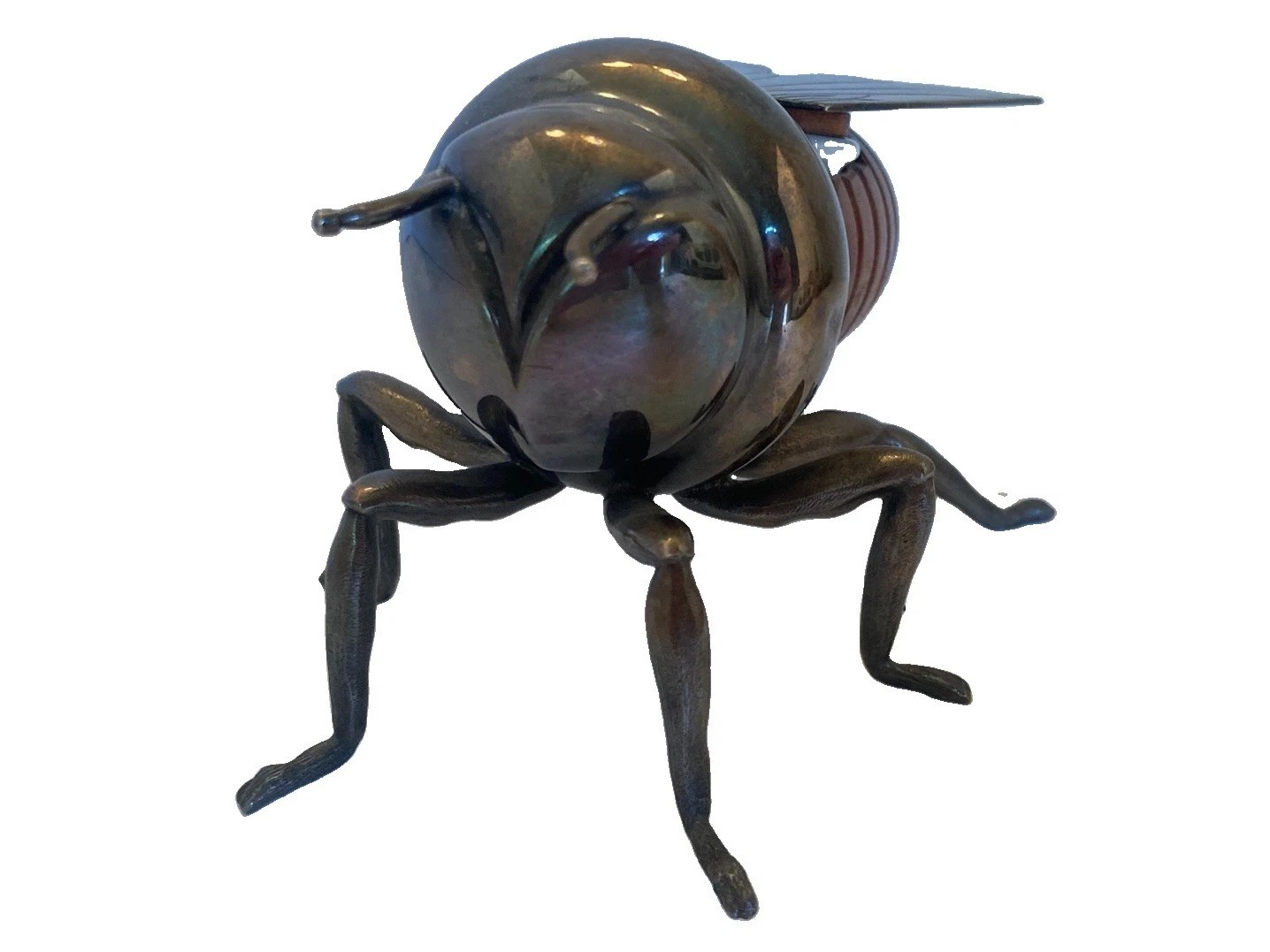
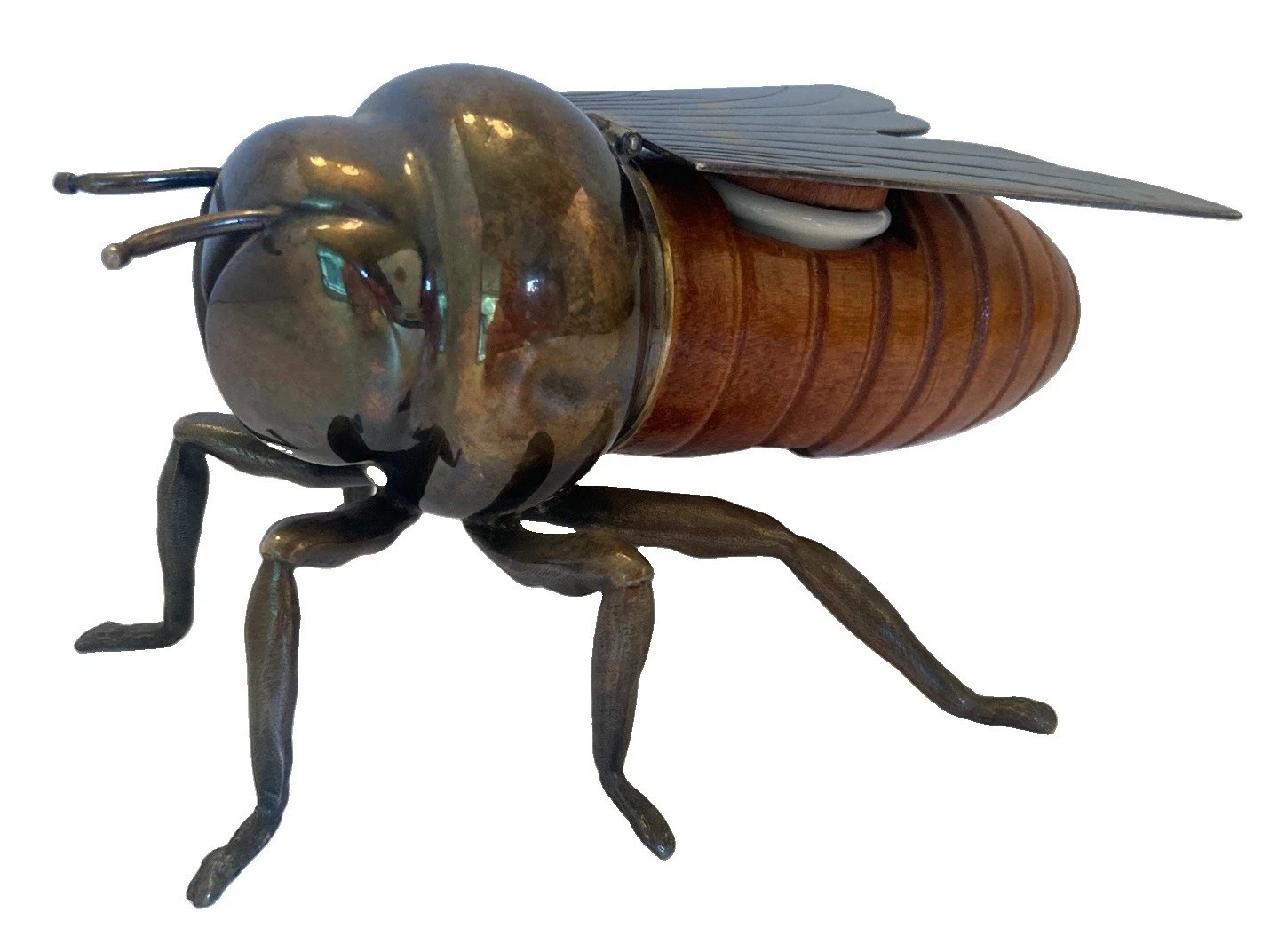
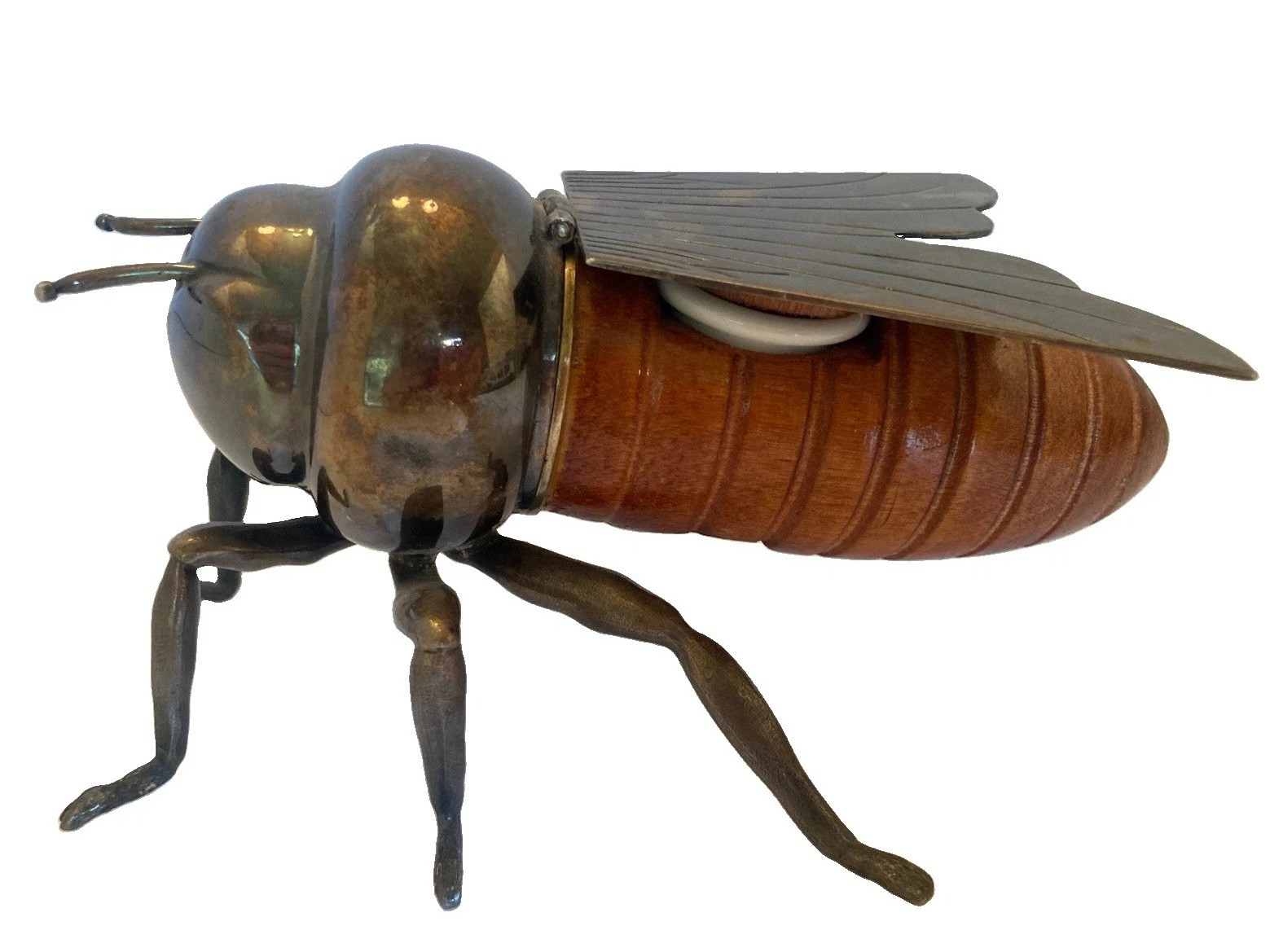
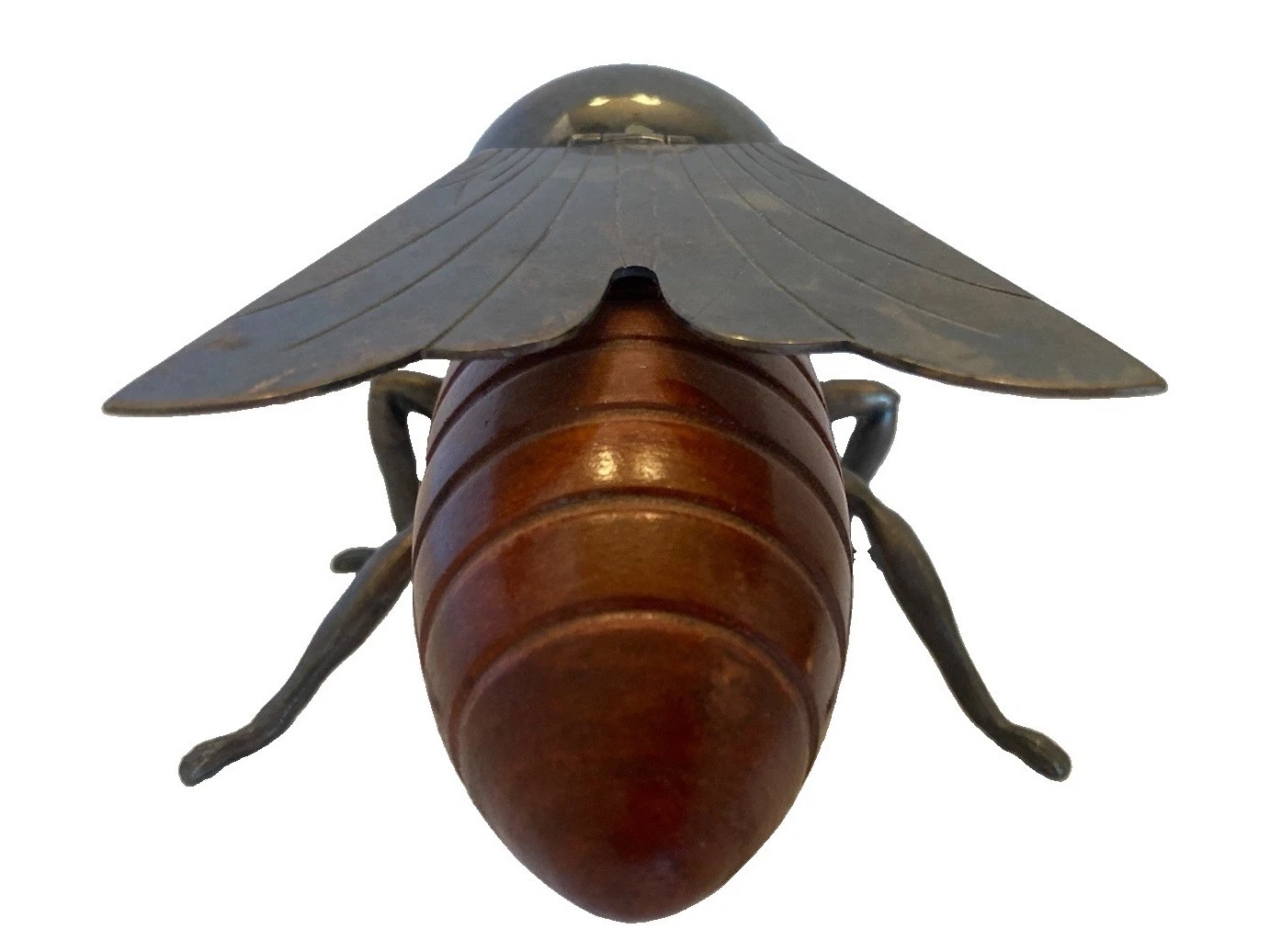
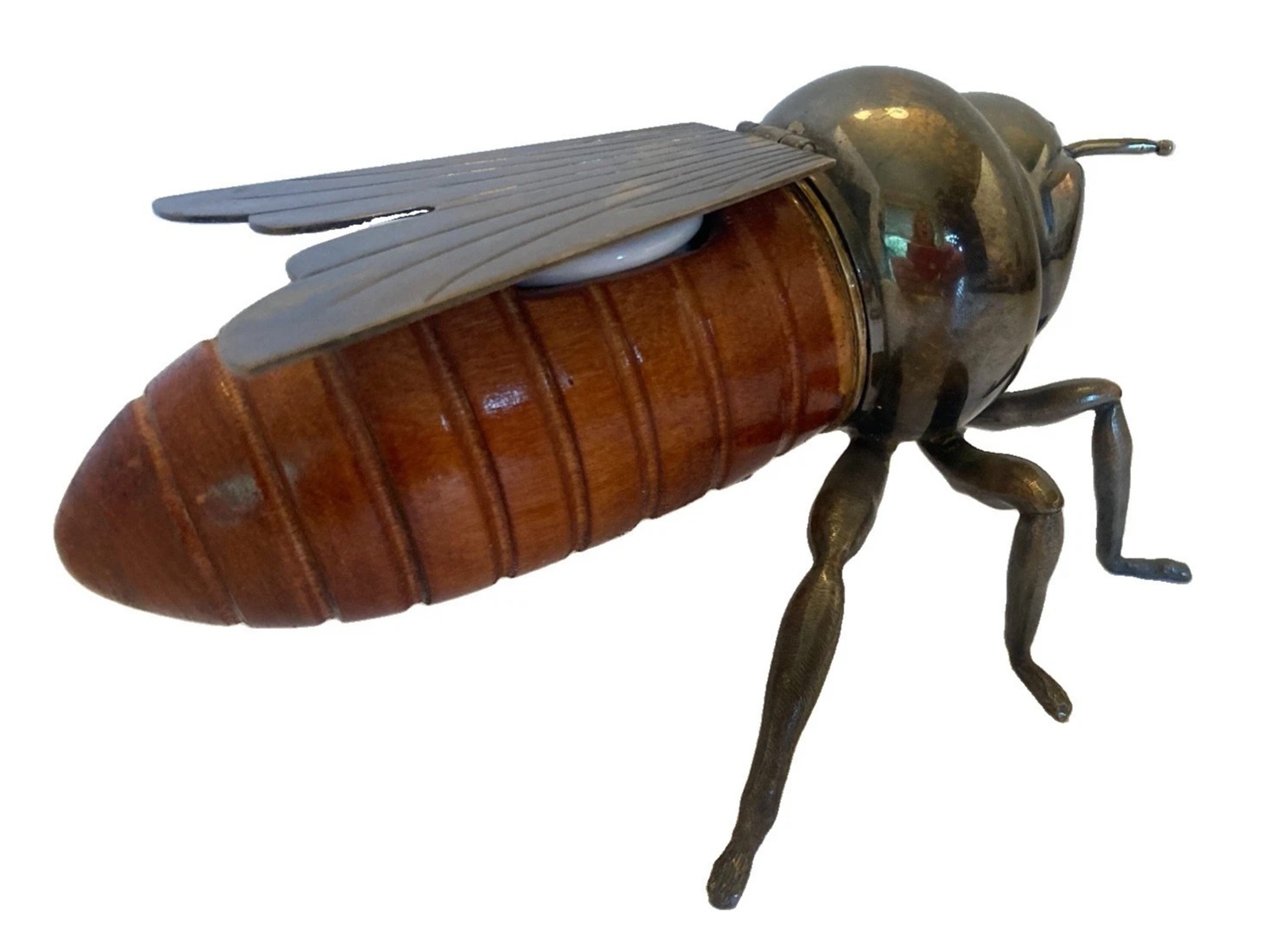
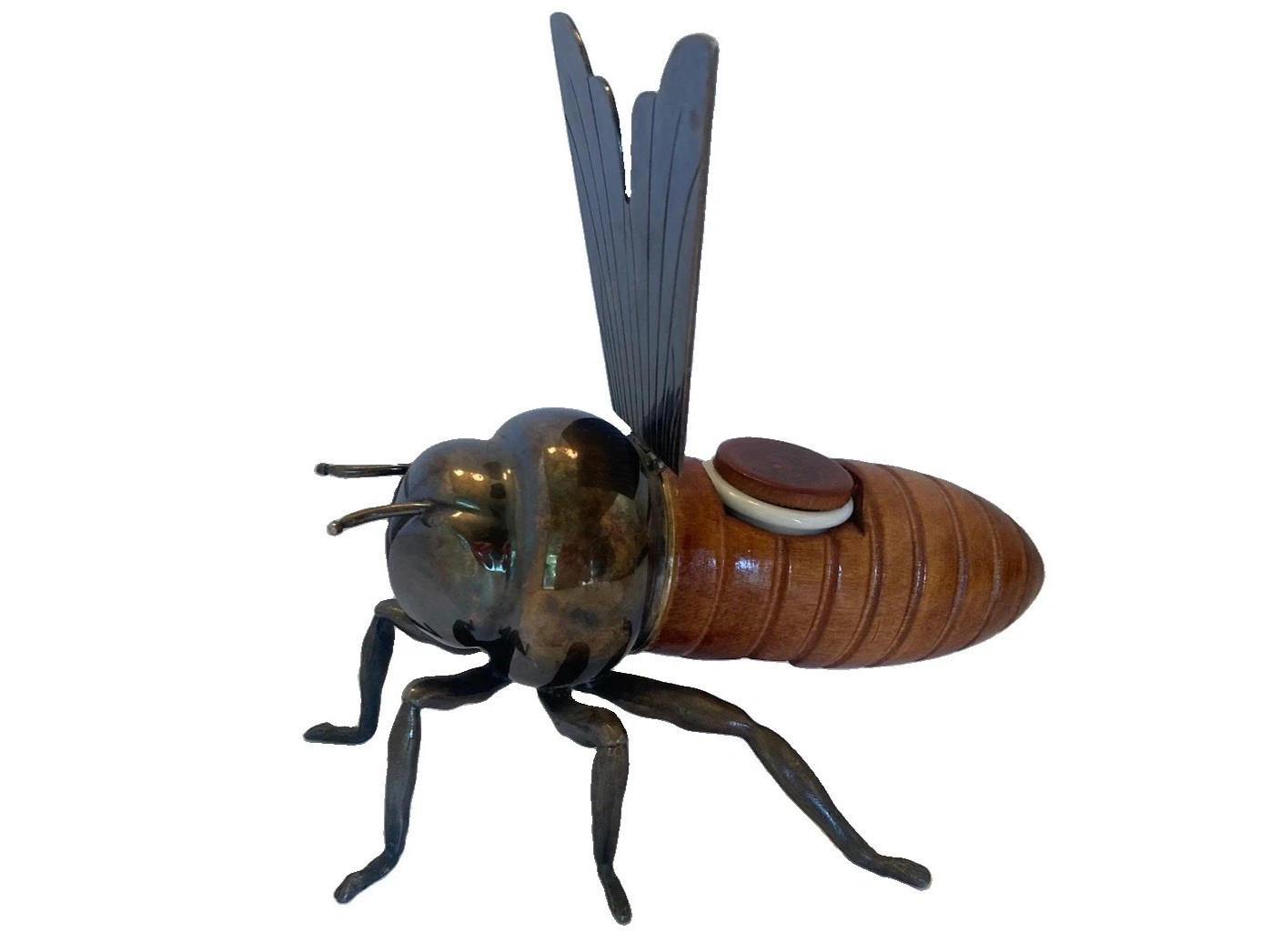
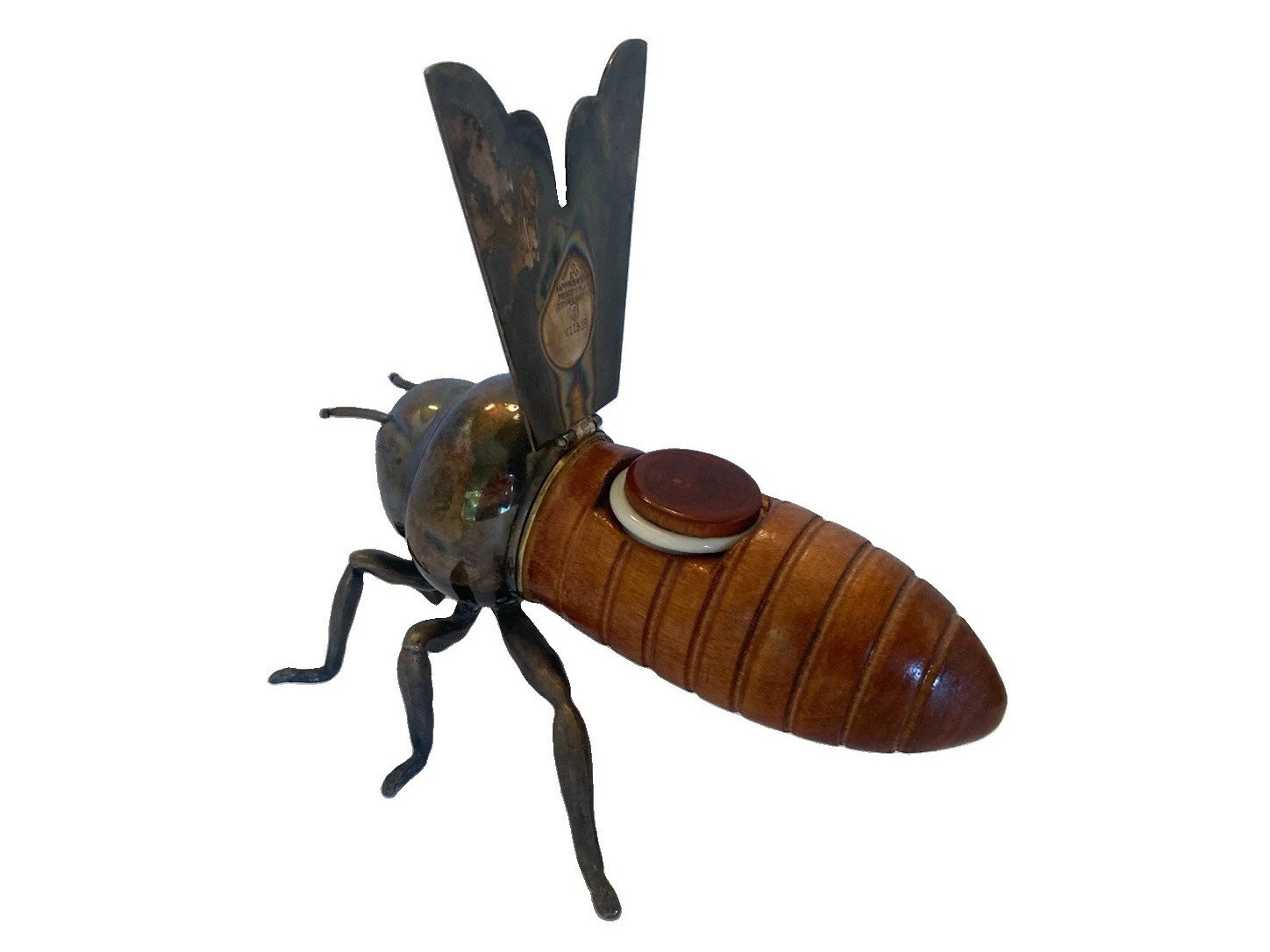
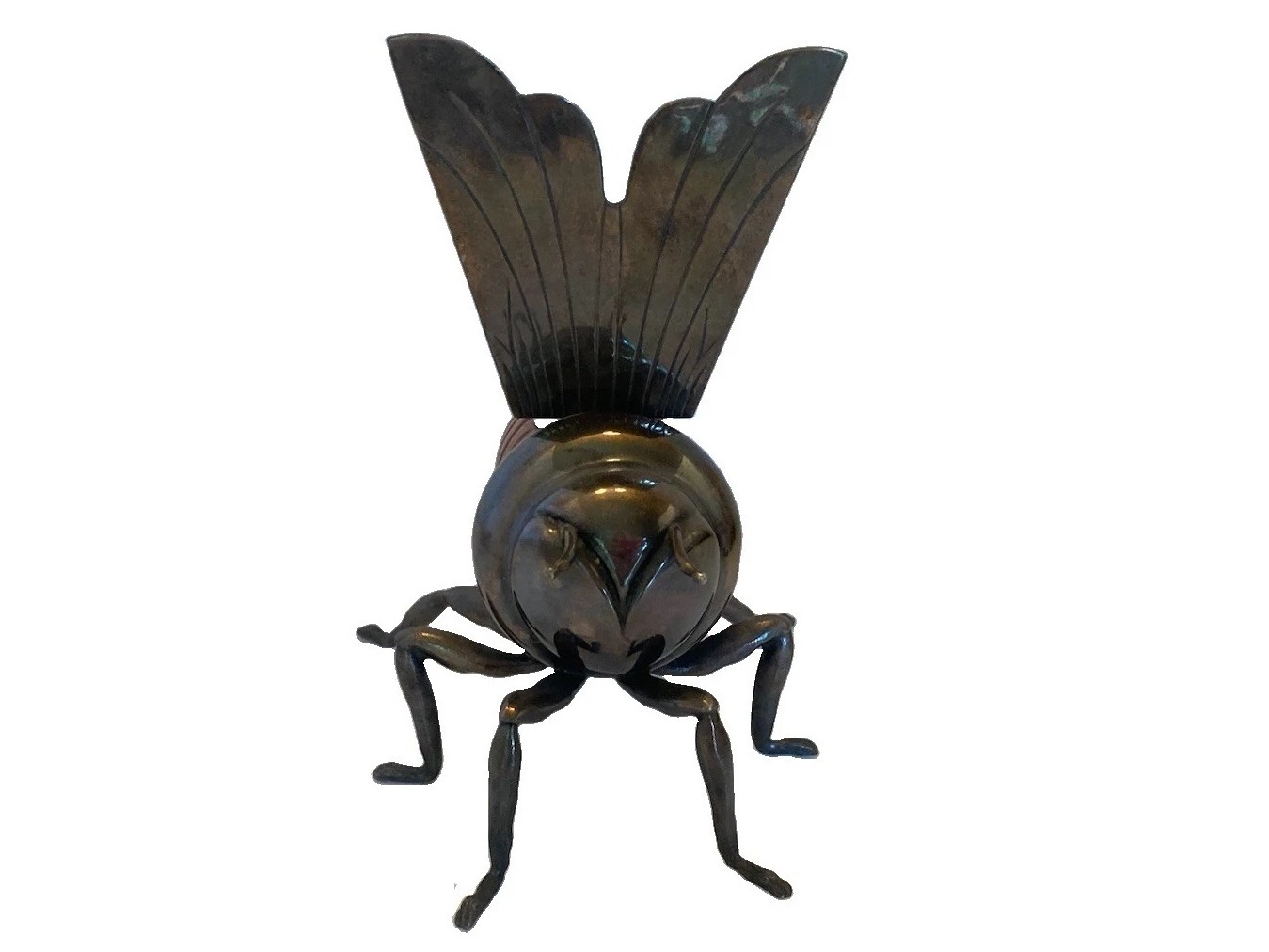
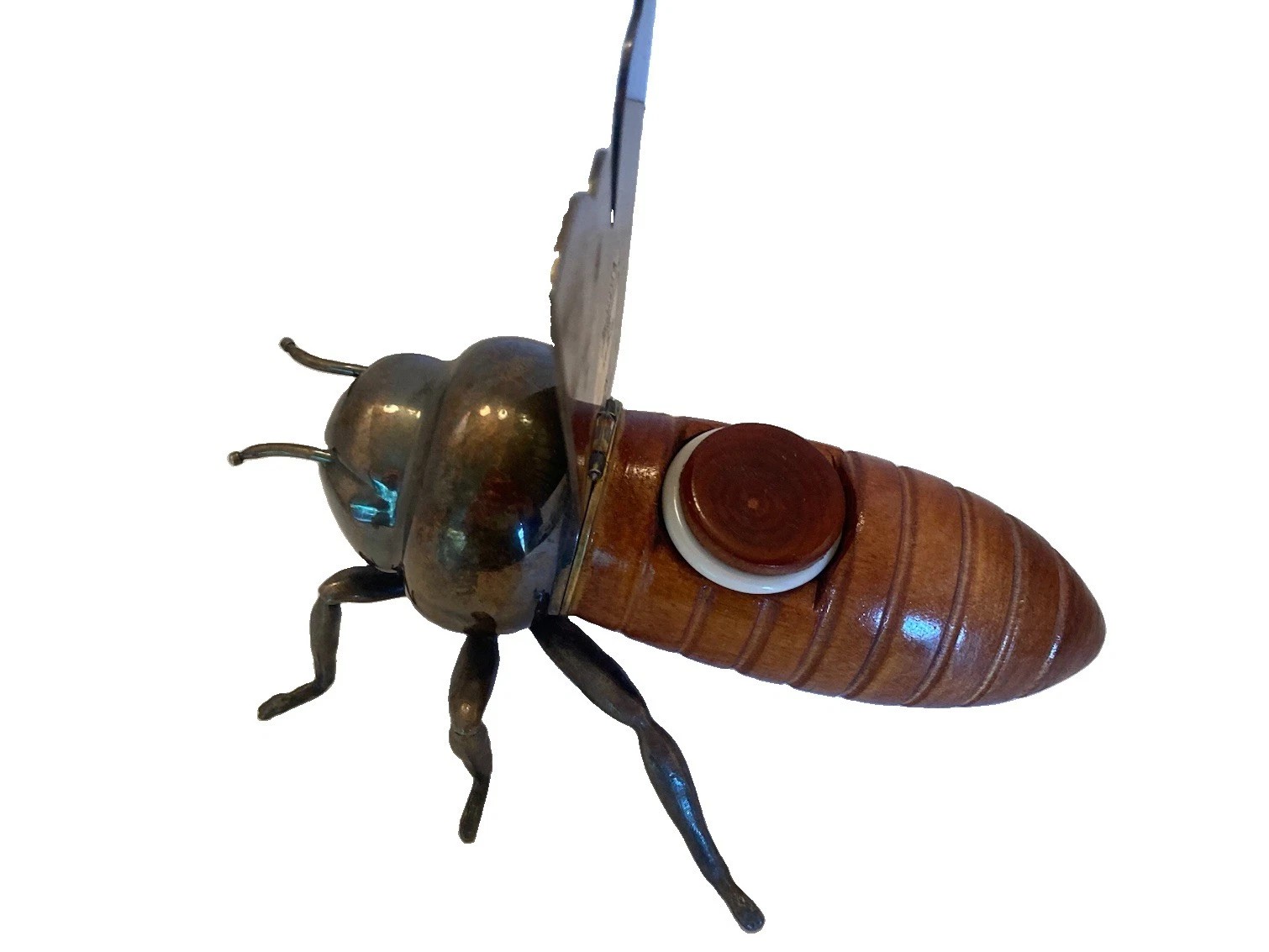
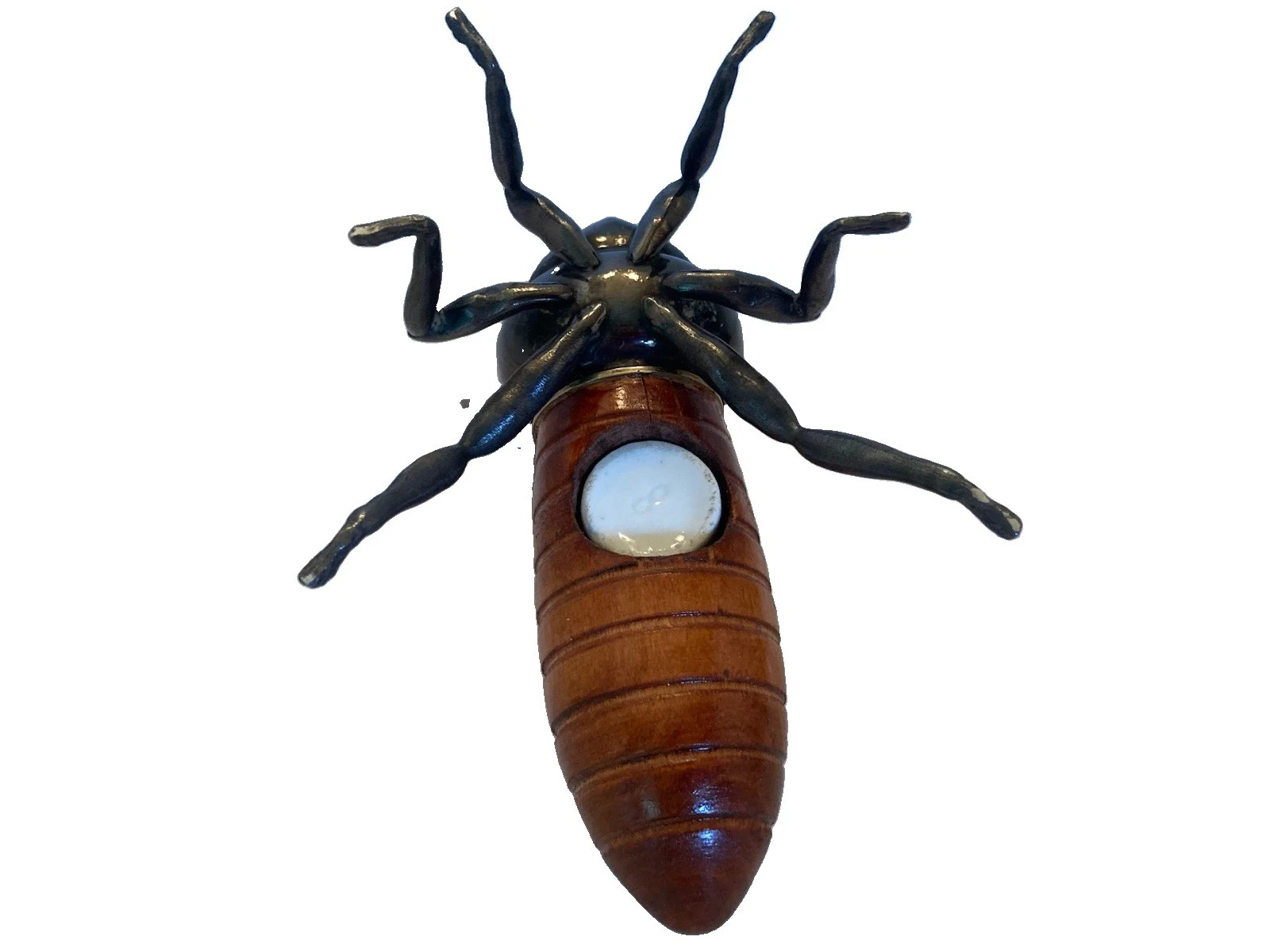
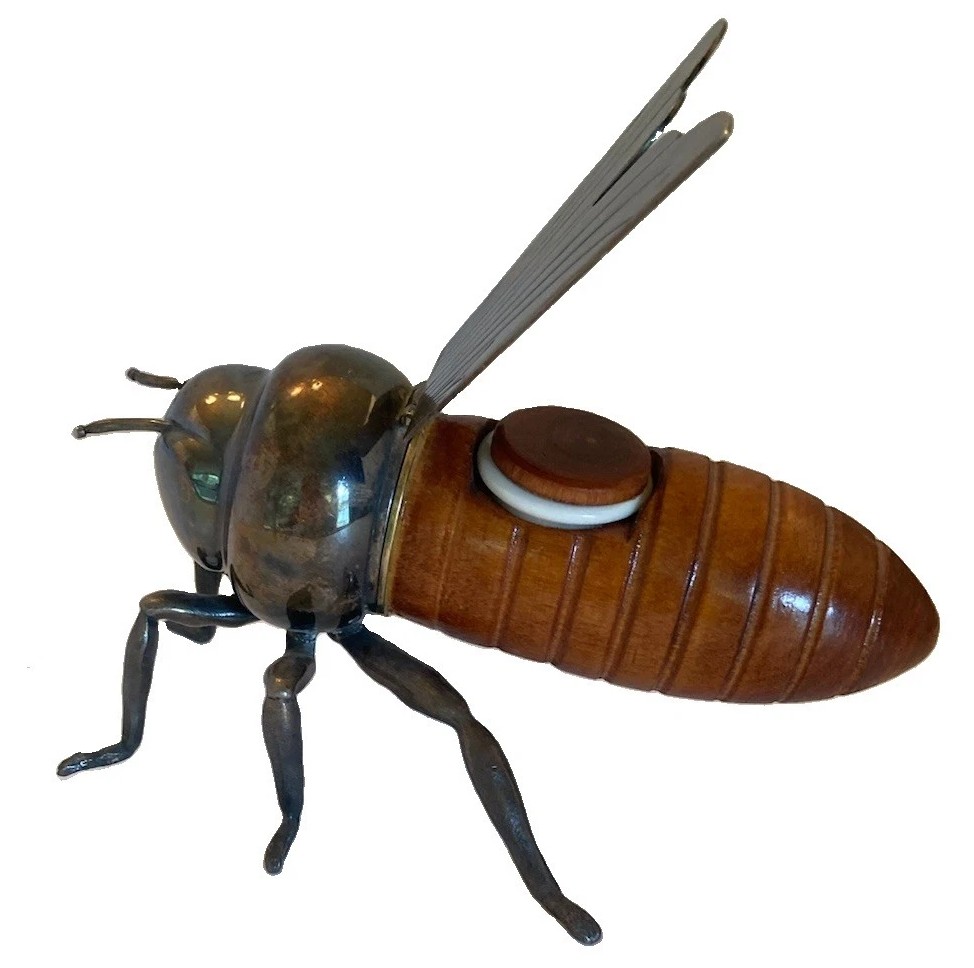
Inkwell in the Form of a Bee
| Categories | Figural - Animals & Living Creatures |
| Type | Insects |
| Material | Silverplate, Wood |
| Markings | See Narrative |
| Manufacturer | Mappin & Webb |
| Origin | England |
| Date or Era | circa 1930 |
| Measuring | 7” long |
Description & Markings
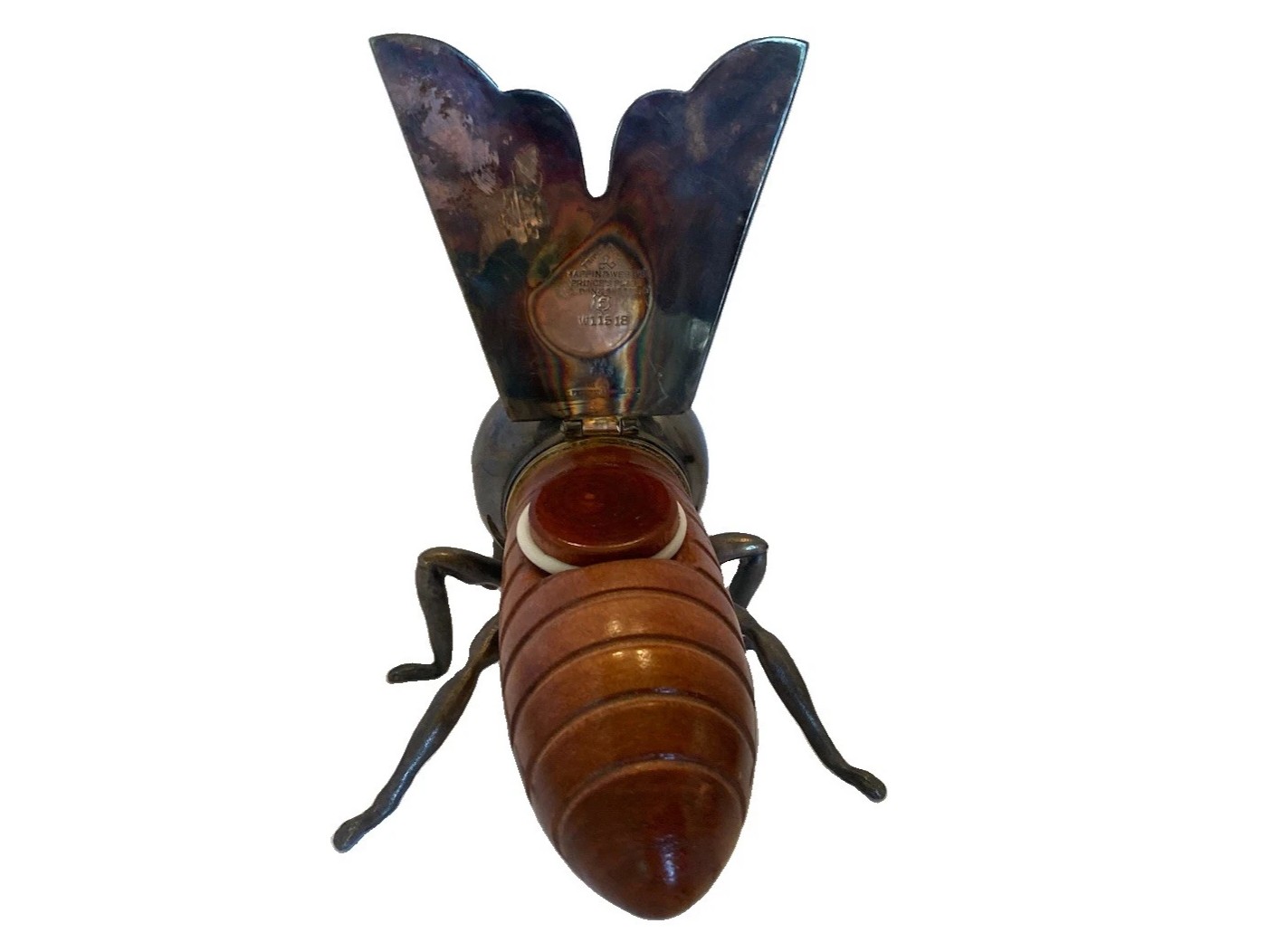
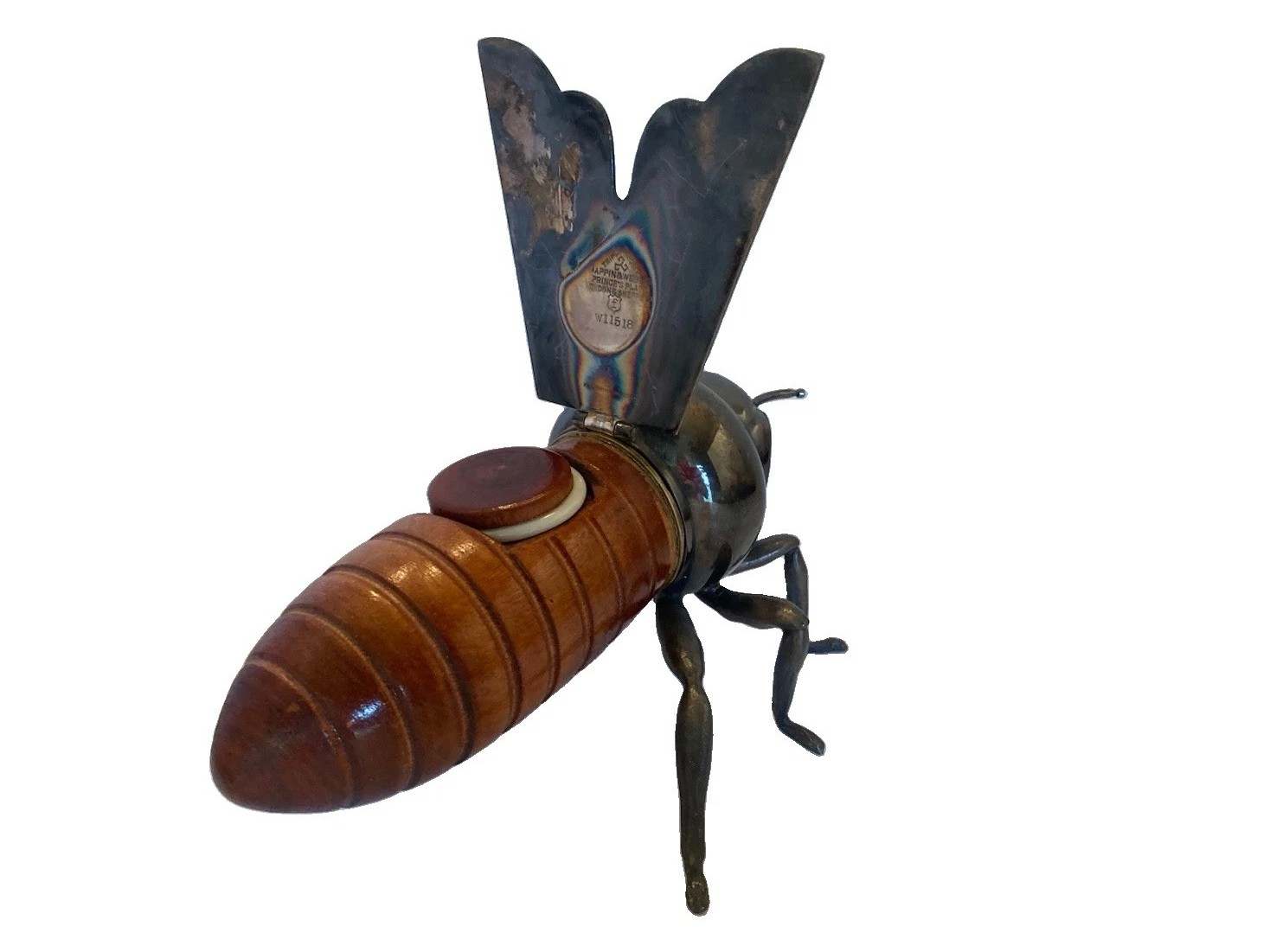
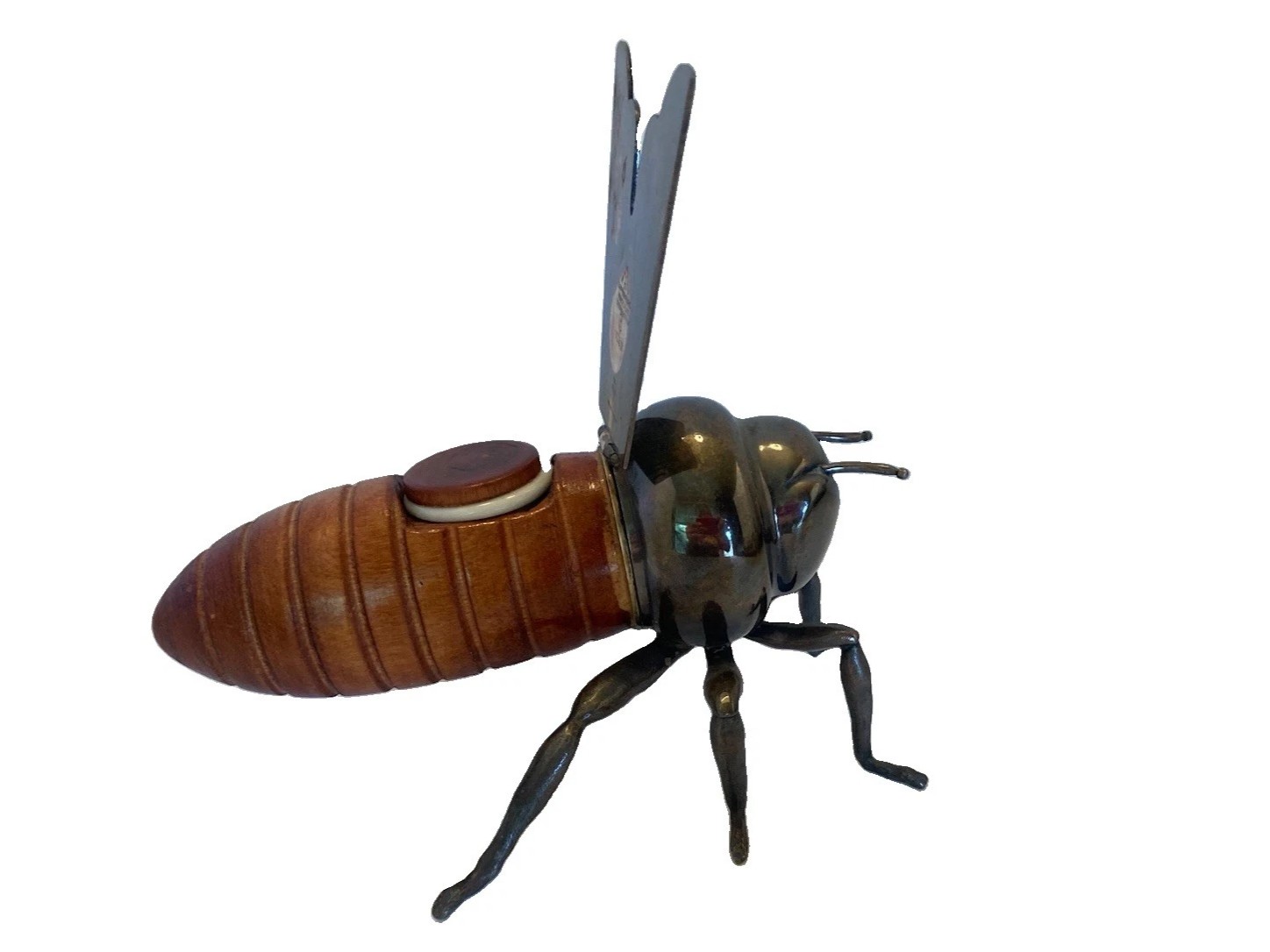
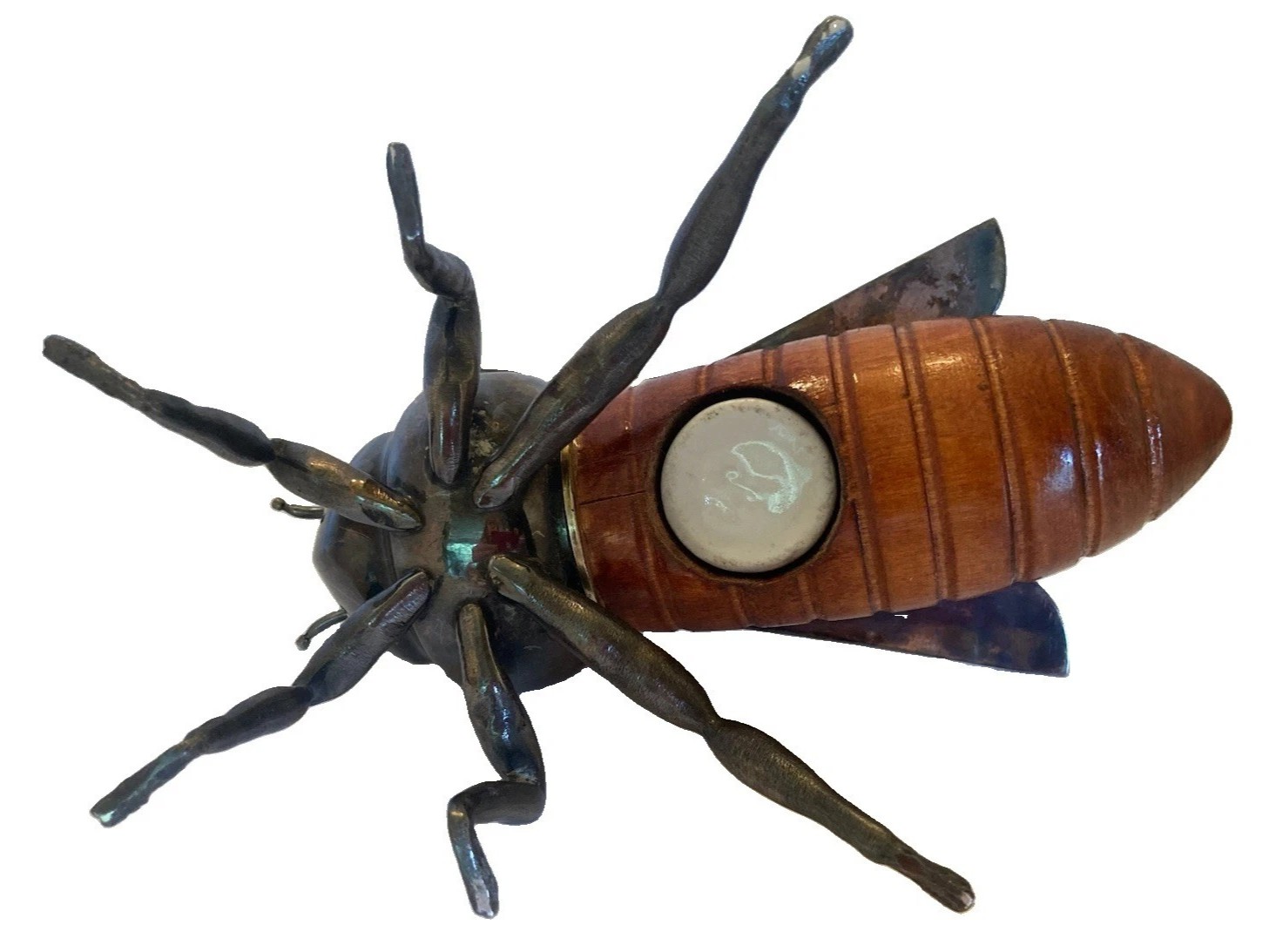
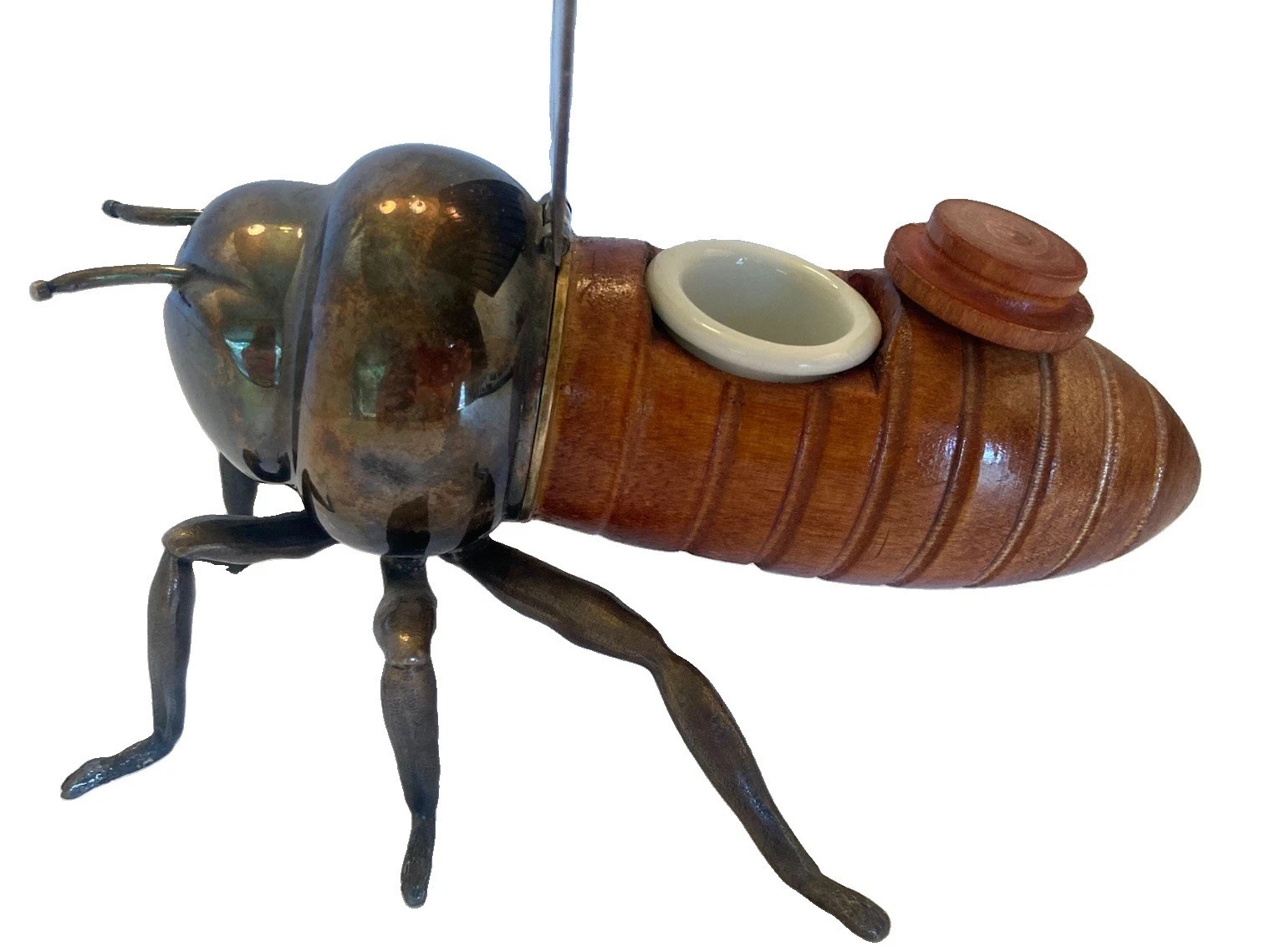
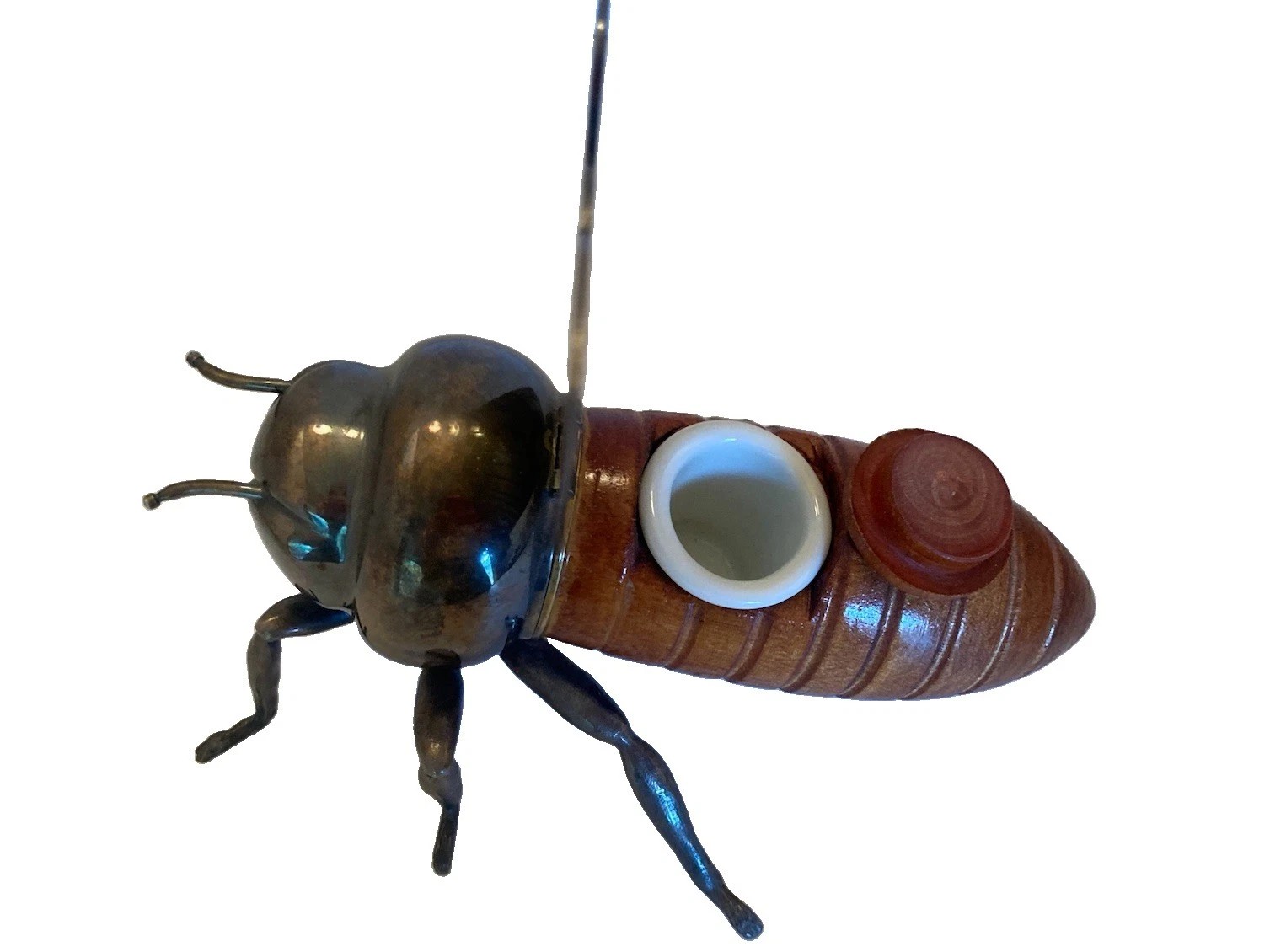
- Construction: The head, thorax, jointed legs, and hinged wings are cast in electroplated silver. The abdomen is turned hardwood with incised concentric rings replicating insect segments.
- Functional Elements: The dual wings pivot upward on a hinge at the base of the thorax to reveal the abdomen. Recessed into the wood is a glazed white porcelain insert, fitted with a turned wooden stopper.
- Hallmarks & Stamps: Stamped directly onto the underside of the hinged wings is the triangular shield mark: Mappin & Webb’s Prince’s Plate / London & Sheffield, accompanied by a letter mark and pattern number W11518.
Original Identity vs. Inkwell Conversion
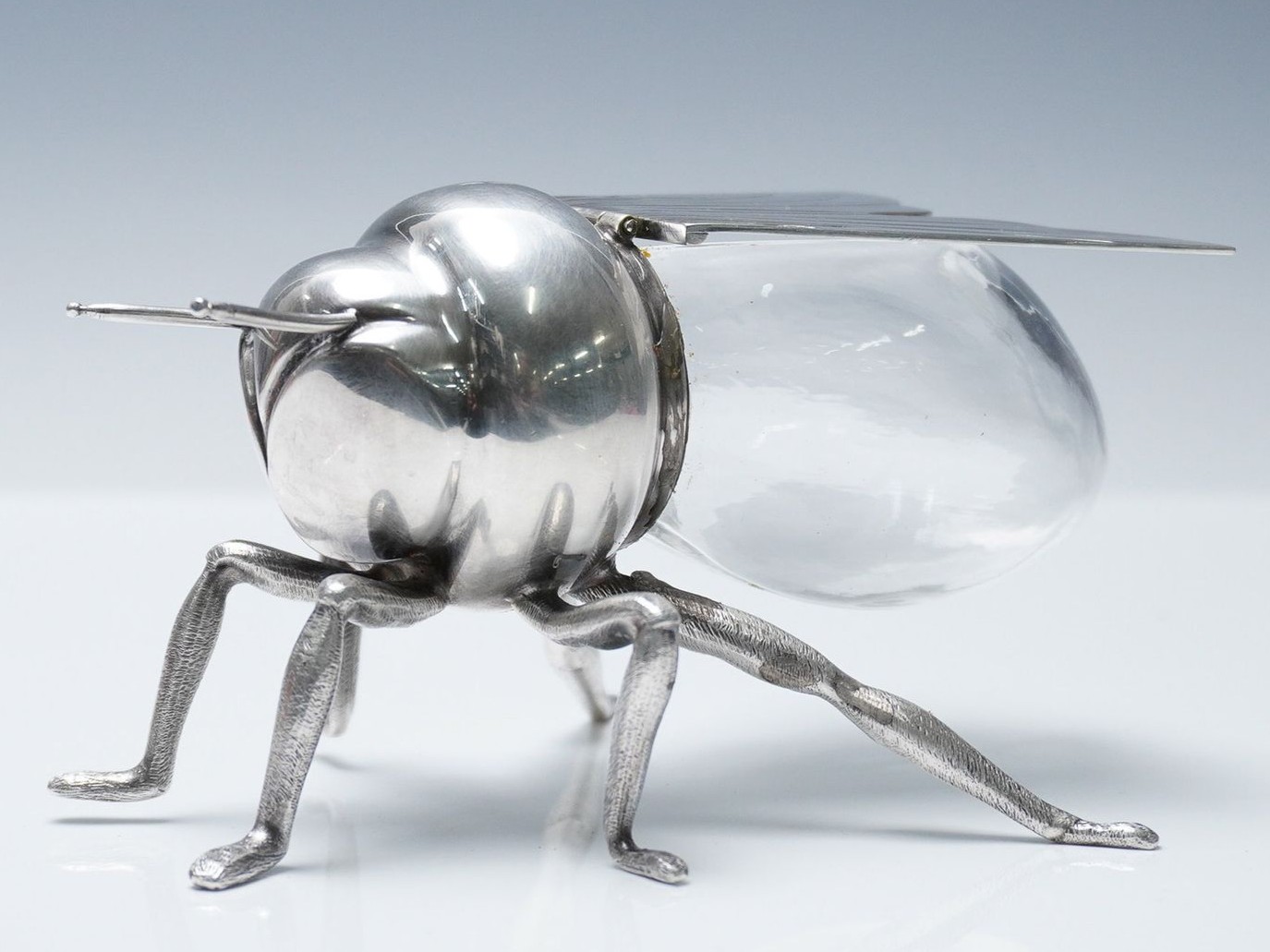
The metalwork was not originally designed as an inkwell. Pattern W11518 is Mappin & Webb’s famous novelty bee honey/preserve pot, originally produced in the late Victorian and Edwardian eras (circa 1900–1925).
- In the original catalog piece, the abdomen was a blown glass reservoir—most commonly ruby-red, honey-amber, or cobalt glass—meant to hold honey or jam, accessed by lifting the wings and served with a miniature spoon.
- These glass bodies were fragile and frequently cracked or shattered over decades of household use.
- This piece represents an ingenious, high-quality period conversion. A craftsman or woodturner lathed a custom ribbed wooden replacement abdomen to lock into the original silver-plated collar, hollowing out the interior to fit a standard ceramic desk well and wooden plug.
Was It One of a Kind?
- The Metal Casting: Not one of a kind. The silver-plated bee frame, legs, and stamped wings were factory-produced catalog pieces sold in Mappin & Webb’s London and regional showrooms.
- The Inkwell Configuration: Effectively one of a kind. Because Mappin & Webb did not catalog pattern W11518 with a wooden body or as an ink reservoir, this is an aftermarket marriage/adaptation. It transformed a broken luxury tabletop curiosity into a functional desk accessory.
History of Mappin & Webb
- Origins (1775): Founded in Sheffield by Jonathan Mappin as a small silversmithing workshop, quickly expanding as Sheffield became the epicenter of British cutlery and silver plate manufacturing.
- Formation of Mappin & Webb (1860s): John Mappin (Jonathan’s great-grandson) established the modern firm, partnering with his brother-in-law George Webb in the 1860s. They expanded rapidly into high-end retail with luxury showrooms on London’s Oxford Street and Regent Street.
- “Prince’s Plate”: Patented by the firm in the late 19th century, Prince’s Plate was a proprietary electroplating process that deposited a substantially thicker layer of silver over nickel silver than standard EPNS, guaranteed by the maker to match the longevity of sterling silver.
- Royal Warrants & Prestige: Mappin & Webb received its first Royal Warrant from Queen Victoria in 1897 and went on to hold warrants for every subsequent British monarch, eventually serving as Crown Jeweler.
Sold for $207 in August 2026
Content disclaimer. The information posted is the owner’s best knowledge and may not have been vetted by the SOIC. We welcome comments, corrections, and additions, working to make our website information comprehensive and accurate.
Join the Society of Inkwell Collectors (SOIC) – it’s free!
Founded in 1981 as a non-profit organization,
we are documenting inkwells (and accessories).
We’re here to help and inform!