

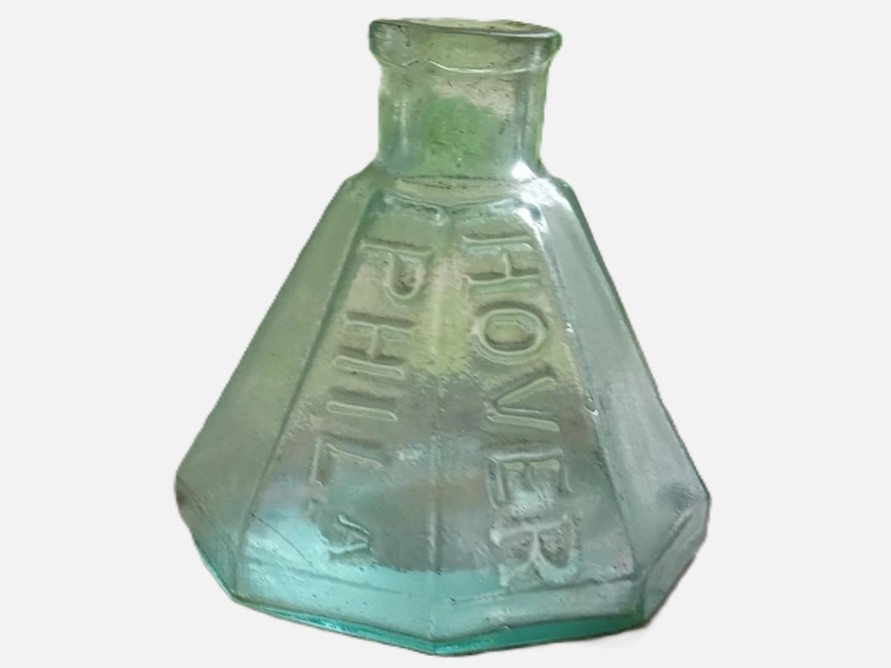
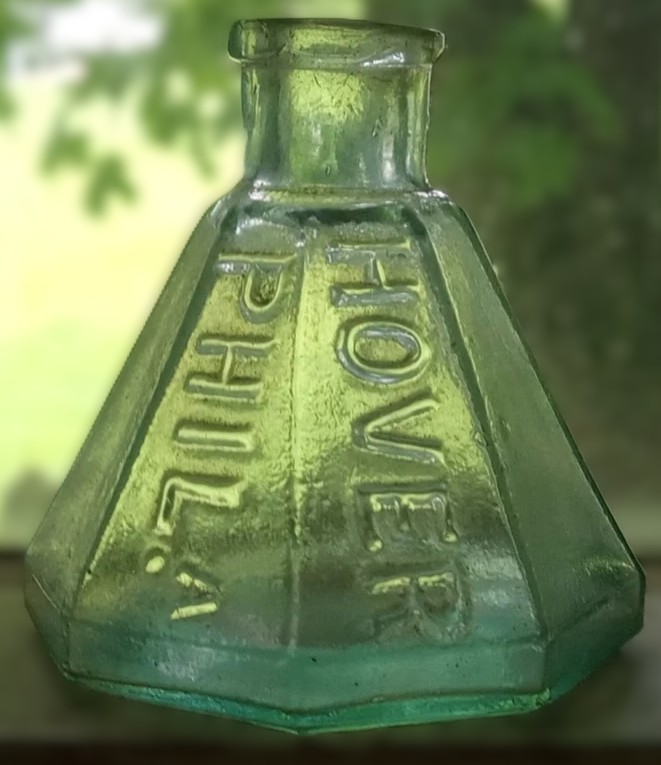
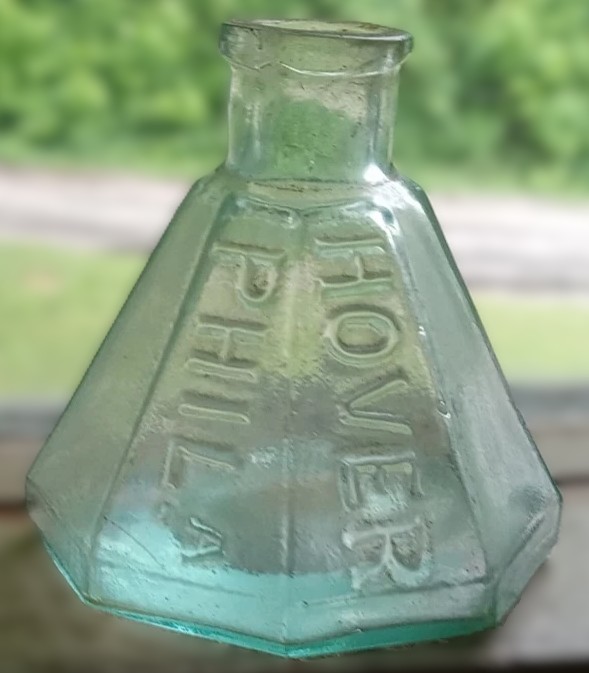
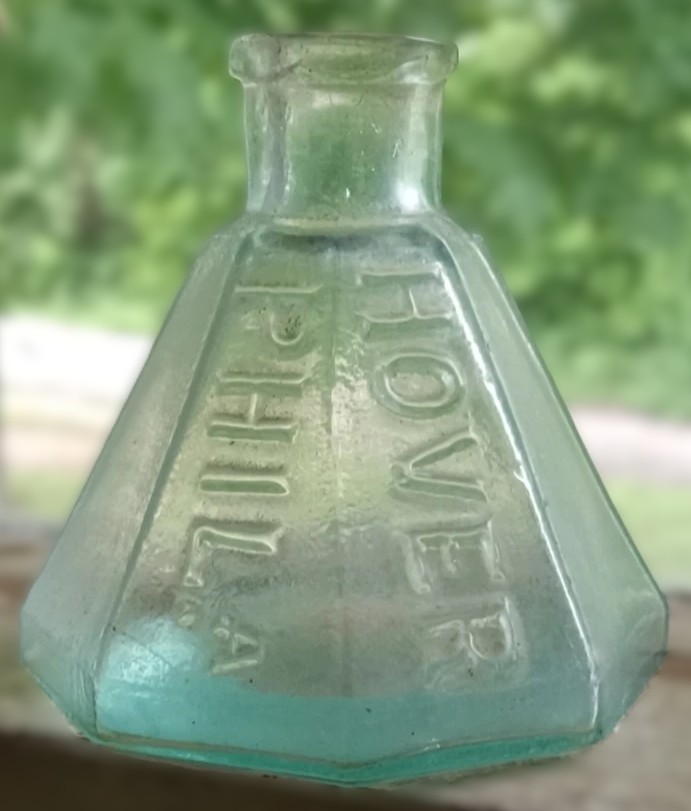
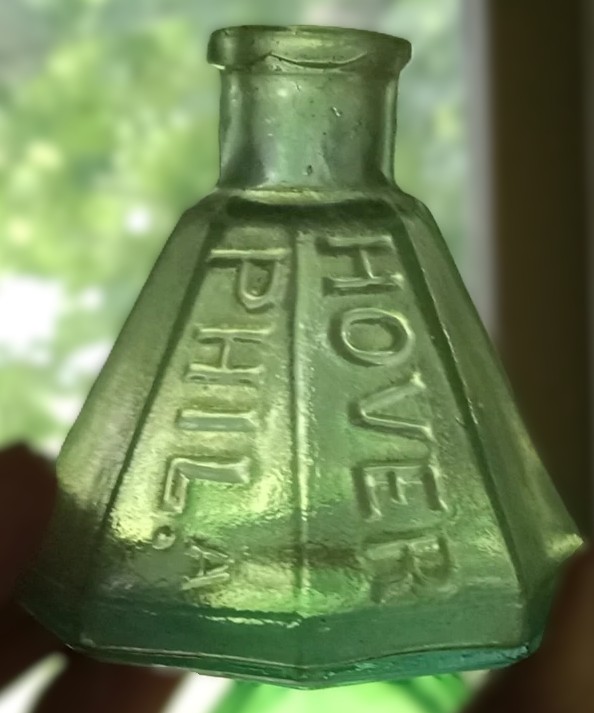
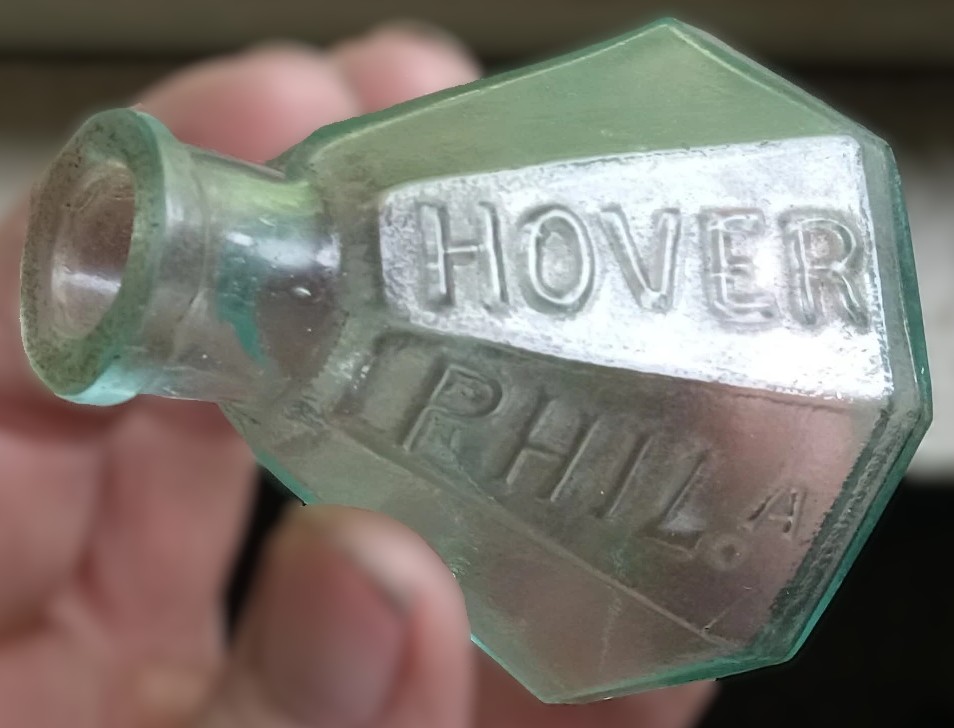
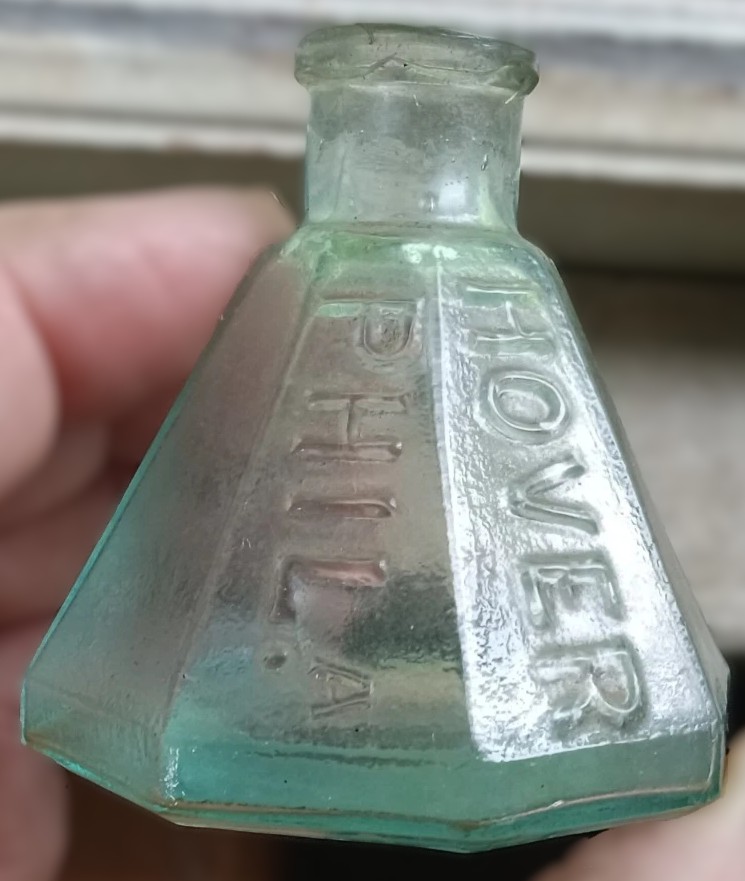
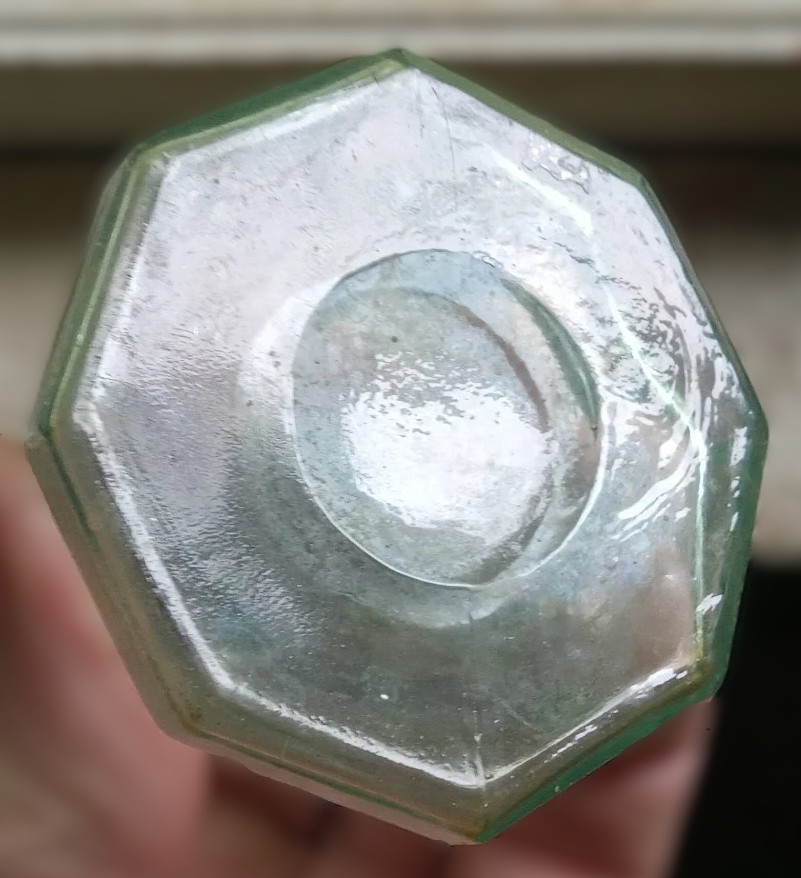
Ink Bottle Embossed Hover Phila
| Categories | Ink Bottle |
| Type | Umbrella |
| Material | Glass |
| Markings | See Narrative |
| Origin | United States |
| Date or Era | circa 1860 |
| Measuring | 2¼ inches tall |
Description
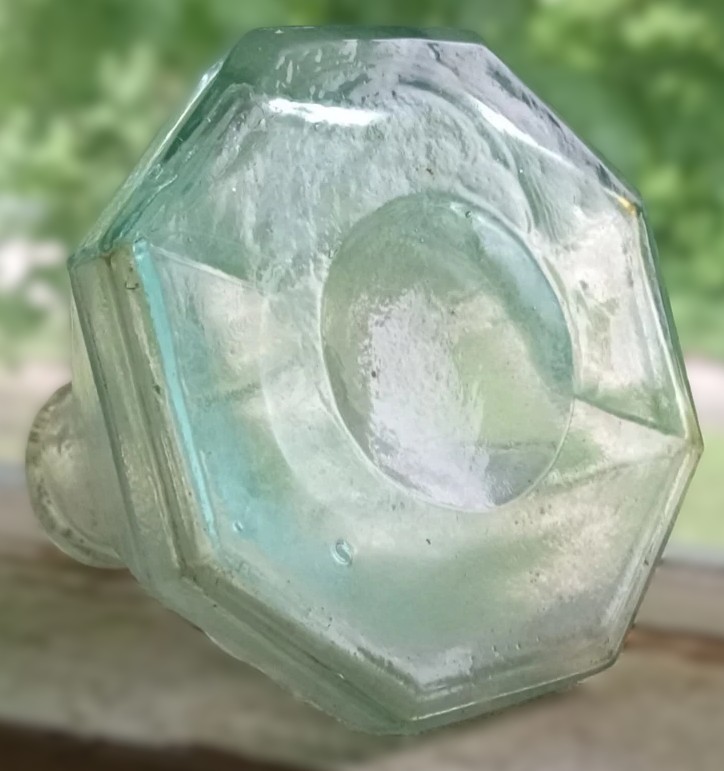
This “umbrella” style ink bottle is atypical due to its manufacturing transition marks.
- Form & Body: The bottle features a classic umbrella shape characterized by an octagonal footprint. It has eight broad, sloping umbrella panels that meet a corresponding series of eight short, vertical panels forming the heel and base.
- Embossing: Two adjacent sloping panels are boldly embossed in crisp, sans-serif block lettering. One reads HOVER reading downward, and the next reads PHILADA (stylized here as PHIL.A with a raised, smaller ‘A’ and an underlining dot/period).
- Color & Glass Character: Blown in a bright aqua (pale blue-green) glass. The glass displays an authentic texture with light, wavy inconsistencies and a few tiny seed bubbles inherent to mid-19th-century batch melting.
- Lip & Finish: Features a crude, hand-tooled ring lip (or narrow shear flange finish) showing distinct asymmetry from the gaffer’s tool, typical of early-to-mid 19th-century finishing techniques.
- Base: A crucial diagnostic feature. Unlike the standard iron-pontil or blow-back pontil scars typically found on Hover umbrellas, this specimen features a completely smooth, slightly recessed octagonal base with clear evidence of a post-bottom mold seam.
- Dimensions: Approximately 2¼ inches tall.
Manufacturer & Historical Context
The bottle was produced for Joseph E. Hover, an ink manufacturer based in Philadelphia, Pennsylvania, whose active operations spanned the mid-19th century.
Joseph E. Hover’s Ink Empire
Joseph E. Hover began his career in the 19th-century stationery and chemical trade. By the late 1840s and early 1850s, his business was highly visible in Philadelphia directories, located at 144 (later renumbered to 416) Race Street.
Hover was an aggressive marketer who claimed his ink formulas were chemically superior to foreign imports. He specialized in several proprietary mixtures:
- Hover’s Chemical Writing Fluid: A highly popular iron-gall variant that wrote a clear blue and dried to an intense, permanent black.
- Hover’s Black Jet Ink: Favored by clerks and bookkeepers for its sheen and durability.
His advertisements frequently boasted endorsements from banks, academic institutions, and the United States government, cementing his brand as a staple of American bureaucracy during the expansion of westward commerce.
The Significance of the Smooth Base
The vast majority of Hover umbrella inks encountered by collectors date from c. 1845 to 1855 and bear heavy, iron-colored pontil scars or rough blow-pipe scars. The presence of a pontil mark indicates that a hot iron rod was fused to the base to hold the bottle while the lip was tooled.
This bottle represents the technological transition era (c. 1860–1865). Around the time of the Civil War, American glass houses rapidly adopted the snap case—a mechanical clamp that held the hot bottle by its body or base without leaving a raw scar.
Because Hover’s business was winding down/evolving by the late 1860s, the window of production for a snap-case, smooth-base variant of this specific embossed mold was narrow. It is likely that a glass house (such as the nearby Dyottville Glass Works or Whitney Glass Works in New Jersey, which frequently blew utilitarian wares for Philadelphia merchants) utilized an existing Hover mold or a slightly modified copyright at the tail end of the umbrella ink era.
Condition Assessment & Rarity
- Rarity: Extremely High. In the realm of antique ink bottles, variant base configurations change an item from common to a significant historical anomaly. While a pontiled Hover umbrella is a classic cornerstone piece, a verified smooth-base example is a prize.
- Condition: Excellent. The embossing remains sharp, showing no high-point high-case wear. The faint interior haze is stable and does not detract from the glass’s natural brilliant clarity when backlit. The lack of chips on the fragile, crude ring lip is remarkable given its utilitarian history.
Sold for $250 in May 2026
Content disclaimer. The information posted is the owner’s best knowledge and may not have been vetted by the SOIC. We welcome comments, corrections, and additions, working to make our website information comprehensive and accurate.
Join the Society of Inkwell Collectors (SOIC) – it’s free!
Founded in 1981 as a non-profit organization,
we are documenting inkwells (and accessories).
We’re here to help and inform!